Balsam Karam: The Singularity

“I come from a tradition of loss.”

Kurdish authors — whether their Kurdish-ness belongs to the Iranian, Iraqi, Turkish, or Syrian side — all come from the same amorphous tradition of storytelling, and they have an artful way of wrapping their own originality around this. But they also come from another kind of tradition; that of loss. 

Balsam Karam describes herself as, “a Kurdish writing in Swedish.” That is exactly why, even without checking what this novel is about, I immediately purchased a copy. There is a scarcity of Kurdish voices in literature, and this scarceness urges me to listen to each one.

Now I have found that this book is about mothers losing children; and children losing mothers; motherlands being uprooted of her children; and children being separated from their motherlands; written by a woman who is in the process of retrieving her voice when she thought she had lost it along with her firstborn; and all these meld into each other in a mosaic of poetry and prose.

Yes, it is fragmented and it is painful. That’s what loss feels like.

Nawal el Saadawi: Two Women in One

While I have long discovered that I prefer the nonfiction writer in Nawal, her fiction remains to be in a class by itself. (That’s why I still continue collecting what I can of her books, fiction and nonfiction, especially now that I’ve discovered these excellent editions — in terms of publication quality and translation — from Saqi Books.)

Two Women in One is not straightforward storytelling. There’s a tinge of Clarice in the free indirect prose. Unsettling, like any piece by Nawal; claustrophobic, and therefore, effective.

It’s not a good place to start if one is new to Nawal. The angst of a young woman, wanting to be an artist but who’s forced into medical school, is potent here. 

Conformity becomes suffocating to her, “Everything had the same color and shape to her. All bodies were similar, and all gestures and voices. She found herself running aimlessly… fleeing the deadly sameness within and without…” When she realizes that none of her life is her doing or her own choice, she unleashes a rebellious other woman in her. “Freedom is dangerous, but life without it is no life at all.”

But what I found most powerful in this work is the underlying message that unless Egypt is free, she cannot be free. “Egypt was not free. The chains were still there.” Because when all is said and done, how a nation treats their women, is always a measure of that nation. A woman’s personal freedom is often symbiotic and synonymous with national freedom. 

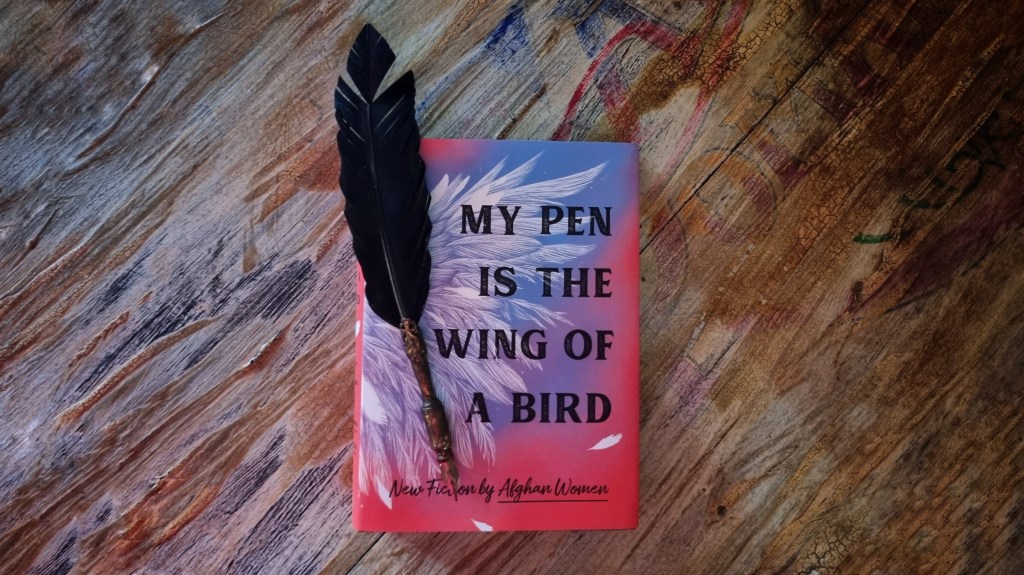
My Pen is the Wing of a Bird: New Fiction by Afghan Women

This book came into my possession on International Women’s Day. That day I was asked to speak at an event in celebration of Woman; and as one who never goes out without a book (in case of emergency), I slipped this in my bag on the way out. I was early at the venue so I took this out and flipped the title page. It read:

“My pen is the wing of a bird; it will tell you those thoughts we are not allowed to think, those dreams we are not allowed to dream.”

Batool Haidari, Untold Author, International Women’s Day 2021

The line was written on exactly the same day three years earlier. That’s when I knew I brought the right book with me.

The first open call inviting Afghan women to submit short fiction came in 2019. The creation of this anthology and the translation of the pieces from Afghanistan’s two principal languages, Dari and Pashto, pressed on through more than just power outages and internet service interruptions, but also a global pandemic lockdown and the Taliban takeover in 2021. The book that now sits on my shelf is a triumph.

As anyone might have guessed, there is little happiness here. But it makes us see that there is humanity, kindness, and so much more to Afghanistan’s stories than just war. As in any short story collection, some stories have more literary merit than others, but every single one deserves our attention if we wish to educate ourselves and see a more thorough picture of Afghanistan and the world we live in — especially when their humanitarian crisis continues even as the world’s attention is no longer on them.

“My pen is the wing of a bird; it will tell you those thoughts we are not allowed to think, those dreams we are not allowed to dream.”

This line made me realize the wide gulf between literature by women from places of conflict and the first world. In literature from the first world, this would refer to careless and obsessive romantic affairs, and the women who write about these things are lauded for their rawness and honesty. In literature from marginalized communities, the thoughts they are not allowed to think and the dreams they are not allowed to dream are education, work, the freedom to do the right thing, and the freedom to live. A dose of the latter is always a healthy reality check on the disparity present even within women’s literature.

Hanne Orstavik: Ti Amo

And I’ve written fourteen novels, and if there’s one thing my writing has to be, for me, it has to be truthful. What I write has to be truthful. I’ve wanted that to apply to my whole life too, in my relationships with other people, my relationship with myself.

My first experience with Hanne Ørstavik’s writing was in 2022 with her novel, Love, wherein she seemed to have invented a literary equivalent of the Shepard tone — that auditory illusion used in film soundtracks to create a palpable suspense and disquiet. With a narrative that demanded complete attention, it revealed a writer in full command of form and style.

Expecting another work of sparse and exacting Nordic prose, I was surprised to be met with vulnerability and painful honesty in Ti Amo. It cannot be more different than Love. Expertly calculated tension dominated Love, Ti Amo announces death candidly right from the beginning and nothing is veiled. 

Love was fiction, Ti Amo is not, and I cannot somehow bring myself to judge a work by someone writing through her husband’s terminal illness. It is a book about life, death, and writing, and nothing describes this book better than the author’s own description of the marble pillars in Ravenna’s Basilica di San Vitale.

“In the San Vitale — the way the great marble blocks of the pillars possess a quieter beauty than the glittering mosaics. The mottled markings in the marble are just there, silent and displayed, defenseless, and what was hidden within the stone, the veins, the figures they trace, is exposed now for all time, laid bare, halted in once so sweeping, now dissected movements through the stone. And what we see is the cross section, the wound, and the beauty of what simply exists, neither devised nor constructed, merely disclosed.”

I thought wrong when I surmised it was written as closure. (As if grief had closure!) Of the wound and the beauty of what exists, it is simply, and not too simply, a disclosure.

Clarice Lispector: The Apple in the Dark

“It was as if love were the desperate clumsy shape that living and dying take…”

“If it hurts, that’s the way in which things are alive.”

“But what kind of silence did she want to share with him?”

I love you.
Yes, he said after a pause.
Both sat quiet for an instant, waiting for the echo of what she said to die.

The Penguin Classics covers got it right. Surrealist Giorgio de Chirico’s art answers the dreamlike quality of Clarice Lispector’s writing. Not in the sense that reality is bent, but in the sense that the unconscious corridors and objects of the soul, heart, and mind are suspended, isolated, turned over, and perused in poetic abstractions that only she can get away with. 

New Directions Publishing chose to be literal. With an apple. In the dark. And it’s an effective counterpoint to the metaphysical prose that the contemporary reader is more than willing to bite into. “After all a person is measured by his hunger… All I’ve got is hunger. And that unstable way of grasping an apple in the dark — without letting it fall.” But what is this hunger? And what is this apple? 

The book is about Martim, a fugitive who finds his way to an outlying ranch run by two women. There is a storyline. There is suspense and there are surprise twists. Lispector readers know that these are things she does not always give us because she deems them secondary to the subliminal probing of how we love, how we desire, how we live, and how we exist. Clarice for whom writing and being are one and the same thing. But she is especially generous here. This longest novel of hers is not fixed and final. It’s a sentient thing wherein her words and the reader gestate. It is a book only a Clarice Lispector can write.


It’s one of my favorite reading months and I’m thrilled to have kicked it off with Hurricane Clarice. Happy Women’s Month to the women who hunger for life and endless learning!

Maylis de Kerangal: Eastbound

What a ride! How Kerangal builds suspense that makes the entire book feel like one long, deep, drawn breath that you would not want to interrupt!

The majesty of Russia’s landscape appears through the window of the trans-Siberian train, but it is surprisingly subtle in portraying a vulnerable Russia.

Yes, it is a serendipitous train ride shared by a man and a woman, but don’t expect the deep conversations of Celine and Jesse from Before Sunrise. Aliocha and Hélène practically pantomime their way throughout the journey; he being Russian and she being French.

Yes, it concerns an army conscript who wants out, but don’t expect Francis Mirković of Mathias Enard’s Zone. Aliocha won’t sing to you a threnody of the crimes of nations. He is only concerned about his escape.

I love the aforementioned titles and I feel relieved that Eastbound did not turn out like any of those. They are only alike for the reason that they are each in a league of their own.

On the surface, it stays true to its promise of being an adventure story, but I see it as an intelligent political novel. Not because the characters discuss politics, they don’t. But can there be a more political story than two people pursuing their individual freedoms?

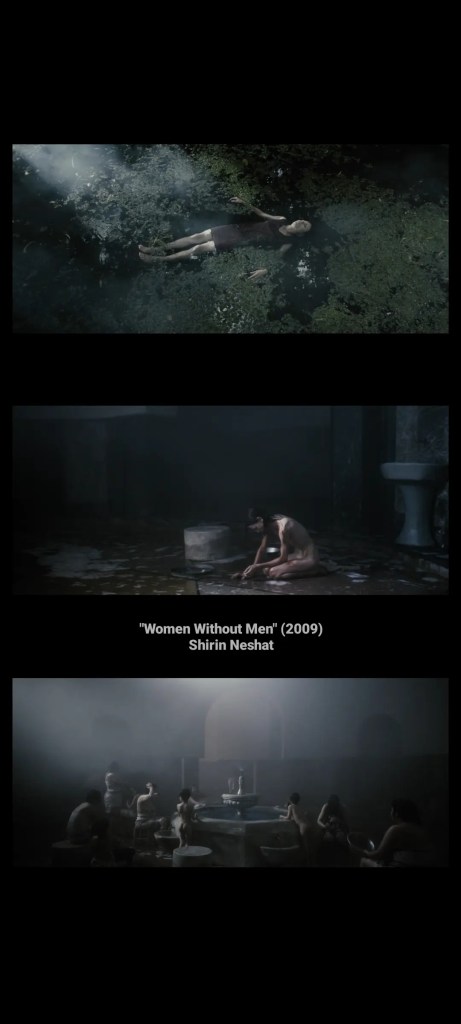
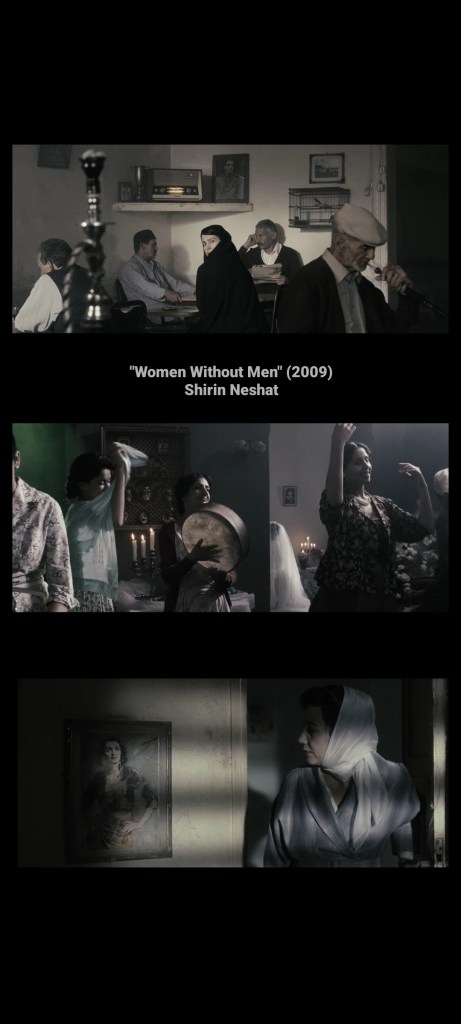
Book and Film Pairing: Women Without Men

…because I would immediately pick up a novel of/from Iran without any prodding.

It took me almost halfway through to get into the book’s rhythm, however: Apart from being surprised that it is not set in contemporary Iran but pre-revolutionary Iran (and horrified to think that things have only gotten worse for women in post-revolution Iran), one main character irked me, and I kept weighing it up against another Iranian work of magic realism that remains unsurpassed in my books. But as I read on and the threads of the story came together, I came to appreciate Women Without Men for its own merits. It is, after all, about women overcoming hardships and breaking free from the conventions that Iranian society imposes on them. It is therefore no surprise that it was banned shortly after its publication.

The lives of Iranian women and the experiences depicted here are not isolated cases, and they bring to mind a line from Universal Compassion, an essay by Natalia Ginzburg: “We have come to recognize that no event, public or private, can be considered or judged in isolation, for the more deeply we probe the more we find infinitely ramifying events that preceded it…” Thence the problems that the characters face are not merely personal. In an ideal world, these are issues that an entire civilization must address.

The book naturally ushered me to the screen adaptation. The director, who wrote the preface for this edition, worked closely with the author and the collaboration seems to have led to a beautiful fleshing out of ideas. Being a fan of Iranian cinema — because no one does cinema like the Iranians! — I am tempted to say that I like the film more than the book. But for an exceptional experience, allow me to suggest a book-movie-pairing instead; because what was ambiguous and abstract in the novel became poetry in the film; and if not for the book, there would be no film.

Natalia Ginzburg

The City and the House (March 2023)

“The telephone isn’t made for saying important things that need time and space.”


Happiness, as Such (August 2024)

The merit of Natalia Ginzburg’s epistolary novels — whether they are wholly or partially comprised of an exchange of letters between characters — is their being time capsules of an age when corresponding through letters was the principal means of remote communication. It was in letters that banalities could be reported as much as consequential information, and people were allowed space to be frank. Letters tracked the growth, or stagnation, of their writers. Self-expression flowed freely where individual and shared stories unfolded. Ginzburg seems to have maximized on the medium and preserved it, foreknowing a time, our time, when letter writing would be at the point of near extinction.


“Happiness… It is like water; one only realizes it when it has run away.”

Voices in the Evening (January 2024)

Of sad loves and sad lives. For me to truly appreciate Ginzburg’s work and write something of worth about it is, perhaps, to regard it as a whole after I’ve read everything she’s ever written.

For now, this book only evokes a specific memory:

He and I had just listened to the whiskey-soaked voice of Tom Waits. We said we did not want to end up like the people sung by the raspy voice.

But we can’t really predict life, we agreed. 

We can only try, I said.

We did not try hard enough.


Claudia Piñeiro: A Little Luck

The phrase “a little luck” appears nine times in A Little Luck, just as “Elena knows” appears nineteen times in Elena Knows.

Does it matter? Not really. Maybe noticing those details says more of me as a reader than Claudia Piñeiro as a writer. One thing is certain; she does not repeat herself because she is running out of ways to say things. She is consistently unpredictable. 

Elena Knows, which I read much earlier, is exceptionally written and translated. The choice to highlight a specific incapacitating disease that isn’t limited to women — to effectively confront every reader with what it feels like to lose bodily autonomy — is, I believe, the most impressive allegory that should be uncovered from under the many brilliant qualities of the novel. There are other apt adjectives for Elena Knows, but beautiful is not one of them.

But for the soulful strains of Piazzolla that wove through A Little Luck’s narrative; for how a woman damaged found the first steps to healing through literature; for how I thought it would all be about pain only to discover that it was principally about happiness; and for the sheer deftness of Piñeiro’s writing — this one is beautiful.

Just as unputdownable, just as suspenseful, just as affecting… and this time, beautiful. 

Adania Shibli: We Are All Equally Far from Love & Touch

Adania Shibli is the queen of stark but poignant and powerful prose. I’d feel pretentious if I tried to say more than necessary.

Having read Minor Detail already, I downloaded these books in response to her unjustly cancelled award ceremony at the Frankfurt Book Fair that was supposed to take place on October 20, 2023. Shibli’s first two works are described as non-political. I disagree. But maybe they are, if one compares them to Minor Detail, her most famous work, which exposes the rape and murder of a Palestinian girl by Israeli soldiers.

In these two books there is no talk of occupation or governments, most characters do not have names, locations are vague, they recount ordinary lives; but I don’t think it takes a genius to notice that the dismal lives depicted in these earlier works are consequences of systemic trauma and oppression.

For books such as these, it is not the reader’s duty to offer literary analysis, or to say whether they liked it or not. It is the reader’s duty to empathize. Because today, even empathy is hard to come by.