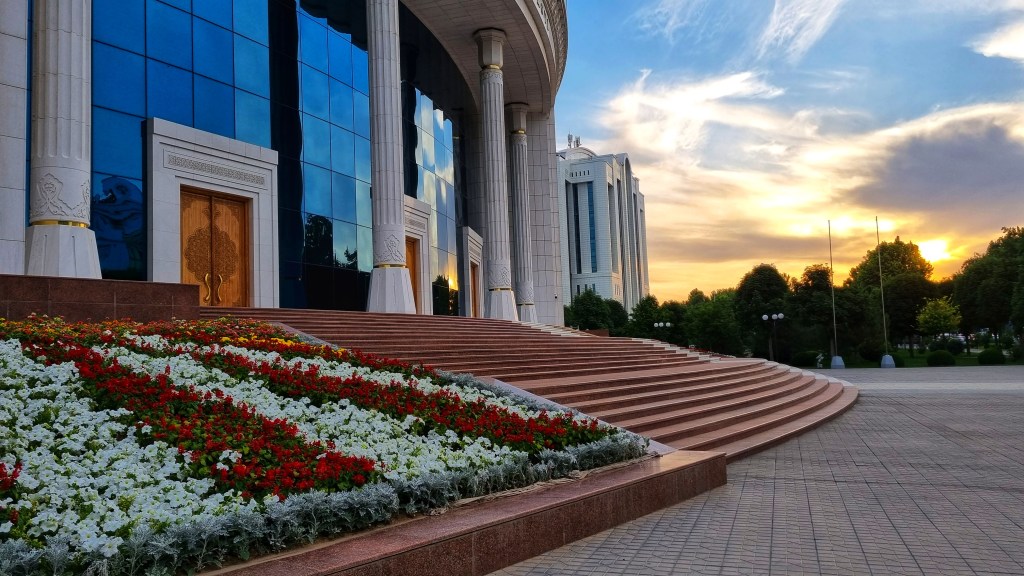
June 14, 2022 – Tashkent, Uzbekistan

© 2022 MDR
Tashkent, Uzbekistan

In which city did Alexander Solzhenitsyn miraculously heal from a stomach tumor that he chose the place to be the setting of Cancer Ward? Where did Mikhail Bulgakov’s widow hide the manuscript of Master and Margarita before it was published? To where did Anna Akhmatova evacuate during the Leningrad siege? For which city did Vronsky refuse an assignment significant to his military career in favor of Anna Karenina? In which city is the oldest Quran kept? Tashkent.

It has played important roles in literary history, and literary history seems to be woven along the threads of daily life here. Three of Tashkent’s Metro Stations that I was able to pass through today are dedicated to writers: Alisher Navoi, the greatest writer in Chagatai history; Abdulla Qodiriy, the nonfictional character of the novel, The Devil’s Dance, which I read earlier this year, and writer of what is considered the first Uzbek novel; and Alexander Pushkin!

Abdulla Qodiriy (1894–1938), author of the first Uzbek novel, translator of Russian literature into the Uzbek language, and nonfictional protagonist of Hamid Ismailov’s The Devil’s Dance.

A baffled immigration officer at our international airport asked me, “Why Uzbekistan?”

This post is the first of a series of answers.
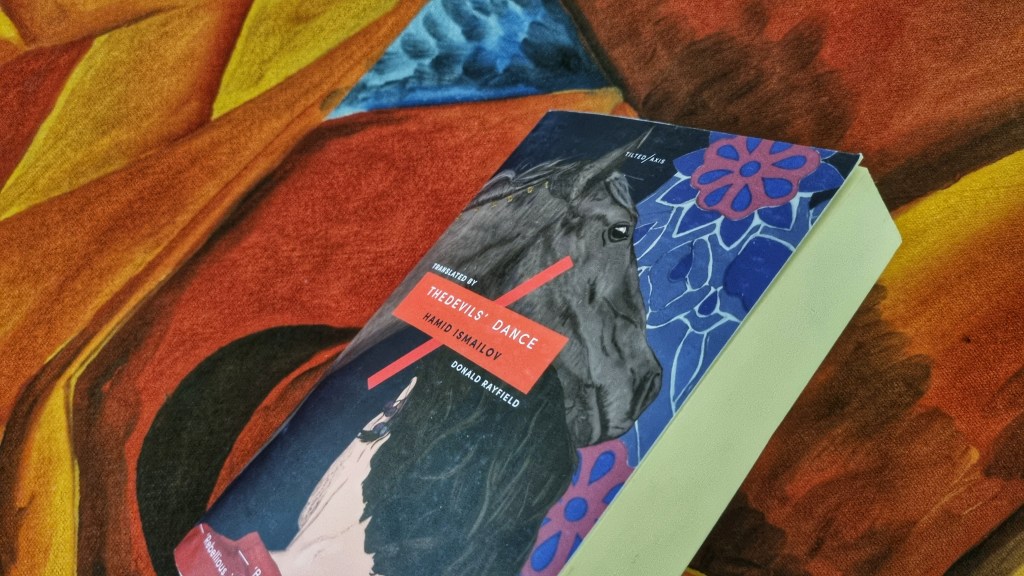
Hamid Ismailov: The Devils’ Dance

Old Uzbek language has one hundred words for different manners of crying, and special verbs for gestures like gazing imploringly into a lover’s face. 

Elif Batuman writes about this in The Possessed, and I reacted to this information as a reader would and thought, “How rich Uzbek literature must be!”

So here I am. Few things are more appealing to this reader than a scarcely-translated and relatively scarcely-read novel by an author whose works are banned in his own country.

It is intense in both intellectual and emotional degrees, and probably not too easy for those who are unacquainted with the Arabian Nights fashion of telling stories within stories within stories. This is one of those jealous novels that demand your full attention, but also one of the most masterful I have read for my Silk Route Reading Project.

The characters are real figures from Uzbek history. It chronicles the arrest of the nation’s prominent writer, Abdulla Qodiriy, by the Soviet secret police in the 1930s. His abduction interrupted the work on what he himself believed would be his greatest masterpiece, a novel about 19th-century poet-queen Oyxon. Abdulla Qodiriy’s manuscripts were subsequently burned and his last novel remained unwritten, but this is where Hamid Ismailov spins an imagined tale of Abdulla Qodiriy who, despite being in prison and enduring its horrors, continues to write the novel in his mind. 

In this book we have Hamid Ismailov telling a story about Abdulla Qodiriy who is telling a story about Queen Oyxon.

“Wasn’t the concoction of endless misfortunes that made up Oyxon’s life a reflection of the nation? …when and how had Oyxon’s tragic life-story turned into Abdulla’s own?” Concerning betrayals or intellectual persecution, perhaps Ismailov’s, too.

Yes, it is absolutely political, but how the Uzbek character is laid bare, their superstitions, their literary traditions, the exceptionally moving ending that had a cinematic quality which inspired a soundtrack in my mind, and most of all the tormenting pleasure of a writer’s thought process and how it is like a dance with jinns; these are the reasons why I think this is the perfect initiation to Uzbek literature — albeit complete with figurative hazing.

Expect no less from a people who has a hundred words for crying.

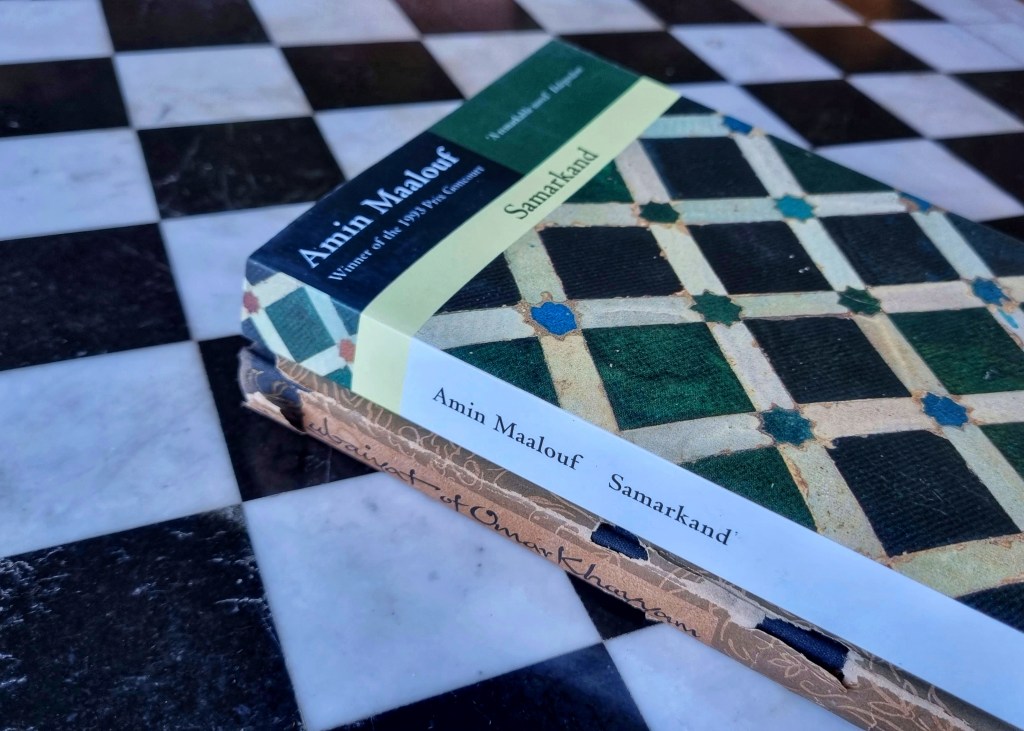
Amin Maalouf: Samarkand

November 20, 2021

It is almost impossible to tell a story of Omar Khayyam without involving his contemporaries: Hassan-i Sabbah, founder of the Order of Assassins, and Nizam Al-Mulk, Persian history’s most famous vizier — the very first victim of the Assassins. Their destinies and of Persia’s are so entwined that it would also be impossible to discuss Persian history without touching on this legendary trio. Amin Maalouf takes these characters and animates history with his seamless blending of fact and imagination, making Samarkand an entertaining read for any Persophile.

Chapter one wrests the reader from the present to vibrant 11th century Samarkand where a qadi tells Omar Khayyam, after the latter is nabbed in the marketplace and recognized as a failasuf (a philosopher or a person associated with the sciences widely considered profane at such a time and place), “The Almighty has granted you the most valuable things that a son of Adam can have — intelligence, eloquence, health, beauty, the desire for knowledge and a lust for life… I hope that He has not deprived you of the wisdom of silence, without which all of the foregoing can neither be appreciated nor preserved.”

The wise judge proceeds to present the young Omar a blank book wherein he could write his thoughts instead of speaking them out loud to a populace unprepared for his unconventional views. The pages would then be filled and would persevere through time to become what we know as The Rubaiyat.

The Rubaiyat is a collection of ruba’i or quatrains that would establish Khayyam’s name as a poet centuries later in the West, but the work of poetry would ironically make readers oblivious to the complete man — a polymath: mathematician, astronomer, scientist, philosopher, among many other things. Born eleven years after the death of the great Ibn Sina (Avicenna), Khayyam is considered his intellectual successor.

Although Samarkand is mainly about the imagined fate of The Rubaiyat’s original manuscript, in my mind these all took a backseat to a man whose genius was irrespective of the mode of expression. It made me feel wistful when the novel’s timeline left Omar Khayyam and the 11th century. It feels as if something of myself, sitting in a Persian garden while listening to him speak, remained in Samarkand.

“I am old now and need to know that I have a trusty man at my side — because of the manuscript. That is the most precious thing I possess. In order to take on the world, Hassan-i Sabbah has built Alamut (the Assassins’ fortress), whereas I have only constructed this minuscule paper castle, but I choose to believe that it will outlive Alamut.”

It did. It continues to…