The music of Giza is a counterpoint between the honking of impatient drivers and the voice of the muezzin. As the call to prayer washed across the Giza Plateau, my ride to the airport came and it was my call to head back home. After all, home is a prayer.
But how can one leave a place when it says goodbye looking like this? Your heart would break a little, too. But then again, what’s a little heartbreak if your heart has not been too well for a while?
The ancient Egyptians believed that when a person died, their heart would be weighed against a feather. It was always a question of whether the heart was heavy or light. As I leave, may the scales find my heart lighter than when I arrived.
It was comical at first. The sight of the crowd by the entrance told me that I would not be having epiphanies or spiritual experiences.
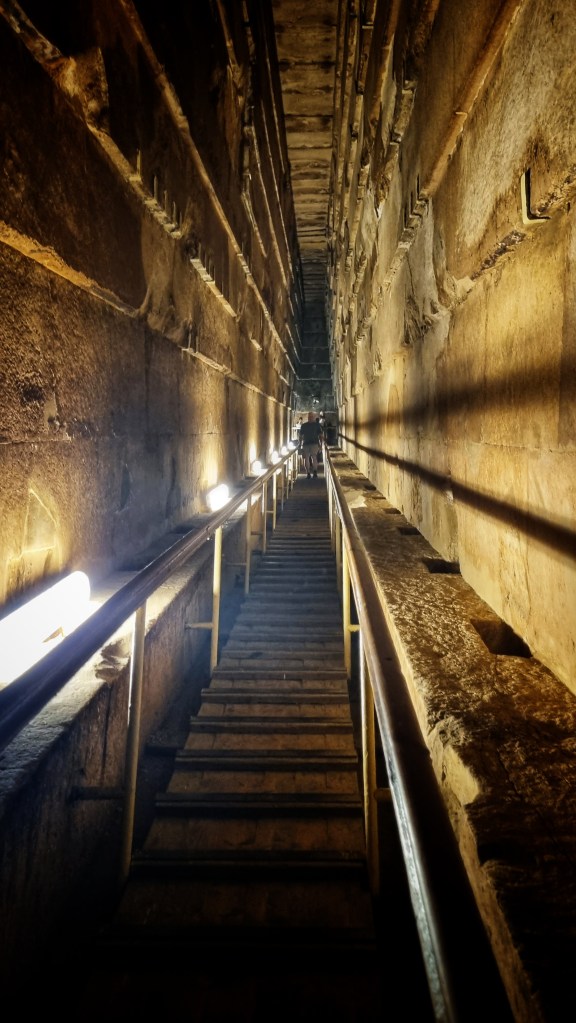
And the guide said that if I wanted to go inside the Great Pyramid, I would have to pay an extra fee, climb a narrow and steep incline that could cause claustrophobia, and see nothing inside.
I paid the fee. Being inside the Great Pyramid is not nothing!
So there I was climbing the steep incline when I noticed figures of a family of three ahead of me. The father muttered, “Kapoya man diay ani! Ta-as pa ni? Mao ra ni makita?”
Bisaya! Inside the Great Pyramid!
Amused and extremely happy to be hearing Binisaya for the first time in over two weeks, I laughed out loud and, even without seeing their faces in the dark, called out to the mom a few feet away from me, “Bisaya diay mo Ma’am? Ako pud! Grabe jud ang Bisaya kay mag-abot bisa’g sulod sa pyramid!” And we laughed our heads off while sweating profusely.
When we finally arrived at the King’s Chamber, instead of having a life-changing experience amidst the rose granite especially chosen for the chamber — the heaviest stones used in the entire pyramid, I acted as photographer for my new friends.
The way out took longer because more people were entering by the time. As I exited back into the glaring sun, the guide was waiting for me. He asked me how it went and I told him I did not regret going in.
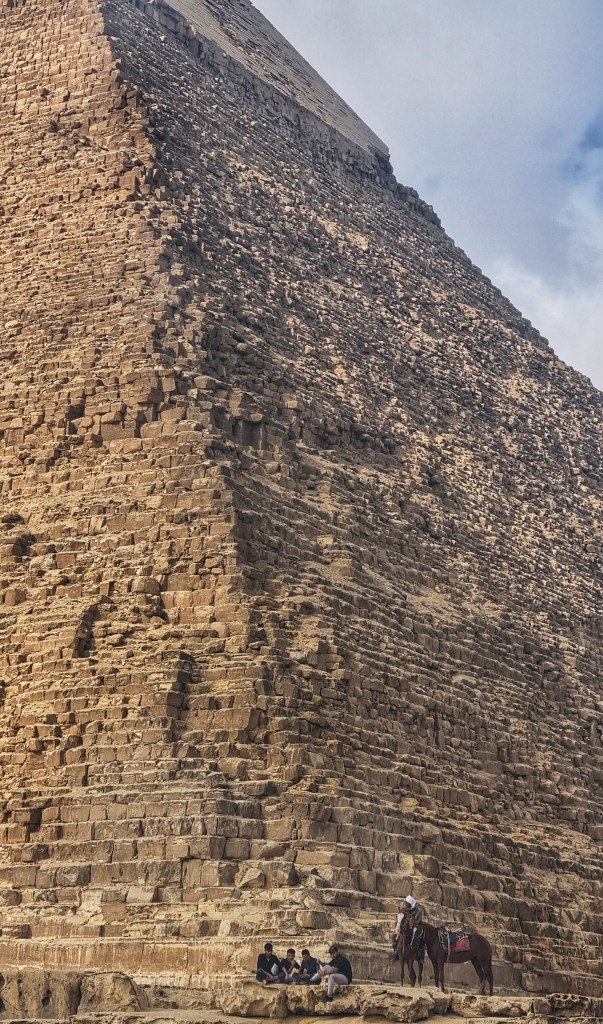
He drew my attention to the limestones of the pyramid. (The smooth outer layer, which was granite from Aswan did not erode through time. They were removed, stolen, and used for other structures by succeeding generations.) He then pointed at several fossils in the limestone. “What does that tell you?” He whispered.
The Pyramid of Khafre. The second largest pyramid in Giza next to the Great Pyramid of Khufu.
All at once a strong emotion took hold of me and I burst into tears. I tried to control myself but I couldn’t. The tears kept flowing. The truth that we don’t really know anything and all we can do is speculate, and the enormity of history was just so overwhelming to me at that moment.
These stones, stacked perfectly on top of each other by who knows who, who knows how, and who knows why… these stones speak to you in a different language. These stones do something to you.
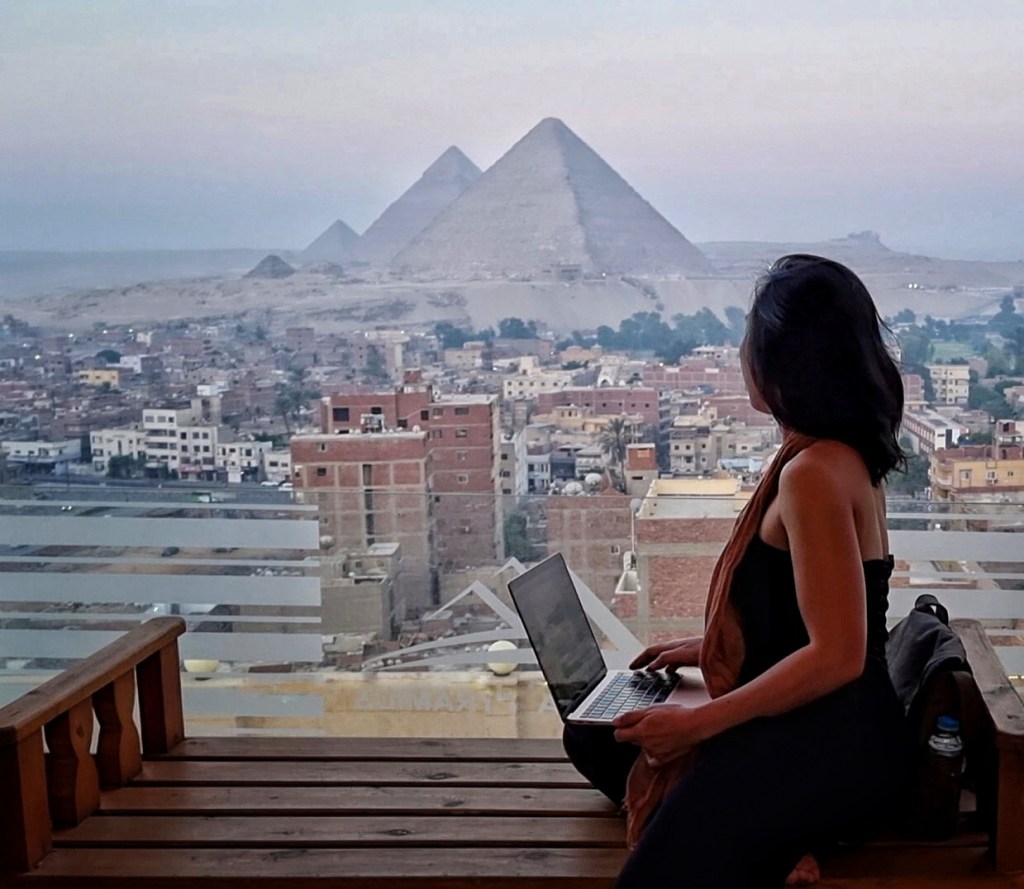
It was surreal to have this view from my hotel bedroom and its roof deck.
For now, let’s set aside the magical fact that the crescent moon was directly above the pyramids on my first night in Giza; that the place I booked has a roof deck with a view of the pyramids; and the surreality of the pyramids being right there before my eyes the whole time…
Set that aside and raise your hands if, like me, one of the things you looked forward to at the height of the pandemic was the premiere of Secrets of the Saqqara Tomb on Netflix!
Lugging overweight eyebags with me from a restless night on a bus from Luxor to Giza, I booked a day tour to Saqqara, Memphis, and the Pyramids of Giza.
Saqqara is a treasure trove! Until now they continue to unearth new findings from the site. If not for limited time, I would prefer to spend at least three days exploring Saqqara alone!
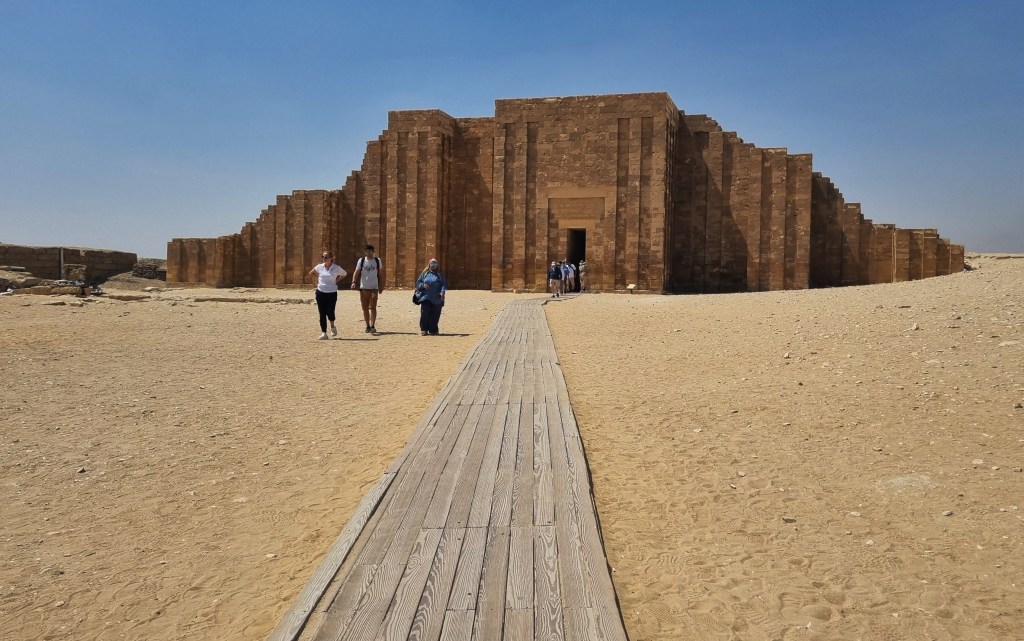
What seems to be a pixelated image of a building is the entrance to the complex, followed by a colonnade made of limestone that pre-dates Doric columns by thousands of years and believed to be its predecessor. The end of the colonnade opens to the Pyramid of Djoser, the oldest pyramid in the world, designed by Djoser’s architect, Imhotep, circa 2630 BCE. By stacking six “mastabas” of diminishing size on top of each other, he created the first step pyramid.
Entombed in Saqqara are kings and noblemen from the first dynasty up to the Ptolemaic period. What differentiates the bas reliefs here from those in the previous tombs I’ve seen are the daily life depictions: There is one of a butcher, a birthing scene, and even a circumcision scene! Details abound! I could hardly believe that I was walking into the documentary that had provided me with so much wonder during the darkest times of the lockdown.
Displaying the souvenir eyebags from the overnight bus from Luxor to Giza.
A podcast episode that I listened to around the same time I watched the documentary pointed out that Cleopatra’s era is closer to the invention of the iPhone than it is to the construction of the pyramids of Giza. It still blows my mind. When dates are mere numbers written on a page, the breadth of history’s timeline cannot be fully grasped until such a comparison is made. The novelists made those epochs come alive for me, but to be here… to be here is entirely something else.
The Pyramid of Djoser. The oldest step pyramid in the world.





 The Book-Butterfly