It was a mind-blowing family tree that brought me here.

Fatehpur Sikri was established as the capital of the Mughal Empire in 1571 by Emperor Akbar. Akbar’s grandson, Shah Jahan I is famous for having the Taj Mahal built. Akbar, as we know, is the third Mughal emperor, as he is the grandson of Babur, founder of the Mughal empire. Babur in turn, is the great-great-grandson of Uzbekistan’s Amir Timur, known in the West as Tamerlane.
I cannot think of a longer bloodline of distinguished rulers who have left their mark so distinctly (with conquests and architecture) in this world. And oh, did I mention that Babur is a descendant of Genghis Khan on both his father’s and mother’s side?


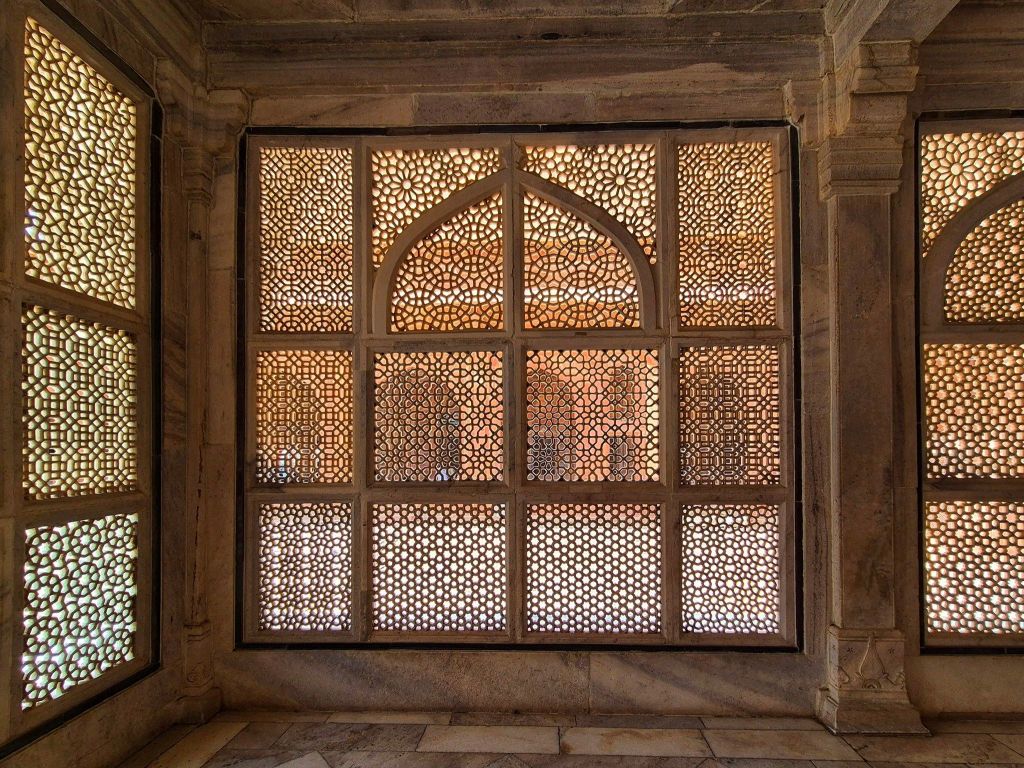
The architectural details of Fatehpur Sikri are just as astonishing as Akbar’s pedigree. The fort walls, the gates, the palaces, the mosques, are made predominantly of red sandstone. And because Akbar had three royal consorts, one Muslim, one Christian, and one Hindu, their individual palaces were masterfully designed and decorated according to their religion and culture.
The Anup Talao especially left an impression on me. It is a pavilion overlooking a platform for musicians. My guide explained that oil was added to the pool of water surrounding the platform to enhance the sound of the musical performances!


On the opposite side is what used to be the library, now off limits, now sans books, but I can only imagine how glorious it must have been. Salman Rushdie’s The Enchantress of Florence was the first novel I read long ago that got me interested in the Mughal Empire. It was partly set here in Fatehpur Sikri.


 The Book-Butterfly