Reading in August


Our ecological crisis is also a ‘crisis of forgetfulness’… we have forgotten how sacred the nature of creation is,” Iraqi-British writer, Dalia Al-Dujaili, reminds us in Babylon, Albion

Although I read this in a perfect setting on a weekend getaway — amidst soothing sounds of nature, enveloped by clean air, and surrounded by mountains blanketed by mist — this ‘crisis of forgetfulness’ where the greed of many has replaced the sanctity of nature manifests in international and national news, and in the floodwaters that lap on my own doorstep back home. 

Readers who find the lyrical wisdom of Aimee Nezhukumatathil refreshing will surely love this wholesome rumination into identity, migration, land, rivers, borders, national and personal myths, familial and arboreal roots, and humanity’s natural heritage. While these somber topics usually weigh down on the reader, Al-Dujaili imparts a hopeful outlook while encouraging us to make our very own existence into a form of praise, and challenging us to scrutinize how we carry identity. Needless to say, Babylon, Albion was a profoundly beautiful way to end August.


August is Women in Translation Month and Buwan ng Wika (National Language Month). To celebrate the latter: Munting Aklat ng Baybayin by Ian Alfonso. No better way than through learning more about our pre-colonial script! To celebrate the former: Iman Mersal’s Traces of Enayat and Lydia Sandgren’s Collected Works.
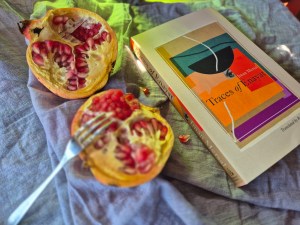
“The best investigative reporting is storytelling,” says journalist Jane Mayer. Traces of Enayat is proof of this as Iman Mersal takes the reader on a quest to find traces of Enayat, an Egyptian writer who took her own life in 1963. Mersal affectingly expresses the attachment and resonance we find in the authors we encounter and whose works derail us from an otherwise uneventful trajectory. It also begs the question: How many Enayats has the world lost into oblivion?
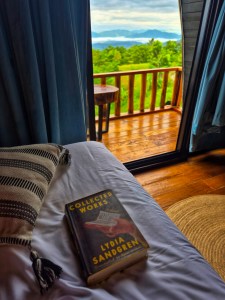
As for Collected Works, seven pages shy of six hundred, this novel quietly draws you into its world. It acquaints you with its setting and its characters without haste. It knows how to linger. It lingers on one’s thoughts on literature and art, on a character’s indecision to call someone or not, whether to read a book or not. It often lingers on everyday scenes where words turn into still life paintings and everyday portraits. But these scenes and characters exist in the shadow of Cecilia’s disappearance. Almost fifteen years after she vanished without a trace, her daughter, Rakel, believes it is her missing mother she is reading about in a novel, and measured suspense and mystery begin to replace the monotony of their lives. I would recommend this to the unhurried reader. Ultimately, Collected Works is a meditation on what one’s life amounts to. 

As for reading life in August? This is what it amounted to. It felt very much like a defiance of my country’s frustrating political climate.

The Beekeepers

Try as we might to hope that the two apian titles speak only of positive lessons from bees — of how theirs is a society where each one functions for the good of the entire colony, of how they continue to work even when everything around them is dying — I am afraid they don’t.

Two beekeepers of neighboring nations; one real, the other fictional. Both written by women; one an Iraqi journalist and poet, the other a novelist who volunteered in refugee centers, herself a daughter of Cypriot refugees.

The Beekeeper of Sinjar is Abdullah Shrem. When DAESH (ISIS) began terrorizing Yazidi communities and abducting their women including Abdullah’s sister, he took advantage of his knowledge of the terrain and select personal contacts to rescue and smuggle women back to safety. Each time he saved a captive woman, he felt that he was also saving his sister.

Among the stolen women was Nadia Murad, who received the Nobel Peace Prize in 2018, the first Iraqi and Yazidi to be awarded the prize.

Dunya Mikhail initially inserts poems into a journalistic approach and recounts distressing interviews with the rescued women who were sold, beaten, and raped repeatedly, but who nonetheless opened up to the author so that she could write about their suffering. “It’s important that your book see the light of day, so that the world will know what’s going on here.” The journalistic eventually veers into the poetic, and I feel that this is one of the books from the region that will endure not only as an overwhelming account but also as a literary work.

The Beekeeper of Aleppo is the fictional Nuri Ibrahim, but through him and the plight he shares with his blind wife, Christy Lefteri expresses the unspeakable realities and consequences of war, of lives ended, uprooted, wasted, abused, and destroyed.

“War,” writes Dunya Mikhail, “comes with various names but with only one face.”

Even though it seems that love and hope is universal, unfortunately, so is war.

“The problem isn’t that the world is going to end, but that it continues without any change.” — Nadia Murad

Gertrude Bell

“The world was awake — it wakes early in the East.”

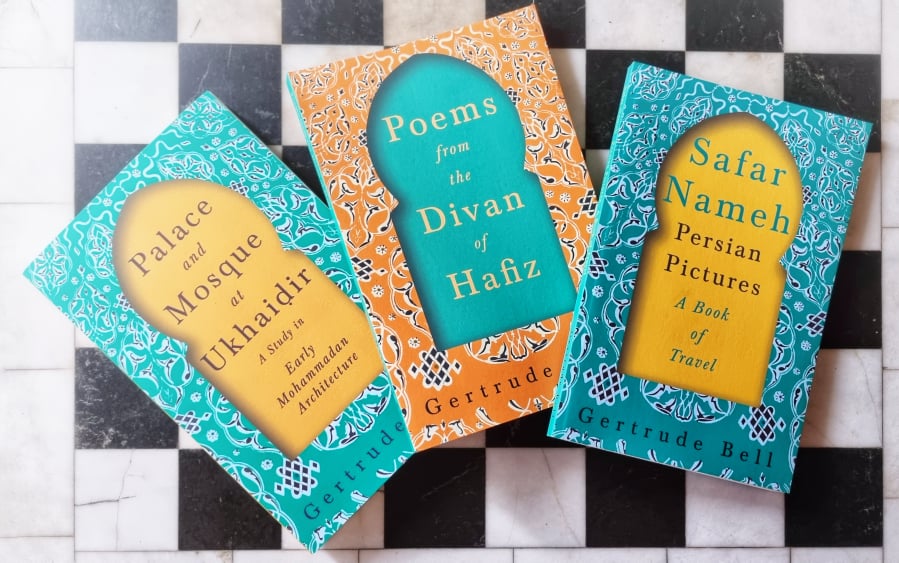
Gertrude Bell’s simple description of a Persian sunrise encapsulates, with figurative overtones, the theme of the books I have been reading lately. In The Silk Roads, she is described as dynamic and fiercely intelligent, brilliant, a mercurial scholar and traveler who knew the region and its people as well as anyone. Portrayed by Nicole Kidman in Queen of the Desert, she is called a Kingmaker for being influential in drawing up the borders of the new nation of Iraq and in bringing King Faisal to power as its first ruler in 1921. But it was only through Safar Nameh that I was introduced to her writing.

She writes so elegantly with a deep perception of places, people, and the relationship between East and West. She speaks of “the careless optimism of those who seek to pile one edifice upon another, a Western upon an Eastern world, and never pause to consider whether, if it stands at all, the newer will only stand by crushing the older out of all existence.”

This is a tiny book of a hundred pages that I thought I would be able to finish in one coffee break, but the writing is too beautiful that I had to savor the lines over and over again.

And for those times when my mind and soul are exceedingly wide awake in wonder, she has the right words… “The world was too lovely for sleep.”

Ahmed Saadawi’s Frankenstein in Baghdad and Elif Shafak’s The Forty Rules of Love

October 19, 2021

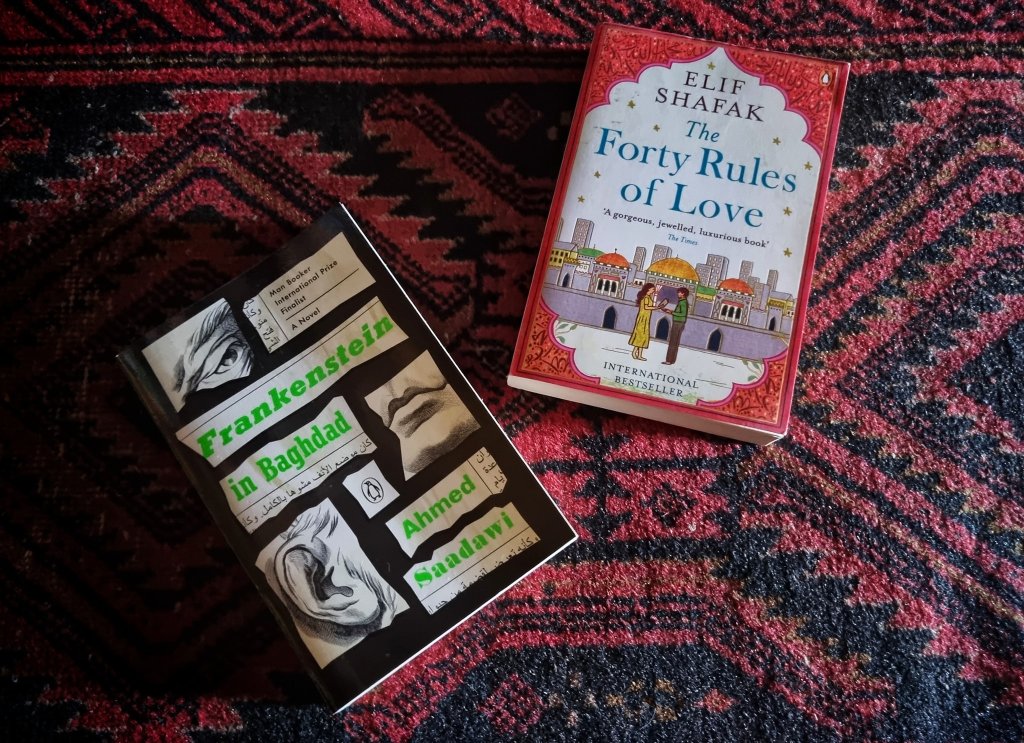
“Things We Fear” — As soon as I learned about the Ex Libris (book club) theme for this month, I immediately took Ahmed Saadawi’s Frankenstein in Baghdad from my shelf. Not a fan of the horror genre, it is one of the few I own that seems closely related to the theme.

I have this book because it is written by an Iraqi and therefore part of my current reading project.

Set in post-Saddam Hussein Baghdad, the novel is a winner of the 2014 International Prize for Arabic Fiction and a finalist of the Man Booker International Prize in 2018. However, it took me a while to process how I felt about it.

A couple of passages eventually led me to conclude that this walking corpse, stitched up from different body parts of victims of violence, is the author’s grim portrait of what it means to be an Iraqi today: “Because I’m made up of body parts of people from diverse backgrounds — ethnicities, tribes, races, and social classes — I represent the impossible mix that never was achieved in the past. I’m the first true Iraqi citizen, he thinks.”

“The definitive image of him was whatever lurked in people’s heads, fed by fear and despair. It was an image that had as many forms as there were people to conjure it.”

I think the novel is powerful in its own way, and it did give me goosebumps on the last page — but it did not really scare me.

So… If we did not have the power outage today that made me miss the book session, I would have presented The Forty Rules of Love by Elif Shafak instead. 

Because, come on! Love is already scary enough! How much more if you add Forty Rules to it? Haha!

Finished only on the third attempt as a humorous attempt to present something “scary” in a bookclub session, I feel conflicted because it features a lot of what I am currently interested in — a time and place where the Crusades and Mongol conquests intersected, a time of Assassins and Mamluks, and basically the time when Rumi lived! I enjoyed the historical details but not so much the parts where the prose got syrupy and saccharine. It has its own beauty, but I think another reader might fare better.