Paolo Maurensig: Game of the Gods

Without meaning to, I read Paolo Maurensig’s three chess novels in chronological order of publishing dates. The Lüneburg Variation, Theory of Shadows, and Game of the Gods. The sequence in which I read these books were, admittedly, influenced by Goodreads ratings. Maurensig is quite obscure in my part of the world, so I had to consult Goodreads despite my distrust of its stars. Game of the Gods has the lowest rating among the three.

But I enjoyed it! It’s not exactly a literary masterpiece, but I found it to be an easy and entertaining read that has its gems. I think the low ratings come from readers who have particular expectations. Those who read this for chess will soon realize that it’s not wholly about chess. Those who read this for its biographical aspect might be disappointed because the story is mostly imagined from the little that the media knows about Indian chess grandmaster, Malik Mir Sultan Khan, who enthralled the chess world in the 1930s by defeating world champions but soon faded into the night sky like a shooting star.

The passages that describe the incorporation of Indian philosophy and thought in Sultan Khan’s games was what I appreciated the most. The book also introduces the reader to chaturanga, the precursor of chess, that had a more sacred aspect to the game, and wherein its player had to transform himself in order to succeed.

And from what this reader can conclude from the third of Paolo Maurensig’s chess novels, the “game of the gods” is not chess. It is fate.
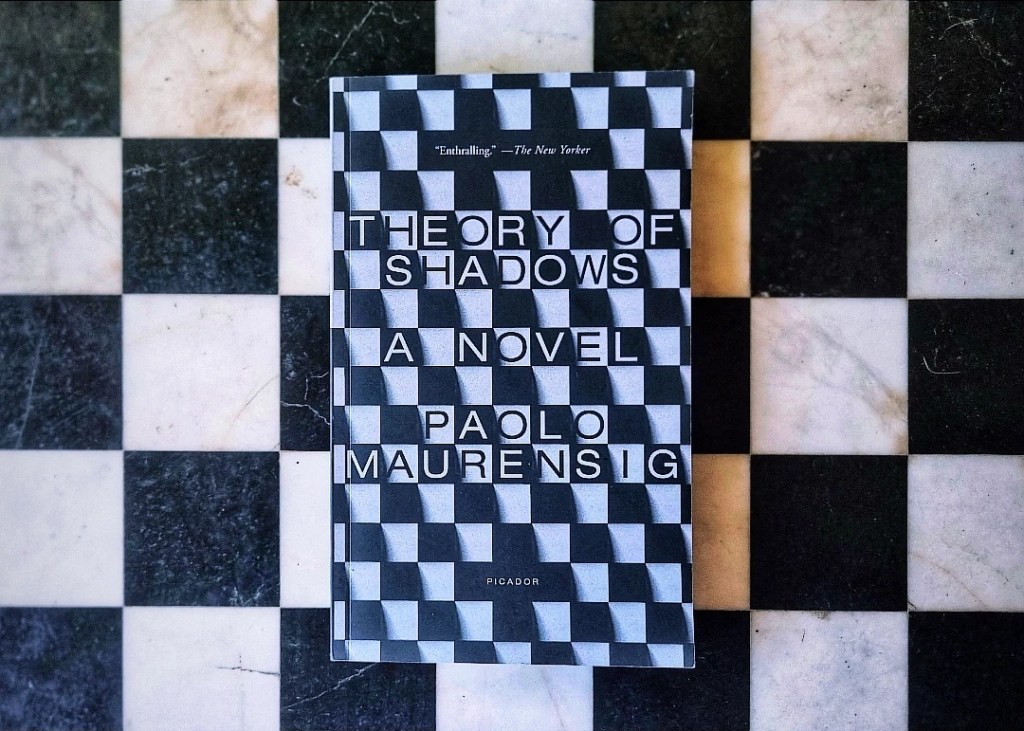
Paolo Maurensig: Theory of Shadows

Is it the fate for all chess novels to be dark?

I’m almost certain that one would not arrive at this book unless they have first been to Zweig’s Chess Story (a.k.a The Royal Game) or Nabokov’s The Defense (a.k.a The Luzhin Defence), or Maurensig’s very own The Lüneburg Variation — and therefore conscious about the sort of darkness to which I refer. 

While Nabokov’s Luzhin is based on the life (and death) of German chess master Curt von Bardeleben, the chess game in Zweig’s story is said to be patterned after a real game between Alekhine vs. Bogoljubow. Theory of Shadows turns the spotlight on the last days of the very same Alexander Alekhine, World Chess Champion, whose reputation was tainted by accusations of Nazi collaboration, and whose death remains a subject of contention.

The setting is 1946, just as the Nuremberg trials have begun in Germany, and Alekhine is preparing for a comeback in chess at idyllic Estoril, Portugal.

At his seaside hotel, Alekhine befriends another guest, a Jewish violinist, and their interesting conversations about music and chess lure me into the narrative. Alekhine exploits this friendship to console himself that he is not racist while he uses his obsession with chess as self-justification for his past actions. But when new hotel guests who recognize the grandmaster appear on the scene and question him about his past, his delusions disintegrate and his guilt becomes more apparent. Then comes the reckoning.

One way or another, there is always retribution when cooperating with evil. The reader can only conclude that Alekhine’s presence in Estoril was simply an endgame played by an unknown hand that very well could have been the Soviets, maybe even the Germans, or Fate, or simply Justice. 


“The real danger lies in not recognizing evil once it is already within us.”

This was Alekhine’s mistake. And it is the mistake of many who often shake hands with evil for personal gain.

Vladimir Nabokov: The Defense

“…and when Luzhin left the balcony and stepped back into his room, there on the floor lay an enormous square of moonlight, and in that light — his own shadow.”

The awareness of this being a story of a man possessed by chess (“…sleep could find no way into his brain; it searched for a loophole, but every entrance was guarded by a chess sentry…”) makes the allusion to the white square of a chessboard more impeccable.

Nabokov is a writer that allows a reader to experience cinematography in literature. The deliberate composition of each frame is so visually satisfying that I’m tempted to say it’s the reason I read him. But I would be lying. I’m also here for the traces of his synesthesia.

“Hearing” the chess moves — “combinations like melodies”, chess notations synthesize with musical scores, games begin “softly, softly, like muted violins” then without the least warning, a chord sings out tenderly, a trace of another melody manifests, some other deep, dark note chimes elsewhere…

Sometimes I, too, ask myself if I’m missing the point and reading Nabokov incorrectly by fixating on those passages and often forgetting that this is a tragic tale about how our sanctuaries can turn into obsessions and lead to madness, or the fact that this novel belongs up there with Stefan Zweig’s Chess Story; but then I find myself falling for those passages all over again. Part of me asserts that if this is me reading him wrong then I’m reluctant to be right!

Paolo Maurensig: The Lüneburg Variation

Zweig’s endgame, Maurensig’s opening sequence.

Lüneburg Variation is a first novel, Chess Story was Zweig’s last; and one cannot really read Lüneburg Variation without recalling Chess Story. Both explore the same themes of Nazi savagery, moral complexity, and the maniacal passion for chess; but Maurensig paints it in darker shades.

Lüneburg Variation’s striking first line sets a sinister tone: “They say chess was born in bloodshed”; on the second page a murder is committed; on the seventh, a confession.

And then we meet the players behind the game and we are brought to a time when Austria was gripped by anti-Semitism, and how the world of chess, peopled by masters of Jewish descent, was purged from Jews to “recover its purity.”

For a book that’s only slightly longer than Zweig’s novella, it has a handful of indelible scenes, but what will stay with me is a particular chess lesson. After a protégé loses to his teacher, the master asks, “What if this has been caused by your inattention?”

But the attention of which the master spoke referred to something beyond the chessboard. That page made me close the book to ponder on those words that endorsed seeing rather than merely looking. I sipped at my postprandial coffee, and thought of life, and I thought of reading. How inattentive we can be to the world around us! How inattentive we can be as readers!

As I read on, the pieces came together and I was chilled by a realization. What if this was a question meant to haunt generations? Genocide, injustice, cruelty are things that can only be perpetrated by the indifference and inattention of many.