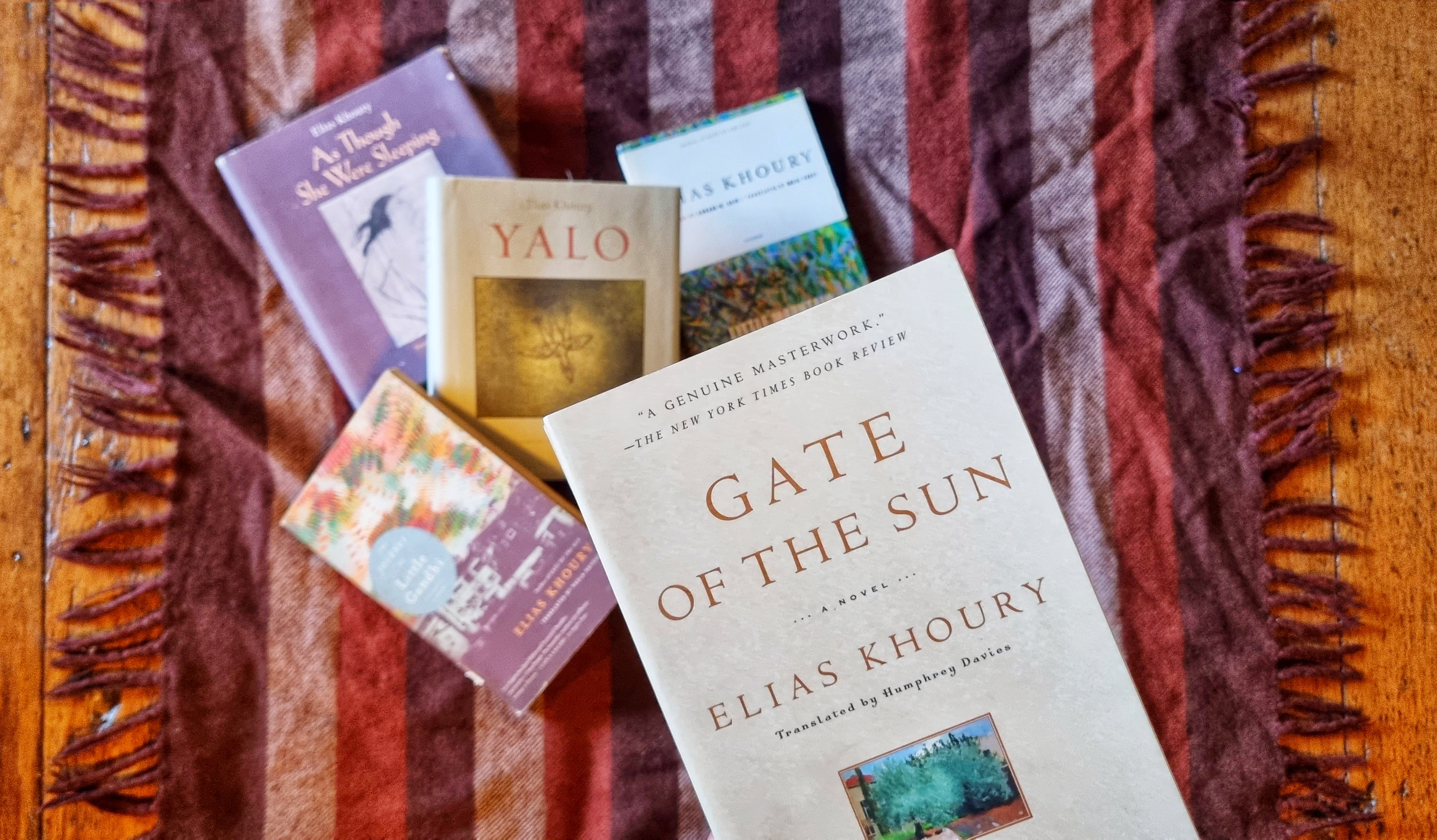
Elias Khoury: Gate of the Sun

October 4, 2021

Gate of the Sun is a steady stream of sorrow flowing for five hundred and thirty one pages.


I can stop there.


But I feel that I have to warn you about those indelible and heartrending parts where a crying baby is suffocated to death to keep him silent so that he would not endanger an entire group; about the pregnant wife of a fedayeen who had to claim she was an immoral woman to protect her husband and keep his whereabouts secret; or of that woman who did not weep with her eyes but with everything inside her… and what if I told you that this novel was inspired by real dialogues between Palestinian exiles and Khoury? I am not sure how my heart was able to bear it.


At this point, you would probably begin to think that this book undoubtedly demonizes Israel. But therein lies the beauty of this magnum opus — despite all the pain it recounts — it does not.


In an interview conducted by an Israeli publication, Khoury articulated, “When I was working on this book, I discovered that the ‘other’ is the mirror of the I. And given that I am writing about half a century of Palestinian experience, it is impossible to read this experience otherwise than in the mirror of the Israeli ‘other.’ Therefore, when I was writing this novel, I put a lot of effort into trying to take apart not only the Palestinian stereotype but also the Israeli stereotype as it appears in Arab literature and especially in the Palestinian literature… The Israeli is not only the policeman or the occupier, he is the ‘other,’ who also has a human experience, and we need to read this experience. Our reading of their experience is a mirror to our reading of the Palestinian experience.”


I think this is important because if this attitude can be applied to one of the most divisive issues in the world, then we can certainly attempt this in our own personal or national conflicts.


We also see this thought being explored in the novel through Khalil, the narrator: “This secret is the mirror. I know no one will agree with me, and they’ll say I talk like this because I’m afraid, but it’s not true. If you’re afraid, you don’t say your enemy is your mirror, you run away from him.”


“But let’s look in the mirror… I confess I’m scared. I’m scared of a history that has only one version. History has dozens of versions, and for it to ossify into one leads only to death. We mustn’t see ourselves only in their mirror, for they’re prisoners of one story, as though the story had abbreviated and ossified them.”


That last sentence hints at the Holocaust, the forceful catalyst — forgive this terrible oversimplification — that led to the Palestinian exodus. Not blind to the faults of the Palestinians, it also asks this difficult question, “Are we imitating our enemies, or are they imitating their executioners?”


“𝐈𝐟 𝐲𝐨𝐮 𝐝𝐨𝐧’𝐭 𝐫𝐞𝐬𝐩𝐞𝐜𝐭 𝐭𝐡𝐞 𝐥𝐢𝐯𝐞𝐬 𝐨𝐟 𝐨𝐭𝐡𝐞𝐫𝐬, 𝐲𝐨𝐮 𝐝𝐨𝐧’𝐭 𝐡𝐚𝐯𝐞 𝐭𝐡𝐞 𝐫𝐢𝐠𝐡𝐭 𝐭𝐨 𝐝𝐞𝐟𝐞𝐧𝐝 𝐲𝐨𝐮𝐫 𝐨𝐰𝐧.”

_ _ _


With the anticipated announcement of the Nobel Prize in Literature on October 7, several people have asked about my projected winner. Aside from thinking myself unqualified to make such a projection, I answered by saying that I’m probably the wrong person to ask because my picks are unlikely to be chosen, because they are not safe choices — Elias Khoury or Nawal El-Saadawi, but she passed away earlier this year, so that leaves Khoury.


But I hope people will not have to wait for Khoury to be awarded the Nobel before they start reading him. After each novel, the Lebanese always leave me asking incredulously, “How was it possible to write a novel that way?!” And yet, Gate of the Sun seems to be the pinnacle of all the Lebanese works I’ve encountered.

Khoury draws the drapes from an incredible window to a way of seeing and storytelling unknown to most of us.

Yasmina Reza: Art

October 14, 2021

A book you can read in the span of two cups of coffee, but one that has more insightful layers than some thicker tomes. I soon discovered that the play has been a recipient of theatre’s most prestigious awards! And it is about art, and friendship, and dissimilar aesthetic opinions.

– – –

Three best friends and their opinions about art and of each other are exposed when Serge purchases an art piece for two hundred thousand francs. It is a white canvas with fine diagonal scars.

Marc thinks it’s ridiculous, Serge takes offense, Yvan attempts to pacify both sides, and in return gets accused of being unable to take a stand.

What is hilarious and entertaining is how the reader can resonate with each character in different parts of their argument. 

Is it a real friendship if we keep our thoughts to ourselves to maintain good relations? Should we allow difference of opinion to imperil friendships?

As the scenes play out, we ultimately learn from the dialogue that offense is given and taken not entirely by the contrasting beliefs but mainly through the approach and manner in which they are presented.

Atiq Rahimi: Three

November 4, 2021

The beautiful preface written by Rahimi for this special edition that holds three of his most well-known novels already made me want to stand up and applaud.

“By writing, I allowed myself to grieve, renouncing revenge; by writing I set sail into history, denouncing terror.”

Atiq Rahimi might be more renowned as a filmmaker, having won awards as a director at Cannes and other film festivals; but he is hands down the best Afghan writer I have read so far. For his literary work, he has been awarded the Prix Goncourt.

Earth and Ashes
“Have the Russians come and taken away everyone’s voice? What do they do with all the voices? Why did you let them take away your voice?”

These lines do not pierce the heart so much until you realize that they are spoken by a young child who was made deaf by the bombings, and he wonders where all the voices have gone.

A Thousand Rooms of Dream and Fear
There is an unbelievable sustained tension from beginning to end, and it is yet another evidence of the unique and gripping way Rahimi unravels a story.

The Patience Stone
I am almost a hundred percent sure that Elias Khoury’s Gate of the Sun was an inspiration. I have listed the many reasons why in my book journal, but I will spare people the detailed geeking out unless asked. Although it has stark similarities, Rahimi turns his whole piece into something entirely different — a cry about womanhood imprisoned in such a context, and a cry for womanhood in such a culture. In fact, it is written in memory of Nadia Anjuman, an Afghan poet savagely murdered by her husband. It is a work for which Afghans accused Rahimi of treason; but it is a homage to women, the victims of what he describes as a “cult of fear”. 

All three, tragedies. All three, realities. But all three, transmuted into great art. 

This book makes tangible a power that only the interdependence of life and art can yield.