Imagine my delight when I opened this recently acquired secondhand book and discovered that it was a signed copy!
_ _ _
Nagasaki just before the bomb dropped in 1945, Delhi at the cusp of the partition that created Pakistan in 1947, Istanbul briefly, life in Pakistan in the early 1980s where Islamic fundamentalism began to be felt, post-9/11 New York, Afghanistan amid the hunt for Osama bin Laden, Iran much more briefly than Istanbul, and back to North America — this is where the book takes you.
Now I understand why Salman Rushdie described Kamila Shamsie as a “writer of immense ambition and strength.” The scope of this novel is ambitious, and to succeed in carrying it out is where her strength manifests.
Although admittedly, this will not be one of the books I would immediately recommend if asked to suggest a Pakistani work, I have to say that it also gave me much. Through the characters the reader encounters the nuances of what it felt to be an ordinary German or Japanese after the Second World War, to be English in India during the last days of the British Empire, to be Muslim in India before the partition, to be a member of the mujahideen that would drive the Soviets out of Afghanistan, to be an American in the midst of all these, and simply to be human in the face of war and conflict.
To humanize what we tend to generalize is what this novel does best. This one is certainly not bereft of poetry and pain.
Out of all the post-Iranian Revolution books I have encountered, this one is rather unusual. Here, the revolution takes a backseat. Or does it?
Published in 2020, perhaps it is heralding the era of significant literature on the revolution’s longterm effects.
Named after the prophet Jonah, Yunus is a bus driver arrested during a strike, and sent to Tehran’s most notorious prison where his descent into absurdity deepens.
At first glance, the physical belly of the whale is Evin prison. But given a closer look, the psychological belly of the whale is madness and totalitarian politics from which there is no reprieve for this Yunus; and its haunting effects on the psyche, lasting.
The novel is unnerving, but even more so when the reader remembers scripture and realizes… Wasn’t the prophet Jonah sent to warn the people?
— “A contemporary dictator wishing to establish power would not need to do anything so obviously sinister as banning the news: he or she would only have to see to it that the news organizations broadcast a flow of random-sounding bulletins, in great numbers but with little explanation of context, within an agenda that kept changing, without giving any sense of ongoing relevance of an issue that had seemed pressing only a short while before, the whole interspersed with constant updates about the colorful antics of murderers and film stars. This would be quite enough to undermine most people’s capacity to grasp political reality — as well as any resolve they might otherwise have summoned to alter it. The status quo could confidently remain forever undisturbed by a flood of, rather than a ban on, news.”
— “The opposite of facts is bias.”
— “The news may present itself as the authoritative portraitist of reality. It may claim to have an answer to the impossible question of what has really been going on, but it has no overarching ability to transcribe reality. It merely selectively fashions reality through the choices it makes about which stories to cast its spotlight on and which ones to leave out.”
— “For all their talk of education, modern societies neglect to examine by far the most influential means by which their populations are educated. Whatever happens in our classrooms, the more potent and ongoing kind of education takes place on the airwaves and on our screens.”
— “To consult the news is to raise a seashell to our ears and to be overpowered by the roar of humanity.”
— “…without regular contact with poetry, we may lose our vitality, cease to understand ourselves, neglect our powers of empathy or become unimaginative, brittle and sterile. Literature… is the medium that can reawaken us to the world.”
A manual on how to approach and handle the news whether you are at the giving or receiving end; a challenge for “journalists in a hurry” to turn to art; a masterclass in journalism and photojournalism, and of course — because this is Alain de Botton — life.
Our “Unnecessary Woman” is a Beiruti who spends a life reading and translating the works of non-Arabic literary giants into Arabic. What I find remarkable here is that her whole life and character is unfurled through the literary criticism of other works.
By the time a reader is done reading this book, they will have an infinite reading list.
No dizzying magic carpet rides from Rabih Alameddine this time, no shocking form-defying stunts of the novel, just an engaging and steady stream of thoughts and memories about Beirut and its place in the world, and mainly a life lived in literature.
This is a contemplation on such a life, on writers, on readers, on literature. But if we listen closely, it does not necessarily glorify this kind of life. Instead, it asks questions: “𝘎𝘪𝘢𝘯𝘵𝘴 𝘰𝘧 𝘭𝘪𝘵𝘦𝘳𝘢𝘵𝘶𝘳𝘦, 𝘱𝘩𝘪𝘭𝘰𝘴𝘰𝘱𝘩𝘺, 𝘢𝘯𝘥 𝘵𝘩𝘦 𝘢𝘳𝘵𝘴 𝘩𝘢𝘷𝘦 𝘪𝘯𝘧𝘭𝘶𝘦𝘯𝘤𝘦𝘥 𝘮𝘺 𝘭𝘪𝘧𝘦, 𝘣𝘶𝘵 𝘸𝘩𝘢𝘵 𝘩𝘢𝘷𝘦 𝘐 𝘥𝘰𝘯𝘦 𝘸𝘪𝘵𝘩 𝘵𝘩𝘪𝘴 𝘭𝘪𝘧𝘦?”
Our heroine is a flawed human being especially when it comes to human relations, and to read Alameddine is to learn to be patient with some details that make one uncomfortable — but does he teach you so many things! And to learn… isn’t that exactly why we read? Even when one of the things being taught indirectly is that tricky balance between literature and life.
Discovering a wonderful but obscure writer adds to my happiness these days. Although obscure only in my part of the world, at least… for after all, there is a public library in Paris named after Andrée Chedid!
Having shelves largely organized by geography, I had trouble categorizing an author of Lebanese descent, born in Cairo but resided in Paris and wrote in French, and has won French literary awards including the Albert Camus Prize and the Prix Goncourt de la Poésie in 2002.
Matters of roots often spring up in the novel. “𝘏𝘰𝘸 𝘵𝘰 𝘱𝘶𝘭𝘭 𝘶𝘱 𝘵𝘩𝘰𝘴𝘦 𝘳𝘰𝘰𝘵𝘴 𝘸𝘩𝘪𝘤𝘩 𝘴𝘦𝘱𝘢𝘳𝘢𝘵𝘦 𝘢𝘯𝘥 𝘥𝘪𝘷𝘪𝘥𝘦 𝘸𝘩𝘦𝘯 𝘵𝘩𝘦𝘺 𝘴𝘩𝘰𝘶𝘭𝘥 𝘦𝘯𝘳𝘪𝘤𝘩 𝘵𝘩𝘦 𝘴𝘰𝘯𝘨 𝘰𝘧 𝘮𝘢𝘯, 𝘵𝘩𝘦 𝘵𝘦𝘹𝘵𝘶𝘳𝘦 𝘰𝘧 𝘩𝘪𝘴 𝘴𝘰𝘶𝘭, 𝘵𝘩𝘦 𝘪𝘮𝘱𝘦𝘯𝘦𝘵𝘳𝘢𝘣𝘪𝘭𝘪𝘵𝘺 𝘰𝘧 𝘩𝘪𝘴 𝘩𝘦𝘢𝘳𝘵? 𝘉𝘦𝘯𝘦𝘢𝘵𝘩 𝘴𝘰 𝘮𝘢𝘯𝘺 𝘸𝘰𝘳𝘥𝘴, 𝘢𝘤𝘵𝘪𝘰𝘯𝘴, 𝘭𝘢𝘺𝘦𝘳𝘴, 𝘸𝘩𝘦𝘳𝘦 𝘥𝘰𝘦𝘴 𝘭𝘪𝘧𝘦 𝘣𝘳𝘦𝘢𝘵𝘩𝘦?”
But for the time being, I will keep her in my Lebanon section, because although she writes with the elegance of the French (there is even one sentence that is Proustian in length and spans an entire page), this book has the structure of a Lebanese novel — unconventional and unpredictable, and it is very much a reflection of Lebanon.
It ends as the civil war begins. Centered on the lives of a grandmother and granddaughter, we see their mirrored lives unfold while an unusual and refined suspense that drones throughout the delightful passages suddenly grips your whole being towards the end.
Andrée Chedid is a literary gem! I am wondering at the scarcity of her works in our bookshops!
At times when life outside of books becomes too overwhelming, I turn to pages that do not demand so much from me. Such books that are not lacking in depth are few.
For reading to be easy and yet remain in the company of a narrator who can tell good stories about people and places that interest me, I go back to Amin Maalouf.
His non-fiction are eye-openers, and his historical fiction fills history’s gaps with thrill and amusement. Among my favorite Lebanese writers, he is the only one who does not throw my brain and emotions into the fray and cradles it instead in snug storytelling while filling it with information.
Origins is not merely a family chronicle but a highly engaging memoir that reads like a novel. It is essential reading for those who wish to look into Levantine life and history more intimately, and learn life lessons from them regardless of nationality.
The Crusades Through Arab Eyes, published in 1984, questioned and redrafted the prevalent narrative of who the world thought of as barbarians. The reader is made mindful that at the time of the Crusades, the Arab world, from Spain to Iraq, was the intellectual and material repository of the planet’s most advanced civilization, and it was only posterior to the Crusades that the trajectory of intellectual advancement and world history would shift to the West. More valuable is the epilogue where we are made to understand the repercussions and a seeming collective trauma nearly a thousand years later.
Samarkand is an entertaining read for any Persophile like myself. It is almost impossible to tell a story of Omar Khayyam without involving his contemporaries: Hassan-i Sabbah, founder of the Order of Assassins, and Nizam Al-Mulk, Persian history’s most famous vizier — the very first victim of the Assassins. Their destinies and of Persia’s are so entwined that it would also be impossible to discuss Persian history without touching on this legendary trio. Maalouf takes these characters and animates history with his seamless blending of fact and imagination.
The Rock of Tanios and Leo the African takes the reader on a journey through the vicissitudes of fate and empires.
I have just fingered the pages of Balthasar’s Odyssey and I cannot wait to see where it takes me!
On War — Barely a hundred years ago, Lebanese Christians readily proclaimed themselves Syrian, Syrians looked to Mecca for a king, Jews in the Holy Land called themselves Palestinian… none of the present-day Middle Eastern states existed, and even the term “Middle East” hadn’t been invented. The commonly used term was “Asian Turkey.” Since then, scores of people have died for allegedly eternal homelands, and many more will die tomorrow.
— War is aggression and pillage; it is destruction and carnage. But it is a crime for which we forgive kings, whereas we make children pay for it.
On Origins — …there is no need for us to know about our origins. Nor is there any need for our grand children to know anything about our lives. We each live through the years assigned to us and then go to our eternal sleep in the grave. Why bother to think about those who came before us, for they mean nothing to us? Why bother to think about those who will come after us, for we shall mean nothing to them?
But if everything is destined to sink into oblivion, why do we build anything, and why did our ancestors build anything? Why do we write anything, and why did they write anything? Why even bother to plant trees or have children? Why do we bother to fight for a cause, or speak of progress, change, humanity, and the future? By living exclusively for the present, we let ourselves be hemmed in by an ocean of death. Conversely, by reviving the past, we enlarge our living space.
Gate of the Sun is a steady stream of sorrow flowing for five hundred and thirty one pages.
I can stop there.
But I feel that I have to warn you about those indelible and heartrending parts where a crying baby is suffocated to death to keep him silent so that he would not endanger an entire group; about the pregnant wife of a fedayeen who had to claim she was an immoral woman to protect her husband and keep his whereabouts secret; or of that woman who did not weep with her eyes but with everything inside her… and what if I told you that this novel was inspired by real dialogues between Palestinian exiles and Khoury? I am not sure how my heart was able to bear it.
At this point, you would probably begin to think that this book undoubtedly demonizes Israel. But therein lies the beauty of this magnum opus — despite all the pain it recounts — it does not.
In an interview conducted by an Israeli publication, Khoury articulated, “When I was working on this book, I discovered that the ‘other’ is the mirror of the I. And given that I am writing about half a century of Palestinian experience, it is impossible to read this experience otherwise than in the mirror of the Israeli ‘other.’ Therefore, when I was writing this novel, I put a lot of effort into trying to take apart not only the Palestinian stereotype but also the Israeli stereotype as it appears in Arab literature and especially in the Palestinian literature… The Israeli is not only the policeman or the occupier, he is the ‘other,’ who also has a human experience, and we need to read this experience. Our reading of their experience is a mirror to our reading of the Palestinian experience.”
I think this is important because if this attitude can be applied to one of the most divisive issues in the world, then we can certainly attempt this in our own personal or national conflicts.
We also see this thought being explored in the novel through Khalil, the narrator: “This secret is the mirror. I know no one will agree with me, and they’ll say I talk like this because I’m afraid, but it’s not true. If you’re afraid, you don’t say your enemy is your mirror, you run away from him.”
“But let’s look in the mirror… I confess I’m scared. I’m scared of a history that has only one version. History has dozens of versions, and for it to ossify into one leads only to death. We mustn’t see ourselves only in their mirror, for they’re prisoners of one story, as though the story had abbreviated and ossified them.”
That last sentence hints at the Holocaust, the forceful catalyst — forgive this terrible oversimplification — that led to the Palestinian exodus. Not blind to the faults of the Palestinians, it also asks this difficult question, “Are we imitating our enemies, or are they imitating their executioners?”
The Lebanese often leave me asking, “How was it possible to write a novel that way?” And yet, Gate of the Sun seems to be the pinnacle of all the Lebanese works I’ve encountered.
Khoury draws open the drapes of an incredible window that leads to a way of seeing and storytelling unknown to most of us.
As Though She Were Sleeping
August 14, 2021
Nobody enters a dreamlike state and makes sense of it immediately. So, too, with a book like this. It reads like a long dream where visions of the present blend into the past and future. The first chapter is 176 pages long. Can one allow the flow of dreams to be interrupted by brief chapters?
It is 1947, Lebanese Milia marries Palestinian Mansour, and though it is not explicitly stated in the book, nor can the term “Partition Plan” be found in its pages, we know that this was the turbulent year in the Middle East when a particular land would be divided between Jews and Arabs. It is through this time that Milia responds to life, her marriage, the religious and political climate, her family history… as though she were sleeping.
Elias Khoury, a pillar of modern Lebanese literature, writes this novel with a magic realism so convincing and so natural that it never feels contrived. He creates a sublime balance of literary elements with a distinct sensuality. Nobody enters a dreamlike state and makes sense of it immediately. So, too, with a novel like this, but if you read through, it will be worth it.
On the surface this is a magnificent ode to the Arabic language and Arabic poetry, and that is what people keep saying about this book. And it is! I indulged in those sumptuous passages about poetry and words!
But this is what I have not heard being said about this book but which I felt deeply: Milia is Lebanon. Mansour is Palestine. This is a seldom told story of how the relationship affected Lebanon. To know how it ends, one must either read the book, or know history.
Little Mountain
July 2021
This is one of those art forms that make you feel that you have absorbed so much and understood so little at the same time. It has been identified as the finest novel on the Lebanese Civil War, but I am more convinced that it is postmodern poetry.
The point was over there. A woman, glowing… I was holding her by the hair and drowning in the place where the pain flowed from her shoulders… I was not saying anything but was not quiet either. The apogee of sadness. She cried, sitting at the edge of the room, holding her breasts. I went toward her, frightened. No, I wasn’t frightened. I was looking for something or other, for a word. But she remained on the edge of the room. Then stood up, came toward me. I held her, she dropped to the floor and broke, and the room filled with pieces of shrapnel. I bent down to pick them up, blood began to flow and the walls were covered in mud and trees… She was the point. To hold her was to hold nothing. She would run off, leaving me baffled. I would run after her. That’s how she imprisoned me inside a dream that was hard to abandon… This is the revolution, I said. Just like this, living in the constant discovery of everything, in the nothingness of everything. That is revolution.
Elias Khoury comes from the generation of Lebanese novelists who reflect in their writings the constant threat of their national identity’s dissolution. Read this forewarned that they do not adhere to the Western form of the novel, because to them “form is an adventure”, as the Edward W. Said writes in the foreword of this edition. “…when the chapters conclude, they come to no rest, no final cadence, no respite.”
Read this to feel — not to know, but to feel — a nation’s tragic plight. Read this for the strangely beautiful language. Read this like you would a prolonged and lingering poem…
Broken Mirrors (Sinalcol)
January 2023
“In the old days pomegranates stood for a woman’s breasts and when a lover spoke words of love to his beloved he would liken her breasts to pomegranate fruit. Do you know what we mean today when we say ‘pomegranate’? A pomegranate is a hand grenade. See how far pomegranate has fallen from the throne of love and become a part of war?”
NYRB’s launching of Anton Shammas’ Arabesques with an introduction by Elias Khoury prompted this reading. I am thrilled to finally see Khoury’s name on an NYRB cover, but still baffled as to why this virtuoso of form, poetic prose, historical and political insight continues to be extremely underrated!
One probably cannot read his books consecutively because of all the trauma they contain, and how he presents a different form of the novel each time could disorient those who prefer the familiar; but on my fourth novel by Khoury, I remain amazed…
…especially when I disliked the main character for his views on marital infidelity right from the beginning, and I found more repulsive revelations in other characters; and yet, the hypnotic storytelling with beautiful lines about words and meaning just pulled me in. Strong female characters emerged, the plight of foreign domestic workers in Lebanon was addressed (an especially meaningful aspect as I’ve noticed how Lebanese authors from Alameddine, al-Shaykh, to Khoury have often included Filipina domestic help in their depiction of the Beiruti socio-scape), Lebanon’s history came through in well-executed layers, with two brothers on different sides of the civil war clashing ideologies were dissected, but as broken pieces of the mirror began to come together for the reader, the characters’ lives fell apart.
Khoury is less abstract here. These are all symptoms of the same sickness, he says. “He’d told her that his soul hurt and that there was no pain worse than that of the soul.” This is what war does to lives, he says. This is what war does to identity. This is what war does to love. This is how war never ends if we allow it to live inside us.
Children of the Ghetto: My Name is Adam
June 2023
Children of the Ghetto: My Name is Adam is my fifth Khoury. Would I recommend this? Perhaps not as a reader’s first Khoury. Would I read another Khoury after this? Absolutely!
In what seems to be a foreword signed by the author, he recounts how the notebooks of Adam Dannoun came into his possession. The entire book is the purported sum of Adam’s scribblings. “This is neither a novel nor a story nor an autobiography. And it isn’t literature,” writes Adam in his notebooks. But of course, through his virtuosity, Khoury turns the non-novel, the non-story, and the non-autobiography into literature.
It is literature that is one of the trickiest webs that he has woven because it challenges himself as a storyteller. It is soon revealed that Adam claims to have known the characters in Gate of the Sun personally, and he dislikes “the author of the novel Gate of the Sun, standing next to the bald Israeli director, presenting himself as an expert on Palestinian history, and lying.”
Adam, an infant in 1948, named so as the first born of the Ghetto of Lydda. Adam lived through the horrors of the ghetto, the massacre in Lydda, and the Lydda Death March. Before his suspected suicide in New York as an older man, he struggled to write about what befell his people. The notebooks contained his attempts. The whole history of our Nakba is unwritten. Does that mean we don’t have a history? That there was no Nakba? Does that make sense?
It possibly cannot be the unfathomable pain of the Nakba or the senseless violence of the Lebanese Civil War that keeps me coming back to Elias Khoury. It’s probably not the history either, because he is the kind of writer who questions it.
Or maybe it is because he questions history that I keep coming back. Maybe it’s also for the reason that every book I’ve read that’s written by a Lebanese reveals how capricious and adventurous the Lebanese are with form, or with the defiance of form. Maybe I’ve been lucky with the chronology of which I read, and of which the books came to my possession, that instead of being thwarted by this unconventional and sometimes disorienting quality, each book has only heightened the allure for me.
And maybe it is because Khoury, as a writer, urges and trusts the reader to be the one to bring a story to life. He is that truly Eastern composer of tales who wants to obliterate the author and make his identity of no interest so that literature becomes, like Eastern music, not a fixed composition, but an unfolding.
“I have never yet managed to see the moment of the petals of a bud unfurling. I might dedicate the rest of my life to it and might still never see it. No, not might, I will: I will dedicate the rest of my life, in which I walk forward into this blossoming.”
“Libraries save the world, a lot, but outside the narrative mode of heroism: through contemplative action, anonymously and collectively. For me, the public library is the ideal model of society, the best possible shared space, a community of consent — an anarcho-syndicalist collective where each person is pursuing their own aim with respect to others, through the best possible medium of the transmission of ideas, feelings and knowledge: the book.”
“I believe that within every library is a door that opens to every other library in time and space: that door is the book… It is a site of possibility and connection (and possibility in connection).”
“I believe libraries are essential for informed and participatory democracy, and that there is therefore an ideological war on them via cuts and closures, depriving individuals and communities of their right to knowledge and becoming on their own terms.”
“That’s what public library means: something communal. The important thing about the notion of a public library now is that it’s the one place you can just turn up to, a free space, a democratic space where anyone can go.”
“The brand new building brought with it the idea that our local history was important — that books were important, but also that we were too, and that where we lived was, that it had a heritage and a future that mattered.”
“A library card in your hand is your democracy.”
“Because libraries have always been a part of any civilization they are not negotiable. They are part of our inheritance.”
“…it is the poorest, most isolated and the least able in our society who suffer most if they are gone. So if our society does not care for libraries, then it is not caring for its most vulnerable.”
— Excerpts from Public Library and Other Stories by Ali Smith
Thank you for being my Public Library today, Ex Libris!
It is also here that great writing intersects with my fascination for Iran.
But first, the trivia: — This novel became an inspiration for Assassin’s Creed, although it was published long before the era of video games. — It was written in 1938, after Slovenian Vladimir Bartol spent ten years of extensive research on the Assassins, as a response to the rise of totalitarianism in Europe. — Bartol intended to dedicate the first edition to Benito Mussolini, but it goes without saying that no publisher would have allowed that. — The nature of the book is frightening that it led a recent reviewer from L’Express in France to write, “If Osama bin Laden did not exist, Vladimir Bartol would have invented him.”
_ _ _
While there are many myths surrounding the Order of the Assassins who inspired terror from 1090 to 1275, it is agreed among historians that no enemy of theirs ever managed to evade their daggers. The fanaticism of their followers readily willing to die for their cause became legendary. They felled viziers, emirs, and caliphs, shaped the entire political landscape in the region according to their conceits, and held the reins of power for almost two hundred years. Their most mighty fortress stood in Iran, the “Eagle’s Nest,” the impregnable Alamut.
_ _ _
Engrossing, tragic, and rife with philosophy, Bartol also plays on the myths, but this novel is essentially a chilling warning against charismatic leaders who test the limits of human blindness, against ideologies that have the ability to manipulate minds and emotions and subsequently annihilate logical thought.
It is both unsettling and incredible how a novel set in the 11th century, written in 1938, reads like a warning written specifically for our generation.
My Name is Red was unlike anything I had ever read that it drove a scimitar across my consciousness sixteen years ago. Its literary mischief, its bursts of color, and its contemplations on art and style ushered me into a whole new world of literature.
Since then I have been looking for the Pamuk I encountered there in each of his books. I admit that I even looked for the actual Pamuk and visited his Museum of Innocence, on the European side of that wondrous city straddling two continents, with the hope of bumping into him.
I never seemed to encounter that Pamuk again but I would instead go on to discover other aspects of him, other aspects of the city so inextricably entwined with his soul, and other aspects of myself.
As serendipity would have it, his books have been present in life’s significant moments to vivify specific memories. On the way back home from Turkey in 2016 and while inside a cafe waiting for someone, I attempted to finish reading Istanbul in Manila. I soon found out that the book would not exactly become a favorite — the consolation is that the person I waited for would be.
While I cannot say that every single work by Pamuk wholly appeals to me, he bottles the sounds, the smells, the sights, the tastes, the textures, the realities, and the melancholies of Turkey; and allows me to be, as he would say, “In possession of another world”.
Pamuk has, in some measure, shaped my mindscape, and I would have remained a much poorer reader and traveler had I not stumbled across that mass market paperback copy of My Name is Red one fateful day at the Fully Booked branch at Greenhills Promenade. I have since upgraded my editions to two different trade paperbacks and then to hardcover, re-reading it each time a new edition fell into my hands.
“The beauty and mystery of this world only emerges through affection, attention, interest and compassion… open your eyes wide and actually see this world by attending to its colors, details and irony.” — Orhan Pamuk, My Name is Red
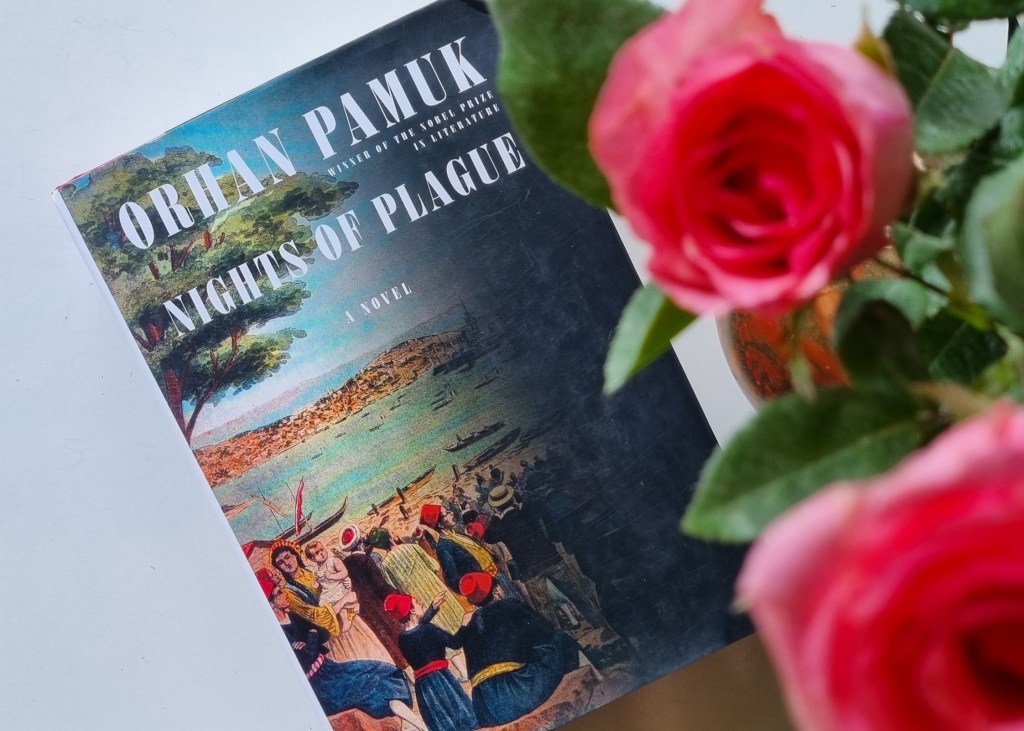
Nights of Plague
November 2022
Orhan Pamuk’s longest novel to date unravels with a pace that tends to linger, to wit: it is not for readers who are in a hurry. For that reason, I found it strangely refreshing. Strange because it is a plague narrative that is not meant to be refreshing, refreshing because of the reading experience it provided; defiant of the modern reader’s preference for a literary quick fix, and defiant of our silly reading goals that have more to do with the number of books rather than the languid relishing in an author’s descriptive prowess.
Perhaps I simply feel at home in the expression of an author whose mind is a museum of melancholy, but I am now sensing that part of the allure is in how his books are written for their own sake — written because he felt they needed to be written rather than written for their salability. Isn’t that pure art?
Set in 1901, in the fictional island of Mingheria, “on the route between Istanbul and Alexandria,” it is a curious deviation from a usual Pamuk novel that stays within reach of Istanbul. While Snow is set farther in eastern Turkey, an invented island between Crete and Cyprus is still a surprising backdrop for seasoned Pamuk readers; but only until we realize that the creation of Mingheria allows for a certain leverage and freedom for political criticism. Methinks Mingheria speaks more about present-day Turkey than it does about an imaginary island nation in 1901.
This novel can teach a thing or two about running a nation during a plague; about epidemiology; how to deal with resistance from different sectors against quarantine measures; how plagues do not distinguish between Christian or Muslim; how failed attempts at containing a plague can fan the flames of a revolution; how revolutions can be exploited; the similarities between solving a murder and stopping an epidemic; and living or loving through the sickness and political ferment. It is about plagues, and revolutions, nationalism, the fickleness of governments, about the accidents of history, how history is made, and how history is written.
It echoes Camus’ The Plague in the way that the narrator’s significance is revealed only at the end and also for the chilling reminder that plagues reappear throughout history “for the bane and enlightenment of men”.
Unfortunately, man easily forgets, and unwittingly asks to be reminded ever so often.
Other Colors
Other Colors, my first signed copy by a Nobel laureate.
“Nothing can penetrate into the cracks, holes, and invisible gaps of life as fast or as thoroughly as words can. It is in these cracks that the essence of things — the things that make us curious about life, about the world — can be first ascertained, and it is good literature that first reveals them.”
The White Castle (a re-reading)
June 2021
Fifteen years ago The White Castle meant nothing more to me than a tale set in the 17th century about an Italian intellectual who sets sail from Venice to Naples only to be captured by Turks and brought to Constantinople where his master would turn out to be his doppelgänger. I knew it was a novel about identity, but it did not leave a lasting impression back then.
I had even forgotten that this was set during a pandemic wherein people lived in fear of the plague! “Janissaries guarded the entrances to the market-places, the avenues, the boat landings, halting passers-by, interrogating them: ‘Who are you? Where are you going? Where are you coming from?’”
The same questions that each doppelgänger would often ask the other and himself — the same questions that confront the reader.
Through my re-reading, I discovered nuances that were lost to my younger mind; and passages that I previously failed to mark with a pencil leapt up from the pages with intensity.
Over the course of time, the two characters’ lives would become inextricably entwined, they would embark on engineering projects, study astronomy, work on other branches of science, write books and and share a life together. As soon as Pamuk tricks us into thinking that one is inferior to the other, and into making us think we have a good grasp of who is truly master or slave, their roles would be reversed until it becomes difficult to tell them apart. And yet, their likeness is something that they do not acknowledge openly.
By and by, the question of who is superior? fades into oblivion and metamorphoses into who is who?
On one occasion, the Sultan asks them, “Have you two never looked at yourselves in the mirror together?”
And there it was, the very point that I missed hiding in plain sight — East and West personified!
And who else more qualified to write about their tumultuous but inevitable relationship? But of course! A man from that city perched on both East and West!
The Black Book
February 2025
This reader has been through Pamuk’s longest novels and still felt the density of the mystery and prose in this book’s mere four hundred pages.
It explores the writing process and the precariousness of identity. It is also about how much the books we read, the stories we hear, the movies we watch, the everyday objects in our lives, and our city’s history shape the multiplicities of our being.
I enjoyed that twist at the end and relished the familiarity of Istanbul as a breathing character in a Pamuk novel. But maybe, just maybe, The Black Book is not for the Pamuk newbie, and not for those who are in a hurry.
A Strangeness in My Mind
February 2021
The first page of this book quotes a passage from William Wordsworth’s The Prelude: “I had melancholy thoughts… A strangeness in my mind, A feeling that I was not for that hour, Nor for that place.”
For someone who has felt like an anachronism all her life, I felt like I owned these lines. It was as if I was meant to read the book just for this, and having come across it right at the start, the rest of the book was an additional literary present.
There are things Pamuk writes that make me uncomfortable, but these simultaneously compel me to admire a straightforwardness about life that only the most courageous writers can execute. It is only through this book that I have seen for myself what all his works have in common — aside from providing details that escape the average consciousness, perhaps a result of having gone to architecture school — every book is a love story, no matter the plot or the characters: A love story between a writer and a place; between a writer and Istanbul, or Kars; between a writer and Turkey; a love story about the effects of the bittersweet passing of time on a place; about someone who recognizes a nation profoundly inside out, from its complicated politics to its inner conflicts and issues, its customs and traditions, from its spectacular buildings to its impoverished slums, from its most magnificent cities to its humble villages, from its splendid past to what it is now; a love story with a viewpoint only a lasting lover can deliver who, after having seen its glories and deepest flaws and undesirable secrets, remains and continues to love.




 The Book-Butterfly