This is my ninth book by Elif Shafak, and I admit that I sometimes have qualms with her metaphors. Here, she personifies each of her personalities into tiny little women that argue among themselves and with whom she convenes, and it is comical at times. But this may have been necessary to lighten the mood, otherwise it would have been too weighty to read, especially for a woman. Besides, Shafak must always have her whimsy despite the gravity of her topics.
The best parts for me are the contemplations on the lives of other literary women and their differing views on motherhood; from Virginia Woolf, Simone de Beauvoir, Doris Lessing, Jane Austen, Anais Nin, Countess Sophia Andreevna Tolstoy, Louisa May Alcott, to Sylvia Plath of whom Elif Shafak writes so beautifully — “She was the mother to not only two children but to a thousand poems.”
All these women who either struggled or dealt with, longed for, or resisted motherhood.
“After all, as even the smallest glimpse into the lives of women writers — East and West, past and present — keenly shows, every case is different. There is no single formula for motherhood and writing that suits us all. Instead, there are many paths on the literary journey, all leading to the same destination, each equally valuable. Just as every writer learns to develop his or her own unique style and is yet inspired by the works of others, as women, as human beings, we all elaborate our personal answers to universal questions and needs, heartened by one another’s courage.”
This book was closed with a lump in my throat. At times it felt like it was attacking me, and sometimes it felt like it comforted me. But it is a gift that came to me at the right time in my life.
Disclaimer: I am not with child. Haha! But being of a certain age, my many selves are warring against each other about the things discussed in this book. Summed up, it is mainly a witness to a journey of being at peace with all of who you are, including the conflicting voices in your head.
On the other hand, we see that maintaining a healthy sense of democracy among our many selves cannot be achieved without putting in the necessary work.
Because I heard about this book through Bjork, my mind immediately appointed her as the protagonist’s voice in my head. If you don’t know how oddly endearing that is, search for that video of Bjork talking about her TV.
So although our main character is a nonagenarian, the whimsical nature of the book had no problem merging with my brain’s choice of voice.
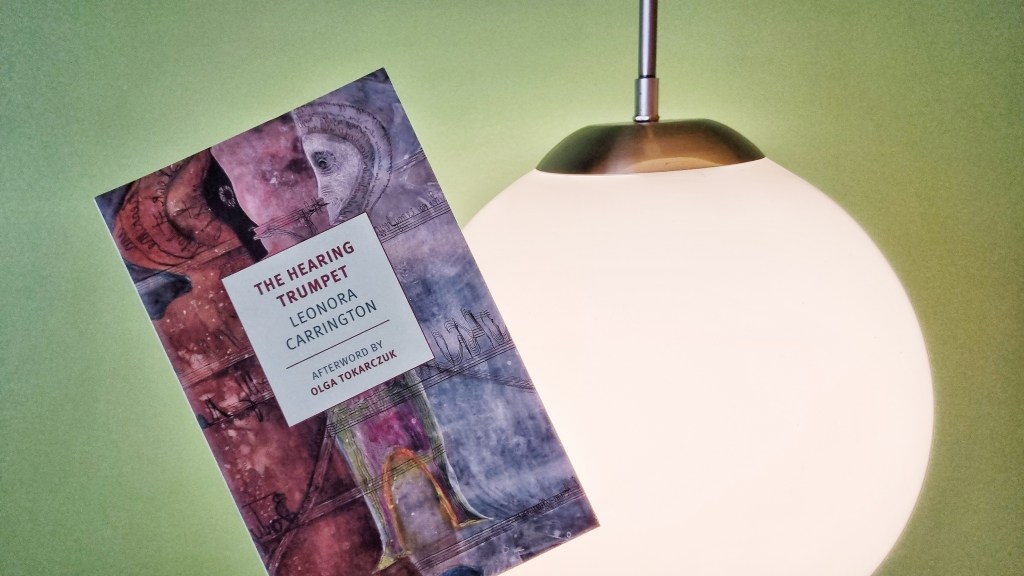
The author was unknown to me, but I soon learned that I am acquainted with her former lover’s art — that of Max Ernst. Apparently, Leonora Carrington herself was also a surrealist painter; and yes, that is her work on the cover of this NYRB edition.
And as it is with art, it overflows through different channels of your being and explores different media, but it stems from the same soul. Needless to say, this is also a surrealist novel.
And as it is with surrealist art, we find ourselves wading through allusions, symbolisms; reality becomes warped, and rules are contorted, and it certainly gets weird. But as it is with paintings, there are only certain people you would gift with surrealist art, those are the same people to whom you would recommend this book.
But why do we read novels in the first place? Olga Tokarczuk asks and answers in the afterword — an afterword which, I believe, is already a ratification of her Nobel: “To gain a broader perspective on everything that happens to people on Earth. Our own experience is too small, our beings too helpless, to make sense of the complexity and enormity of the universe; we desire to see life up close, to get a glimpse of the existence of others… we are seeking a communal order, each of us a stitch in a piece of knitted fabric. In short, we expect novels to put forward a certain hypotheses that might tell us what’s what. And banal as it might sound, this is a metaphysical question: On what principles does the world operate?” She continues to write that a nongenre novel like this “passes disturbing comment on things we never stop to question.” As it is with Bjork’s music, so it is with this novel.
There is an act that the protagonist commits close to the end that seemed most monumental to me (a potential spoiler, so I will refrain from mentioning it, although I am up for a discussion with those who have read this) but which Tokarczuk does not mention in the afterword. It is possible that she left it out to urge us to develop our own thoughts. Besides, what is the point of all this art if we don’t?
I finished reading this book the day an article from the New York Times came into my inbox: “Afghanistan Has Become the World’s Largest Humanitarian Crisis.”
A passage from page 59 immediately came to mind: “We just shared the towering profundity of our loss, tasting that resignation to fate that came to us from our Afghan soil, for even as children, we knew that loss would deepen us. That’s what it means to be an Afghan.”
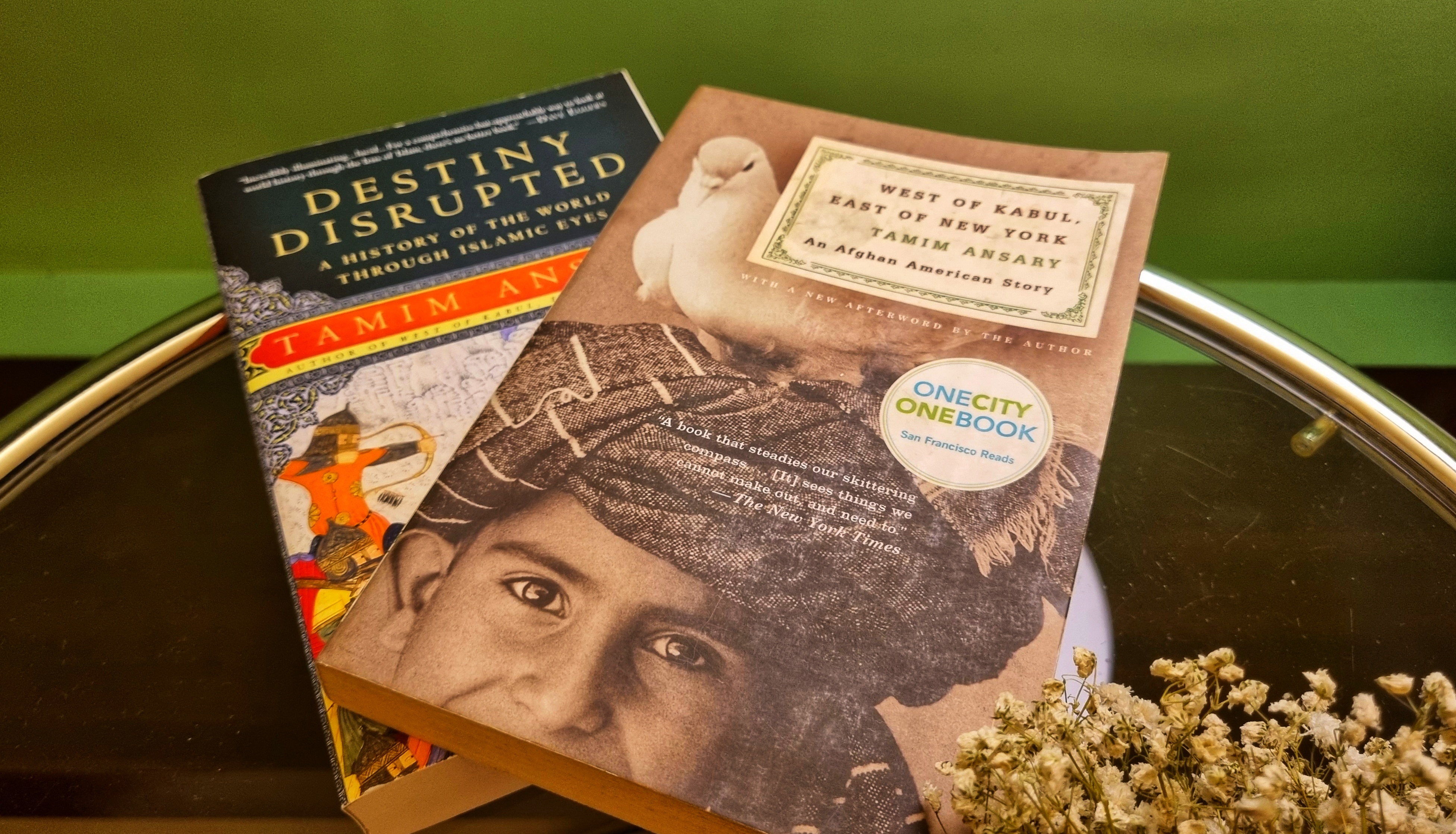
Published after 9/11 when it was Osama bin Laden and the Taliban that put Afghanistan on the map of the majority of Western consciousness, and during a time when the world was angry and calling for the bombing of Afghanistan as retribution, Ansary felt an urgency to let the world know that the Taliban and Bin Laden are not Afghanistan.
“It’s not only that the Afghan people had nothing to do with this atrocity. They were the first victims of the perpetrators… Some say, Why don’t the Afghans rise up and overthrow the Taliban? The answer is, They’re starved, exhausted, hurt, incapacitated, suffering… There are millions of widows. And the Taliban has been burying these widows in mass graves. The soil is littered with land mines, the farms were all destroyed by the Soviets.”
“We come now to the question of bombing Afghanistan back to the Stone Age. Trouble is, that’s been done. The Soviets took care of it already.”
Make the Afghans suffer? They’re already suffering. Level their houses? Done. Turn their schools into piles of rubble? Done. Eradicate their hospitals? Done. Destroy their infrastructure? Cut them off from medicine and health care? Too late. Someone already did that.”
And yet, this memoir gave room to a heart-warming aspect of Ansary’s writing. From his childhood in Kabul and Lashkargah to adulthood in the United States, there was still space for life, love, friendship, and even for travel.
Unfortunately, 20 years after this book’s publication, the dam is breaking in Afghanistan once more.
“History is like a river, except people can only live in lakes, so they dam the current and build villages by still waters — but the dam always breaks.”
“Destiny Disrupted is neither a textbook nor a scholarly thesis,” goes the preface. “It’s more what I’d tell you in a coffee house.”
Isn’t that how we’d rather have history presented to us anyway? Wasn’t it just days ago when supposedly smarter people bashed a purported Nadine Lustre account for tweeting a derogatory remark about history as a subject in school? “Stupid. Go back to being an actress,” they said.
I wouldn’t go so far as to say that history is “a waste of time,” but don’t you agree to some extent that most teaching methods and a majority of the curricula need some overhauling for the study of history to become more engaging and internalized? To be so effective that hardly anyone becomes apologists for an evident human rights violator? To have a healthy amount of eastern perspective to balance the overwhelming eurocentrism?
For most students, history has been reduced to a series of unfortunate dates and names that they have to memorize for an exam. So, yeah. Don’t coffee house conversations stay with us longer and give space for our own thoughts? More space to consider one view alongside another?
If the answer is yes, there is a huge possibility that you will find this book well-organized, entertaining, and illuminating. Perhaps not all-encompassing, but that is why it is accessible. Frankopan’s The Silk Roads is a panoramic view, Maalouf’s The Crusades Through Arab Eyes focuses on a specific sequence of events, Ansary’s Destiny Disrupted zooms in and out so that it does not only provide particulars but also a bird’s eye view. All eye-openers, but among the three, I find this to be the most well-written.
I started 2021 with The Silk Roads, 2022 with Destiny Disrupted. This will make a good reading tradition — new year, new eyes. We can use a pair every now and then.
In case the Philippine IATF needs further proof of how much social distancing I’ve done, the plan was to build a tower out of the books I read this year (minus the e-books and several that are currently being lent to friends).
So what have we here? A ziggurat? Pyramid? Pagoda? Babel? I am not sure anymore, that’s why I refrained from posting this when I took the photo the other day. But it is 2021, after all. A year of things not turning out the way you envisioned them in your head. And apparently, I won’t make such a good architect. Haha
But here is a pile of my closest companions at a time when physical interaction was discouraged and I could not be with people I wanted to be with; fragment of a reply to Camus’ “It is because the world is, in its essence, unhappy, that we need to create some joy,” and partial answer to his “because the world is absurd, we must provide it with all its meaning.”
Yesterday, I got on a plane for the first time since the pandemic started, and suddenly I was flooded with a bright and warm clarity that translated everything I felt and thought — and I realized, this is reading. This beauty. Even without opening the book in my hand, this is reading. This beauty, when, at last, everything worth keeping from all those pages blossoms into something that transcends language inside of you.
“Freedom is an illusion. The only thing that changes is the size of your prison.”
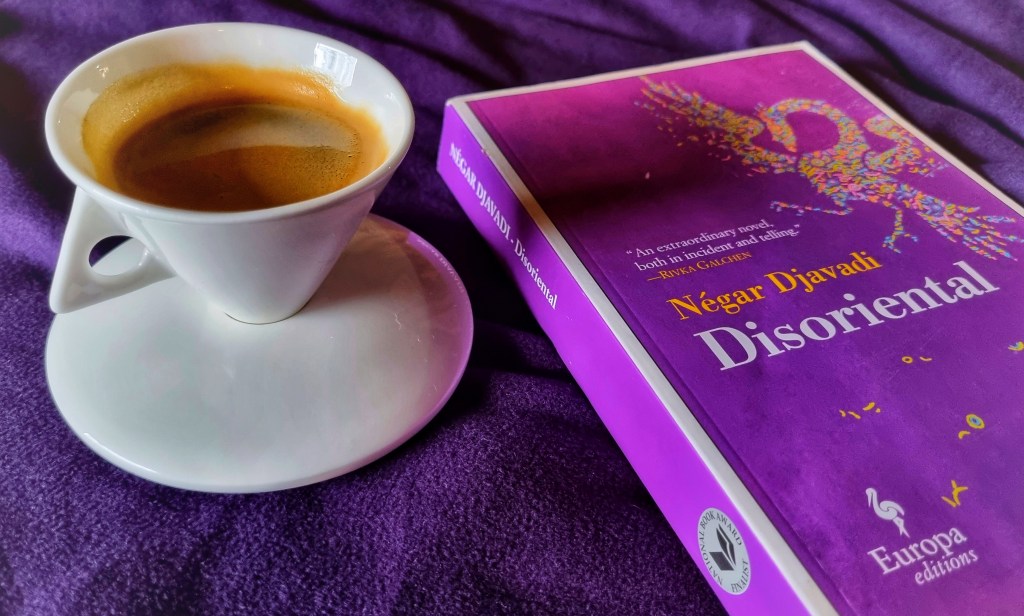
Disoriental. We know what the prefix implies. But the clever wordplay refers to more than something that is non-oriental. It alludes to the disorienting, the experience of being uprooted abruptly from an oriental into an entirely contrasting and unfamiliar culture — the tragedy of exile.
“I can tell you that you have to disintegrate first, at least partially, from your own. You have to separate, detach, disassociate. No one who demands that immigrants make ‘an effort at integration’ would dare look them in the face and ask them to start making the necessary ‘effort at disintegration.’ They’re asking people to stand atop the mountain without climbing it up first.”
Although this novel has the familiar background of a young person having to flee Iran during the Islamic Revolution, this takes a step further. The main character dispenses her own unique commentary on Iran’s political events in fragments, but this delves more into its aftereffects on the internal climate of an exile.
“To be honest, nothing is more like exile than birth. Being torn, out of survival instinct or necessity, with violence and hope, from your first home, your protective cocoon, only to be propelled into an unknown world where you constantly have to deal with curious stares. Every exile knows that path, like the one from the uterine canal, that dark hyphen between the past and future which, once crossed, closes again and condemns you to wander.”
Hers was a personality I could not initially relate to, and so I shelved this a while ago. Returning to it weeks later and reading a little bit more, the dissonant feeling turned to empathy, and by the time I got to the last page, I was crying for this character who had nothing in common with me.
“After so much time and distance, it’s not their world that flows in my veins anymore, or their languages or traditions or beliefs, or even their fears, but their stories.”
And so I’ve learned that stories are written for the sake of the writer and stories are read for the sake of the reader; so the first may pursue connection and the latter empathy.
It is not for nothing that Rodin sculpted a dramatic monument of this writer; not for nothing that a statue of him with a lion stands imposingly in the gardens of Villa Borghese in Rome; and not for nothing that I chose this as my 100th book this year.
Because there are authors we outgrow, there are those we resonate with during a particular stage in life, there are those who deliver exciting information to the mind but barely leave imprints on the soul, and then there are those timeless ones like Victor Hugo who, throughout the years, endure to disclose beauty and depth commensurate with a reader’s growth.
Everyone probably knows by now that the novel is degrees darker, more tragic, and ends nothing like the Disney film. Although it tells of love that transforms, contemplations on fate, there is also lust, obsession, loss, betrayal, death — but had I known the original French title beforehand, Notre-Dame de Paris, perhaps I would have realized sooner that this is, in fact, a gigantic novel about architecture.
After its publication 190 years ago, it launched a movement to preserve French Gothic architecture. A first-time reader of the preface will focus on that fateful Greek word engraved on the wall upon which Hugo stumbled in one of Notre Dame’s towers, and which would inspire him to write the novel. But listening more keenly will reveal that even on the first page of the preface, there are lines that already set the tone for his architectural odes and intentions.
Of the structures from the Middle Ages, he writes in passing, “Mutilations come to them from every quarter, from within as well as from without… What has time, what have men done with these marvels?” But a few dozen pages deeper, he elegantly declares, “Time has bestowed upon the church perhaps more than it has taken away, for it is time which has spread over the facade that sombre hue of the centuries which makes the old age of monuments the period of their beauty. Who has brutally swept them away? It is not time… time’s share would be the least, the share of men the most.”
“On the face of this aged queen of our cathedrals, by the side of a wrinkle, one always finds a scar. Tempus edax, homo edacior (time is a devourer; man, more so); which I should be glad to translate thus: time is blind, man is stupid.”
By the time I read a quarter of the book, I was convinced that this is more about Notre Dame than it is about the Hunchback. “Each face, each stone of the venerable monument, is a page not only of the history of the country, but of the history of science and art as well.”
There are chapters and chapters devoted to detailed descriptions and beautiful thoughts on architecture. He believes architecture to be “the great handwriting of the human race” and how, throughout the ages, it is “developed in proportion to human thought”.
Of the great edifices he writes, “They make one feel to what a degree architecture is a primitive thing, by demonstrating that the greatest products of architecture are less the works of individuals than of society…the deposit left by a whole people… the residue of successive evaporations of human society… Each individual brings his stone. Thus do the beavers, thus do the bees, thus do men. The great symbol of architecture, Babel, is a hive.”
However, I have also recently learned that some architects strongly disagree with a particular chapter where Hugo holds that architecture was dethroned and ceased to be the sovereign art upon the arrival of Gutenberg and the flourishing of literature. He laments this “death”— “no longer the social art, the collective art, the dominating art.”
Perhaps it is the fact that I am not an architect that I did not react so disapprovingly towards the passage (even though the architect with whom I shared some beautiful lines the moment I read them prove the statement wrong with the work that he’s been involved in for the past several years), and perhaps it is because I considered the historical context in which Hugo wrote.
But I am absolutely certain that those who immediately oppose the disputed chapter did not finish reading this giant. On a closing note in this edition, Hugo clearly expresses that he hopes to be put in the wrong about this exact view!
This, ladies and gentlemen, is how you craft the most beautiful architectural challenge ever written.
A fascinating overview of the world my mind has been transported to in 2020. Without any intention of underrating the author, I doubt if I would have found this as easy to ingest had I not gone through all the other materials I devoured prior to reading this. The political, religious, and economic landscape already seemed familiar to me by the time I arrived at The Silk Roads.
Aside from agreeing on accounts and facts with the other books I read, and also declaring that it is time we look at history from another perspective; what details the other books chose not to elaborate, this one expounded and vice versa, altogether offering a more detailed and broader picture of history.
In my recent readings, the vastness of how much mainstream history excludes and how it reeks of western bias disturbed me deeply. I felt rather betrayed by history textbooks and it was tempting to shift entirely to an eastern-centric worldview.
But the remarkable thing about seeking to learn more is that it encourages openness, and you ultimately realize that the most wonderful way of viewing the world and history is to study it through not one, not two, but through as many vantage points as possible.
Quoting Peter Frankopan, “There was good reason why the cultures, cities and peoples who lived along the Silk Roads developed and advanced: as they traded and exchanged ideas, they learnt and borrowed from each other, stimulating further advances in philosophy, the sciences, language… As tastes became more sophisticated, so did appetites for information. Alongside increasingly sophisticated tastes came increasingly refined ideas.” History teaches us that this is how cities and cultures thrived, reasoning implies that this is how our minds could flourish.
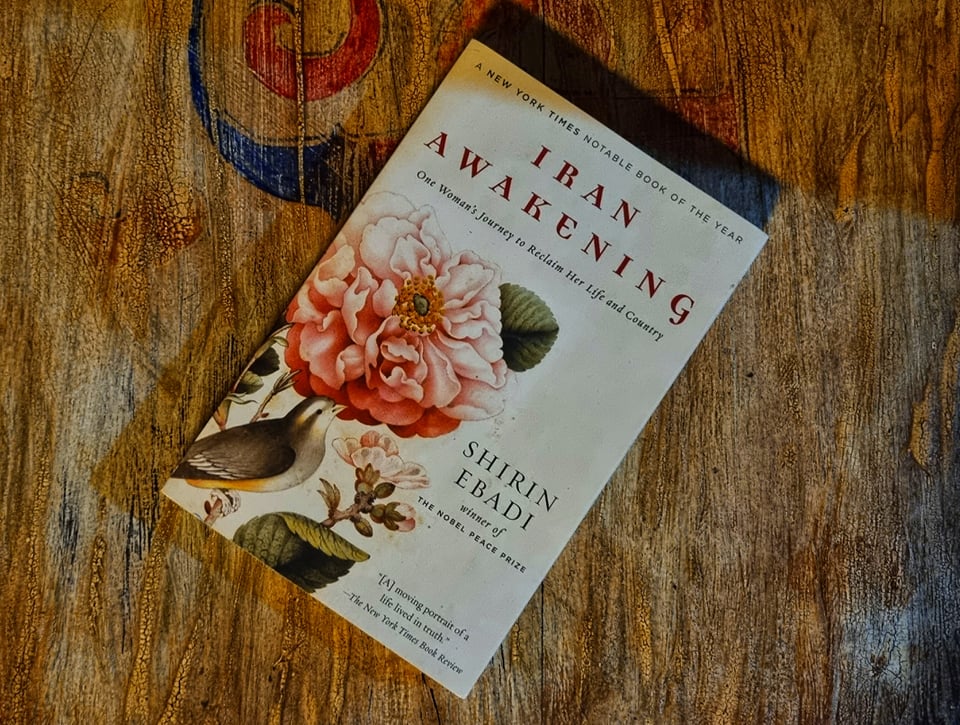
Iran’s first female judge, and winner of the Nobel Peace Prize in 2003, has penned this affecting book with such free-flowing sincerity that I could not help but cry in a number of passages.
Just as in 2011 when I read Azar Nafisi’s Reading Lolita in Tehran and it made me celebrate my freedom as a reader, Shirin Ebadi’s Iran Awakening is making me celebrate my freedom as a woman as it raises awareness of the many liberties that we often take for granted.
“The world was awake — it wakes early in the East.”
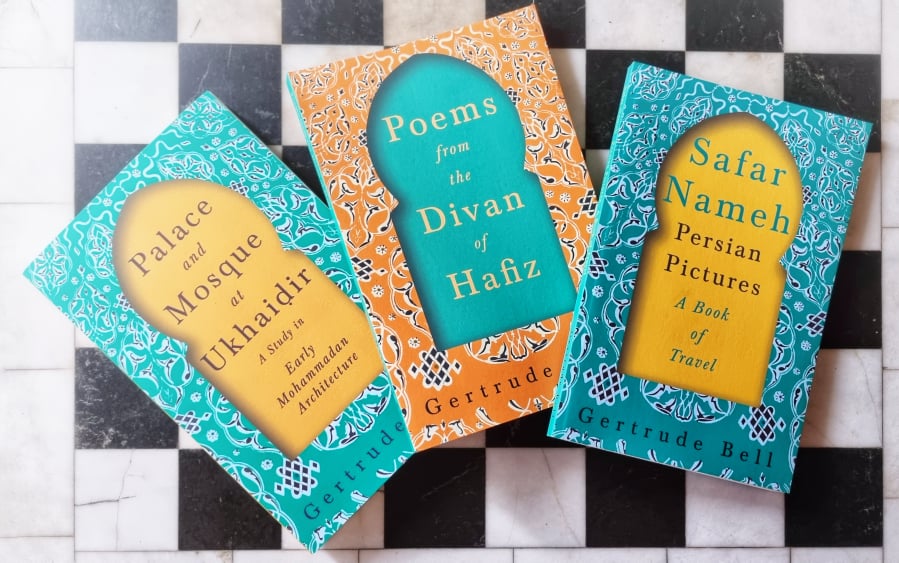
Gertrude Bell’s simple description of a Persian sunrise encapsulates, with figurative overtones, the theme of the books I have been reading lately. In The Silk Roads, she is described as dynamic and fiercely intelligent, brilliant, a mercurial scholar and traveler who knew the region and its people as well as anyone. Portrayed by Nicole Kidman in Queen of the Desert, she is called a Kingmaker for being influential in drawing up the borders of the new nation of Iraq and in bringing King Faisal to power as its first ruler in 1921. But it was only through Safar Nameh that I was introduced to her writing.
She writes so elegantly with a deep perception of places, people, and the relationship between East and West. She speaks of “the careless optimism of those who seek to pile one edifice upon another, a Western upon an Eastern world, and never pause to consider whether, if it stands at all, the newer will only stand by crushing the older out of all existence.”
This is a tiny book of a hundred pages that I thought I would be able to finish in one coffee break, but the writing is too beautiful that I had to savor the lines over and over again.
And for those times when my mind and soul are exceedingly wide awake in wonder, she has the right words… “The world was too lovely for sleep.”





 The Book-Butterfly