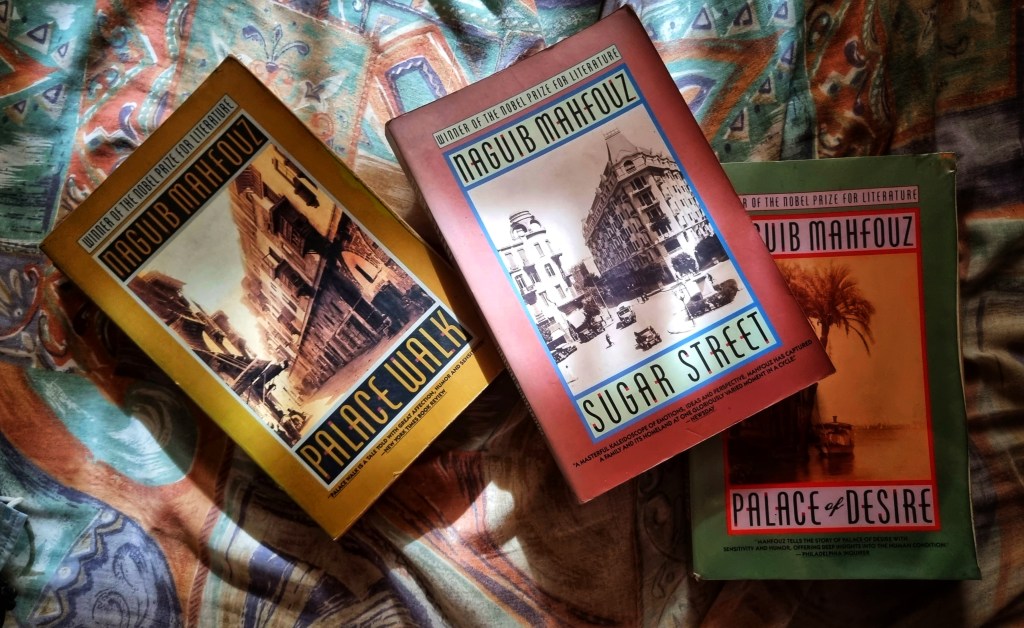
Naguib Mahfouz: The Cairo Trilogy

There are better editions with attractive new covers now. Mine still carry the designs of the first American edition of the English translation, but I love how the first volume depicts the antique mashrabiyas of Old Cairo. These projecting windows with intricate latticework are some of my favorite features of traditional Islamic architecture. They seem to me exemplars of how a thing of beauty and tradition can become a refuge or a prison.

And yet, not even these mashrabiyas could shield Ahmad Abd al-Jawad and his family from life, love, death, and a changing world.

It is often said that the Cairo Trilogy is a family saga spanning three generations, from the period of the Egyptian revolt against British colonizers in 1919 to the final days of the Second World War. But it is more than a family saga: It is an astute record of a society, a city, a nation, and a world in transition. 

I admit that I found good reason to put the first volume down. I was constantly infuriated by how women were perceived and treated by the male characters, by how men justified their immorality and hypocrisy and got off scot-free while women were punished severely for the most innocent blunders, and by how women themselves accepted this as the natural order of things. Those passages were deeply frustrating.

But Mahfouz’s exquisite storytelling carried me through. He does not so much describe Cairo as transport me there — into the volatile political scene of an Egypt yearning for independence, through its wondrous or disreputable backstreets and alleys, and especially into the women’s cloistered lives so I could hear the questions brewing in their hearts, and eventually to the reflection of society’s gradual development through the change in attitude toward women and their education.

In this trilogy, imperial tyranny juxtaposes with tyranny in the family, but through it all, an incredible compassion and empathy emanates from Mahfouz who humanizes everyone, even the tyrants.

Before I knew it I was at the final page of the last volume, not quite ready to let go, and contemplating on the fact that I had just read one of the finest works of literature ever written.

Vladimir Nabokov: The Defense

“…and when Luzhin left the balcony and stepped back into his room, there on the floor lay an enormous square of moonlight, and in that light — his own shadow.”

The awareness of this being a story of a man possessed by chess (“…sleep could find no way into his brain; it searched for a loophole, but every entrance was guarded by a chess sentry…”) makes the allusion to the white square of a chessboard more impeccable.

Nabokov is a writer that allows a reader to experience cinematography in literature. The deliberate composition of each frame is so visually satisfying that I’m tempted to say it’s the reason I read him. But I would be lying. I’m also here for the traces of his synesthesia.

“Hearing” the chess moves — “combinations like melodies”, chess notations synthesize with musical scores, games begin “softly, softly, like muted violins” then without the least warning, a chord sings out tenderly, a trace of another melody manifests, some other deep, dark note chimes elsewhere…

Sometimes I, too, ask myself if I’m missing the point and reading Nabokov incorrectly by fixating on those passages and often forgetting that this is a tragic tale about how our sanctuaries can turn into obsessions and lead to madness, or the fact that this novel belongs up there with Stefan Zweig’s Chess Story; but then I find myself falling for those passages all over again. Part of me asserts that if this is me reading him wrong then I’m reluctant to be right!

Naguib Mahfouz: Three Novels of Ancient Egypt

Cleopatra’s era is closer to the invention of the iPhone than it is to the construction of the pyramids of Giza. A podcast episode that I listened to years ago pointed this out. The fact still blows my mind. When they are mere numbers written on a page, the breadth of history’s timeline cannot be fully grasped until such a comparison is made; but to make those epochs come alive is a task for the novelist.

Khufu’s Wisdom is set in Ancient Egypt’s Fourth Dynasty (circa 2625 – 2500 BCE). Khufu, also known as Cheops, whose sarcophagus rests in the Great Pyramid of Giza, is the pharaoh to whom Egypt’s biggest pyramid is commonly attributed when people are not busy attributing it to aliens. Rhadopis of Nubia in the Sixth Dynasty (circa 2350 – 2710 BCE), gravitates around a courtesan and King Merenra’s short-lived reign. Thebes at War, set between the Seventeenth to Eighteenth Dynasty (1630-1292 BCE), reimagines the interval when Egypt was ruled by the Hyksos or “foreign kings”.

I have read several works by Naguib Mahfouz before taking on this trilogy but have found this to be the easiest to read and the most entertaining thus far! Yes, the language is grand and often pompous — it has to match its pharaonic subjects! Yes, some details can be politically incorrect by today’s standards — the publication years of each volume are as follows: 1939, 1943, and 1944! But reading this made me feel like a very young girl again; one who cannot help but be swept away with abandon into wondrous tales of the past. How I was able to imagine the stories as grand cinematic adaptations in my head is proof of Mahfouz’s skill as a storyteller!

Although the stories are easy to read, they are not as simple as they seem on the surface:

Khufu’s Wisdom is a classic contemplation on fate and duty, and about the difficult submission to both. My favorite passage comes from a secondary character who asks the protagonist, a skilled warrior, “And now, tell me, are you reading anything useful? …the virtuous mind never dismisses wisdom even for a day, just as the healthy stomach does not renounce food for a day… The virtue of the science of war is that it trains the soldier to serve his homeland and his sovereign with might, though his soul does not benefit at all. And the soldier who is ignorant of wisdom is like the faithful beast — nothing more… if the soul isn’t nourished by wisdom then it sinks to the level of the lesser creatures.”

It was in Rhadopis of Nubia where I felt the political undertones deepen. While it also questions the role of beauty and art, there are questions posed to corruption in theocracies and the tricky relationship between king and clergy. In the hall of Rhadopis, politicians and all manner of men gathered to be entranced, even though it was believed to be a most dangerous thing to set eyes upon her. Her tragic tale left me wondering whether she inspired Salman Rushdie’s Enchantress of Florence and whether she is, as I continue to reckon Rushdie’s enchantress, an allegory for Power.

Thebes at War is the most dramatic out of all the three and a most fitting finale for the trilogy. It is where one will find this line, “Weeping is no use, gentlemen. The past will disappear into ancient times and obliteration so long as you are content to do nothing but mourn it.” 

Mahfouz is a man who did more than mourn Egypt’s past. He has built literary edifices forged from existing architectural wonders and archaeological findings, constructed modern allegories out of ancient lives and times, and transformed them into timeless political missives — knowing that there will always be those who are doomed to forget and repeat the follies of history.

Mavis Gallant: Paris Stories

“Leaving was the other half of arriving…”

Underneath the rumblings of revolution and the sparkling notes spilling over like champagne, Chopin’s music reaches for something far away… far away in distance, or in memory. The bulk of the work written in Paris, and yet they speak of other landscapes, of nostalgia for an irretrievable time and place, of exile, of home or the lack of it.

So were and so do Mavis Gallant’s Paris Stories. Had Gallant’s heart been brought home in a jar of cognac whilst the body remained in Paris, perhaps it would also have been found to be larger than the average human heart.

But how those hearts, Chopin’s and hers, continue to beat through the music, through the stories! 


“Like every other form of art, literature is no more and nothing less than a matter of life and death.” — Mavis Gallant

Haruki Murakami: Absolutely on Music

“Have you converted?” asked my best friend when he learned that I was reading this book. In other words, “Have you become a Harukist?”

Murakami became extremely popular in our circle during our teens and every reader we knew waved the Haruki banner high. But both of us shared a terrible secret: We were not into Murakami. We tried. We just somehow couldn’t.

Being both musicians, it was the biggest irony, because we love classical music, grew up with music by the Beatles, and listened to jazz — excellent and key ingredients in any Murakami work. (That After Dark opening? That is sheer music! I intentionally re-read it on a trip to Tokyo as the plane landed. Is there a better prelude to that megalopolis?)

But when we were younger, at what seemed to be the height of Murakami’s popularity, we instead entered a beautiful literary space occupied by the diaries of Anaïs Nin, the gushing streams of Clarice Lispector’s consciousness, and Colette. Perhaps we cannot be blamed if we felt like we weren’t missing anything by not being into Murakami.

Twenty-ish years later, I’m tiptoeing back into Murakami’s music room to eavesdrop on his conversations with Seiji Ozawa. (Recognizable to the younger generation and the world outside of classical music as the elderly conductor who, in a wheelchair and in tears, performed Beethoven’s “Egmont” Overture with the Saito Kinen Orchestra — a performance broadcasted live to outer space on the International Space Station in 2022.)

Glenn Gould breathing through the piano in the background as Leonard Bernstein conducts reassures me that, at least for now, I do not have to think about Murakami’s treatment of women in his novels.

The conversations between the two are like musical counterpoints played in tempo giusto. Writing and music as two melodic lines that diverge but remain in harmony, which oftentimes meet in unison when what the two have in common, hungry hearts and a penetrating ear for sound, “dig deeper and forge farther ahead”. 

From the contrasting conducting styles of Bernstein and Karajan, to the presence of “ma” (a Japanese word for the musical quality of pauses and empty spaces charged with meaning in Asian music) in Gould’s interpretations, to the dissection of Brahms’ orchestration, to the difference of sound between the world’s best orchestras, to John Coltrane’s free jazz, to Mahler’s music and the art of his time… I came out from my eavesdropping feeling more enlightened as a musician and as a person.

What a dream to listen to these conversations all day whilst partaking of Yoko Murakami’s rice cakes…


“…you can’t write well if you don’t have an ear for music. The two sides complement each other: listening to music improves your style; by improving your style, you improve your ability to listen to music… So how did I learn how to write? From listening to music. And what’s the most important thing in writing? It’s rhythm. No one’s going to read what you write unless it’s got rhythm. It has to have an inner rhythmic feel that propels the reader forward.” — Haruki Murakami, Absolutely on Music

Elias Khoury: Children of the Ghetto

Children of the Ghetto: My Name is Adam is my fifth Khoury. Would I recommend this? Perhaps not as a reader’s first Khoury. Would I read another Khoury after this? Absolutely!

In what seems to be a foreword signed by the author, he recounts how the notebooks of Adam Dannoun came into his possession. The entire book is the purported sum of Adam’s scribblings. “This is neither a novel nor a story nor an autobiography. And it isn’t literature,” writes Adam in his notebooks. But of course, through his virtuosity, Khoury turns the non-novel, the non-story, and the non-autobiography into literature.

It is literature that is one of the trickiest webs that he has woven because it challenges Khoury himself as a storyteller. It is soon revealed that Adam claims to have known the characters in Gate of the Sun personally, and he dislikes “the author of the novel Gate of the Sun, standing next to the bald Israeli director, presenting himself as an expert on Palestinian history, and lying.”

Adam, an infant in 1948, named so as the first born of the Ghetto of Lydda. Adam lived through the horrors of the ghetto, the massacre in Lydda, and the Lydda Death March. Before his suspected suicide in New York as an older man, he struggled to write about what befell his people. The notebooks contained his attempts. The whole history of our Nakba is unwritten. Does that mean we don’t have a history? That there was no Nakba? Does that make sense?


It possibly cannot be the unfathomable pain of the Nakba or the senseless violence of the Lebanese Civil War that keeps me coming back to Elias Khoury. It’s probably not the history either, because he is the kind of writer who questions it.

Or maybe it is because he questions history that I keep coming back. Maybe it’s also for the reason that every book I’ve read that’s written by a Lebanese reveals how capricious and adventurous the Lebanese are with form, or with the defiance of form. Maybe I’ve been lucky with the chronology of which I read, and of which the books came to my possession, that instead of being thwarted by this unconventional and sometimes disorienting quality, each book has only heightened the allure for me.

And maybe it is because Khoury, as a writer, urges and trusts the reader to be the one to bring a story to life; a truly Eastern composer of tales who wants to obliterate the author and make his identity of no interest so that literature becomes, like Eastern classical music, not a fixed composition, but an unfolding.

Mathias Énard: Street of Thieves

Maybe if I were not repulsed by Lakhdar who reminded me so much of the young men who catcalled or boldly approached me for my contact details on a solo trip to Morocco, I would have esteemed Street of Thieves better.  At the same time, I also checked myself if it was because I was uncomfortable with the portrayal of the darker streets that a female solo traveller usually circumvents, and which shatter more romantic notions of Morocco, Tunisia, and Spain. After all, the truth hurts, even when it concerns favorite or dream destinations.

“…I had realized that afternoon, Judit’s Tangier did not coincide with mine. She saw the international city, Spanish, French, American; she knew Paul Bowles, Tennessee Williams, and William Burroughs, so many authors whose remote names vaguely reminded me of something, but about whom I knew nothing.”

Still, I’m afraid I cannot agree with the blurb claiming that this novel “may take Zone’s place in Christophe Claro’s bold pronouncement that Énard’s earlier work is ‘the novel of the decade, if not of the century.’” But that’s not to say that this book doesn’t have its merits. The fact that I continued reading up to the chilling last page is proof of Énard’s prowess. The story clarifies the youth’s discontent and anti-government sentiments in the wake of the Arab Spring and the anti-austerity movement of the indignados in Spain. This one has its own special niche in political literature of the Maghreb. 

“‘All young people are like me,’ I added. “The Islamists are old conservatives who steal our religion from us when it should belong to everyone. All they offer are prohibitions and repression. The Arab Left are old union members who are always too late for a strike. Who’s going to represent me?”

I simply think it falls short of the enigmatic and beautiful prose of Tell Them of Battles, Kings, and Elephants; incomparable to Compass that holds certain passages that mean to me more than I can express; and quite a distance away from the extremely impressive threnody for the last century that is Zone.

If there’s one thing that the main character of Street of Thieves definitely got right, it is this: “I think today of that dark parenthesis, that first imprisonment in Algeciras, that antechamber, when around me spin the lost ones, walking, blind, without the help of books…” How dark, indeed, to go through life without books.

Portraits of May

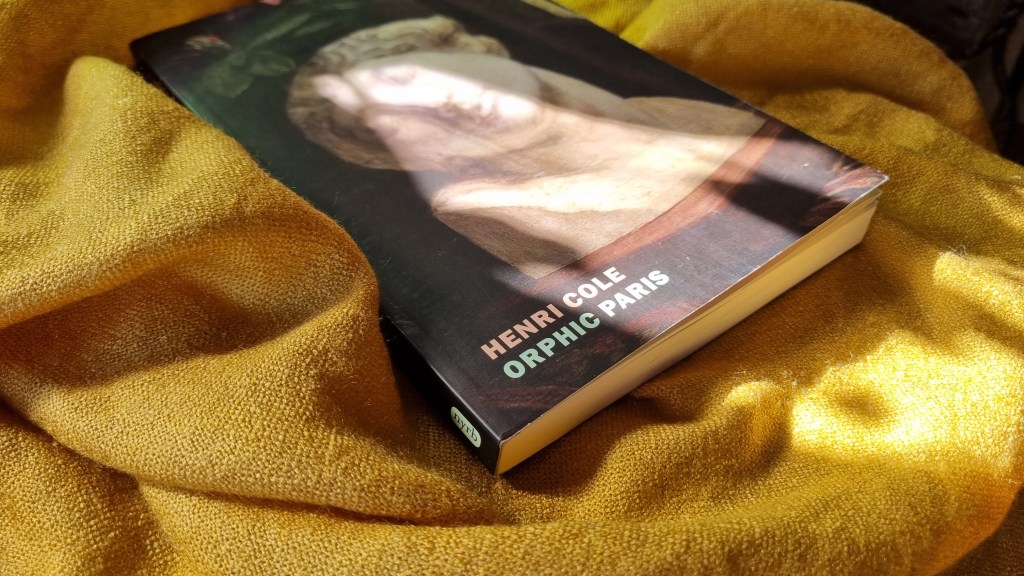
Portraits: Of a young Rebecca Solnit finding, and fending for, herself; of the nature of dictatorships and revolutions by Ryszard Kapuściński; of Eastern Turkey under the veil of its dramatic landscapes by Zülfü Livaneli; of Paris and the poet through the vantage point of Henri Cole; of the unfortunate visage of Skylark by Dezső Kosztoláni. These are some of the extraordinary faces I met on this month of May.

It is not nearly celebrated enough, says Solnit: “The sheer pleasure of meeting new voices and ideas and possibilities, having the world become more coherent in some subtle or enormous way, extending or filling in your map of the universe…this beauty in finding pattern and meaning,” this thing called Reading.

Even so, here we are. The readers (ironically, the ones least concerned about faces), the ones who, by turning each page, celebrate best these encounters, these awakenings, these flights.

“At least I had books. Closed, a book is a rectangle, thin as a letter or thick and solid like a box or a brick. Open, it is two arcs of paper that, seen from the top or bottom when the book is wide open, look like the wide V of birds in flight.” — Rebecca Solnit, Recollections of My Nonexistence
“I’ve always believed that poetry exists in part to reveal the soul’s capacity for compassion, sacrifice, and endurance. For some of us, this satisfies a basic human need, like air or water, but a poem must also have music, imagery, and form. Because there is a kind of nakedness or authenticity in poetry that is associated with truth, on many days I haven’t got the guts for it, and I fail. But when I succeed, there is nothing in life — except love — that equally verifies my existence.” — Henri Cole, Orphic Paris

Renato Cisneros: The Distance Between Us

“If I were moved by any kind of power at all, it would be the power of revealing absolutely everything about who we are.”

It’s been so long ago that I have started to question whether Florentina Ariza ever truly loved Fermina Daza. And why is it that what remains most vivid in my mind is how Dr. Urbino’s tasseled slippers made Fermina weep after his death? 

“The thing you remember most is what has most deeply affected you,” writes Renato Cisneros. Have I always been affected by loss, or afraid of the space of another’s absence?

I apologize. I have fully digressed right from the beginning! Is it even possible to digress right from the beginning?

But what makes the writing and the translation of The Distance Between Us so satisfying is that it is reminiscent of my first encounters with the Latin American greats! (Not the magic realism aspect for there is none of that here, but in the way the writer involves the reader intimately by making the characters palpable, using subtle tricks of psychoanalysis to dig as far within as they can so that one can gaze even into the unconscious.) But perhaps, most of all, for the moving premise of a son writing a book in an attempt to reduce the distance between him and his deceased father, a controversial figure in Peru’s turbulent history: A poignant endeavor to understand who the father really was in order for the son to fully understand himself. To acknowledge the faults of the father so as not to perpetuate them. To break the cycle and confront, rather than escape as his father and forebears have done, “Ignoring and later burying the thornier details of their pasts, they turned their backs on the intrigues of their shared history, embarking on a course of permanent disorientation…”

And yet, “Just as a father is never prepared to bury his son, a son is never prepared to dig up his father.” His undertaking brought to light his father’s amorous affairs; classified information that led him to acknowledge, though he loved him, that his father was a villain, but also that villains are made of wounds; the discovery that his parents were never legally married; and then to write about their love, to legitimize it — “This novel is my parents’ lost marriage certificate.”

Forget my likening Charco Press books to espresso shots. This strong blend of the personal and the political compelled me to spend hours and days between its pages. “Authenticity” is such an abused term nowadays that I sometimes wonder if the overuse has marked the word with a tinge of insincerity. Then comes along a book like this that keeps such doubts at bay. A work devoid of the inauthenticities of biographies and brimming with the honesty that confronts us in fiction.

Was I wrong to wish that the son of a dictator who is now our current president could be more like this son? But I digress, again.

Ryszard Kapuscinski: Shah of Shahs

“As a journalist, I say: Long live the magic. Kapuściński is an advocate for all who have chafed in a straitjacket called the house style, seen their lyrical phrases slashed for space, cursed the whole pedantic army of editors and fact checkers… he is a journalist’s writer, an example of what so many of us would love to be — if only we had the nerve.” — Christopher de Bellaigue

When one has had their fill of different accounts of the 1979 Islamic Revolution, fiction and nonfiction, Iranian and foreign; when an ample idea of its unfolding and its chronology has finally taken root; when details and events have been repeated enough and begin to sound redundant unless they are written with an exceptional voice and perspective; it is time to read Shah of Shahs by Ryszard Kapuściński — my personal cherry on the top of an Iranian Revolution literary stack.

It is not the book to read if one prefers a sequential list of events, a full cast of characters, an emotionally-charged dramatization, or a detailed portrayal of the Shah. This is not a portrait of the last Shah of Iran, neither is it a consummate portrait of a nation. From the collected clutter on Kapuściński’s hotel room desk in Tehran emerges a portrait of the nature of dictatorships and revolutions.

I can only wish he elaborated on that extravagant celebration that the Iranian despot held in Persepolis in 1971, which contributed to the flames of revolution, and in which the first guest to arrive at the event was Imelda Marcos. I would have loved for Kapuściński to have written a book about the Marcos family and our own EDSA Revolution!

For a Filipina reader and albeit dormant journalist, the writing method is illuminating and the subject hits close to home. There are too many passages that feel as if he were describing my own nation’s recent history. But then again, “The rather small arsenal of political tricks has not changed in millennia,” observed Kapuściński, who reported on twenty-seven revolutions during his illustrious career as a journalist.

Within a corrupt government, “Whoever tried to be honest looked like a paid stoolie.” “The higher up, the fuller the pockets,” and in that world, “development” has an entirely different meaning. “Any dictatorship appeals to the lowest instincts of the governed,” “A despot believes that man is an abject creature. Abject people fill his court and populate his environment.”

That a fed and entertained populace does not always signify a free society is a truth that burns: “A terrorized society will behave like an unthinking, submissive mob for a long time. Feeding it is enough to make it obey. Provided with amusements, it’s happy.”

And this is what he says about truth: “It takes a long time for a truth to mature, and in the meantime people suffer or blunder around in ignorance.” I’d like to believe, however, that reading the writings of Kapuściński speeds the process.

At the back of my mind, this question: Is Iran in the cusp of another revolution?