“Because when I read, I don’t really read; I pop a beautiful sentence into my mouth and suck it like a fruit drop, or sip it like a liquer until the thought dissolves in me like alcohol, infusing brain and heart and coursing on through the veins to the root of each blood vessel.” This is how Bohumil Hrabal’s Haňta reads — or how he doesn’t really read.
This is how I read, or how I did not really read, The Hills Reply by Tarjei Vesaas. I do not think there is any other way to read, or to not really read, this book.
What is this book? I can say, “A collection of sixteen short pieces of literature.” Or I can also say, “A lyrical poem, two hundred and seventy five pages long.”
But I’d rather say: A Lispector attuned to nature. An impressionistic artwork so keenly aware of the elements, of the light in different times of the day, and of its sounds and its silences. A swan song of sheer beauty that leaves you quiet and asks your heart, for the time being, to dwell inside its pages… a heart so full, so open, it breaks.
My father’s sculpture with The Sculptor’s Daughter.
This book was a birthday present I received years ago; given to me perhaps because I, too, am a sculptor’s daughter.
If not for the wintry setting, my childhood would not have strayed too far from Tove Jansson’s. Ice and snow aside, I immediately recognized the environment of an artist’s household! A world of creativity and wonder in which the gravest insult one can muster is, “You are not an artist!” Haha!
I know what it’s like to be made aware of chiaroscuro, composition, shapes, and shades, and to perceive the world with this awareness so early in life; and to realize only as an adult that this is rather unconventional.
Sculptor’s Daughter is the first book she wrote for adults, and although written in her senior years, Tove Janssonis once again a child speaking with simplicity and a disarming, childlike wisdom. She makes indelible images of amusing experiences, encounters, and juvenile feelings, and often leaves traces of artistic ideals.
While this may not fall under the category of books I would readily recommend to anyone, I would suggest it for days when a reader wishes to revisit a particular place called Childhood.
It brings to mind the Shepard Tone, an auditory illusion used in film soundtracks to create a palpable disquiet. It occurs when layers of the same scale sequence are played at the same time; the highest layer decrescendos, the middle pitch maintains a consistent volume, and the bottom frequency increases in loudness. Played simultaneously, it manipulates the brain into believing that it is hearing an infinitely ascending tension.
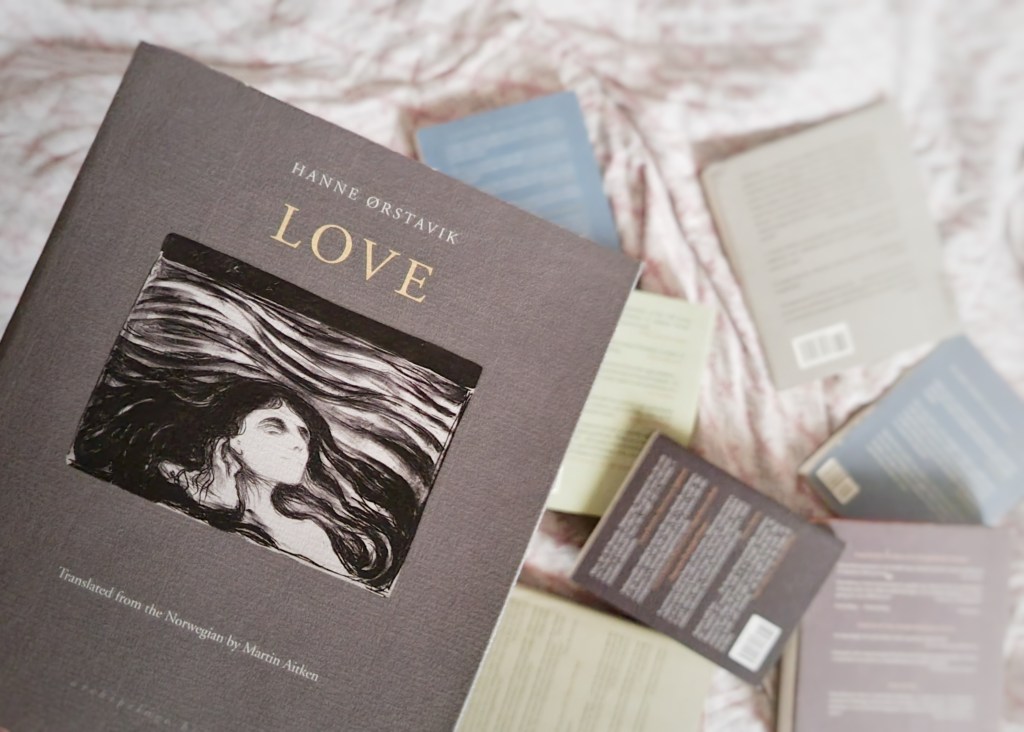
In what appears to be the most original writing style I have encountered in a while, Hanne Ørstavik seems to have invented a literary equivalent of the Shepard Tone, camouflaged in a narrative that demands complete attention.
A village in northern Norway. A mother and son. The frost and the night are tangible.
“When I met Pablo, I knew that here was something larger than life, something to match myself against…”
“People always ask very bizarre questions like, ‘Why did Picasso like you?’ or ‘Why did Jonas Salk like you?’ So I said, ‘Well, usually, lions do not mate with mice!’”
I took an instant liking to this fascinating woman upon hearing her utter this line with a laugh in a documentary that my best friend shared years ago. Right then and there, I was determined to read Life with Picasso one day.
And here it is. The engaging conversationalist comes out in Gilot’s writing. With a clear and strong voice and nary a narcissistic hint, she does not make the book about her, but brings about an unsurpassed portrait of the man that was Pablo Picasso with all the contrasts of light and darkness. She does not play the victim of an eccentric genius, although the book tells us of how she draws the line not only on canvas but also in life.
I doubt if there can be a more intimate and honest account of how Picasso created, his thought process, his private life, and his artistic and political beliefs. As a rippling consequence, Gilot also paints a profound portrait of an extraordinary era that had a surfeit of literary and artistic personages that shaped history.
Stimulating discussions on Modern Art and its dilemmas, on artistic movements, on technique, color, composition; this account is nothing short of enlightening! There is no shortage of lessons on art, on living, on relationships, and on woman.
Introductions to Françoise Gilot usually begin in 1943 when she met Pablo Picasso with whom she lived for ten years and with whom she had two children; and continues on the same thread that in 1970, she married Jonas Salk who was famous for developing the polio vaccine.
What I find remarkable about this woman is how, despite the monumental names to which her name was attached, she remained her own person as an artist, and as a woman — who, apparently, just refused to mate with mice!
I am sure she was, above all, referring to an intellectual symbiosis.
“In those days we associated style with substance, beauty with intelligence… we didn’t know yet that style could be purchased wholesale, that beauty could just be a commodity.”
Venice, through the pen of a mediocre writer, can easily become cliché.
But this is Joseph Brodsky.
If you, like me, have read Lawrence Durrell’s Prospero’s Cell and thought it was alone in its indefinable sub-genre or sur-genre (if there’s such a thing), we can rejoice! Venezia’s Watermark is the worthy soulmate of Corfu’s Prospero’s Cell.
Meditative with a sensual rhythm but not without intelligent humor, here is travel literature that casts an enchanting haze on the borders between poetry and prose, a place and the self.
I would slip this in my handbag in a heartbeat on a return trip to the best city to get lost in.
“History’s only true heroes, the only true leaders of mankind are those who help to establish freedom, who see freedom as the greatest strength of an individual, a nation or state, who fight for the equality, in all respects, of every individual, people and nation.” – Vasily Grossman, Stalingrad
Everything Flows. Stalingrad. Life and Fate.
These three, read in this particular order reminds me of realist painting lessons: One starts by sketching the foundation and the outline, followed by painting the background and setting the mood for the main subject, and then finally filling in the details and emphasizing the contrast of light and shadow by articulating the source of light.
Because of its fullness, it is hard to believe that Everything Flows is an unfinished work, but after having read the three in succession, I now see it as a concise foundation on the scope of Grossman’s knowledge and profundity. Stalingrad exists to set a monumental stage, Life and Fate consummates the masterpiece.
Everything Flowsis a forceful literary piece in which the main character occasionally disappears to give way to in-depth analyses of Russia, Lenin, Stalin, other political figures of that era, and sometimes, its literature.
For someone considered the Tolstoy of the 20th century, it is important to note that the difference between Grossman and Tolstoy is that Tolstoy wrote about a war that took place before he was born, while Grossman wrote about wars in which he was a war correspondent. The things immortalized through his fiction, he experienced and witnessed firsthand.
He wrote at a time when there was hardly any published information regarding the Gulag, Collectivisation, the siege of Stalingrad, the Holocaust, Treblinka, 20th century’s lesser-known acts of genocide — the Armenian, the Circassian, and Ukraine’s Holodomor or Terror Famine — and he wrote of these things. Most of all, he did not merely write, he did so with unbelievable insight and clarity.
And because of current world events, I think there is no better time to read him.
He was born in Ukraine.
Stalingrad, an expression of how the siege impacted the lives of Russians and one particular extended family is, to me, epic in every sense of the word. But what will stay with me is the hopeful tone that Grossman maintained amidst all the human suffering!
“No wartime blackout has darkened the stars.”
Despite the horrors of which he wrote, he never fails to stop to admire beauty: “At times like this we cease to have distinct perceptions of light, space, silence, rustlings, warmth, sweet smells, the swaying of long grass or leaves — all the millions of ingredients that make up the world’s beauty. What we perceive then is true beauty, and it tells us only one thing: that life is a blessing.”
I believe this is also where he leaves clues about the kind of art he sought to achieve. In a brief chapter hides this beautiful passage that book reviews of Stalingrad (at least, the ones I’ve read) fail to mention:
Art of this kind does not separate people from the world. Art like this connects people to life, to other people and to the world as a whole. It does not scrutinize life through strangely tinted spectacles.
As they read this kind of book, people feel that they are being infused with life, that the vastness and complexity of human existence is entering into their blood, into the way they think and breathe.
But this simplicity, this supreme simplicity of clear daylight, is born from the complexity of light of different wavelengths.
In this clear, calm and deep simplicity lies the truth of genuine art. Such art is like the water of a spring; if you look down, you can see the bottom of a deep pool. You can see green weeds and pebbles. Yet the pool is also a mirror; in it you can see the entire world where you live, labor and struggle. Art combines the transparency of glass and the power of a perfect astronomical mirror.
All this applies not only to art; it is equally true of science and politics.”
And if you ask me, Grossman has achieved this in these three works.
Life and Fateis where the excruciating details are.
How can one convey the feelings of a man pressing his wife’s hand for the last time? How can one describe that last, quick look at a beloved face?
And yet he does!
I overestimated my courage when I set out to read this. Some of the most heartrending passages in literature are found between these pages: A Jewish mother who is about to be seized writes a long farewell letter to her son, the last words being, “Live, live, live for ever… Mama”; a woman, mad with hunger, who had just eaten her two children; a suffocating chapter of a scene where Jews are being herded like cattle to their deaths; a childless woman who had a chance at freedom but chose to hold the hand of a boy on the way to a gas chamber, and as she draws her last breath, she reflects, “I’ve become a mother.”
It took me longer to finish reading this than expected because I had to put it away so many times just to catch my breath or to calm myself down before continuing, not to mention a fever that made it difficult for me to read the last two hundred pages. But then again, Life and Fate concludes the painting. And what work of realism would be complete without its darkness?
The thing about masterpieces is that you cannot merely read them. You experience them.
As I review my notes of the three books, I notice recurring themes: Warnings about the tendencies of totalitarianism and its evils, what it means to be human, what causes one to cease being human, freedom, and kindness as the greatest achievement of the soul.
Never mind the fascinating passages on quantum mechanics that reflect Grossman’s knowledge in this field, never mind that Life and Fate contains some of the most illuminating discussions on Russian literature, never mind the other things about Grossman and his works that easily come up in internet searches, Raymond Chandler sums it up beautifully in his introduction to Life and Fate, “It is an exhortation to live.”
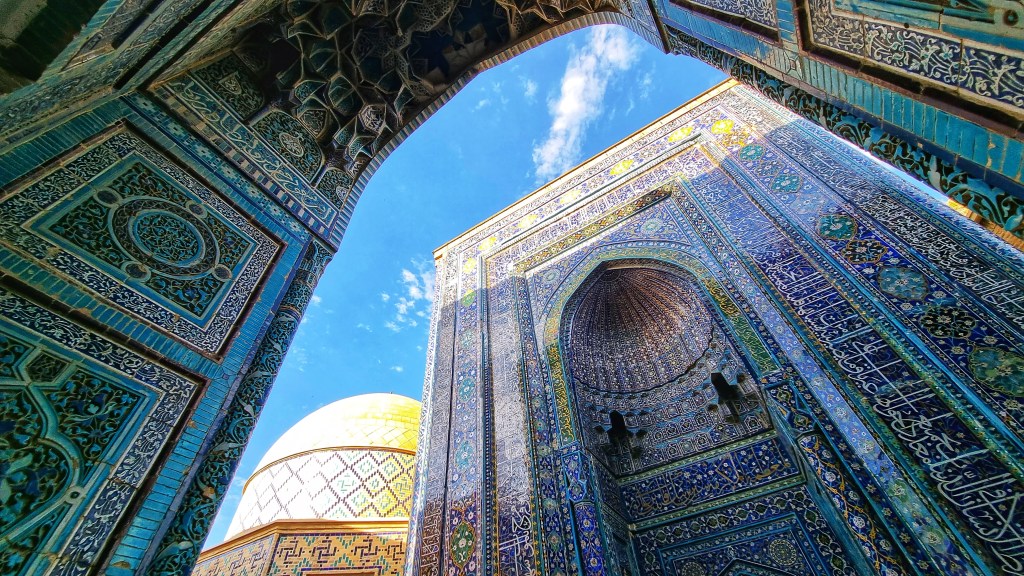
Afternoon light enters silently through the gaps of Shah-i-Zinda in Samarkand and transforms the whole necropolis into a prismatic vision that makes one understand why this place has earned illustrious names throughout the ages, and why it is most widely known as “The Mirror of the World”.
But as I sat there mesmerized, I became more inclined to believe that it mirrored constellations and galaxies… and that so much of what we find beautiful are mirrors of our joys, sorrows, and the distinct libraries of music and thoughts stored in our beings.
It probably was not the first time that a girl stood under its hypnotic gaze and made her contemplate on beauty and celestial realms; and I’d like to think that those reflective beings who came before me must have also gravitated towards its lesser-known epithet — “Garden of the Soul.”
My last few days in Uzbekistan were supposed to be spent in Termez, a place bordering Afghanistan where Alexander (considered not so great in these parts of the world) founded a town. But after learning about the tragic earthquake in Afghanistan, and for the peace of mind of those I love (not that I’ve given them so much of that), I decided to be practical (yes, I can be, sometimes) and come back to Tashkent to be closer to the airport. Termez will have to wait; and perhaps, it is a romantic idea to leave something to come back for.
It is risky to travel these days, and it is crazy how the fate of some dreams and travel plans hang in the balance between two words — Positive or Negative. And when I asked my niece who works in a bank to change some currency for me, she reported that the bank declined upon learning of my destination, “Kay duol sa na-ay gyera.” (It is close to areas of conflict.) She had to go out of her way to another money changer. If one looks at the map, the bank is not wrong.
But here I am. Because when something feels right, it feels right. I booked my ticket with so much faith, and the itinerary that has been ready since 2020 finally came in useful.
“But I thought you wanted to go to Iran?” friends asked. I am in what used to be part of Persia. “Stan” is a Persian suffix that means “place of”. This is the place of the Uzbeks that was once of Persia. When the Achaemenids expanded their empire, they sought not to Persianize whomsoever they conquered but allowed different peoples and cultures to thrive — as long as they paid tribute, of course. And since we know borders are all but manmade, I am in the region of which I have been reading and dreaming for a long time… and it is intoxicating, and beautiful, and enriching.
The books I have been reading did not end on their last pages. The best books never do. They only give the reader a deeper yearning to continue the journey and the learning beyond the pages. They give one an urgency to live.
In the alley right below, a child sings in a language both strange and familiar to me. Strange because she sings in the Khorezmcha dialect, familiar because it is music.
A few meters away from her, women in traditional dress eclipse the child’s voice as they bargain with her mother, a scarf seller. These women are tourists from the other “Stan” nations. They flock the streets by sundown. (Western tourists tend to forego Khiva because it is out of the way. To get here from Bukhara, one has to drive for hours through an expanse of steppeland that seems to stretch to infinity, and the usual tourist would usually opt for another stamp on the passport from another Stan than come to Khiva. I am now closer to Turkmenistan than I am to Bukhara.)
But I also see Khiva changing right before my eyes. I see workers installing LED lights, replacing some crumbling bricks, and fixing the cracks of the old city, making it look new. And although they have the tourist’s best interest in mind, I feel a pinch in my heart. I know Khiva will not look the same in a few months, or weeks… and there is a bittersweetness in realizing that I came just in time — or perhaps, a few centuries late.
In the distance, the tallest minaret in Central Asia calls my attention, calls to prayer, calls time to stand still, and all falls silent.
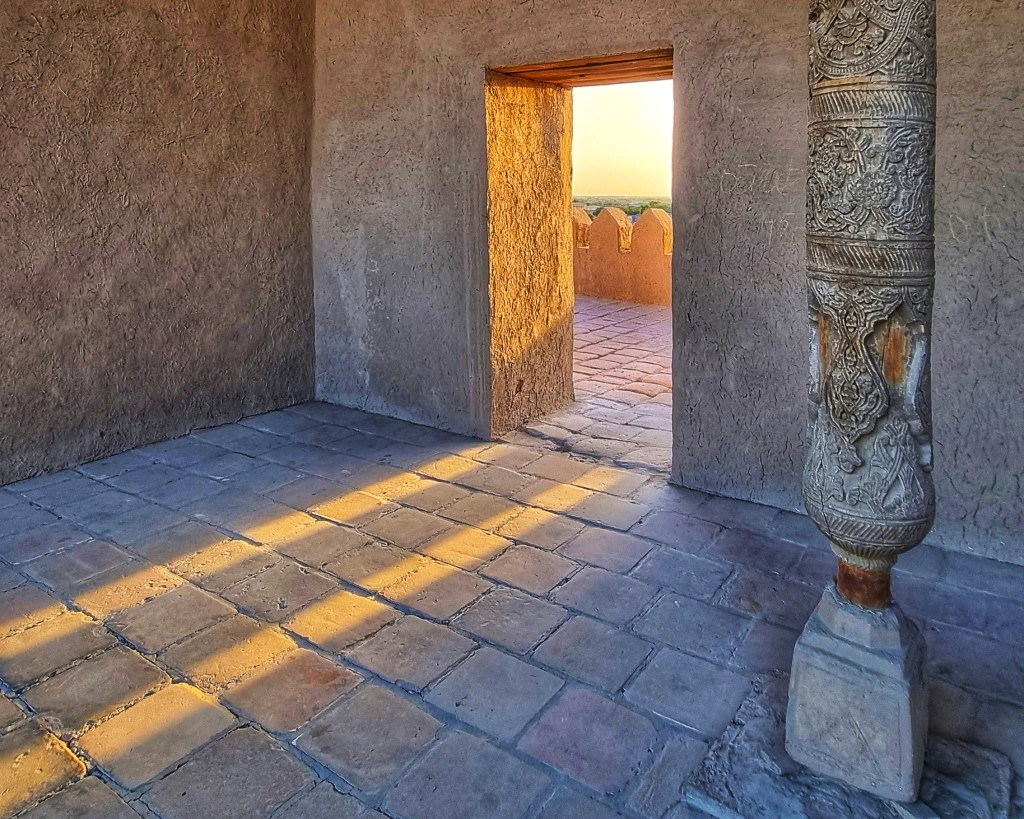
Does this balcony right outside my bedroom explain enough why I chose to stay in Khiva longer?
Resplendent, the summer solstice sunset gilds the citadel of Khiva.
Khiva, the former capital of Khwarazm.
Khwarazm, the region that gave us polymath Muhammad Ibn Musa al-Khwarizmi (780-850), who wrote the book Al-Jabr. From his name we have the word “algorithm,” and from Al-Jabr “algebra”.
The sun blazes differently here. And for knowledge, their wise men, too, seemed to burn so intensely.