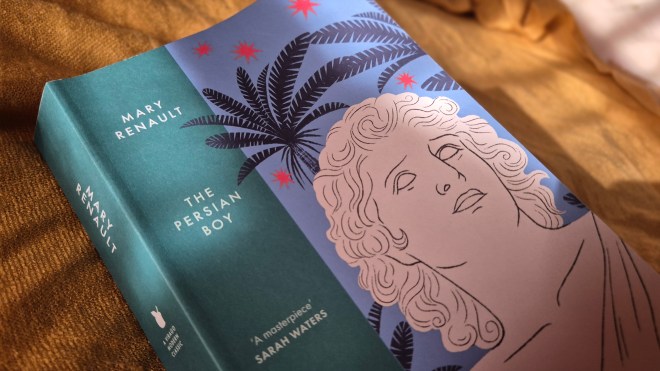
From approaching this as someone who has held the belief that Alexander was not so great, to weeping and mourning Alexander’s death by the end of the novel, speaks volumes of Mary Renault’s prowess.
One can tell that this reading choice was not borne out of admiration for a legendary military commander, who, despite his formidable feats, part of this reader still sees as a nepo-baby that merely inherited his father’s experienced army, who had the Greek historians on his side to deify him, and who seized a Persia that had already conquered the world.
Skipping the first and going straight to the second volume of Renault’s Alexander Trilogy seemed imperative because, once again, Persia is besieged by the West. And when the future is uncertain, we search for clues in the past.
The Persian Boy is narrated through the eyes of Bagoas, a real character who can be found in Persian history and in the writings of Plutarch. Plucked from his home and his childhood, he is sold and is made a eunuch against his will, and ends up as a courtier for Darius III, the king who lost the Achaemenid Empire. The empire was not the only thing that was surrendered to the Macedons after the Battle of Gaugamela. Bagoas, too.
Earning Alexander’s trust, Bagoas becomes his companion, a witness to the conquests and to the life that humanizes the godhead. We are introduced to an Alexander who is well-read, and who gently tells Bagoas, “It’s a great loss to you, not to read.” He was the student of Aristotle, after all.
Most interestingly, we learn of a king who sought out the writings of Herodotus and Xenophon to learn more about Cyrus the Great (“Kyros” in the novel), first of the Achamenids, who raised an empire with clemency and respect, a dominion that was by far the greatest the world had ever seen, and whom Alexander greatly admired and wished to emulate.
Of Cyrus, Alexander says, “He did not make subject peoples; he made a greater empire. He chose men for what each man was in himself, not from hearsay and old wives’ tales… Well, I don’t suppose he found it hard to persuade the conquered. To persuade the victors, that’s the thing.” To which Bagoas wondered, “He wants to follow Cyrus even in this.”
Returning to Persepolis after the Indian campaign, Bagoas muses, “I should have known these places, the royal heartland of my country. It was Alexander who knew them.”
Then came the lines uttered by Alexander that made my heart beat fast: “Macedon was my father’s country. This is mine… They told me so often I’m Persianised.”
It isn’t necessarily Bagoas to whom the title refers as The Persian Boy!
How ingenious, Mary Renault! What a brilliant writer! She does not so much bother with dates as open one’s perception of the classical world beyond textbook language and to a nuanced observation of the collision between a highly civilized East and an ambitious West. She does not so much bombard the reader with history as open one’s heart to the depth and texture of feeling, of longing, of belonging. Her musical prose is the novel’s epic cinematic soundtrack. Renault wins one over, heart and mind, the same way only the greatest conquerors knew that winning hearts and minds is the ultimate siegecraft.

