
“Is this the way to the Museum of Books?” The main entrance where a statue of Shota Rustaveli stood guard seemed to have been closed for an indefinitely long time, so I had to walk around the loggia and look for another door.
“Follow me,” the guard said without hesitation and led me through office backdoors and hallways lined with filing cabinets and some curious eyes peering through them when the rhythmic footfalls of my boots echoed through the corridors.
Just as I was feeling a little lost and self-conscious for being the only non-employee around, he turned around and said, “When you’re done, just exit the way you came in.” He left me, alone, staring open-mouthed at what was the entrance hall of Tbilisi’s Museum of Books.
Amber sunshine streamed through the windows, casting light on intricate adornments that I had never seen applied to buildings before. It was as if I was drawn inside a page of a medieval illuminated manuscript.


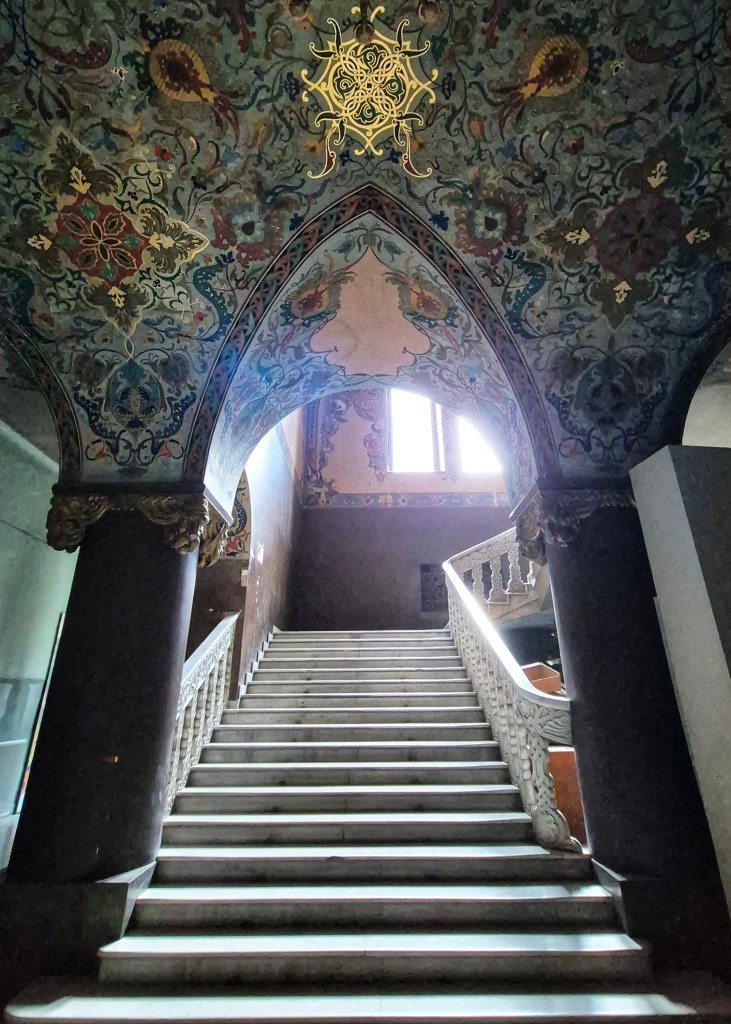

I soon learned that the building is a collaboration between the architect Anatoli Kargin and well-known painter Henry Hrinevski, who was also a book illustrator and manuscript illuminator as well as a scholar on traditional Georgian architecture, but who was sadly arrested and killed during Stalin’s Great Purge.
The building was completed in 1916 and erected as a bank, but became part of Georgia’s series of libraries, fittingly so, in 1931. It is Building I out of V monumental buildings housing the National Parliamentary Library of Georgia.
Recognized as one of the finest museums dedicated to the written word, it boasts of personal libraries of Georgia’s eminent authors, the first book printed in the Georgian language, and autographed works by famous writers including Victor Hugo.
I went there for the books but came out deeply impressed knowing that the building that holds such treasures is, itself, one for the books.







































 The Book-Butterfly