She knew there would be pain in these books. But don’t people in the warmest climes imbibe hot drinks to temper the body’s response to heat? By that logic, here she is; steeped in the rich wordscape and sorrowful history of the Balkans.
The first days of November find this reader still silenced by life. A point in which literature remains among the few things left that can coax words out of her.
Sarajevo Marlboro and Omer Pasha Latas fell into her possession around the same time. That both books come from two of her favorite publishers, that the earth tones of their elegant covers match her autumnal soul, that both authors are exemplary, that their stories juxtapose on the same geographical region, were reasons enough to read them together.
Jergović’s extraordinary vignettes is a dip into a sea of humanity and tragedy in the midst of the Yugoslav wars. Andrić, born a century before these wars, whose words seem to flow as naturally as a limpid stream in the Bosnian countryside, write of a different time under the Ottoman rule, but of eerily similar sufferings.
Sarajevo Marlboro, traces of life retrieved from the rubble, fragments that suggest that the real casualties of war are the living; Omer Pasha Latas, unfinished at the time of Andrić’s death. But none of these books leave this reader dissatisfied. It is strangely easy to be drawn into the hypnotic quality of the details.
Both books intimate our need for context and our need for stories if only to make sense of life and divine its purpose; they whisper about the lies of those in power and of fabricated histories; but both beautifully manifest the ephemerality of life.
Andrić’s last word: “Music”. Jergović’s last paragraph: “You can never list or recall the private libraries that have burned down in Sarajevo… But the fate of the Sarajevo University Library, its famous city hall, whose books took a whole night and day to go up in flames, will be remembered as the fire to end all fires, a last mythical celebration of ash and dust. It happened, after a whistle and an explosion… Gently stroke your books, dear stranger, and remember they are dust.”
Dust: Like everything else we deem precious in this world. So while she can, this reader will stroke her books. They don’t always hold the answers, but they hold her, and hold the dusty, broken pieces of herself together.
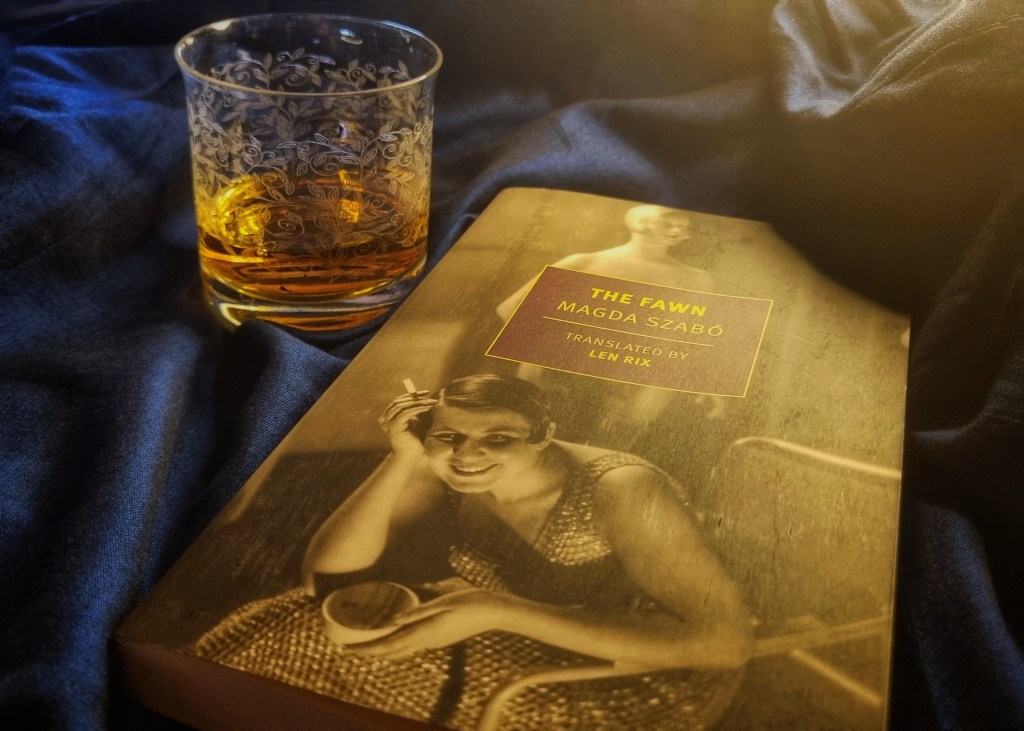
“I wanted to be with you sooner…” This first line, a faint melody, I imagine played by a solitary piano. This unwavering, melancholic undertone, suggesting that Eszter Encsy is addressing someone who is no longer in her life.
There is a calm, almost cold, but delicate aching to be accepted and understood. Recollections of childhood come across as confessions and explanations… including that time she did not mean to kill the fawn.
But how did that seemingly dispensable incident earn the title of the book? Perhaps the fawn is meant to symbolize the fragility of youth, and how easily it can be broken.
Magda Szabó, who died with a book in her hand, has bequeathed to the world novels that aim straight for the soul. She wrote of women; women who do not have to be faultless. She did not demand heroics from them or for them to be worthy of admiration or to be idealized. She only asked that they live — live intensely, and learn.
And yet, I did not expect her to go to the extent of Eszter. The moral puzzles are not vague here, it is made quite clear what kind of person we have as a central figure right from the beginning: “I could never have undertaken to be a good girl and never to tell lies…” “I lie so easily I could have made a career out of it…” “I was also laughing at the monster I really am…” “I wasn’t a very nice person and I wasn’t very friendly…”
We immediately get the picture. Appalled, we double-check the synopsis, even though Szabó readers know that her synopses hardly describe what one encounters between the pages. But we read on. Because Szabó is brilliant. Because we suspect that a gut punch or two awaits round the bend. Because oftentimes, nothing is what it initially seems. Because she writes of those difficult spaces between people that most of us are too inattentive, too timid, or too unimaginative to explore. Because we know that behind all her stories is a carefully woven leitmotif of a history she mourns. Because Szabó is always subtly reminding us of consequences, of how we cannot extricate our personal histories from that of our nation. Because she is eternally thought-provoking, and therefore, rewarding.
…and because those elegiac strains from that lonesome piano will linger long after you’ve turned the last page.
Katalin Street
October 13, 2022
Of the invasions of history into our lives; of moral intricacies, those shadowlands between right and wrong; of the love we give, we take, or do not receive — and a fatal overdose of any of the three; of faulty assumptions and miscalculations; of the tangled complexities of relationships between friends, family, and lovers, and even with ideologies and a nation; of the deaths we die before our real deaths; of things we realize too late; of the damage we wreak on those we love; and the irretrievable losses that time inflicts on us… Some books carry with them all that is unutterable and aim straight for your soul, not out of cruelty but out of an earnest art, and disclose that life will silence you… over and over again.
Abigail
September 22, 2022
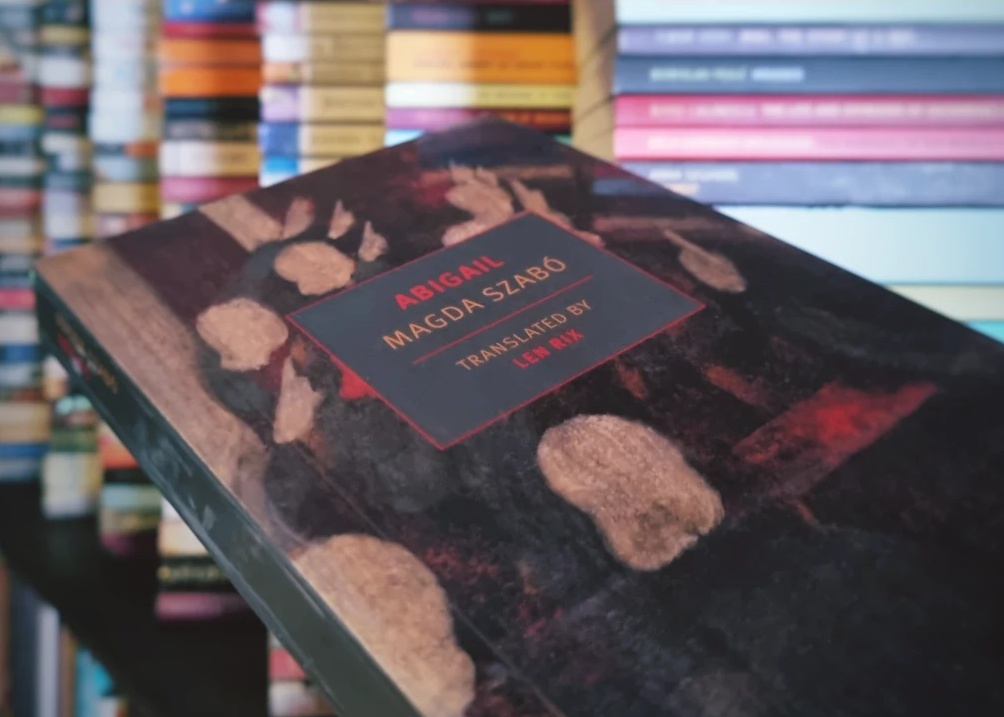
“In any work of literature the most interesting bits are in the detail,” Kőnig had often said in his lessons. “Be sure to attend to them closely.”
If I had a daughter, she’d find this book in a collection I created for her.
Reading this, she’d be reminded that heroines do not have to be faultless; that the surest assumptions can often be wrong; that no matter how clever we think we are, there are people wiser still; that actions always have consequences; that friendship is precious; that even in the most repetitive of routines and what we deem the bleakest of days, life will find ways to astound or surprise us.
If she philosophizes and reads deeper into the book, as I suspect a daughter of mine will, she will venture to question where childhood ends and adulthood begins, and attempt to come up with answers of her own, or a hundred questions more.
If she develops an awareness of history and politics, as she must, she will be sensitive to Magda Szabo’s subtle activism and glean the lessons of sacrifice and duty.
And I imagine this book — so engaging and difficult to put down — will only fuel the love for reading in her.
Can you tell that I read this through the eyes of a wide-eyed adolescent, and not through the eyes of an adult still haunted by the painful and confounding strains from Iza’s Ballad and The Door but who, nonetheless, acknowledges that Magda Szabó has now become a favorite?
Iza’s Ballad and The Door gnaws at the soul. Abigail educates the heart.
The Door
September 2, 2022
“But a door can hint at so much more.” — Geetanjali Shree, Tomb of Sand
Having come fresh from a streak of world literature for Women in Translation Month, which included Tomb of Sand, I have become more attuned to the implication of doors being more than architectural features. Doors as metaphors for boundaries.
But in contrast to Geetanjali Shree’s doors where, ideally, anyone came and went; Magda Szabó’s door was meant to remain shut. The physical door of the latter was not only a boundary but the framework of a person’s dignity.
Szabó’sIza’s Balladturned out to be the most exquisitely written work from my WiTMonth selection, so I wasted no time in taking a peek into this door.
Curiously, Iza’s Ballad and The Door both have characters hired as household help who do not work for the money. One is a minor character in Iza’s Ballad, but in The Door it is the baffling, the imposing, elderly Emerence, one of the two central figures in the story. Adding to the intrigue is the younger and other main character, a writer, the author’s namesake.
Two decades of love-hate relationship yield misunderstandings and reconciliations, but also critiques on each other’s lives, on art, and on their clashing beliefs. At some point, the writer eventually achieves “the prize” and receives a prestigious recognition for her work, but not without the question of what it cost.
There is a challenge in talking about this book without giving away what the author meticulously wrapped in layers, because reading Szabó is like a careful and deliberate peeling of an onion. The core is shrouded in well-executed veneers where even the revelations continue to maintain a mystery that lead toward a confounding finality.
But she is yet another testament to my hunch that 20th century writers remain unsurpassed. Even with a tinge of absurdism, there is that deep exploration into the dark of interior characterization, a delving in the psychological, spiritual, and philosophical condition of its characters, if only to pose the argument of what it is that really matters in life.
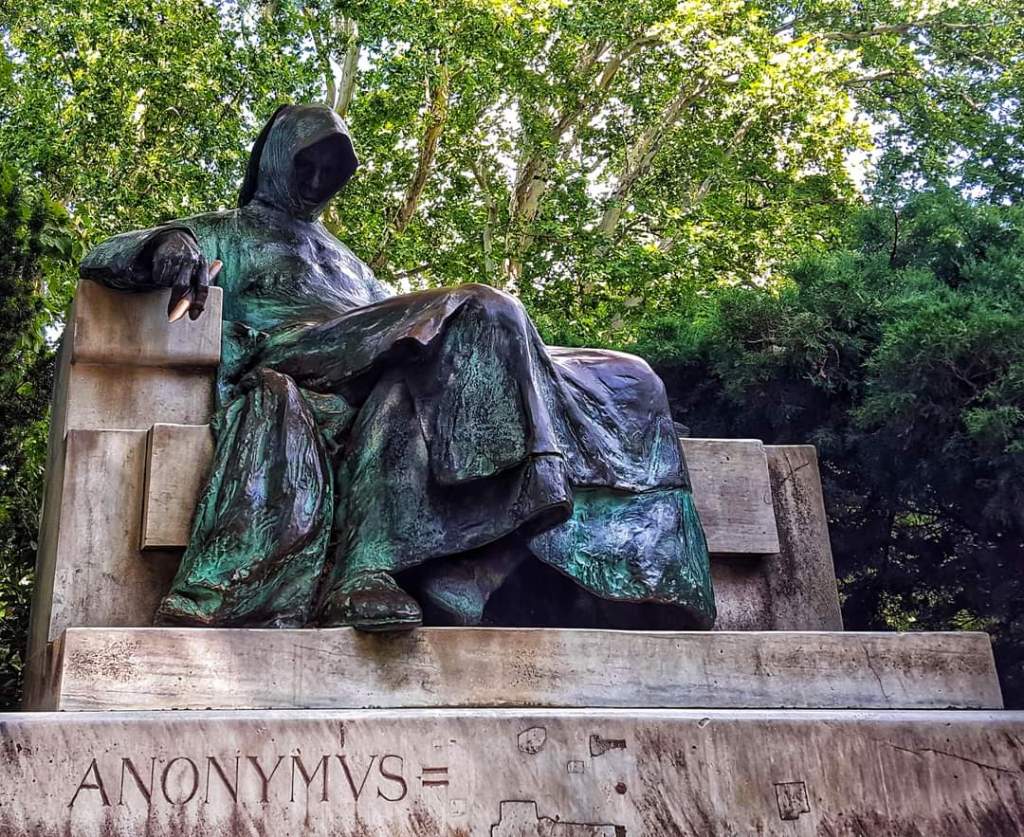
“As he spoke Lidia could see the schoolgirl Iza discussing the future with her father. She saw her as her father described her, as a pint-sized redeemer spreading out her school atlas and examining the map of Budapest because she wanted to see a major city, a really big city, and trying to work out where in City Park the statue of the historian Anonymous might stand. Iza loved the look of that hooded faceless figure. She saw it once when she was a young woman visiting Budapest…” – Magda Szabó, Iza’s Ballad
How pleased I was to have identified with Iza so much! There was even something close to a silent pride that I initially felt. It was as if I were reading my own mother’s description of myself – how Iza organized her life and her schedule, the tidiness, the discipline, the sense of responsibility, the restraint, her satisfaction in not having to give account of herself to anyone!
But how I trembled, as I turned the pages approaching the finale when I realized that it was because of this unrelenting self-discipline seeping into the cracks of her relationships that led to heartbreaking consequences.
It is for readers with aging parents. It is for every new generation that believes they are so much wiser than the previous one, so practical even in matters of the heart, and yet, unwittingly, so heartless.
It is for societies that reject the past and the old deeming these to be outdated and sentimental, failing to acknowledge that the past and the old hold the clues to the present and the new.
Although set in postwar Hungary, the spirit of this novel is contemporary: the timelessness of its message, its tragedies that are themselves the lessons, will gnaw at my soul for years to come.
Few books leave me feeling defeated. This one did. I felt so helpless under the influence of such simple but penetrating prose.
It is that dazed emotion one undergoes when someone so much wiser with experience sings in a pensive gasp, “I really don’t know life… at all…” Yes, someone like the inimitable Joni Mitchell, only Magda Szabó does it with an outstanding novel that she affectionately hands over to the reader saying, “You really don’t know life… at all…”
And in the presence of such masterful artistry and truth, what else can one do but applaud and weep?
Having sensed, perhaps, that I am loving the Hungarian bend of my Silk Route Reading Project, a bookseller inserted this surprise as a thoughtful gift along with my book-mail.
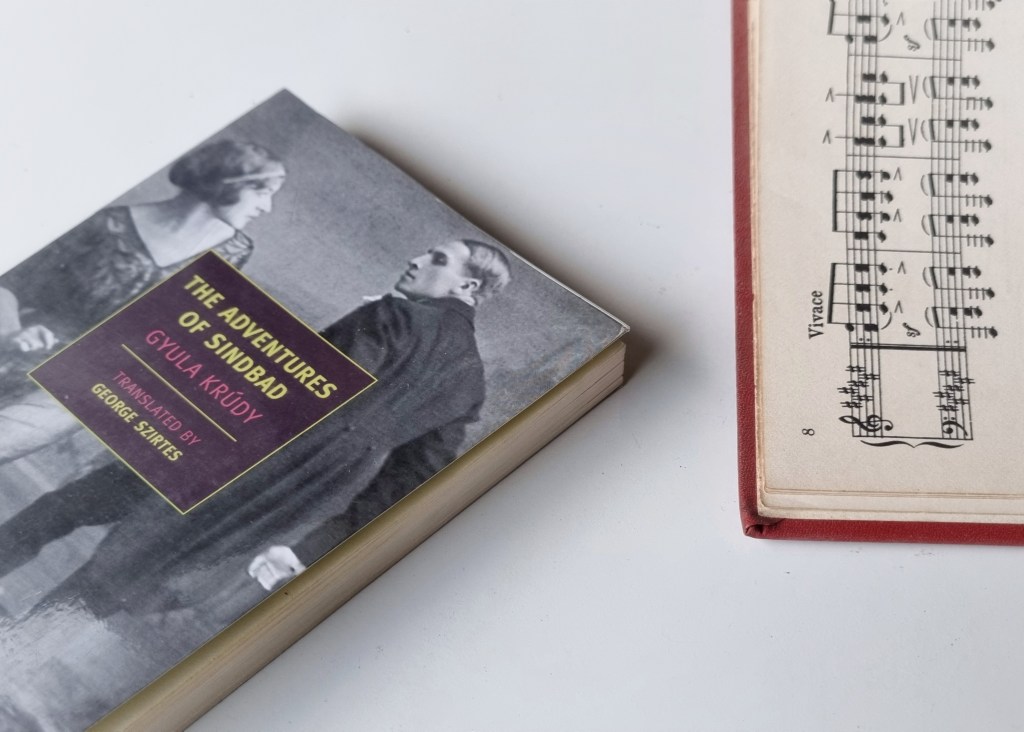
With a protagonist named after a character from The Thousand and One Nights, one can immediately sense the literary flavors that meet and fuse along these cultural routes.
Readers would be dissatisfied if they treated this like a novel, however. Although often related, the brief chapters should be read as a collection of stories, each one capable of standing on its own like any story from a Chekhov anthology.
These “adventures” are primarily amorous, and I would have easily dropped this book had I overlooked the sad irony masked behind the comic caprice.
Sindbad speaks beyond the grave, literally. More often than not, he is the ghost of a womanizer who committed suicide and returns to visit the women with whom he has had affairs, whether in his memories or through his phantasmic imaginings. Some of these women, victims of his philandering ways, some seductresses themselves.
“Bearing all this in mind it is understandable that the unhappy young man should have taken his own life. His desires were incapable of fulfillment. It was of no consolation to him that one hundred and seven women had reciprocated his love.”
But having died, Sindbad is described to have grown wise in death. On one occasion, he even laments how the dead see no change in the living.
Even so, it is too late to start again.
“Why can’t you find peace in the other world?” one woman asks Sindbad.
It would seem that peace and love are things you can strive for only in the world of the living.
Have you ever read a novel by a Hungarian author that is not a page-turner?
I haven’t!
“I need a drink. Because I have to tell you who Tamás Ulpius was, and how he died,” on the fourteenth page, is the same bomb of intrigue that Magda Szabó drops on page three of The Door when she writes, “Thus far I have lived my life with courage, and hope to die that way, bravely and without lies. But for that to be, I must speak out. I killed Emerence.”
Intrigue is the paprika that flavors Hungarian pages up until the very end.
I was drawn to this book not for what the blurb promised, but for its writer: Antal Szerb, who sadly perished in a camp during the Holocaust. But like Irène Némirovsky, also a Catholic Jew who nonetheless shared a similar fate despite their conversion to another faith, there is nothing politically blatant in their writings.
There is, however, a certain psychological depth in Szerb’s style that makes it extremely appealing to me. The characters themselves are not that likeable but they seem to represent the state of disorientation of the generation between the first and the second world wars.
“‘There’s nothing wrong with you,’ said the doctor, ‘just horrendous exhaustion. What were you doing, to get yourself so tired?’
‘Me?’ he asked, meditatively. ‘Nothing. Just living.’ And then he fell asleep again.”
Death plays a role in this novel, but so does Life. An existential crisis and unresolved issues of his youth haunt the main character and result in the fickleness of his decisions. He abandons his wife on what was supposed to be an idyllic honeymoon in Italy, and there begins what seems to be a muted exploration into the psychopathology of guilt.
In this edition’s introduction, we learn of Szerb’s fascination for Italy; “its art, its history, its people, its language, its ancient towns and their narrow back streets.” He had lived there as a young man from 1924 to 1929 and the country took hold of him. He returned in 1936, suspecting that it was for the last time. In a travel journal entry, he wrote, “I initially wanted to go to Spain… but it occurred to me that I simply must go to Italy, while Italy remains where it is, and while going there is still possible. Who knows for how much longer I, or any of us, will be able to go anywhere? The way events are moving, no one will be allowed to set foot outside his own country.”
Needless to say, his suspicions tragically proved true, but this final trip to Italy gave birth to this novel, which is a poignant love letter to Italy.
But through all of what Szerb says with clarity or through undertones, what I found most disquieting were descriptions of the generation’s moral insanity, how they viewed war with indifference — “bore the changing times on their backs with astonishing passivity, and lived quite unconnected with their own remarkable history.”
And unfortunately, Antal Szerb did not live to tell the tale, but we all know what happened next.
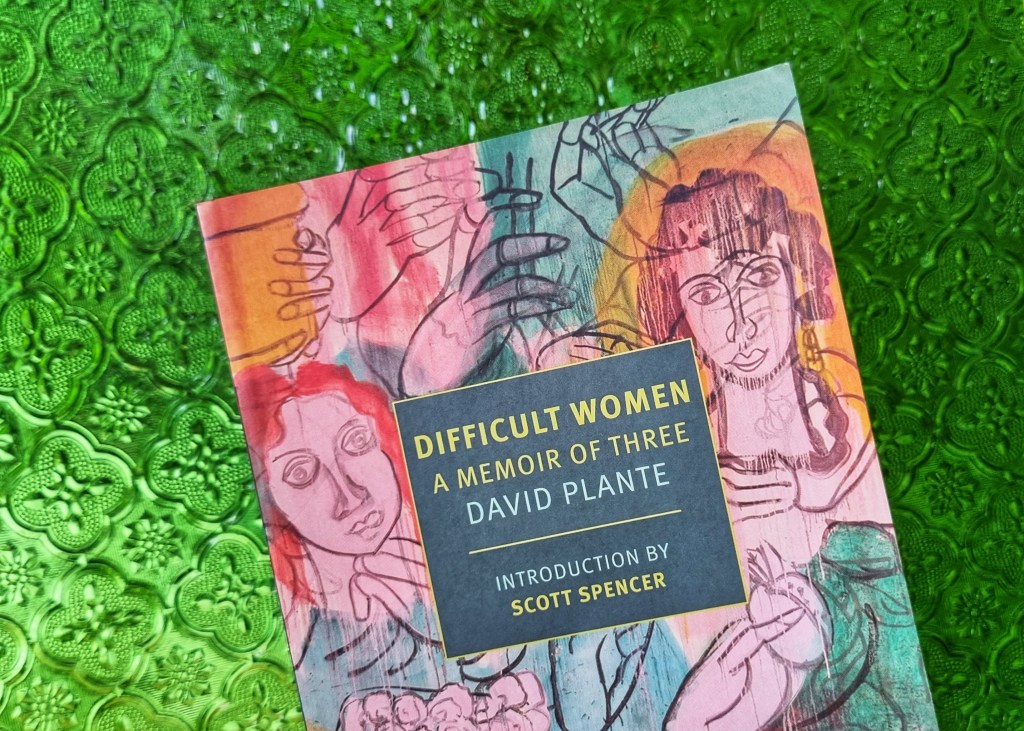
Difficult Women. Difficult reader. This book and I did not mix well.
I found no satisfaction or pleasure in reading this, although I did not feel arrogant enough to consider it a bad book deserving to be consigned to the DNF pile. There must be something to be learned here.
To be appreciated, these sketches of Jean Rhys, Sonia Orwell, and Germaine Greer through David Plante’s personal encounters with them in the 70s, should probably be read as a literary specimen: a study on the microscopic boundaries between honesty and invasion of privacy; a rare sample that lays bare the characters of these women at particular points in their lives; an excision of the writer’s intentions, for scrutiny; and the final diagnosis that literary figures are just as human and as difficult as the rest of us. And perhaps, that’s what makes this… well… difficult.
“In any work of literature the most interesting bits are in the detail,” Kőnig had often said in his lessons. “Be sure to attend to them closely.”
If I had a daughter, she’d find this book in a collection I created for her.
Reading this, she’d be reminded that heroines do not have to be faultless; that the surest assumptions can often be wrong; that no matter how clever we think we are, there are people wiser still; that actions always have consequences; that friendship is precious; that even in the most repetitive of routines and what we deem the bleakest of days, life will find ways to astound or surprise us.
If she philosophizes and reads deeper into the book, as I suspect a daughter of mine will, she will venture to question where childhood ends and adulthood begins, and attempt to come up with answers of her own, or a hundred questions more.
If she develops an awareness of history and politics, as she must, she will be sensitive to Magda Szabo’s subtle activism and glean the lessons of sacrifice and duty.
And I imagine this book — so engaging and difficult to put down — will only fuel the love for reading in her.
Can you tell that I read this through the eyes of a wide-eyed adolescent, and not through the eyes of an adult still haunted by the painful and confounding strains from Iza’s Ballad and The Door but who, nonetheless, acknowledges that Magda Szabó has now become a favorite?
Iza’s Ballad and The Door gnaws at the soul. Abigail educates the heart.
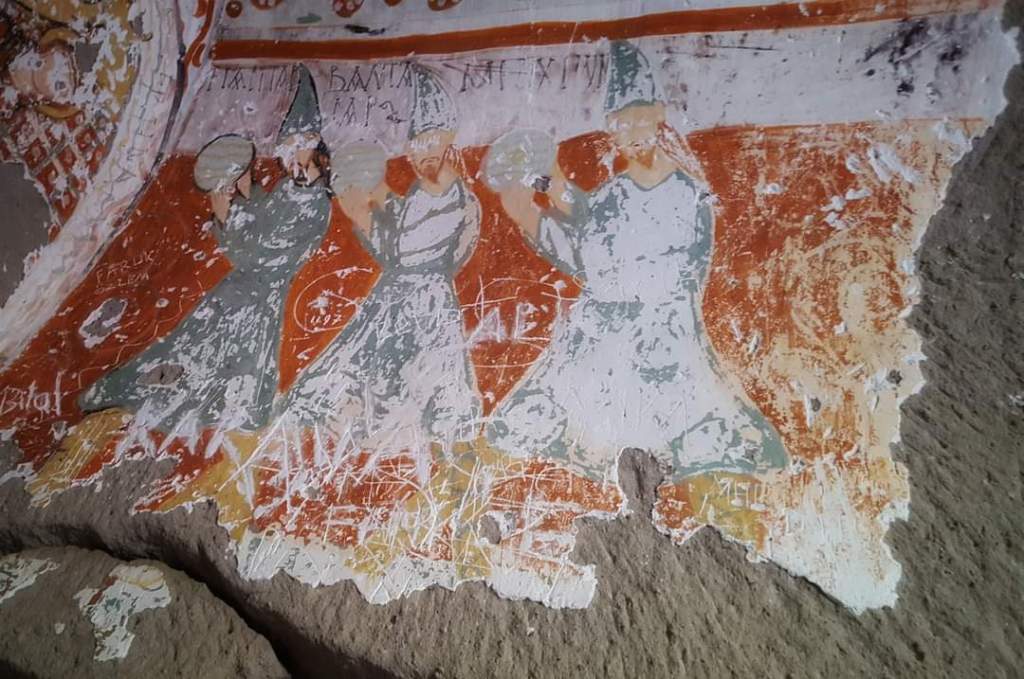
The book had me at its cover; a landscape distinctly Cappadocia, one of my favorite places in the world, however otherworldly.
It had me at the introduction by Karen Armstrong. Who else more suited to introduce such a book?
Patrick Leigh Fermor had me at, “The book was based — whole passages of it word for word — on letters I wrote at the time to a correspondent (whom I later married) without the remotest thought of publication.”
He had me the entire time because reading his prose felt like meditation.
A Time to Keep Silence is a lovely exemplification of that Thomas Merton line I encountered through Rebecca Solnit earlier this year: “The inner journey is the interpolation of the meanings and signs of the outer pilgrimage. One can have one without the other. It is best to have both.”
Known for traveling to Turkey on foot and for being one of the finest travel writers of the past century, this is a record of Fermor’s travels to a more inward direction. Through Europe’s monasteries with their divine libraries, chanting monks, cloistered lives, and vows of silence, and to Cappadocia’s abandoned rock monasteries, we are made recipients of their histories and these letters, too; but most of all, of the contemplation on modern man’s need for silence and solitude.
For someone who recently took three weeks off from social media to retreat from its noise and with only one foot back inside, this book expressed many of my unspoken thoughts, and I can only agree with a constant book friend who thinks that the only problem with this book is that it is too short.
Here’s to places, experiences, or books where “…the troubled waters of the mind grow still and clear, and much that is hidden away and all that clouds it floats to the surface and can be skimmed away; and after a time one reaches a state of peace that is unthought of in the ordinary world.”
“A concern for truth did not always accord with political expediency.”
There is much to mull over and absorb that I took my time with this book. Maxime Rodinson does not only paint a portrait of realism of a man, but also a stunning landscape of a world and age.
The portrayal is constructed based on meticulous research, and because it is not always compatible with prevailing ones, he treads on dangerous ground. In fact, censorship issues led the American University in Cairo to halt its publication in 1998.
“The picture is not a simple one. It is neither the static monster of some or the ‘best of all created things’ of others, neither the cold-blooded impostor nor the political theorist, nor the mystic wholly in love with God. If we have understood him rightly, Muhammad was a complex man, full of contradictions… But there was a power in him which, with the help of circumstances, was to make him one of the rare men who have turned the world upside down.”
“Let us, with undue naivety or too many illusions, acknowledge the greatness of the creators of the systems which have played so large a part in the world; and among them, Muhammad.”
This is a work of history. But history is a tricky issue, especially in the Philippines right now. Rodinson, however, poses this challenge in the introduction: “If one is to criticize in turn, in order to reject its conclusions, one must study and refute its findings according to the same critical standards with regard to sources.”
_ _ _
A confession: While reading this, there was a constant imagining of how it would have turned out had Olga Tokarczuk written it. It would surely have been just as carefully researched but peppered with literary mischief and, perhaps, slightly more entertaining.
Only slightly because Rodinson, a historian of Islam, does not write drably either. For Edward W. Said to claim that there can be no doubt about this book being “the major contemporary Occidental work on the Prophet and is essential reading” was recommendation enough for this reader.
This reader, a nonbeliever of Islam and an amateur on the subject but who has, through an ongoing reading project, realized that even a humble comprehension in the war of succession after Muhammad’s death between his father-in-law and son-in-law that created the Sunni and Shia chasm can allow one to grasp better the complex relationships or conflicts between Islamic nations and organizations. And so, with this realization, the acknowledgement of how taking a small step can open doors to understanding.
I hadn’t built anything, I’d demolished myself. Here, look!
In that sublime realm where literature and architecture meet, Hugo’s Notre Dame and Calvino’s Invisible Cities occupy the high throne. I nominate Pekić’s Houses to sit with them.
One would expect this book to be political, Borislav Pekić being a founding member of the Democratic Party in Serbia. And indeed, it is.
Belgrade’s turbulent history of clashing ideologies is not an undertone in this novel but a counterpoint to an unusual but brilliant motif that is architecture — which is, of course, political.
What took me by surprise, despite the obvious title and the summary about an eccentric character who loves houses more than the average person does, was the non-perfunctory view on the subject. The discourse ranges from houses being compared to human souls, to the ideal harmony of a building with urban space and its character, to how preservation is of great importance to a place, to criticisms on the sacrificing of aesthetic quality for the sake of profit, to describing a particular house as like an erratum, a coarse printing error in the elegant context of the street, and even to the communion with buildings as if they were alive, which in fact they were!
Of course I can’t say that those books about architecture made me fall in love with houses. They only explained to me why I love them. From them I was schooled in houses’ physiology, their circulatory system, their epidermic defensive envelope, even their stomachs, their sensitive stomachs, not to mention their life process… From books, then, I had come to know the mysterious process of a house’s conception, initiated long before its violent birth on the building site.
Arsenie Negovan is an imperfect but intriguing man who will irritate you or gain your sympathy. He makes a name for himself as a builder and a lover of houses, but after an existential maelstrom, he withdraws himself from the world and allows himself to be oblivious to the unrelenting flow of time for twenty seven years.
When at last he decides to come out of his self-alienation, he is an old man in the process of writing his will, and he soon begins to suspect a great divide between the world in his mind and the world in reality.
Houses is one of the most intelligent novels I have ever read. With the absence of chapter breaks, I found myself being pulled steadily towards its exceptionally executed finale. Its abstract metaphors grant liberal spaces for contemplation as they convey nagging questions on possession, and on building and ruin, whether concerning a city, society, a house, or a life.
While most of its readers describe the progression of the story as a descent into madness, I choose to see it as an awakening.
So, my friend, time is passing. We’re all in the power of time. So hurry and come here. Come and see the city of Delhi, and the realm of beauty, for both are waiting for you. Come and join them, before silver fills the part in her hair, and your head becomes a drift of snow, and our lives are merely a story.
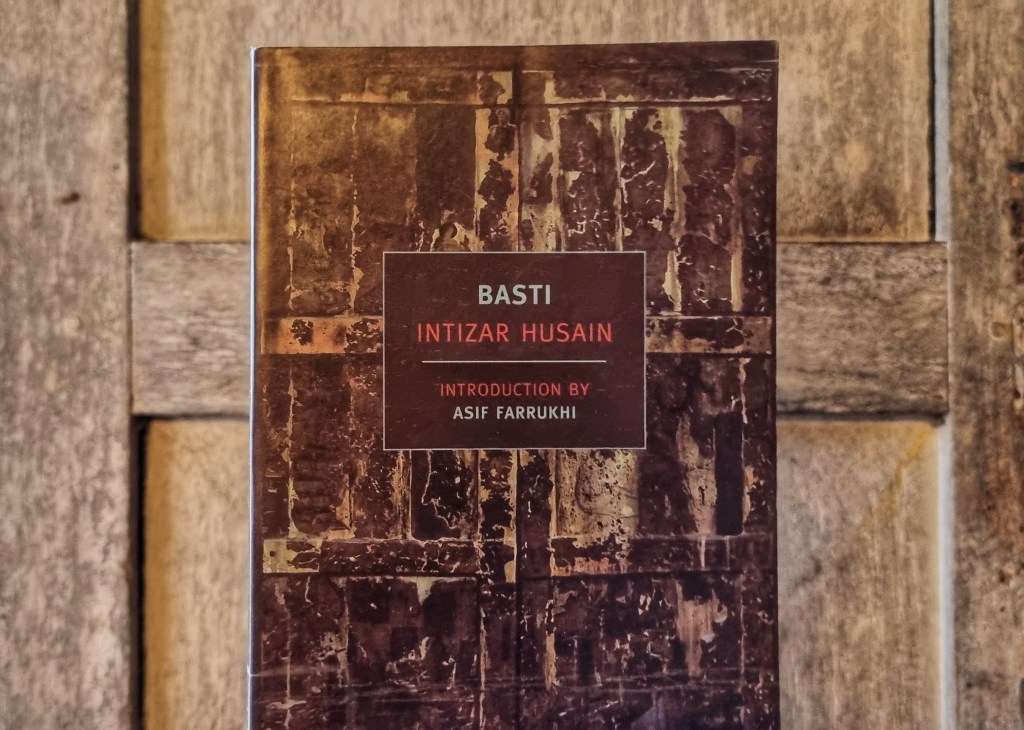
Basti is a lovely Urdu word that hints at space and community, a human settlement of any dimension, from a few houses to a city.
The word alone is enough to pique my interest. But because some books lead you to other books, that is exactly what Geetanjali Shree’s Tomb of Sanddid for me. I stopped counting at six — the number of times Intizar Husain’s name was raised in the novel.
Now I see why. Basti can be looked upon as a literary father of Tomb of Sand in the family of borderland literature. Both also defy the borders of literature.
Basti maps the life of Zakir who experienced the divisions that created Pakistan that created Bangladesh that separated him from the love of his life.
I have to admit that it took nearly half of the book before I was able to get into its rhythm and flow, but I allowed its poetic beauty to lead this reader from outside the Indian subcontinent to be drawn into its history and heritage; and sadly, into the tragic quotient of its divisions.









 The Book-Butterfly