There has been a significant increase of Maghrebi literature in my reading repertoire, and the recent discovery of Malika Moustadraf is yet another strong force that pulls my literary compass in that direction.
She is Morocco’s answer to Egypt’s Nawal el Saadawi whose depictions of how women are viewed and treated are unflinching. But Malika has a distinct style that draws the reader right into a scene, into the midst and into the cracks of such a society, sometimes forcing us to look through the eyes of the scoundrels themselves. I daresay she is the more masterful fiction writer.
But fiction, as we know, is just a tool to reveal the rawest of truths, and Malika has succeeded in this. The tragedy is that she will no longer be writing. The few works that she leaves in her wake are glimpses of the undeniable literary powerhouse she would have become had she not passed away from a chronic illness at the age of thirty-seven in 2006.
One thing I’ve noticed in Maghrebi authors is the sensitivity and the softness of the men and the forcefulness of the women. Their literature can teach us many things, but among these is the truth that softness can be extremely masculine, and forcefulness immensely feminine.
This book was, indeed, a fitting way to start this reading month. Wishing you a rewarding Women’s Month!
Literature continues to witness the exciting rise of old stories and histories told in new perspectives. We now have Greek mythology narrated through the vantage point of the misunderstood or footnoted women, we have world history that challenges purely Eurocentric lenses, the Crusades recounted through the Arab viewpoint, and various retellings of otherwise prevailing narratives that have been unquestioned for years.
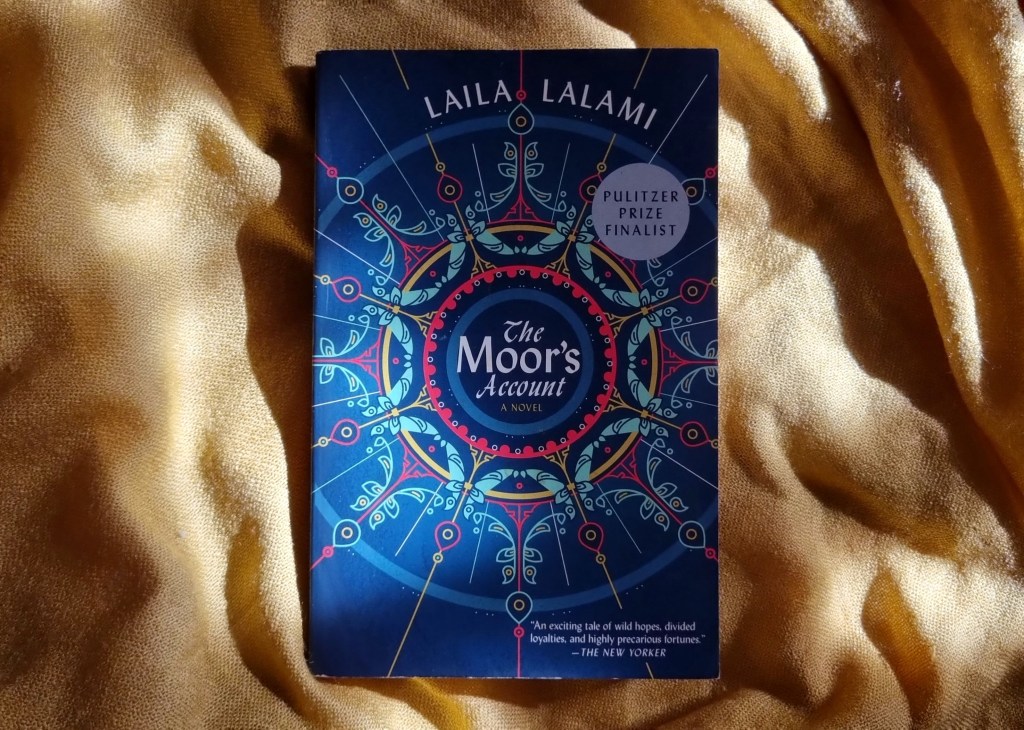
The Moor’s Account falls in the category of books that offer readers a new point of view. It is an imagined memoir of the first black explorer to the Americas. Although history will not remember him as such, as he was the Moroccan slave of Andrés Dorantes de Carranza. Together they would be half of only four survivors of the unfortunate Narváez Expedition, a Spanish expedition that set sail in 1527 with the aim of establishing settlements in La Florida.
The Moor in question is Mustafa al-Zamori, baptized Estebanico when he became a slave. This event at the beginning already hints at how, through an imposed name change, an entire history is erased: “A name is precious; it carries inside it a language, a history, a set of traditions, a particular way of looking at the world.” It was the first of many erasures, Estebanico would later learn.
My first attempt at reading this book was unsuccessful, but the recent announcement of Pulitzer nominees reminded me of this 2015 finalist that has remained sitting on my shelf for a while. Now that I have finally reached its last page, I have realized that the value of this novel lies in its reflections on identity, in its acknowledgment of the precarious power of stories, and in its critique on how history is written — how “unfounded gossip can turn into sanctioned history if it falls in the hands of the right storyteller.”
“How strange, I remember thinking, how utterly strange were the ways of the Castilians — just by saying that something was so, they believed that it was. I know now that these conquerors, like many others before them, and no doubt like others after, gave speeches not to voice the truth, but to create it.”
After dodging an ambush led by Indians, I found in Ruiz, a member of the expedition, an arrogant colonizer who felt victimized when natives tried to protect what was theirs — an embodiment of entitled powers that still plague the present: “‘Do you think we did something to them?’ Ruiz said. ‘No one did anything. That is just how the heathens are. Look what they did to me. He pointed to the dark socket where his left eye had been, oblivious to the role he had played in his own predicament.’”
This book does not contain literary acrobatics. The style is quite simple. But it lends the reader old truths and a new set of eyes.
“If women haven’t fully understood the state of inferiority in which they are kept, they will do nothing but perpetuate it.” — Leïla Slimani, Sex and Lies
“I freed a thousand slaves. I could have freed a thousand more if only they knew they were slaves.” — Harriet Tubman
It was the hottest month of 2019 in Morocco, and I was at a station in Chefchaouen waiting for my bus to Fez. Even with my nose buried in a book, I had an odd feeling that someone was watching me.
Sure enough, when I looked up, two large eyes framed by a hijab glinted and stabbed me like the blades of a koummya. I could see she was seething. I had to glance around and check if the anger was meant for someone else, but her sustained glare guaranteed that they were directed at me.
She said something to the man beside her who turned his back towards me while she continued to glower. Admittedly, my first instinct was to glower in return.
Then I remembered where I was; a foreign country whose laws are not known to be very kind to women. Confused, I immediately lowered my head to avoid trouble.
And there it was. The offending sight. The bag’s leather strap strung across my body had unbuttoned my dress shirt and revealed an undershirt and a little bit of chest!
I who had been so careful about dress codes in my travels, I who wore a buttoned-up long-sleeved shirt over an undershirt over a bra despite the temperatures rising up to 46°C during the day, accidentally exposed a little bit too much of my body in one of the worst places to have a wardrobe malfunction.
I felt so embarrassed, horrified, and even guilty.
As soon as the bus arrived, I hurriedly boarded to avoid bumping into the couple. I saw them saying goodbye to each other. A worried look now replaced the anger on her face as her expressive eyes followed the man inside the bus.
Imagine the horror on her face when she saw through the window that the man’s seat number was the empty one right beside mine — her man would be sitting beside this immoral woman for 4 to 5 hours!
I hid behind my scarf for the rest of the trip while next to me, he showered himself with crumbs from the pastries that he ate.
– – –
I had an incredible trip to Morocco, but despite being amply covered, I have never been catcalled more in any of my travels; I was followed by a stranger through the alleys of Fez; and two random acquaintances in Marrakech said they wanted to marry me. But somehow it was that incident with the woman that made me shudder. It accented how difficult it must be to be a woman in such a place.
This memory came back to me while reading Leïla Slimani’s book. Coincidentally, it was exactly on this day when I left for my Moroccan adventure three years ago.
– – –
Feminist voices from Islamic nations have been part of my reading life for quite some time already, and I don’t wish to write another cliché by saying that reading this made me grateful for the liberties I take for granted — even though it still rings true.
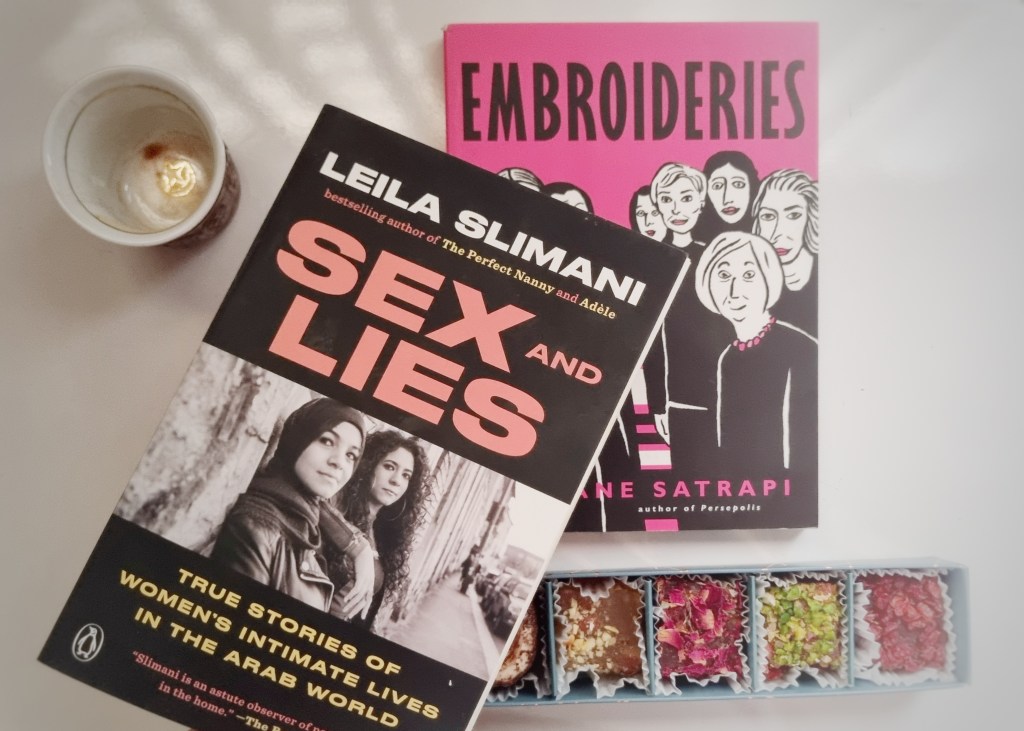
Sex and Lies is a broader and more serious version of Marjane Satrapi’s hilarious graphic novel, Embroideries. They both bring to light the double standards of men and their laws, and the many predicaments of what it means to be a woman in such a setting.
Let us take note that this setting is such where love and affection are as taboo as sex; where women are not allowed to feel desire; where religious pressure and social humiliation lead to nearly six hundred abortions carried out in secret every day and hundreds of women die as a result of the appalling medical conditions in Morocco; and while men can sleep around all they want, they require “virginity certificates” from their brides; hymen restoration clinics exist (which is not far from the kind of “embroideries” Satrapi hints at); and it was only in 2014 that article 475 of their penal code was amended, two years after a sixteen-year-old took her life after being forced to marry her rapist. The rapist who married his victim could avoid punishment under article 475.
Each important female writer has their own approach to broaching the subject of women in repressive cultures. Iranian Marjane Satrapi does it with humor while Moroccan Leïla Slimani curiously makes a case for a healthy relationship with traditional, religious, and cultural backgrounds. I am not Muslim but I think it is significant how she did not make this into an assault on Islam. (Although she does mention the soullessness of certain sects.)
“I try to explain that a society in which women had more freedom would not necessarily be contrary to the faith but rather could allow us to protect women better.”
“For the Muslim religion can be understood as primarily an ethics of liberation, of openness to the other, as a personal ethics and not only a Manichaean moral code.”
“Muslims can turn to a long written tradition, led by scholars, that saw no incompatibility between the needs of the body and the demands of the faith.”
While Sex and Lies unveils real and enraging accounts of the unnatural demands their society imposes on their women, it remains hopeful for a Morocco in transition. Another thing that stood out for me was how many of the women who shared their stories recounted that it was reading books that opened their eyes. Leading by example, Slimani highlights the necessity for women to use their most powerful weapons at hand:
“If… Scheherazade appears a magnificent character, this isn’t because she embodies the sensual and seductive oriental woman. On the contrary: it is because she reclaims her right to tell her own tale that she becomes not merely the object but the subject of the story. Women must rediscover ways of imposing their presence in a culture that remains hostage to religious and patriarchal authority. By speaking up, by telling their stories, women employ one of their most potent weapons against widespread hate and hypocrisy: words.”

 The Book-Butterfly