February Reading Wrap-Up


A Month in Siena, Hisham Matar

“Only love and art can do this: only inside a book or in front of a painting can one truly be let into another’s perspective. It has always struck me as a paradox how in the solitary arts there is something intimately communal.”


An understated book that is a meditation and an education in art and life.

“I hope that when there is laughter, it’s laughter made wise by having known real grief — and when there is grief, it is made wise by having known real joy,” Kaveh Akbar writes in Martyr! Whether writing about art, architecture, Libya, or politics, Hisham Matar’s books are often so heartfelt — wholly made wise by having known sorrow and loss.


Fires, Marguerite Yourcenar

…because maybe, subconsciously, this month’s reading theme is about finding solace in the works of authors whose masterpieces have already left an impression on me, that I immediately dove into Yourcenar’s Fires without hesitation, having been incredibly moved by Memoirs of Hadrian in 2022.

She does admit, and warn, in the Preface that this book is, “the product of a love crisis” and that writing this was, in a way, “exorcising a very concrete love”; and yet it still surprised me that the elegance I encountered in Hadrian was replaced in Fires by a certain violence and ferociousness in the prose. 

Antigone, Sappho, Clymenestra, and Achilles are just some of the main characters of the nine lyrical prose pieces, or stories, that Yourcenar amalgamates with her own experiences. I was left wondering if I understood the allusions correctly, or whether I understood anything at all.

One thing is certain, Fires is a masterclass on opening lines:

Phaedra’s piece begins with, “I hope this book will never be read.”

The Patroclus opening, “A heart is perhaps something unsavory. It’s on the order of anatomy tables and butcher’s stalls. I prefer your body.”

Lena’s? “Loving eyes closed is to love blindly. Loving eyes open is perhaps to love madly.”

“Love is a penalty. We are punished for not having been able to stay alone.” Clymenestra’s.


Face Shield Nation, Gideon Lasco

Articles that I looked forward to during the pandemic compiled in a book. Lasco was the voice of calm and reason at a time of confusion; evoking through his column the architectural definition of a column as a sturdy pillar of support. An essential time capsule of an era that we cannot afford to forget if we intend to learn from it. Read full entry here.


One Hundred Years of Solitude, Gabriel Garcia Marquez (a re-reading)

Growing up is realizing that Gabo is the real Melquiades who brought us magnets, magnifying lenses, astronomical observations, and mercurial storytelling. It was he who made imagination and literary possibilities flourish in the fertile and pristine Macondos of our minds, and who never really died. Read full entry here.


Nothing but the Night, John Williams
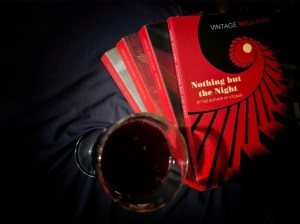
Maybe the first disappointment that assails the reader is the realization that, despite the slenderness of this volume, there is a heaviness in each page that restrains forward motion.

“Boring,” the lazy might judge hastily somewhere within the first three chapters. But one should not be too quick to criticize even though I myself could only read a couple of pages per sitting. For if one looks closer, and feels deeper, isn’t this genius, how John Williams conveys exactly what depression feels like?

“…there came to him that peculiar loneliness which is felt only in the monstrous impersonality of a multitude…” “What was the senseless circumstance which led him on and on, deeper and deeper into what seemed to him a maze labyrinth, devoid of pattern or meaning? …some unnameable power pushed him from one place to another, down paths he had no wish to travel, through doors he did not know and had no wish to know. All was dark and nameless and he walked in darkness.”

But then the reader is momentarily allowed to come up for air. I’m referring to the fourth chapter that is briefly set alight with a Proustian beauty! “That is the very best time of life, he thought: lost time.” And then John Williams proceeds to craft this fleeting tribute to the master searcher of lost time before he relinquishes the ethereal chapter to the fading light.

As the novel finally builds suspense, it spirals into a nihilistic darkness that ends with a violent and repulsive slap in the face.

Written in Burma when he was only twenty-two while recovering from injuries brought about by a plane crash over the Himalayas during WWII, he wrote this first novel at a particularly dark time when there was nothing else but the night.

The John Williams here is not the John Williams that gave us Stoner and Augustus. The John Williams here is the John Williams that would eventually give us Stoner and Augustus.


The Black Book, Orhan Pamuk

This reader has been through Pamuk’s longest novels and still felt the density of the mystery and prose in this book’s mere four hundred pages.

It explores the writing process and the precariousness of identity. It is also about how much the books we read, the stories we hear, the movies we watch, the everyday objects in our lives, and our city’s history shape the multiplicities of our being.

I enjoyed that twist at the end and relished the familiarity of Istanbul as a breathing character in a Pamuk novel. But maybe, just maybe, The Black Book is not for the Pamuk newbie, and not for those who are in a hurry. 


The Golden Road, Willliam Dalrymple

It is not only the Silk Roads that are rising again, as Peter Frankopan proclaims in a forceful last line that gave me goosebumps. Rising, too, are buried or forgotten histories that have now resurfaced to challenge centuries of unquestioned narratives.

Frankopan’s The Silk Roads was an eye-opener, but The Golden Road takes this non-Eurocentric view of ancient and early medieval history to an intriguing direction by revealing India as a catalyst that transformed the world. Read full review here.

Hisham Matar: A Month in Siena

A Month in Siena, Hisham Matar

“Only love and art can do this: only inside a book or in front of a painting can one truly be let into another’s perspective. It has always struck me as a paradox how in the solitary arts there is something intimately communal.”


Yesterday was heavy. Not only for me but for a lot of people I care for, and for different reasons. It somehow made me yearn for Hisham Matar’s prose, because I don’t think I have read any other writer who speaks straight to my heart about life with such authenticity and accuracy and with such emotional and artistic intelligence. (I read three of his books in 2024, and one of them, My Friends, was the best book I read last year. Until now I cannot find the words to do it justice.)

So, I tried to see if there was an older book of his that escaped my attention. A Month in Siena was the answer. I finished reading it last night and had taken five pages worth of notes by midnight. I’m glad today is a Sunday so that I can reread my notes and fully process the beauty of this understated book that is a meditation and an education in art and life.

“I hope that when there is laughter, it’s laughter made wise by having known real grief — and when there is grief, it is made wise by having known real joy,” Kaveh Akbar writes in Martyr! Whether he is writing about art, architecture, his homeland, or politics, Hisham Matar’s books are often so heartfelt — wholly made wise by having known such things.


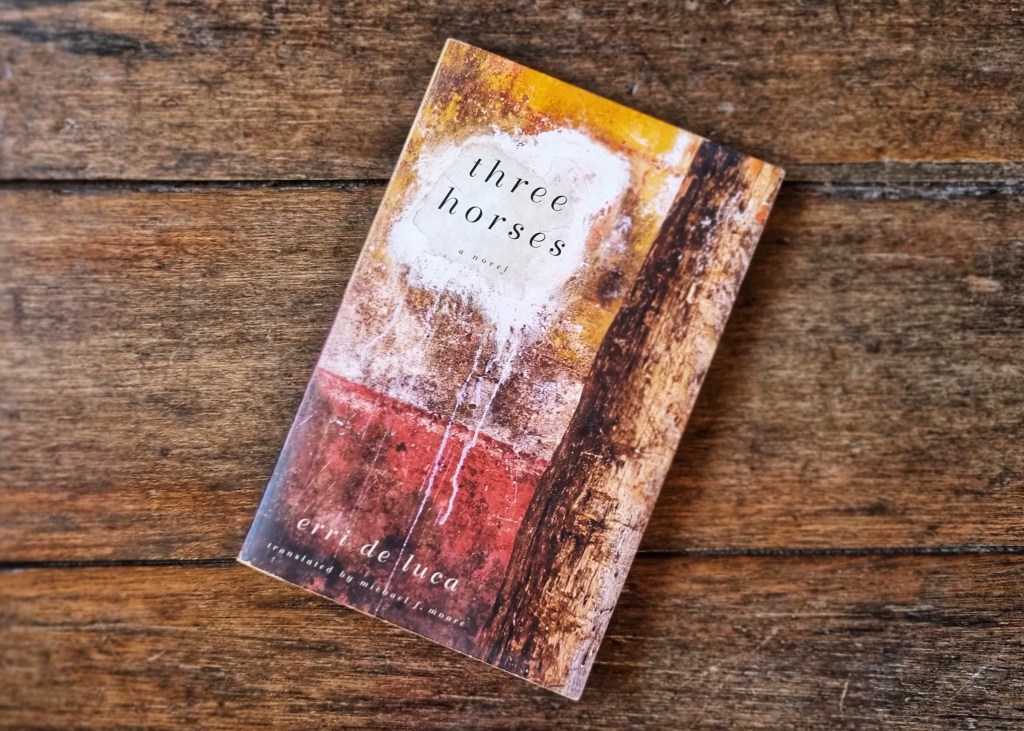
On books and reading from Erri de Luca’s Three Horses

“This is what books should do: Carry a person and not be carried by him…”


“…Because every book can belong to many lives. Books should be kept in public places and step out with passersby who’ll hold onto them for a spell. Books should die like people, consumed by aches and pains, infected, drowning off a bridge together with the suicides, poked into a potbellied stove, torn apart by children to make paper boats. They should die of anything, in other words, except boredom, as private property condemned to a life sentence on the shelf.”


“I put the book in my jacket’s inside pocket… Where the gun used to be, now there is its opposite.”

Paolo Maurensig: Game of the Gods

Without meaning to, I read Paolo Maurensig’s three chess novels in chronological order of publishing dates. The Lüneburg Variation, Theory of Shadows, and Game of the Gods. The sequence in which I read these books were, admittedly, influenced by Goodreads ratings. Maurensig is quite obscure in my part of the world, so I had to consult Goodreads despite my distrust of its stars. Game of the Gods has the lowest rating among the three.

But I enjoyed it! It’s not exactly a literary masterpiece, but I found it to be an easy and entertaining read that has its gems. I think the low ratings come from readers who have particular expectations. Those who read this for chess will soon realize that it’s not wholly about chess. Those who read this for its biographical aspect might be disappointed because the story is mostly imagined from the little that the media knows about Indian chess grandmaster, Malik Mir Sultan Khan, who enthralled the chess world in the 1930s by defeating world champions but soon faded into the night sky like a shooting star.

The passages that describe the incorporation of Indian philosophy and thought in Sultan Khan’s games was what I appreciated the most. The book also introduces the reader to chaturanga, the precursor of chess, that had a more sacred aspect to the game, and wherein its player had to transform himself in order to succeed.

And from what this reader can conclude from the third of Paolo Maurensig’s chess novels, the “game of the gods” is not chess. It is fate.

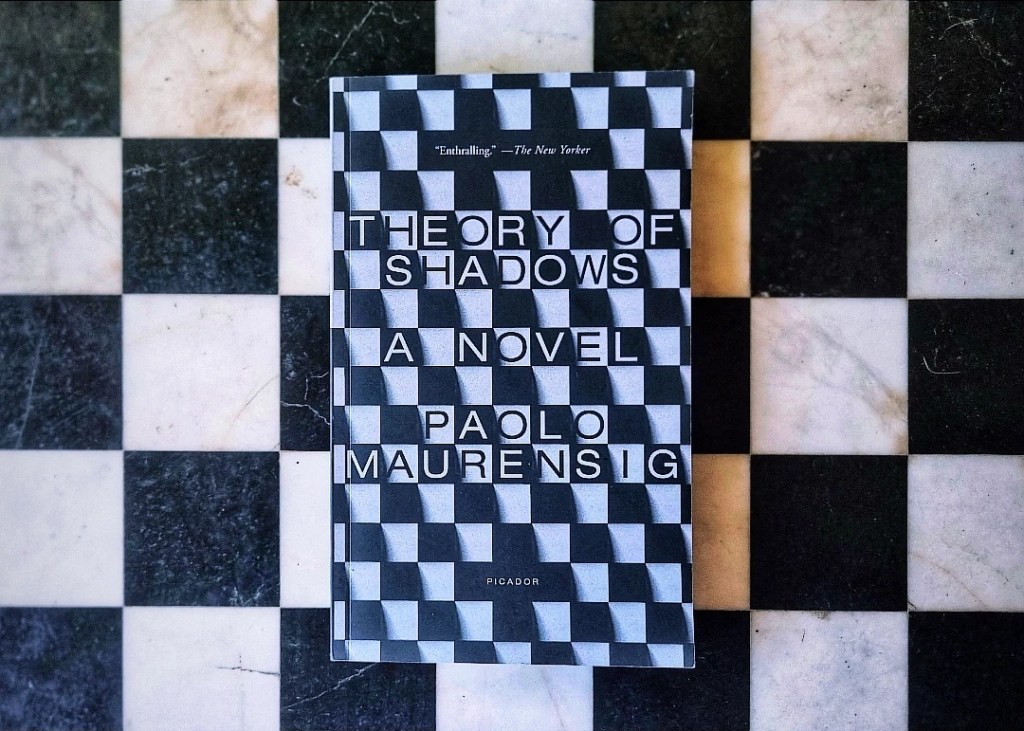
Paolo Maurensig: Theory of Shadows

Is it the fate for all chess novels to be dark?

I’m almost certain that one would not arrive at this book unless they have first been to Zweig’s Chess Story (a.k.a The Royal Game) or Nabokov’s The Defense (a.k.a The Luzhin Defence), or Maurensig’s very own The Lüneburg Variation — and therefore conscious about the sort of darkness to which I refer. 

While Nabokov’s Luzhin is based on the life (and death) of German chess master Curt von Bardeleben, the chess game in Zweig’s story is said to be patterned after a real game between Alekhine vs. Bogoljubow. Theory of Shadows turns the spotlight on the last days of the very same Alexander Alekhine, World Chess Champion, whose reputation was tainted by accusations of Nazi collaboration, and whose death remains a subject of contention.

The setting is 1946, just as the Nuremberg trials have begun in Germany, and Alekhine is preparing for a comeback in chess at idyllic Estoril, Portugal.

At his seaside hotel, Alekhine befriends another guest, a Jewish violinist, and their interesting conversations about music and chess lure me into the narrative. Alekhine exploits this friendship to console himself that he is not racist while he uses his obsession with chess as self-justification for his past actions. But when new hotel guests who recognize the grandmaster appear on the scene and question him about his past, his delusions disintegrate and his guilt becomes more apparent. Then comes the reckoning.

One way or another, there is always retribution when cooperating with evil. The reader can only conclude that Alekhine’s presence in Estoril was simply an endgame played by an unknown hand that very well could have been the Soviets, maybe even the Germans, or Fate, or simply Justice. 


“The real danger lies in not recognizing evil once it is already within us.”

This was Alekhine’s mistake. And it is the mistake of many who often shake hands with evil for personal gain.

Natalia Ginzburg

The City and the House (March 2023)

“The telephone isn’t made for saying important things that need time and space.”


Happiness, as Such (August 2024)

The merit of Natalia Ginzburg’s epistolary novels — whether they are wholly or partially comprised of an exchange of letters between characters — is their being time capsules of an age when corresponding through letters was the principal means of remote communication. It was in letters that banalities could be reported as much as consequential information, and people were allowed space to be frank. Letters tracked the growth, or stagnation, of their writers. Self-expression flowed freely where individual and shared stories unfolded. Ginzburg seems to have maximized on the medium and preserved it, foreknowing a time, our time, when letter writing would be at the point of near extinction.


“Happiness… It is like water; one only realizes it when it has run away.”

Voices in the Evening (January 2024)

Of sad loves and sad lives. For me to truly appreciate Ginzburg’s work and write something of worth about it is, perhaps, to regard it as a whole after I’ve read everything she’s ever written.

For now, this book only evokes a specific memory:

He and I had just listened to the whiskey-soaked voice of Tom Waits. We said we did not want to end up like the people sung by the raspy voice.

But we can’t really predict life, we agreed. 

We can only try, I said.

We did not try hard enough.


Paolo Maurensig: The Lüneburg Variation

Zweig’s endgame, Maurensig’s opening sequence.

Lüneburg Variation is a first novel, Chess Story was Zweig’s last; and one cannot really read Lüneburg Variation without recalling Chess Story. Both explore the same themes of Nazi savagery, moral complexity, and the maniacal passion for chess; but Maurensig paints it in darker shades.

Lüneburg Variation’s striking first line sets a sinister tone: “They say chess was born in bloodshed”; on the second page a murder is committed; on the seventh, a confession.

And then we meet the players behind the game and we are brought to a time when Austria was gripped by anti-Semitism, and how the world of chess, peopled by masters of Jewish descent, was purged from Jews to “recover its purity.”

For a book that’s only slightly longer than Zweig’s novella, it has a handful of indelible scenes, but what will stay with me is a particular chess lesson. After a protégé loses to his teacher, the master asks, “What if this has been caused by your inattention?”

But the attention of which the master spoke referred to something beyond the chessboard. That page made me close the book to ponder on those words that endorsed seeing rather than merely looking. I sipped at my postprandial coffee, and thought of life, and I thought of reading. How inattentive we can be to the world around us! How inattentive we can be as readers!

As I read on, the pieces came together and I was chilled by a realization. What if this was a question meant to haunt generations? Genocide, injustice, cruelty are things that can only be perpetrated by the indifference and inattention of many.