“The afternoon advances, you feel proud of all the time you’ve passed. Passed but not lost, no, won, and won again.”
This is how I feel about all the time I spend reading. It’s time won, and won again. And here’s where Delerm has, perhaps, slightly gained an upper hand over Proust. Haha
This is a book that one can read fast, but which one should not read fast or else miss the whole point. It’s a most delightful exercise in paying attention to life’s ordinary little details. (It’s always the French! They seem to have all the time in the world for such things! Haha) But I won’t write too much about it. Once in a while, a book comes along and compels one to write about life, rather than about the book itself. This book is such a book.
What a ride! How Kerangal builds suspense that makes the entire book feel like one long, deep, drawn breath that you would not want to interrupt!
The majesty of Russia’s landscape appears through the window of the trans-Siberian train, but it is surprisingly subtle in portraying a vulnerable Russia.
Yes, it is a serendipitous train ride shared by a man and a woman, but don’t expect the deep conversations of Celine and Jesse from Before Sunrise. Aliocha and Hélène practically pantomime their way throughout the journey; he being Russian and she being French.
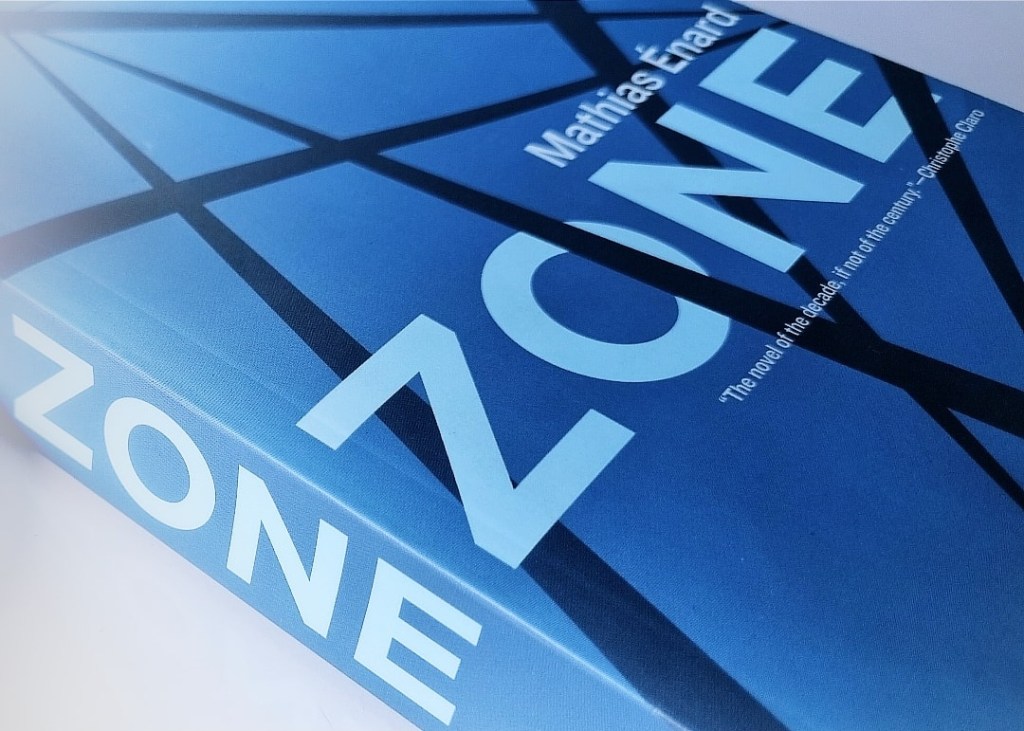
Yes, it concerns an army conscript who wants out, but don’t expect Francis Mirković of Mathias Enard’s Zone. Aliocha won’t sing to you a threnody of the crimes of nations. He is only concerned about his escape.
I love the aforementioned titles and I feel relieved that Eastbound did not turn out like any of those. They are only alike for the reason that they are each in a league of their own.
On the surface, it stays true to its promise of being an adventure story, but I see it as an intelligent political novel. Not because the characters discuss politics, they don’t. But can there be a more political story than two people pursuing their individual freedoms?
In some editions, the full title is The Sun King: Louis XIV at Versailles. This is more apt because the book is not an exhaustive portrait of Louis XIV but a well-researched record of the workings of the French Court in Versailles, its intrigues and its scandals, and the intimate lives of its prominent figures.
It is rather detailed in a sense, and to a fault, that if not for Nancy Mitford’s entertaining wit, it would have bored me to read about the rivalries of the mistresses and the parts that read like royal gossip.
But I would still recommend reading this book on a weekend when one would prefer something that does not weigh on the emotions. Of course, a better recommendation would be to bring this book on a trip to Versailles. At a hundred and sixty nine pages, it is a none too heavy starting point for one interested in reading about the birth of the ostentation that led to the Revolution two kings and less than a century later; and yet another reminder of how quickly and drastically the tides of history turn.
Underneath the rumblings of revolution and the sparkling notes spilling over like champagne, Chopin’s music reaches for something far away… far away in distance, or in memory. The bulk of the work written in Paris, and yet they speak of other landscapes, of nostalgia for an irretrievable time and place, of exile, of home or the lack of it.
So were and so do Mavis Gallant’s Paris Stories. Had Gallant’s heart been brought home in a jar of cognac whilst the body remained in Paris, perhaps it would also have been found to be larger than the average human heart.
But how those hearts, Chopin’s and hers, continue to beat through the music, through the stories!
“Like every other form of art, literature is no more and nothing less than a matter of life and death.” — Mavis Gallant
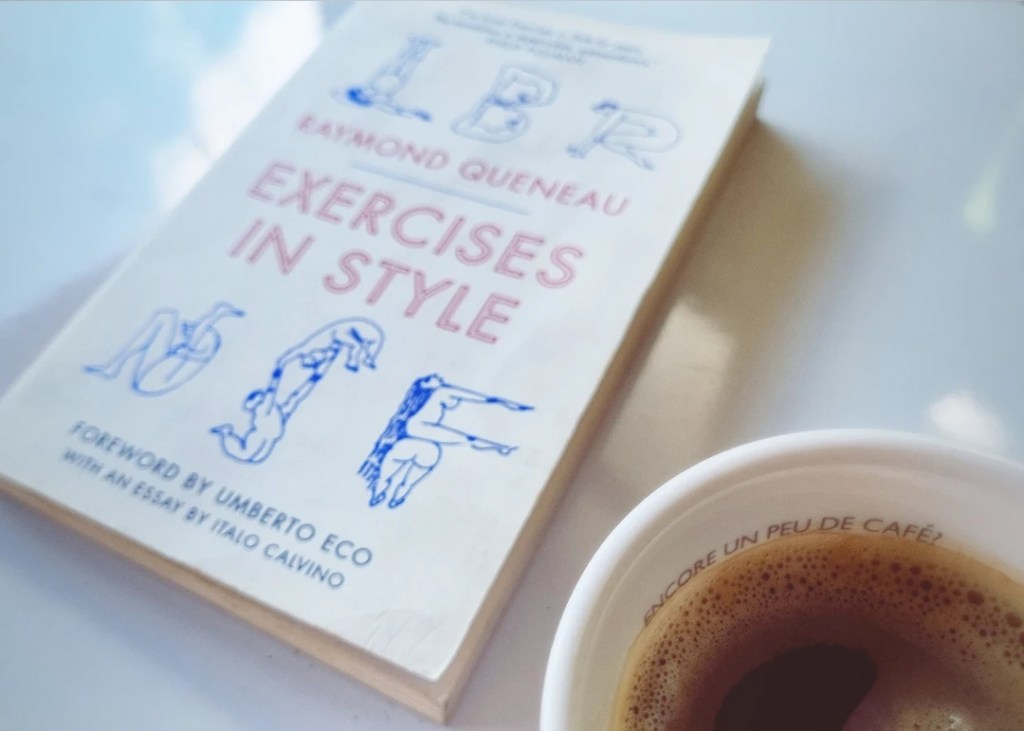
No, this isn’t the Kama Sutra: But it can be, if you enjoy the art of making love with words and trying out different positions with them.
A more conservative comparison: If classical music has Beethoven’s Diabelli Variations, literature has Queneau’s Exercises in Style.
The truth: I had no idea who Queneau was. I’ve come across NYRBs with his name on them, but I only grabbed this book because I’ve enjoyed the works of both Umberto Eco and Italo Calvino. (It must mean something when two outstanding Italians endorse the work of a Frenchman!) The former wrote the foreword and this edition features an essay by the latter, with a prescient first line directed to me, “Who is Raymond Queneau?”
Well, now I know Raymond Queneau: The first man who has managed to make me chuckle all the way while reading an entire book! This was just delightful! It is a retelling of the same short story in different styles that simply renders some books on writing and reading irrelevant — while making the reader laugh.
To those who love to read and write a bit, or write a lot: If this isn’t on your shelf yet, there’s an empty spot where Exercises in Style is supposed be. 😘
Mira, keep this close to Luis Sagasti’s A Musical Offering, close to Olga Tokarczuk’s Flights.
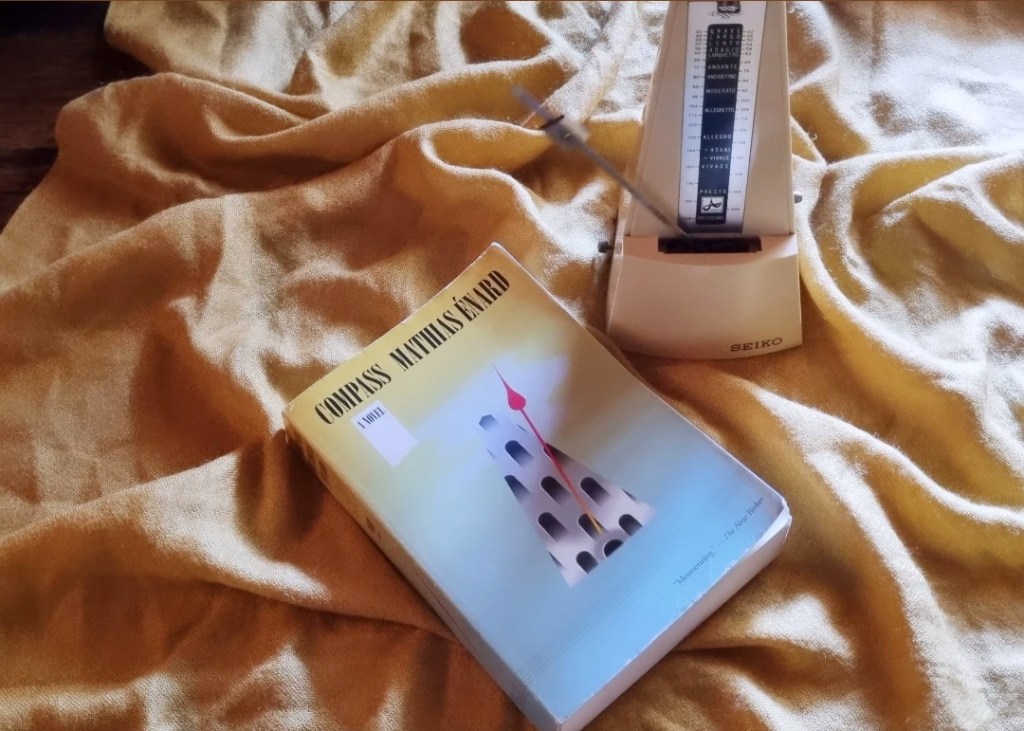
It is, after all, a musical offering — golden threads of western music’s entwining with the orient, of Liszt’s recitals in Constantinople, of how Nietzsche wanted to Mediterraneanize music, of the narrator’s replica of Beethoven’s compass that insisted on pointing east, but most of all because it reminds you beautifully that “music is a fine refuge against the imperfection of the world,” one that describes music as “time thought out, time circumscribed and transformed into sound… time domesticated, reproducible time, time shaped,” and cautions that “life is like a Mahler symphony, it never goes back, never retraces its steps…” but also that “this feeling of the passing of time is the definition of melancholy, an awareness of finitude from which there is no refuge.” Take note of how there is a metronome on the cover instead of a compass. Perhaps because a metronome goes back and forth between directions whilst keeping the music in time.
It is about flights. A hypnotic trip across east and west, tick tock, east, west, art, love, time, self, other, literature, until they have intermingled and are present in each other, an adventure with Being — of traveling to the lands of your dreams and to your favorite cities, about crossing the borders of genres, art forms, literary forms, and geographical borders, but also flights from sanity, and traversing through memory, history, and dreams, suggesting that “our dreams might be more knowledgable than we.” Flights of flavors, an exotic dish not everyone will love; disturbing at times, an acquired taste with a scent of opium.
But keep this book close to Luis Sagasti’s A Musical Offering, close to Olga Tokarczuk’s Flights, close to your heart. Only you know how much this book means to you. Don’t forget you were constantly wide-eyed with wonder when you read it and you agreed with the following lines. How much you were in need of reading that last sentence!
“Sometimes I feel as if night has fallen, that western darkness has invaded the Orient of enlightenment. The spirit and learning, the pleasures of the spirit and learning, of Khayyam’s and Pessoa’s wine, have not been able to stand up to the twentieth century; I feel that the global construction of the world is no longer carried out by the interchange of love and ideas, but by violence and manufactured objects… You have to have… energy to constantly reconstruct yourself, always look mourning and illness in the face, have the perseverance to continue searching through the sadness of the world to draw beauty or knowledge from it.”
Not the West Bank this time, just the Left Bank. The thing about my Silk Route | Fertile Crescent reading project is that — despite being a source of enlightenment through discovering underrated but astounding literature — novels from this route in question are usually emotionally taxing.
Although I have sensed that I am drawn to writings from places of conflict for the reason that they have a sensitivity to beauty commensurate with their heightened awareness of the fragility of life; once in a while, I need a breather, and that’s when I turn to books related to other interests. In this case, not merely an interest, but a love.
But as love would have it, we oftentimes become accustomed to a beloved’s presence and we slowly take its magic for granted.
The Piano Shop on the Left Bank: Discovering a Forgotten Passion in a Paris Atelier refreshed me about the intricate workings of a piano; of how extraordinary this instrument is; of the alchemy and difficulty involved in piano-making and music-making; and how beautiful tone production relies so much on the precision of piano makers, the skill of piano technicians, and the heart and hands of a pianist. This rekindled a fire that led me straight to the piano after turning the last page.
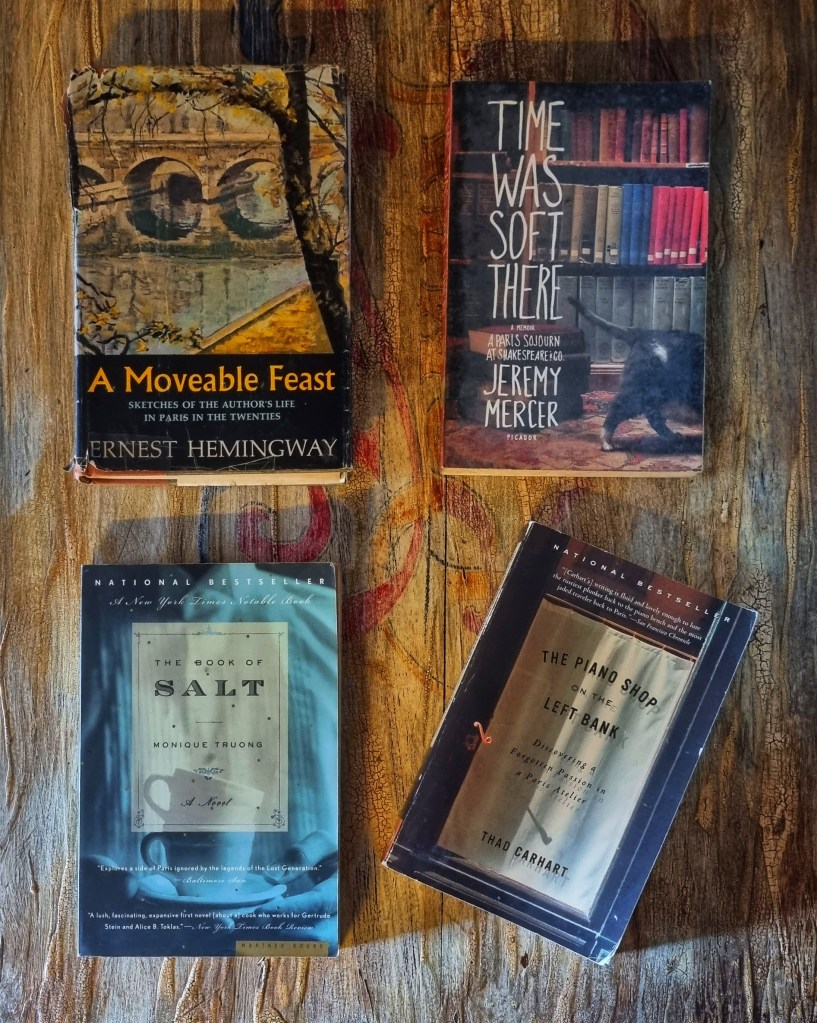
But this book is not just about pianos and trivia from the music world. (Although, while we’re at it: Did you know that when the Eiffel Tower was built in 1889, the first thing to be hauled to the rooms at the top was a piano?) It is also about the Paris that is inaccessible to the tourist. In fact, this would make a lovely pair to Mercer’s Time Was Soft There: A Paris Sojourn at Shakespeare & Co.
Surely, these books did not intend to rival Hemingway’s A Moveable Feast or the aching poignancy of Truong’s Book of Salt, but at times, lesser-known books are beautiful for the simplicity that they lead us to find something that draws out music from within.
Because I arrange my books based on geography, Nikolai Gogol, Mikhail Bulgakov, Vasily Grossman, and Irène Némirovsky among a few others share a spot on my shelf. They were all born in Ukraine while it was still under the Russian Empire.
Fire in the Blood was thought to be unfinished when Némirovsky died in Auschwitz in 1942. It was only through subsequent research years later that the rest of the manuscript was found and published posthumously.
She wrote this around the time she was arrested and deported to Auschwitz, but there is no pain of epic proportions in this book. There are none of Gogol’s ghosts, none of Bulgakov’s political caricatures, and none of Grossman’s wars.
At the beginning I was so convinced that this was simply a charming picture of rural life in an idyllic French village. She makes the reader believe that, until one surprising revelation after another piles up towards the end, and it reveals its own unique depth.
“Are we not all somewhat like these branches burning in my fireplace, buckling beneath the power of the flames?”
Fire in the Blood, the fire of youth contrasted with the sobriety of old age through the introspection of Sylvio and the lives of those around him leaves the reader with a subtle sting that leads to a silent contemplation on, or the questioning of, passion, love and life.
There may have been none of Gogol’s dark humor, none of Bulgakov’s satire, and none of Grossman’s reportage on tragedy, but perhaps Némirovsky deserves her place alongside these men as someone who lays bare the human heart.
“No, it wasn’t that simple. The flesh is easy to satisfy. It’s the heart that is insatiable, the heart that needs to love, to despair, to burn with any kind of fire… That was what we wanted. To burn, to be consumed, to devour our days just as fire devours the forest.”
The Mirador by Élisabeth Gille
Don’t you love it when an underexposed book surprises and transcends expectations? I had not anticipated The Mirador to contain this much beauty!
Having read nothing by Élisabeth Gille prior to this, I approached it as someone who was simply curious about her famous mother, Irène Némirovsky.
From her mother’s journals, letters, unpublished notes, “dreamed memories”, and with the help of her elder sister’s own memories and research, Gille recreates a striking portrayal of the mother they lost to Auschwitz when they were mere children.
Regardless of the applause that her novels garnered and despite her tragic fate, it was for her indifference and lack of political sense that Némirovsky was criticized. Gille, however, does not justify her mother’s shortcomings. She allows a beautiful irony to unfold through the pages and writes a lyrical and clearsighted grasp of her forebears, literature, history, and the political arena that surrounded Némirovsky from her early childhood in Kyiv, growing up in St. Petersburg, fleeing to Finland in the wake of the Russian Revolution, and building a life and a successful writing career in France until the German Occupation.
I must admit that I personally prefer the daughter’s writing over the mother’s, and it was saddening to learn that Gille died from cancer in 1996, only four years after The Mirador was published. But I beam at the thought that Némirovsky would have been so proud.
How cathartic it must have been for a daughter to write this! It makes one wonder at the mysterious power of writing — how it can liberate the writer and the subject at the same time, how it can be a simultaneous act of holding on and letting go.
Reading this reminded me of a trip to the National Museum of the Philippines. I went there for the masterpieces, but found myself spending more time, and being most delighted, in a room full of practice sketches by Amorsolo.
Exteriors are sketches, little fragments of writing that feel like ingredients for a larger canvas; and Annie Ernaux is the great artist who guides readers to become keener observers of people, of gestures, of the world beyond the intimacy of the self, of exteriors.
Peruse the sketches more carefully and find priceless lessons on writing and observing. Once in a while, we need an artist to lead us to details we should pay attention to. Once in a while, we need an Annie Ernaux to take our hand.




 The Book-Butterfly