“The afternoon advances, you feel proud of all the time you’ve passed. Passed but not lost, no, won, and won again.”
This is how I feel about all the time I spend reading. It’s time won, and won again. And here’s where Delerm has, perhaps, slightly gained an upper hand over Proust. Haha
This is a book that one can read fast, but which one should not read fast or else miss the whole point. It’s a most delightful exercise in paying attention to life’s ordinary little details. (It’s always the French! They seem to have all the time in the world for such things! Haha) But I won’t write too much about it. Once in a while, a book comes along and compels one to write about life, rather than about the book itself. This book is such a book.
By now, Palestine and Israel are probably on everyone’s radar. By now, young and old have probably taken a side, or have opinions; but sadly, based only on social media algorithms. By now, many have probably come across that post about the Palestinian writer, Mahmoud Darwish, who fell in love with a Mossad agent, reposted many times however false. (He did have a relationship with an Israeli-Jew that would haunt many of his works: “Rita” in his poems, Tamar Ben-Ami in real life, who later served for a time in the IDF.) Or he may be known to some as the controversial poet who criticized Hamas.
I know his name from every important Palestinian work that I have read. It’s sad that it took a war for me to try harder to acquire his books and finally experience his writings. I have been reading these four collections slowly and carefully, in random order, and in-between other books. The very last piece, I read today. And yet, here I am, still lost for words that will give justice to this body of work.
How beautifully he writes! And how enlightening his works are of the Palestinian sentiment and predicament!
A River Dies of Thirst is where one will find the famous line, “All beautiful poetry is an act of resistance.”
“In the Presence of Absence” hints at the term “present absentee” that refers to Arabs who fled or were expelled from their homes during the Nakba, and it is the volume that touched me the most.
“Poetry, then, is an act of freedom.”
“For what can a poet do before history’s bulldozer but guard the spring and trees, visible and invisible, by the old roads? And protect language from receding from metaphorical precision and from being emptied of the voices of victims calling for their share of tomorrow’s memory on that land over which a struggle is being waged? A struggle for what lies beyond the power of weapons: the power of words.”
“What does it mean for a Palestinian to be a poet and what does it mean for a poet to be Palestinian? In the first instance: it is to be the product of history, to exist in language. In the second: to be a victim of history and triumph through language. But both are one and the same and cannot be divided or entwined.”
Why Did You Leave the Horse Alone? is special not only for its poems but for being a bilingual edition! Even though I cannot read Arabic, I love tracing the elegant curves of its script with my eyes.
Journal of an Ordinary Grief is anything but ordinary and it is the volume out of these four that I would readily recommend, no matter whose side one is on. Because maybe after turning the last page, one will be less concerned about taking sides, but be more concerned about having humanity.
And I’ve written fourteen novels, and if there’s one thing my writing has to be, for me, it has to be truthful. What I write has to be truthful. I’ve wanted that to apply to my whole life too, in my relationships with other people, my relationship with myself.
My first experience with Hanne Ørstavik’s writing was in 2022 with her novel, Love, wherein she seemed to have invented a literary equivalent of the Shepard tone — that auditory illusion used in film soundtracks to create a palpable suspense and disquiet. With a narrative that demanded complete attention, it revealed a writer in full command of form and style.
Expecting another work of sparse and exacting Nordic prose, I was surprised to be met with vulnerability and painful honesty in Ti Amo. It cannot be more different than Love. Expertly calculated tension dominated Love, Ti Amo announces death candidly right from the beginning and nothing is veiled.
Love was fiction, Ti Amo is not, and I cannot somehow bring myself to judge a work by someone writing through her husband’s terminal illness. It is a book about life, death, and writing, and nothing describes this book better than the author’s own description of the marble pillars in Ravenna’s Basilica di San Vitale.
“In the San Vitale — the way the great marble blocks of the pillars possess a quieter beauty than the glittering mosaics. The mottled markings in the marble are just there, silent and displayed, defenseless, and what was hidden within the stone, the veins, the figures they trace, is exposed now for all time, laid bare, halted in once so sweeping, now dissected movements through the stone. And what we see is the cross section, the wound, and the beauty of what simply exists, neither devised nor constructed, merely disclosed.”
I thought wrong when I surmised it was written as closure. (As if grief had closure!) Of the wound and the beauty of what exists, it is simply, and not too simply, a disclosure.
What a ride! How Kerangal builds suspense that makes the entire book feel like one long, deep, drawn breath that you would not want to interrupt!
The majesty of Russia’s landscape appears through the window of the trans-Siberian train, but it is surprisingly subtle in portraying a vulnerable Russia.
Yes, it is a serendipitous train ride shared by a man and a woman, but don’t expect the deep conversations of Celine and Jesse from Before Sunrise. Aliocha and Hélène practically pantomime their way throughout the journey; he being Russian and she being French.
Yes, it concerns an army conscript who wants out, but don’t expect Francis Mirković of Mathias Enard’s Zone. Aliocha won’t sing to you a threnody of the crimes of nations. He is only concerned about his escape.
I love the aforementioned titles and I feel relieved that Eastbound did not turn out like any of those. They are only alike for the reason that they are each in a league of their own.
On the surface, it stays true to its promise of being an adventure story, but I see it as an intelligent political novel. Not because the characters discuss politics, they don’t. But can there be a more political story than two people pursuing their individual freedoms?
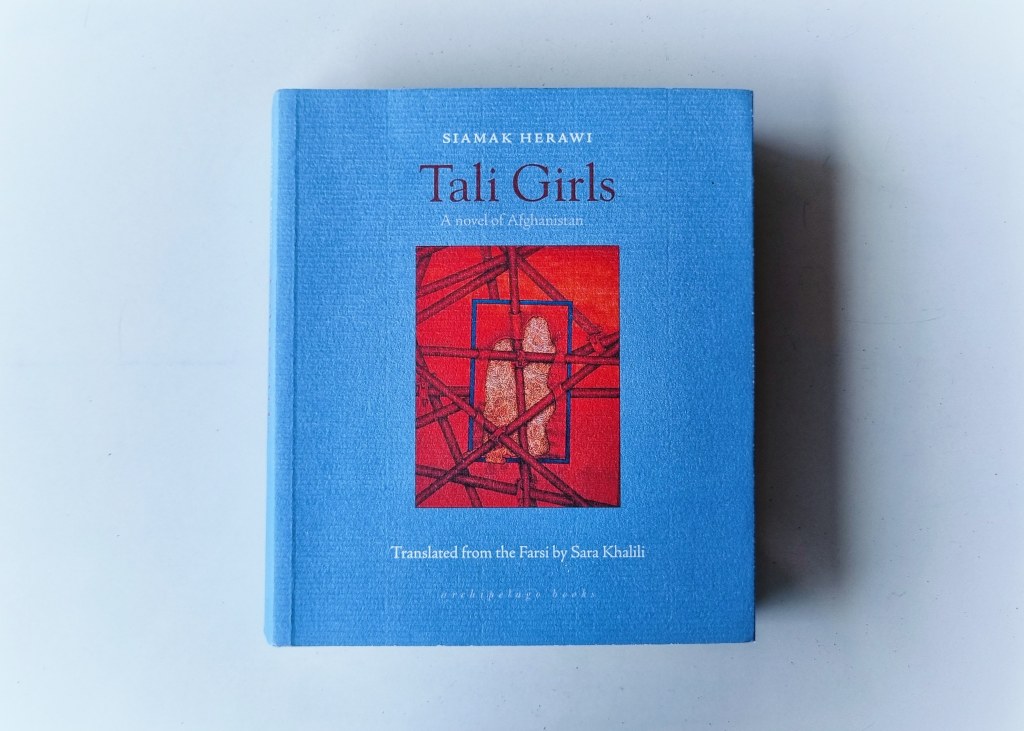
It’s almost absurd to expect happy novels from Afghanistan. I knew I had sorrow coming when I selected this as my third book of 2024. I could have shelved it for later, but how could I resist this blue from Archipelago Books, translated from the Farsi to boot? How often can one find literature translated from the Farsi?
So it was on me when it started to break my heart and made me recoil from the brutality.
Unlike most books about Afghanistan, the characters are not caught in the crossfire of any of the wars that have ravaged Afghanistan for decades.It is set in a picturesque mountain village in the early 2000s when life was simple and young girls were allowed to dream about education and love, and villagers were content with raising livestock and planting their own wheat, beans, and melons. That is until the Talibs discovered the beauty of their nine-year-olds and found their land ideal for the cultivation of poppy to be sold to the “infidels”. Tali Girls is based on true events.
The first person narration shifts from one character to another, effectively and intimately thrusting the reader into a world plucked from its innocence.
I would be reluctant to recommend this for the anguish that it contains, but I am more inclined to listen to one of this novel’s wisest characters:
“‘Remember,’ he says, sitting in his library, ‘the more your eyes open to the world, the more you are likely to suffer. But better that you learn and understand… Read, Kowsar, read to understand the world around you.”
This book does not say anything about Egon Schiele. But it very well could have been written by him, had he been a novelist instead of a painter.
An unexpected turn inside the Belvedere Museum in Vienna once brought me face to face with enormous paintings by Schiele. When you go to a place for Klimt and be confronted by Schiele, it is a staggering experience you will not easily forget.
Haunting eyes, naked and exaggerated anatomies, comical expressions, grotesque scenes, and dark humor — whether you like it or not, you cannot look away. Even if you eventually manage to, you will be forced to take another look, and another.
Because by some bizarre and compelling artistry, the artist wraps you around a strangely proportioned finger, the way Cheon Myeong-Kwan does in this whale of a tale.
So, do not let the cover design of the Archipelago Books edition with its happy colors fool you. Or maybe, let it fool you; so that it startles you, the way some skillful art and literature should. Maybe take that turn and be confronted by something you normally would not seek out.
Oftentimes, the art that we find grotesque are missives from a mind sensitive to how the world truly operates. For isn’t this book a critique on justice, economic, and social systems; and even on American influence through Hollywood? And aren’t these political caricatures in the guise of troubling characters and a metafictional storyline?
I would think twice before criticizing this book for what it seems on the surface, lest I become akin to that judge in 1912 who set fire to one of Schiele’s drawings at a trial wherein Schiele was accused of indecency.
“Reader, you will believe what you want to believe. That’s all there is to it.”
It is and it isn’t Kafkaesque. It is because, not too long ago, the Tutsi people woke up as inyenzi — cockroaches. It isn’t because it is no longer allegory, no longer fiction.
“The soldiers… were always there to remind us what we were… cockroaches. Nothing human about us. One day we’d have to be got rid of.”
Mukasonga, who lost an entire family, an entire clan, and an entire people in the genocide, chronicles life as a Tutsi in Hutu-dominated Rwanda. As a child, she and her family were forced to relocate to a camp during the first pogroms against the Tutsi; and from then on, they knew what awaited them. “Humiliated, afraid, waiting day after day for what was to come, what we didn’t have a word for: genocide.”
In this disturbing and exceptional account, we become witnesses to how hatred and prejudice crescendoed from the 1950s into what erupted as the Rwandan genocide in 1994.
OUR LADY OF THE NILE
In two chapters of Cockroaches, there is an account of being unexpectedly accepted to the prestigious Lycée Notre Dame de Citeaux, a Catholic boarding school in Kigali. The experience becomes a fictionalized novel here.
The elite school for young women perched on the ridge of the Nile remarkably becomes a microcosm of Rwandan society. Corruption, the tension between Tutsis and Hutus, history, their myths, Rwanda’s relationship with the west, orientalists, disinformation and lies that fuel prejudice — “It’s not lies,” justifies one of the girls. “It’s politics.” — the complexities of government and society, and how Mukasonga proficiently mirrors these through the lives of the young women makes it a powerful work of fiction.
IGIFU
An anthology of 5 stories that remind us of why we should read about worlds and lives so different from our own. And if you’re wondering about the identity of Igifu, “who woke you long before the chattering birds announced the first light of dawn,” who “stayed at your side…to bedevil your sleep,” “the heartless magician who conjured up lying mirages…” you would be heartbroken, just as I was, to know that he is Hunger.
THE BAREFOOT WOMAN
A lament with pockets of lightheartedness dedicated to the mother she lost, written by someone who, in her own words, has the sorrow of surviving.
KIBOGO
A spirited portrait of a people grappling with the choice between the faith of their European colonizers and their pagan beliefs. A relatable quandary amongst peoples of colonized lands, but written in a manner only Mukasonga can achieve.
Truly, an African section of a library would be inadequate without Mukasonga. These are essentials in world literature. The word essential has been abused, but there are times when essential is appropriate.
Children of the Ghetto: My Name is Adam is my fifth Khoury. Would I recommend this? Perhaps not as a reader’s first Khoury. Would I read another Khoury after this? Absolutely!
In what seems to be a foreword signed by the author, he recounts how the notebooks of Adam Dannoun came into his possession. The entire book is the purported sum of Adam’s scribblings. “This is neither a novel nor a story nor an autobiography. And it isn’t literature,” writes Adam in his notebooks. But of course, through his virtuosity, Khoury turns the non-novel, the non-story, and the non-autobiography into literature.
It is literature that is one of the trickiest webs that he has woven because it challenges Khoury himself as a storyteller. It is soon revealed that Adam claims to have known the characters in Gate of the Sun personally, and he dislikes “the author of the novel Gate of the Sun, standing next to the bald Israeli director, presenting himself as an expert on Palestinian history, and lying.”
Adam, an infant in 1948, named so as the first born of the Ghetto of Lydda. Adam lived through the horrors of the ghetto, the massacre in Lydda, and the Lydda Death March. Before his suspected suicide in New York as an older man, he struggled to write about what befell his people. The notebooks contained his attempts. The whole history of our Nakba is unwritten. Does that mean we don’t have a history? That there was no Nakba? Does that make sense?
It possibly cannot be the unfathomable pain of the Nakba or the senseless violence of the Lebanese Civil War that keeps me coming back to Elias Khoury. It’s probably not the history either, because he is the kind of writer who questions it.
Or maybe it is because he questions history that I keep coming back. Maybe it’s also for the reason that every book I’ve read that’s written by a Lebanese reveals how capricious and adventurous the Lebanese are with form, or with the defiance of form. Maybe I’ve been lucky with the chronology of which I read, and of which the books came to my possession, that instead of being thwarted by this unconventional and sometimes disorienting quality, each book has only heightened the allure for me.
And maybe it is because Khoury, as a writer, urges and trusts the reader to be the one to bring a story to life; a truly Eastern composer of tales who wants to obliterate the author and make his identity of no interest so that literature becomes, like Eastern classical music, not a fixed composition, but an unfolding.
“You want us to form a friendship built on disregarding the past, on ignorance and forgetting. Like all rulers, you want to burn your secrets so nobody can look at them after you die… We are not on the same path.”
How fittingly this line can be addressed to our current leader, and how I’d love to take some of Bachtyar Ali’s allegories to take a jab at the state of our politics!
But I doubt if railing against authorities was the main intent of this novel. Bachtyar Ali, injured in 1983 during a protest against Saddam Hussein’s Ba’ath Party and author of the first Kurdish novel to be translated in English, surely knows about unjust leaders and speaking out against them.
This story of a peshmerga fighter who is released after being detained in a desert prison for twenty one years and goes on a quest to find the son he left behind is told with the magical realism of A Thousand and One Nights, but with a more discernible moral aim, which also weaves in its tale the sufferings and the violent history of the Iraqi Kurds.
The Last Pomegranate Tree, with its moments of breathtaking lyricism, seems to me more of a profound contemplation on freedom, on what it means to be really free, and on what it is we should seek and hold on to when all seems lost.
“Only one thing has been left to us, the one thing they can’t reach: our hearts, our inner worlds.”
“Would Chekhov have suffered writer’s block?” Maria wondered, as the hull of the sunflower seed snapped open between her lightly clamped teeth.
Had it not been for gravity and absentmindedness, it might have appeared like a final attempt of helpless rebellion as the kernel fled in its nakedness, first escaping through Maria’s lips and slipping straight into the narrow entrance of a cowl-necked blouse, lapsing between two mounds of mysterious bosomy matter, and finally shelving itself in the black hole of the navel.
There, cradled in the darkness was the sunflower seed, and it knew not what parallel or different fate it would have encountered had it slipped inside – on the other side, of that warm, heaving skin. At that moment, it knew not time nor space, it only knew of warmth, suspension, and a false feeling of relief.
Maria’s eyes swept the floor but found no trace of the seed, so she picked up another one when suddenly, an idea! A writing idea after weeks of creative standstill! She mock-kissed the second sunflower seed with glee and tossed it back on the table. “If Chekhov could eye an ashtray and tomorrow furnish a story called ‘The Ashtray,’ what tales I could conjure from a sunflower seed!”
With confident strokes of her pen she inked ‘The Sunflower Seed’ on the top of a blank sheet, and Maria wrote:
“Would Chekhov have suffered writer’s block?” Alejandra wondered, just as the sunflower seed snapped open between her semi-clenched teeth.
Of what seemed as a definitive act of impetuous rebellion, the seed fled in its nakedness, first escaping through Alejandra’s lips and slipping straight into the abyss of a cowl-necked blouse, lapsing between two mounds of mysterious bosomy matter, and at last shelved itself in a black hole which was the navel. There, cradled in the darkness was the sunflower kernel, and it knew not what parallel or different fate it would have encountered had it slipped inside – on the other side, of that warm, heaving skin. At that moment, it knew not time nor space, it only knew of warmth, suspension, and an ersatz feeling that resembled belongingness.
Maria continued to write vigorously and narrated how Alejandra’s husband discovered the mutinous seed in her bellybutton later that night and punished it by plopping it into his mouth with a teasing gleam in his eyes.
Pleased with the South American tone of absurdity in her story despite aiming for a Russian shade, and unaware that her tale was half fiction-half accidental truth, she put her pen down with a satisfying staccato. “Ah, the sound of a period!” she exclaimed. As she stood up, the sunflower seed fell to the floor, later to be identified as midnight snack by the little mouse that lived in between Maria’s walls.
The above story is not from the two books featured here. I wrote this in 2009 when reading a volume of Chekhov, who happens to be one of the most handsome of authors, ignited a spark of creative inspiration. Since then, I’ve found that the best short story compendiums do not inspire me to write reviews; they nudge me to pay more attention to the details of everyday life and to write my own short stories however inferior mine may be.
Ferit Edgü is more minimalist than Sait Faik but I find both their stories to be of a distinctive hue. There is something almost monochromatic about them: But akin to the most masterful black and white photographs, this quality does not reduce them to something less but raises and intensifies their expressiveness.
My best attempt to describe them would be to ask one to look into photographer Ara Guler’s black and white images; or better yet, grab that photo book, Ara Guler’s Istanbul with a foreword by Orhan Pamuk. Each photograph a story, each story an evocative photograph.
It is said that every Turk knows a Sait Faik line or story by heart. He is, after all, considered the Turkish counterpart of Anton Chekhov. Turkey’s most prestigious short story award, the Sait Faik Prize, is named after him — which Ferit Edgü received in 1979.
Needless to say, last month’s release of this Ferit Edgü collection resulted in yet another NYRB | Archipelago book-pairing at my end.
Now, excuse me as I attempt to write another short story. If that doesn’t work, I’ll be content with seeking beauty in the ordinary.
“And so the role of literature on this earth: It is that thing seeking beauty.” — Sait Faik




 The Book-Butterfly