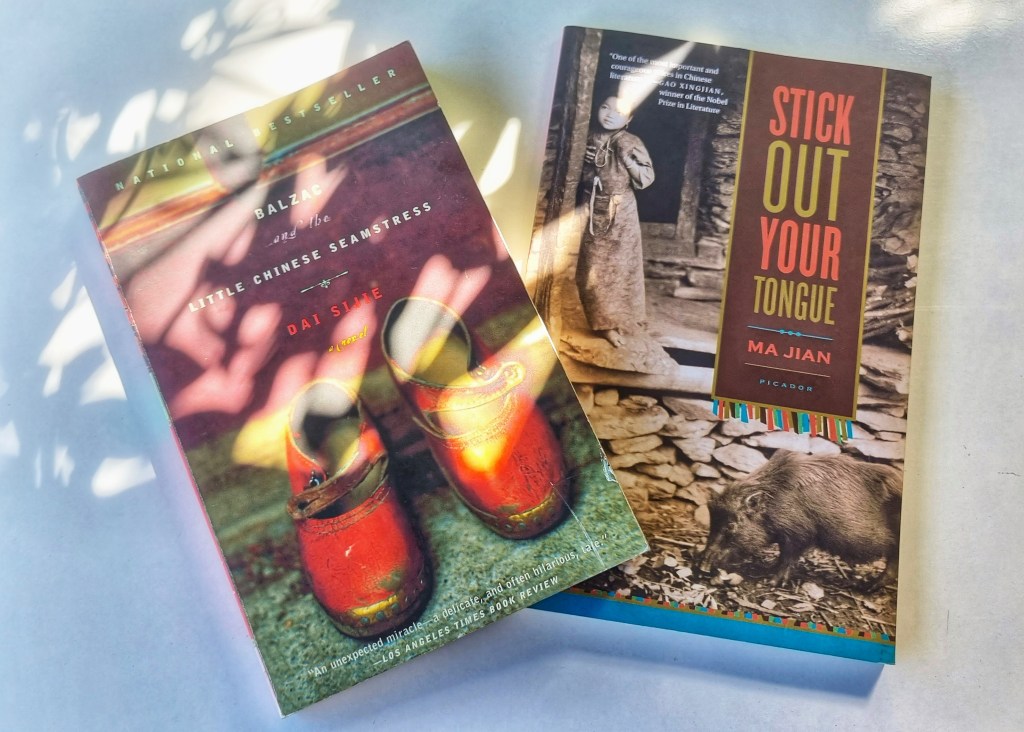
I call it my Fertile Crescent and Silk Route Reading Project and yet there is a glaring dearth of Chinese writers in my literary diet. Maybe because I know that Chinese literature is a sort of Pandora’s box disguised as an ornate lacquer case. One that would release a curse upon the reader. The curse of wanting to read and acquire more.
Unready for another full-blown obsession, this is me prying the lid of that box ever so gently.
Dai Sijie’s Balzac and the Little Chinese Seamstrees is closer to Chinese fast food and so much easier and more pleasant to swallow than Ma Jian’s Stick Out Your Tongue; and I can only be glad that I read these two in succession so they could balance each other out.
Stick Out Your Tongue is the slimmer volume and yet its morbid stories of sky burials, incest, and disturbing Buddhist initiation rites juxtaposed with Tibet’s harsh landscape shakes one to the core. I cannot even think of recommending this book. But it is the afterword that I find especially striking as it draws attention to the destruction that the Chinese government has wrought in Tibet, or the fact that over a million Tibetans have died due to political persecution or famine — yet another case of a people denied control of their lands and destinies by a powerful bully.
Balzac and the Little Chinese Seamstress, on the other hand, offers more heartwarming and comic imagery as two bourgeois teenage boys navigate their “re-education” in the countryside during China’s Cultural Revolution. They were among the millions of China’s youth who were sent to the rural areas to be re-educated by peasants from the mid-60s to the mid-70s. Their lives take a turn when they meet the little Chinese seamstress, but these lives are truly altered when they unexpectedly encounter French literature at a time when “ignorance is in fashion”. It may not be classified as a literary masterpiece but it is a celebration of the transformative power of literature; and I can’t blame you if this book made you scour bookshops and the internet for a definitive English translation of Romain Rolland’s Jean-Christophe. That’s what it made me do.
 The Book-Butterfly
I can’t say I’ve ever read Chinese Lit either… i am sure there are many great voices to come out of that country though!
LikeLike