
November 16, 2024 — That cliché about turning forty? I don’t buy it. People shouldn’t wait that long for life to begin. I am, however, a believer in new stories and new adventures beginning at forty.
As light often precedes sound, the moon casting an ethereal halo over the city greeted me as the plane landed. The polyphony followed; of old and new, of east and west, of a language that sounds like a blend of High Valyrian and Dothraki, of autumnal chill and inner fire.
It is almost midnight in yet another junction of the immeasurable Silk Route, one of the oldest trade centers in the Caucasus. A stone’s throw from where I’m staying is an underground market that was part of a network of tunnels dating back to the 4th century where East and West have traded goods and stories for hundreds of years.
It is safe to walk at night. I have only encountered friendly faces and a group of men intoning the most otherworldly polyphonic singing at a roadside table as if it were the most natural thing on earth. At every turn lingers the influence of Scheherazade, mother threader of stories in the East, and Penelope, mother un-threader of storytelling in the West. Here, the narratives do not seem to contrast, they coexist. They take turns coaxing travelers to find their own stories to weave, and to unravel.
Looking around and looking within, I can tell you that forty (and Old Tiflis), is a wonderful place to be. And I cannot wait to see Old Tiflis (and forty) shimmering in the sunlight!
November 20, 2024 — “It’s likely and unfortunate that you are probably only dimly aware of Georgia—the country, not the state. It’s tucked away beneath Russia, next to Turkey, a contentious, strategic piece of real estate under constant pressure.
You should know Georgia because it’s nice. Because the food is excellent. The country is beautiful—some of the most beautiful scenery on Earth. It’s a place you should absolutely visit if given the chance.
But you should know it as well because it’s important. Because it emerged from years of Soviet rule into a chaotic, awful, lawless period, yet managed to turn itself around into a functioning democracy in a few short years.
And because, as you will see, it is still under constant threat from an increasingly belligerent Russia.
It’s a fascinating and very welcoming country. And I hope we convince some of you to visit it.”
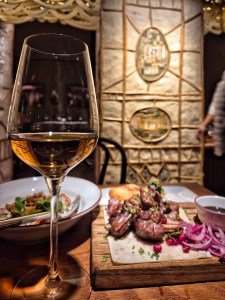
Don’t take my word for it. Take Anthony Bourdain’s. He said that, and I took his word for it. And so the first restaurant I checked out was one that he visited, and I ordered a dish that he also had (lamb ribs “semichka” with pomegranate sauce). Since that first dinner I haven’t had bad food or bad wine.
I’ve been pairing most of my meals with the amber wine for which Georgia is known, and I don’t even know where or how to begin with Georgian wine. But as a preview, let me just say that it tastes exuberant. It’s like drinking the sunlight of a Georgian autumn.


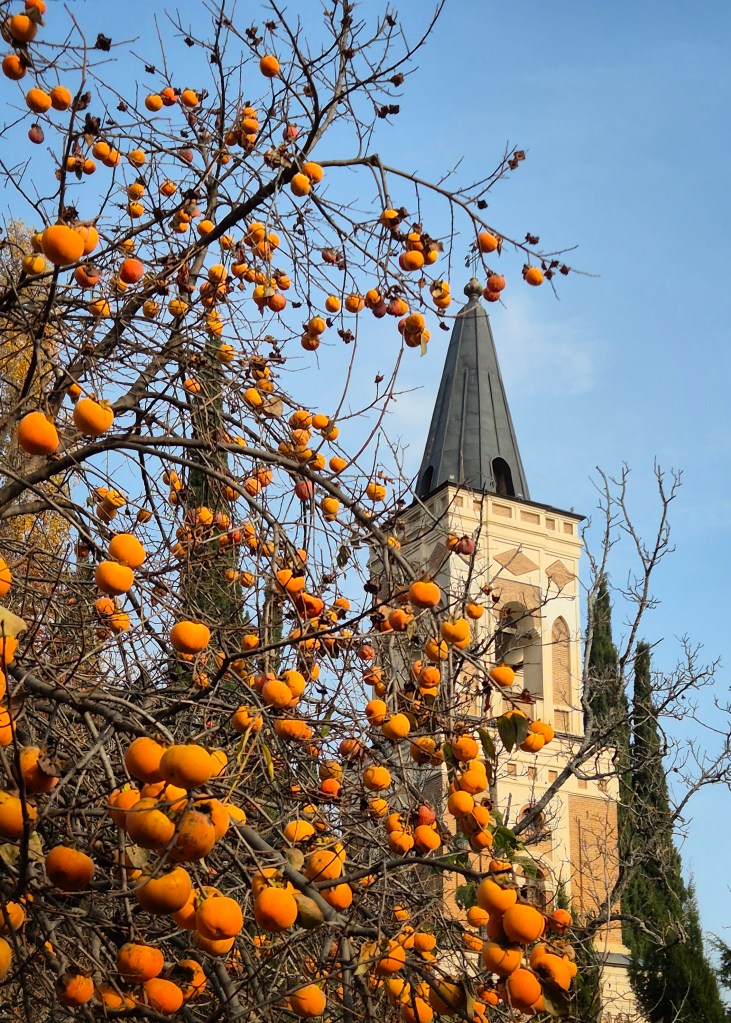
In autumn, Sighnaghi is tinted by all the colors of Georgia’s wines.


 The Book-Butterfly