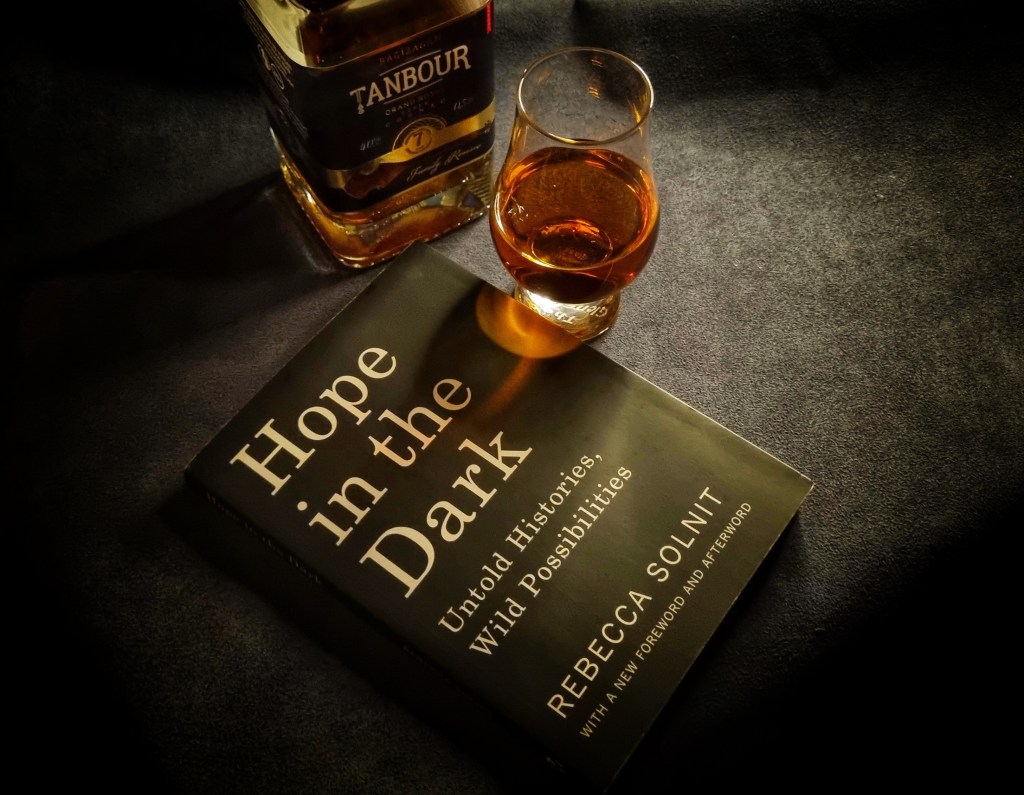
Rebecca Solnit: Hope in the Dark

If it were not Rebecca Solnit who wrote this, I would have dismissed the title as another one of those inspirational books that I do not gravitate towards so much. But having experienced four Solnits this year prior to this, which all proved to be books I needed at the exact time I read them, I seized this as soon as it arrived. And once again, she delivered.

I felt it was written for me, who, upon returning from an exhilarating trip, returned to my country with a new president whom I did not vote for. Solnit’s books are extremely political, but she wrote this to make the case for hope, especially for those who, on the surface, seemingly lost:

To point out that just because my side did not win the election, does not mean we are not victorious in many things. To challenge myself to live the same way with the leadership I did not choose as I would have had my candidate won, and to continue being a responsible citizen and human being — because being victorious and seemingly right is small comfort when, around the world, and around the country, there is still injustice and there are still people dying and living horribly.

“Hope doesn’t mean denying these realities. It means facing them and addressing them by remembering what else the twenty-first century has brought, including movements, heroes, and shifts in consciousness that address these things now.”

“The hope I’m interested in is about broad perspectives with specific possibilities, ones that invite or demand that we act. It’s also not a sunny everything-is-getting-better narrative, though it may be a counter to the everything-is-getting-worse narrative.”

Consider reading this if you, like me, paid your taxes dutifully and was called “self-righteous” when you pointed out that our new president failed to pay his; if you campaigned for your candidate without insulting anyone but the many enjoyed branding everyone on your side as toxic, even though poisonous ones were actually present on both sides if we care to admit (I have screenshots); if you were maligned and called names because of who you supported while the same people demanded respect but has been disrespecting your candidate for six years; if you, hopefully, like some of them, just wished for a better country. Consider reading this if you are frustrated and you think hope is lost, because it just made me realize that it isn’t.

This book reminded me that hope and action feed each other, and that every action and inaction have more impact than we know; to not merely demand change but to embody it. 

Hope, above all, is action; and as long as we do our part and, if possible, do more than what’s required of us, there is hope. 

Rafik Schami: Damascus Nights

“Writing is not the voice’s shadow but the track of its steps… only writing has the power to move a voice through time, and make it as immortal as the gods.”

In an attempt to read something that would get my mind off Philippine politics, I sought asylum at my Silk Route | Fertile Crescent shelf. This is one of the books from a hefty stack that a bookseller set aside for me because he knows of my current preferred literary flavors and reading project. And sure enough, I could hardly put this one down as soon as I started!

It is about a storyteller who loses his voice and the stories that allowed him to retrieve it.

As much as it is a wonderful reflection on writing and storytelling, Damascus Nights is, as you may have already guessed, a play on the Arabian Nights. But Rafik Schami makes the Arabian Nights what I would have preferred it to be! The fantastical quality of the original is still there, but he allows you to feel, smell, and hear the Syria before the humanitarian disaster, the lively early to mid-20th century Damascus, while weaving a social commentary on Damascene life, exploring identity and exile, foreign affairs, corruption, and a none too subtle criticism of its rulers! This turned out to be excessively political — without losing its humor and lightness!

Nevertheless, page 108 made me stop in my reading tracks. It is where an old man is insulted by an official, but his son who owns a teahouse begs him to refrain from retaliating: “‘That would ruin me,’ he said, ‘they’d shut down the place within hours.’ Someone would plant a handful of hashish somewhere, you see, or else a book by Lenin. The police would show up an hour later, and they’d find the hashish and the Lenin exactly where the man from the secret police had stashed them. The place would be closed and its proprietor thrown in prison for ten or twenty years.” Red-tagging and this so-called drug war abused to punish political or personal critics are some of the oldest tricks in the book, my friends. I will not write anything else on the matter. Even in reading, you cannot escape from something you care about.

Rafik Schami is another proof of the claim that we are missing so much as readers if we cease from exploring the literary wonders of this region. And isn’t his About the Author section the most charming you’ve ever encountered?

“…is an award-winning author who used to be a baker but didn’t like the flour and early hours. Since giving up baking, he has tried his hand at chemistry to discover the formula for immortality. What he found was that he could only do that through writing, because only literature lives forever.”

Excuse me as I go hunt for more books by Rafik Schami…

Milan Kundera: The Book of Laughter and Forgetting

“‘You begin to liquidate a people,’ Hübl said, ‘by taking away its memory. You destroy its books, its culture, its history. And then others write other books for it, give another culture to it, invent another history for it. Then the people slowly begins to forget what it is and what it was.’”

It was this quote from the book making the rounds on social media recently that led me to re-read The Book of Laughter and Forgetting, but then I found more to retrieve from the margins of memory.

“…but the past is filled with life, and its countenance is irritating, repellent, wounding, to the point that we want to destroy or repaint it… we fight for access to the labs where we can retouch photos and rewrite biographies and history.”

“They wanted to efface hundreds of thousands of lives from memory and leave nothing but an unstained age of unstained idyll.”

“…erased from the country’s memory, like mistakes in a schoolchild’s homework.”

“The constitution did indeed guarantee freedom of speech, but the laws punished anything that could be considered an attack on state security. One never knew when the state would start screaming that this word or that was an attempt on its security.”

Fortunately and unfortunately, Kundera reminds us that we are not alone in this plight, and there are still those who remember.

“The struggle of man against power is the struggle of memory against forgetting.”

It’s funny how this book made more sense when I read it as a younger person — the passages about music and literature I glorified, the obscenities I took as metaphors and almost everything else as literary symbols. Now that I’m older, it all seems absurd.

And it is absurd because of how real it has become.

Along with my old yellowed notes tucked between its pages lie the pretentiousness of a young reader and the confounding of an older one.

“You don’t have to burn books to destroy a culture. Just get people to stop reading them.” — Ray Bradbury, Fahrenheit 451

Mourid Barghouti: I Saw Ramallah

“Here I am walking toward the land of the poem…”

When a poet writes a memoir, the entire book is a poignant song. Exiled from his homeland after the Six Day War, Mourid Barghouti returns after thirty years and sings of his experience and his memories.

“And now I pass from my exile to their… homeland? My homeland? The West Bank and Gaza? The Occupied Territories? The Areas? Judea and Samaria? The Autonomous Government? Israel? Palestine? Is there any other country in the world that so perplexes you with its names?”

And yet, as Edward W. Said intimates in the foreword, the account is free of bitterness and recrimination.

“I know that it is the easiest thing to stare at the faults of others and that if you look for faults you see little else. Which is why—after each setback that befalls us—I look for our faults too; the faults of our song. I ask if my attachment to the homeland can reach a sophistication that is reflected in my song for it. Does a poet live in space or time? Our homeland is the shape of the time we spent in it.”

The pages teem with beautiful questions…

“Who has stolen our gentleness?”

“Are they really afraid of us or is it we who are afraid?”

“What should we remember and what should we forget?”

“Did I paint for strangers an ideal Palestine because I had lost it?”

…and express in simple ways the everyday sorrows of displacement.

“I have never been able to collect my own library. I have moved between houses and furnished apartments, and become used to the passing and the temporary. I have tamed myself to the feeling that the coffeepot is not mine.”

But in the vast desert of pain, there is room for love and joy…

“Love is the confusion of roles between the giver and the taker.”

“Joy needs training and experience. You have to take the first step.”

…and even vaster spaces for art. 

“I said to myself that the heart of the matter was in a detailed knowledge of life, and of the human maturity that is the foundation for all artistic maturity. These are features that no work of art worthy of the name can do without, whatever the lived experience. What is important is the piercing insight and the special sensitivity with which we receive experience, not simply our presence at the event, which, important as it is, is not enough to create art.”

I Saw Ramallah — read, once again, to humanize what we tend to generalize.

Peter Frankopan: The Silk Roads

A fascinating overview of the world my mind has been transported to in 2020. Without any intention of underrating the author, I doubt if I would have found this as easy to ingest had I not gone through all the other materials I devoured prior to reading this. The political, religious, and economic landscape already seemed familiar to me by the time I arrived at The Silk Roads.

Aside from agreeing on accounts and facts with the other books I read, and also declaring that it is time we look at history from another perspective; what details the other books chose not to elaborate, this one expounded and vice versa, altogether offering a more detailed and broader picture of history.

In my recent readings, the vastness of how much mainstream history excludes and how it reeks of western bias disturbed me deeply. I felt rather betrayed by history textbooks and it was tempting to shift entirely to an eastern-centric worldview.

But the remarkable thing about seeking to learn more is that it encourages openness, and you ultimately realize that the most wonderful way of viewing the world and history is to study it through not one, not two, but through as many vantage points as possible.

Quoting Peter Frankopan, “There was good reason why the cultures, cities and peoples who lived along the Silk Roads developed and advanced: as they traded and exchanged ideas, they learnt and borrowed from each other, stimulating further advances in philosophy, the sciences, language… As tastes became more sophisticated, so did appetites for information. Alongside increasingly sophisticated tastes came increasingly refined ideas.” History teaches us that this is how cities and cultures thrived, reasoning implies that this is how our minds could flourish.