“The afternoon advances, you feel proud of all the time you’ve passed. Passed but not lost, no, won, and won again.”
This is how I feel about all the time I spend reading. It’s time won, and won again. And here’s where Delerm has, perhaps, slightly gained an upper hand over Proust. Haha
This is a book that one can read fast, but which one should not read fast or else miss the whole point. It’s a most delightful exercise in paying attention to life’s ordinary little details. (It’s always the French! They seem to have all the time in the world for such things! Haha) But I won’t write too much about it. Once in a while, a book comes along and compels one to write about life, rather than about the book itself. This book is such a book.
“Does one truly forget with time, as they say? It’s not true. Time polishes memory…”
For an era and a place teeming with history, there isn’t enough literary fiction set in Al-Andalus.
Prior to Hoopoe Fiction’s republication of Radwa Ashour’s Granada: The Complete Trilogy, I had only read Tariq Ali’s Shadows of the Pomegranate Tree, and I remember being immensely affected by it but finding it too short.
Ashour’s trilogy, now available in a single volume, answers that yearning and enables readers to linger a little bit longer, with its 465 pages, in the tragic century following the defeat of the last Muslim state in Iberia; the fall of Granada that extinguished seven hundred years of Muslim rule in Spain.
The story traces five generations of one family and those they loved while giving the reader a glimpse of how an entire people navigated betrayal, subjugation, persecution, and the undoing of their culture and traditions. Abu Jaafar, the patriarch, a learned man in the bookbinding trade who dies of sorrow after witnessing the burnings of Arabic books and texts at the behest of the Spanish Inquisition, and Salima, the granddaughter who reminds me of Hypatia, are some of this novel’s most enduring characters.
Some plot lines are slightly itinerant, and this reader wonders whether what seems like inadequacies are merely little black holes of translation. Reading this is rewarding, nonetheless, and it is a step closer to that ultimate novel set in Al-Andalus that I hope to read in this lifetime. Although heartbreaking, this book contains lovely imagery and questions that cling and will not easily let go — just like the question of why these historical episodes from the 1500s feel awfully recent and familiar.
But we need books like this to polish our memory of history and to make our worldview flourish. As Marina Warner points out in the foreword, “In Arabic, the root of the verb for watering, rawa, happens to be the same for storytelling: a storyteller is a rawi. As the comparative literature scholar and Arabist Philip Kennedy comments, ‘Rawwii is well-watered; there are lots of versions of the root, including riwaaya which now means a story (or novel).’ Narration is irrigation, irrigation is narration.”
What a lovely thought, that to be well-watered and nourished is to be well-read, or well-storied.
“Franz Kafka was Prague and Prague was Franz Kafka,” wrote Johannes Urzidil.
But by the time I was able to travel to Prague in 2018, the Kafka House where the author was born, which is a few meters away from the Old Town Square, had already closed for reconstruction, and my own Kafkaesque experiences of the city kept me from buying a Kafka book as a preferred souvenir.
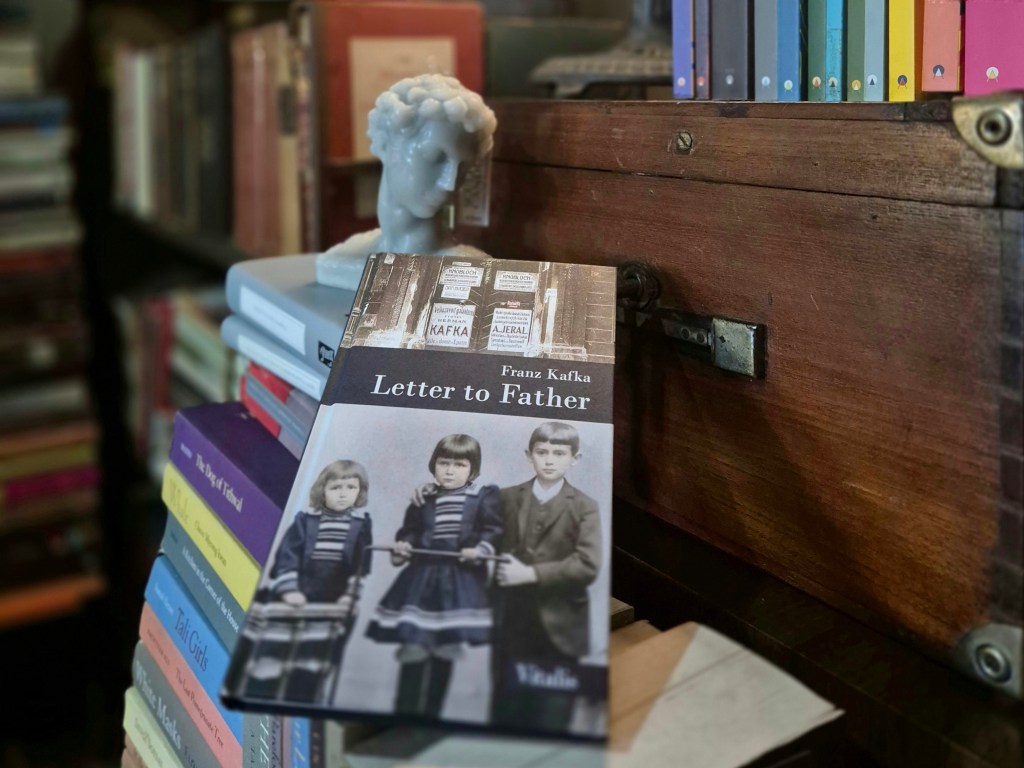
What a delightful surprise to receive “Letter to Father” as pasalubong from family friends who just got back from a trip to Europe a few weeks ago!
This publication by Vitalis is exquisite as it reveals Kafka’s lesser-known side as a graphic artist by featuring Kafka’s drawings in this famous indictment of his father.
Although it is a painful book to read, and it took me longer to finish it than I would normally a text of this length, it is nonetheless a revealing and important part of the author’s body of work. It is probably the Kafka work that has affected me the most. One line especially stood out: “My writing was all about you, all I did there was lament what I couldn’t lament at your breast.”
Intercepted by his mother for obvious reasons, the letter sadly never reached the father. And here I am, heartbroken over the fact that these words have struck the hearts of millions who have read it over a hundred years after its writing, but forever lost to the eyes that were meant to read them.
“Is this the way to the Museum of Books?” The main entrance where a statue of Shota Rustaveli stood guard seemed to have been closed for an indefinitely long time, so I had to walk around the loggia and look for another door.
“Follow me,” the guard said without hesitation and led me through office backdoors and hallways lined with filing cabinets and some curious eyes peering through them when the rhythmic footfalls of my boots echoed through the corridors.
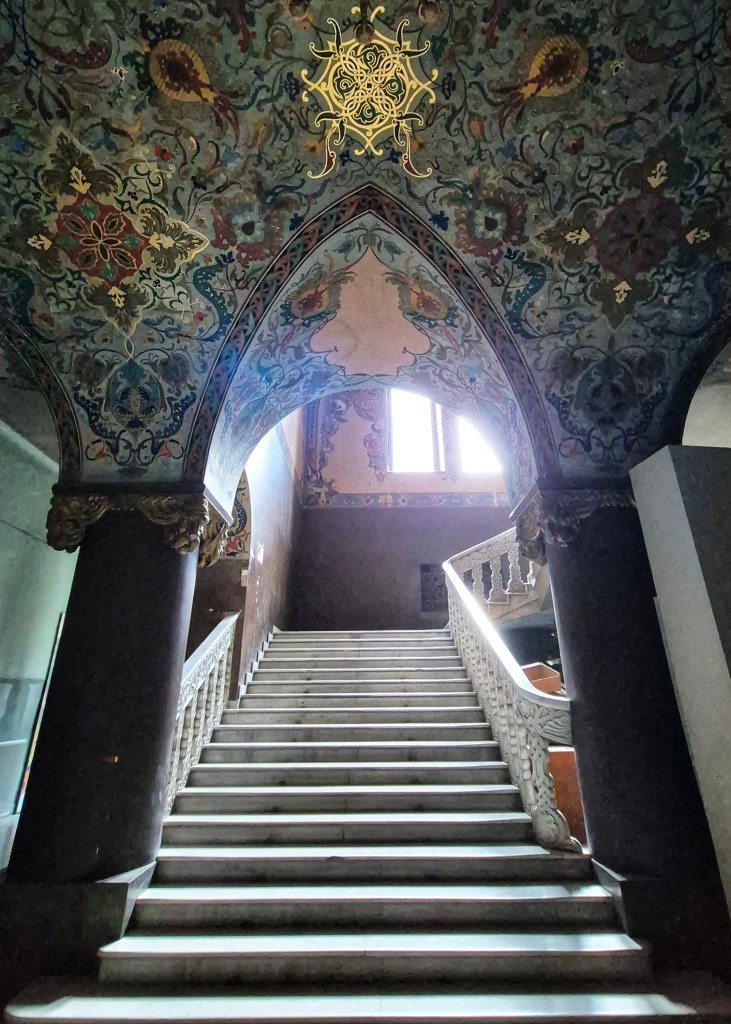
Just as I was feeling a little lost and self-conscious for being the only non-employee around, he turned around and said, “When you’re done, just exit the way you came in.” He left me, alone, staring open-mouthed at what was the entrance hall of Tbilisi’s Museum of Books.
Amber sunshine streamed through the windows, casting light on intricate adornments that I had never seen applied to buildings before. It was as if I was drawn inside a page of a medieval illuminated manuscript.
I soon learned that the building is a collaboration between the architect Anatoli Kargin and well-known painter Henry Hrinevski, who was also a book illustrator and manuscript illuminator as well as a scholar on traditional Georgian architecture, but who was sadly arrested and killed during Stalin’s Great Purge.
The building was completed in 1916 and erected as a bank, but became part of Georgia’s series of libraries, fittingly so, in 1931. It is Building I out of V monumental buildings housing the National Parliamentary Library of Georgia.
Recognized as one of the finest museums dedicated to the written word, it boasts of personal libraries of Georgia’s eminent authors, the first book printed in the Georgian language, and autographed works by famous writers including Victor Hugo.
I went there for the books but came out deeply impressed knowing that the building that holds such treasures is, itself, one for the books.
Significant Palestinian literature, to this reader, seems to indirectly and collectively ask the Other this particular question: We acknowledge your pain, do you acknowledge ours?
The frustration and the trouble stem from the fact that the answer has often been “no”.
Although worded differently and more succinctly, this book asks the same question, alongside all the other important questions concerning Palestine and Israel. It is Israeli-Palestinian Conflict 101 for those who cannot decide on what to think or say about the whole thing.
Without the dramatic and emotional pronouncements of novels, Edward Said organizes rational thinking, facts, and hopeful solutions with the most concise, coherent, and decisive voice I have ever heard on the Palestinian predicament. All that, while being understanding and un-dismissive of Jewish history and concerns.
This book is evidence that it is not so hard to understand the question of Palestine — but only if one is willing to understand and undo years of hearing only one side. It is also the perfect antidote to well-intentioned and shallow sloganeering. Never have I been so impelled to give a book a standing ovation.
But this book does not need my commentary. It only needs to be read.
“But the thing is, she didn’t die. No, she went on.”
Black Butterflies by Priscilla Morris
A book set during the Siege of Sarajevo hits differently when it is recommended by someone whose family was directly affected by the Bosnian War. It heightens the truth in a work of historical fiction.
It was an easy pick as my first book of the year, despite the promise of grim events. I did not wait for the hard copy to fall into my hands. The e-book was immediately downloaded when I learned that its main characters were an artist, a writer, and a bookstore owner who lent his books during the siege because he believed it was a time when people needed stories the most; and I could not put the book down as soon as I learned that “black butterflies” were the scorched pages from the burning of the national library — “burnt fragments of poetry and art catching in people’s hair.”
The friend who told me that I should read this was not wrong. It is a poignant story about how art triumphs and can oftentimes be the thing that saves us. But at the same time, this book is a sobering and relevant reminder, amidst the season’s celebrations, that similar things are happening in other parts of the world; histories are being erased; libraries are being bombed and burned; entire nations are going through the most violent traumas; and the heritage of entire peoples are being turned to debris.
Books like this convey what hate can do, but books like this also proclaim what art can do. To be one less person in this world who hates — may this be the lesson that the books and the art we consume always teach us.
“He had put the Times Atlas of World History under the paper on which he was noting my answers… The boy likes leafing through it when the shells fall.”
Death in the Museum of Modern Art by Alma Lazarevska
These evocative short stories by Bosnian writer, Alma Lazarevska, complement Black Butterflies. It does not go into detail about the history of the besieged city in which her characters are set. Nothing about what caused the war or about the opposing factions, nothing about a nation’s history. Rather, the history of a day, the history of a feeling, and the intimacy of a thought. Lazarevska leaves the greater scheme of things to the historians and paints ordinary life and “the space of their painful interweaving” as the city is being starved and bombed.
This was recommended to me by another friend after I posted about Black Butterflies. I wouldn’t have predicted earlier on that the first two books I’d read in 2025 would be set in the Balkans, and yet, here we are. Are the Balkans calling (louder this time)?
In one of the stories, an Austrian writer is referred to, “Whose books are an excellent weapon against shallow sentiment.” That line stuck with me and it aptly applies to this masterful work.
Thank you, Anna and Vishy for these splendid recommendations!
To celebrate my 40th in Iran, that was the dream. It was supposed to be Iran.
But life often has a knack of improvising on my dreams. Flights to Iran were suspended as I was about to book tickets; and it wouldn’t have been good for my parents’ hearts had I forced it at this volatile time in history.
Iran chose to remain elusive. Then I was reminded of a line from Ali & Nino: “Surely love is the same in Georgia as in Iran.” Georgia, or Gurjistan, was one of the Persian “stans,” after all, and was under Persian suzerainty for centuries. And surely, if love is, as they say, the same in Georgia as in Iran, then perhaps celebrating 40 in Georgia wouldn’t be too different either? (“But there are protests,” they said. “At least there are no missiles,” I answered.)
The time had come for Georgia to be lived, aside from being read — for the literature of the Caucasus to be finally given the chance to lend depth and texture to my travels, and to the narrative of my experience.
Doha – Tbilisi Flight RouteFlying over ShirazEven Iran’s skies are incomparableThe Zagros Mountains peeking through the clouds!!!Flying over IsfahanTwinkling lights of Armenia
Little did I know that the flight route from Doha to Tbilisi would fly over Shiraz and Isfahan. As if on cue, there was a sudden otherworldly sunset display through the airplane window just as we flew over Isfahan. Instead of Isfahan’s Eternal Flames, I was given the sun. And through the clouds, I saw traces of Isfahan down below; appearing to reassure me that it would be there waiting until the right time came along.
Then a full moon ushered me to Georgia. And I soon learned that Georgia, for a nation so tiny, is a generous country — not just in their wine servings, but in beauty and unforgettable experiences. (Maybe therein lies the advantage of smaller countries: beauty is concentrated, undiluted, and undiffused.) All at once, Georgia felt right.
Hopefully, someday, Iran will feel right, too. But at this particular point in life, Georgia is exactly what I needed. The trip was a gift that I’ll always be grateful for — a melding of deeply beautiful things and non-things, as if traveling knew no other way to be.
I’ve been asked what being forty feels like. With books (and maybe an occasional glass of wine haha) by my side, forty feels right. 🤍
“I hope you’ll remember me,” one of my guides said after a lovely day. “If not me, I hope you’ll remember my people and my country. I hope you’ll remember us as people who know how to live, and I hope your trip taught you a thing or two about how to live. I hope you love your country as much as we love ours.” Then he held out his glass of wine and said, “May this be the worst day of our lives. Gaumarjos!”
How their words for saying “cheers” and “hello” are rooted in the word for victory already speaks volumes of their history. Geographically flanked by some of the greatest empires the world has known, this isthmus connecting Europe to Asia has been bathed in blood for centuries. It is crazy to think that I have lived far longer than their democracy.
I have written my guide’s words in my journal, and they keep coming back to me as news of the intensifying protests reaches me here at home. I witnessed the peaceful protests in Tbilisi first-hand and it made me question if the media had exaggerated things. But I just saw a tranquil avenue I walked through many times swarming with protesters, now I’m not sure what’s really happening out there anymore. I can’t ask the people I’ve met because, as a rule, I rarely exchange contact details with people I meet in my travels.
But I do keep Georgia and her people on my mind. I remember them as people who know how to live. I know how much profound pride and love they have for their country, far from the shallow, sloganeering kind of pride and love for country. I hope their streets and their pathways remain free from conflict and violence, because I, for one, found peace walking down those avenues and through those pathways.
Thus begins one of Pushkin’s most personal and most poignant poems, it inspired the composer, Rimsky-Korsakov to set it to music.
The full moon, an air balloon, and the Bridge of Peace over the Kura River
“Such sadness and such ease; my melancholy’s light…”
Has any other poet ever expressed this exact point in loving and having lost; when there is still sadness, but there is now ease; when there is melancholy, but it has become light?
On hills of Georgia lies the covering of night. There is darkness, but there is beauty, and there is light.
“Georgia is a land that bursts with emotion, flavor, and texture, in people, landscape, food, and — so important — wine.” For the Love of Wine, Alice Feiring
Most of the Georgian words that I’ve brought back home have something to do with wine: Qvevri – the clay vessel used for fermentation (only their brandy and chacha are aged in barrels). Chacha – a cross between brandy and vodka derived from grape which Bourdain nicknamed the “national firewater”. Kantsi – animal horns converted into drinking vessels. Piala – terra cotta wine cup, like the one Mother of Georgia is holding with one hand, a sword on the other. Marani – a winery. Add to that the names of their wines: Kisi, Saperavi, Rkatsiteli, Kindzmarauli, Khvanchkara, etc…. The Georgians taught me well.
Mention “wine tasting” in the Philippines and you’ll come off to many as “pa-sosyal” (bourgeois with a dash of pretentious haha).
Not in Georgia. With approximately 525 indigenous grapes, an 8000-year-old winemaking history, and families producing their own wine, wine is tradition, wine is culture, and wine is part of religion, poetry, and daily life. After being assailed by the Ottomans, by the violence of the Mongols, by the Persians under Shah Abbas II who uprooted their grapevines, or by forced Soviet industrialization that replaced quality artisanship with mass production, natural wine is their symbol of survival. Wine is identity.
“Wine is an essential thread in the fabric of the country and the people… nowhere in the modern world is there a nation like Georgia, with this concept of wine — a fire coursing through its veins,” writes Alice Feiring. For the Love of Wine: My Odyssey Through the World’s Most Ancient Wine Culture prepared me for, and accompanied me to, a wine-tasting event for almost every day I was in Georgia.
These wine tastings are not like the ones in my country that are only for the privileged. Georgians are willing to let their guests experience this for free if only to convey that in order to understand Georgia and its people, one must understand their wine culture.
Additives are not used and it is illegal to add sweeteners to their qvevri wines, and chemical fertilizers for the vines are denounced. One Georgian vintner was quoted in Feiring’s book saying, “Every inch of my soil is soaked with the blood of my ancestors. This is the strength of the Georgian wine. This is our terroir. What do you use?”
But perhaps the best lesson I’ve learned is that producing the finest wine is also about planting the vines in places where they have to struggle. “If grapes had it too easy, the fruit had less character…”
That adds a profound layer to that adage about aging like fine wine, doesn’t it? It’s a rather fitting lesson to learn on a birthday trip. Fine wine is what survives the struggle. Gaumarjos!