The Iranian Jewish main character adds a layer of complexity to an already convoluted political terrain, and that is what sets it apart from the few books I have read about the Iranian Revolution.
Isaac Amin, a poet turned wealthy gemologist, is arrested and accused of being an Israeli spy. His ethnicity and his status incriminates him. He is guilty of the blatant sin of being a wealthy Jew.
But who can hope for a fair trial? “If you think there is going to be a trial you’re going to be very disappointed.” There is only interrogation and torture.
Dalia Sofer writes with a slow burning suspense and unravels difficult matters with a remarkable ease. From affecting scenes of prisoners reciting poetry to each other, to dialogues that confront social issues, to thoughts about religion and family, she breathes into them beautiful subtleties and realities that are literary pearls.
I judged this book by its cover. There seemed something saccharine about it that it took me a while to pick it up. But because of a long-standing personal intention to piece together a literary tapestry of the Fertile Crescent, I finally read it.
How wrong I was! There is absolutely nothing saccharine about post-Revolution Iran or in the physical and psychological tortures of their prisons.
The novel moves back and forth between Isaac in prison, his wife and daughter who take control of their situation in individual ways in Tehran, and a son studying architecture in New York. We see almost nothing of Shiraz, and it takes a while to understand that Septembers of Shiraz is a wistful metaphor and allusion to brighter days that have become irredeemable.
Rabih Alameddine is insane. His Hakawati is Arabian Nights on drugs, a dizzying magic carpet ride. When I thought a book’s structure could not get crazier, I end up with this: I, The Divine. A novel in first chapters. Yes, each section is Chapter One all throughout the book! With the exception of the Prologue on page 110 and the Introduction at the very end!
But I cannot recommend this author to everyone. He will make readers feel uncomfortable. There are obscenities. Lots of it. But these obscenities are often realities — war, murder, suicide, rape. With the Lebanese Civil War as backdrop, and through the main character and her family, we are shown how a nation’s events shape the lives of its people.
He seems to be the kind of writer who loves giving the reader a good challenge; one has to be sensitive to allusions and metaphors otherwise the point is overlooked. But amidst these dark and heavy themes, he surprises you by making you laugh! I repeat, Rabih Alameddine is insane…
…but who also happens to be a painter who has exhibited in London, New York, and Paris. This explains the colorful passages, and in his two works that I’ve read, references to art and artists adorn his pages. In one of the earlier first chapters, he quotes the artist, John Dwyer McLaughlin, “These Asian paintings I could get into and they made me wonder who I was. By contrast, Western painters tried to tell me who they were.”
This, to me, was a signpost that signaled how this book is, above anything else, about identity, a comparison of Eastern and Western thought, and an additional reflection to my Fertile Crescent literary tapestry on individuality and community. By the end of the book, this is confirmed:
“If I wanted to know about lion, I had to look at the entire pride. I had to look at it not as a single organism per se, but as a new unit much larger than the sum of its parts… I could not begin to fathom what being a lion was if I only looked at each lion individually, or even at the relationships between the lions. All of them together, not all of them individually summed up, but all of them as a dynamic organism, were the species; all were the word lion.
I had tried to write my memoir by telling an imaginary reader to listen to my story. Come learn about me, I said. I have a great story to tell you because I have led an interesting life. Come meet me. But how can I expect readers to know who I am if I do not tell them about my family, my friends, the relationships in my life? Who am I if not where I fit in the world, where I fit in the lives of the people dear to me? I have to explain how the individual participated in the larger organism, to show how I fit into this larger whole. So instead of telling the reader, Come meet me, I have to say something else. Come meet my family. Come meet my friends. Come here, I say. Come meet my pride.”
My initiation to Pamuk was My Name is Red circa 2006. He opened up a whole new world of literature to me. Scouring bookstores for his other works was a natural aftermath.
It goes without saying that I found the writing spectacular, but fifteen years ago The White Castle meant nothing more to me than a tale set in the 17th century about an Italian intellectual who sets sail from Venice to Naples only to be captured by Turks and brought to Constantinople where his master would turn out to be his doppelgänger. I knew it was a novel about identity, but it did not leave a lasting impression back then.
I had even forgotten that this was set during a pandemic wherein people lived in fear of the plague! “Janissaries guarded the entrances to the market-places, the avenues, the boat landings, halting passers-by, interrogating them: ‘Who are you? Where are you going? Where are you coming from?’”
The same questions that each doppelgänger would often ask the other and himself — the same questions that confront the reader.
Through my re-reading, I discovered nuances that were lost to my younger mind; and passages that I previously failed to mark with a pencil leapt up from the pages with intensity.
Over the course of time, the two characters’ lives would become inextricably entwined, they would embark on engineering projects, study astronomy, work on other branches of science, write books and and share a life together. As soon as Pamuk tricks us into thinking that one is inferior to the other, and into making us think we have a good grasp of who is truly master or slave, their roles would be reversed until it becomes difficult to tell them apart. And yet, their likeness is something that they do not acknowledge openly.
By and by, the question of who is superior? fades into oblivion and metamorphoses into who is who?
On one occasion, the Sultan asks them, “Have you two never looked at yourselves in the mirror together?”
And there it was, the very point that I missed hiding in plain sight — East and West personified!
And who else more qualified to write about their tumultuous but inevitable relationship? But of course! A man from that city perched on both East and West!
When Naguib Mahfouz wrote this, he had not been awarded the Nobel yet, but his Adrift on the Nile had already been banned during the term of Anwar Sadat — the leader to whom the title refers. The story is set during Sadat’s Infitah, the policy that would incense Arabs to oppose him and one that would lead to his assassination.
Mahfouz had not known then that after Sadat there would be worse intellectual persecutors, and the future would find him stabbed in the neck in an attack that would tragically impair his writing hand.
Eleven years before the incident, this was published. One should not expect grandeur from this, or a sweeping account of Egypt’s history and politics. Here, Mahfouz intimates to us the lives of three common people, “redundant people,” as one narrator would describe.
The three narrators are Muhtashimi Zayed, the grandfather; Elwan, the grandson; and Randa, Elwan’s fiancée: Characters whose daily lives are affected by the Infitah.
The juxtaposition of their lives and the trajectory of their sentiments with the day the leader is killed is an intelligent tool. Because with momentous events such as the assassination, we think little of these lives, their loves, their troubles. The strength of this book is in the intimacy that Mahfouz beckons us to experience. I like how the title cleverly deceives us like a headline by a Western news network of news in the Middle East: We are tricked into thinking that we already know what the story is about, when in fact, we don’t.
“It happened all the time in this city that encompassed seven hills, two continents, three seas and fifteen million mouths… yet another cry that went unheard in Istanbul… Istanbul was no stranger to sexual abuse.”
These were fleeting lines from Shafak’s Three Daughters of Eve, but it is what takes center-stage in 10 Minutes 38 Seconds in This Strange World.
This novel is an act of activism. Beyond the pretty covers, Shafak always lends a voice to those who do not have any, or whose voices are weaker than others — social pariahs, the unwanted, the unworthy, the unidentified, cultural lepers, and women.
This is a difficult read, especially for women. For women to get emotional when reading this is an understatement. Its bitter truths are suffocating; and at the verge of tears, I often felt my heart constricting.
Shafak does not romanticize Istanbul. She shows us the Istanbul that the Ministry of Tourism would not want foreigners to see — a place where sexual assault, psychological abuse, and violence against women often go unpunished. Sure, it happens all over the world, one might reason; but it is worse for women in nations that do not honor their rights.
This is an especially apt read after Turkey’s President Erdoğan officially withdrew from the Istanbul Convention, a treaty preventing and combating violence against women, and domestic violence. That is what led me to read this. Erdoğan followed the withdrawal by unveiling an “Action Plan for Combating Violence against Women,” which includes goals such as reviewing judicial processes, improving protection services and gathering data on violence, but Turkish women feel unsafe and remain doubtful.
So, incase you have not read this yet and ask yourself upon reading the summary of this book, “What would I get from a story about a dead prostitute?” The answer is awareness. And hopefully, empathy.
Needless to say, it is certainly well-written, too.
This is one of those art forms that make you feel that you have absorbed so much and understood so little at the same time. It has been identified as the finest novel on the Lebanese Civil War, but I am more convinced that it is postmodern poetry.
The point was over there. A woman, glowing… I was holding her by the hair and drowning in the place where the pain flowed from her shoulders… I was not saying anything but was not quiet either. The apogee of sadness. She cried, sitting at the edge of the room, holding her breasts. I went toward her, frightened. No, I wasn’t frightened. I was looking for something or other, for a word. But she remained on the edge of the room. Then stood up, came toward me. I held her, she dropped to the floor and broke, and the room filled with pieces of shrapnel. I bent down to pick them up, blood began to flow and the walls were covered in mud and trees… She was the point. To hold her was to hold nothing. She would run off, leaving me baffled. I would run after her. That’s how she imprisoned me inside a dream that was hard to abandon… This is the revolution, I said. Just like this, living in the constant discovery of everything, in the nothingness of everything. That is revolution.
Elias Khoury comes from the generation of Lebanese novelists who reflect in their writings the constant threat of their national identity’s dissolution. Read this forewarned that they do not adhere to the Western form of the novel, because to them “form is an adventure”, as the Edward W. Said writes in the foreword of this edition. “…when the chapters conclude, they come to no rest, no final cadence, no respite.”
Read this to feel — not to know, but to feel — a nation’s tragic plight. Read this for the strangely beautiful language. Read this like you would a prolonged and lingering poem…
Syria came to international attention in 2013 because of the refugee crisis. Since then, I have been searching for a book that would cover more than its current conflict and tell me about Syria’s history and the everyday lives of its people before the humanitarian disaster.
This book delivered just that. Alia Malek designates her grandmother’s old apartment building in Damascus as the heart of the memoir, and effectively narrates over a century of Syrian history and political phases through the different generations and families that occupied and moved through its space.
In this fine balance between family and national chronicle, one does not overshadow the other; thus allowing history to be accessible and engaging, and leaves room for the captivating details of society and tradition.
The author succinctly outlines Syria’s history from the fall of the Ottoman Empire that ruled Greater Syria, to the 1916 Sykes-Picot Agreement between France and the United Kingdom (resulting in France taking Syria and Lebanon, and the British laying hold of Palestine and Iraq), the foreign-imposed evolution of its borders, its numerous coups, the rise of Hafez al-Assad, and up to the bullet-ridden Syria that we see on the news.
Probably owing to being both journalist and lawyer, Alia Malek does away with over-sentimentality despite the painful undercurrents but writes with great sensitivity and insight. This did not rend my heart the way other books about Syria have done, but at the end of the acknowledgments a line still managed to ambush me and stirred up tears: “Lastly, to Syria and the generations before, which gave us life, beauty, and this profound pain, thank you for making us your children. And may you find it possible to forgive us.”
Through the memoir we are shown a Syria and a people that we do not often see portrayed; a Syria of rich cultural heritage, a multi-cultural and colorful nation of Arab Jews, Armenians, Christians, Sunnis, Shias, and Alawites. After all, Syria was once a haven for the persecuted during the Armenian genocide, a significant punctuation in the Silk Route, a place of Crusader castles, and the site of many Roman metropolises. Yet Syrians arrive at the doors of our consciousness either as despots, extremists, or refugees. We are guilty of viewing people from this region monolithically, and it is time we realize that the loss of their home and heritage is the world’s loss, too.
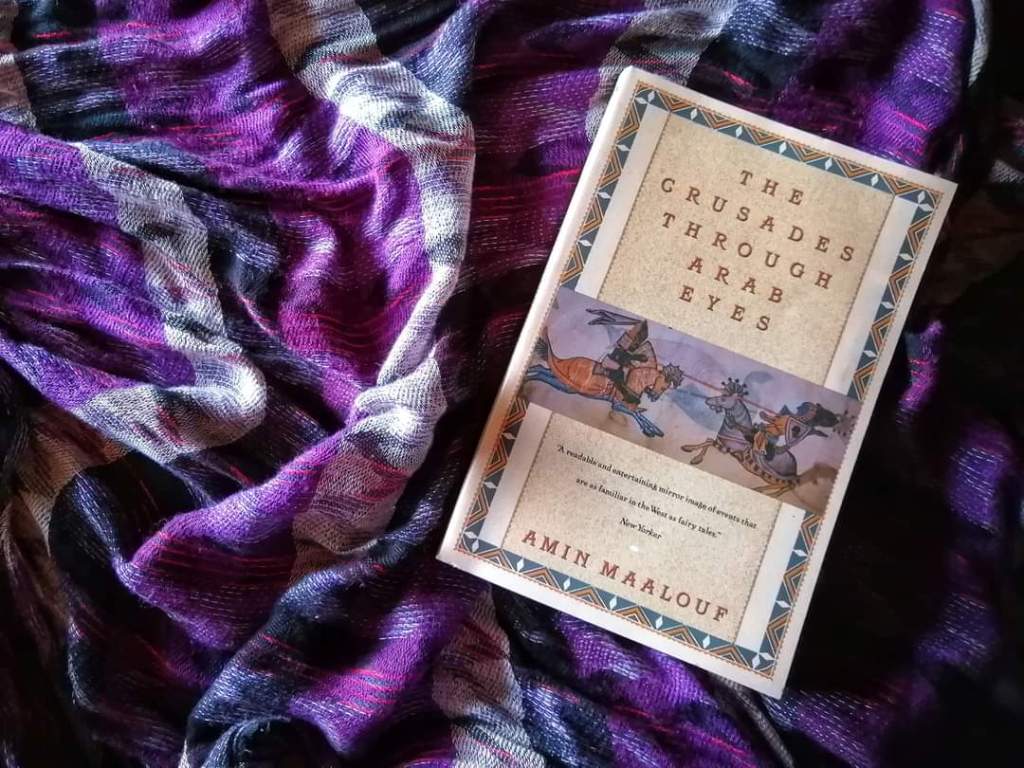
When Kingdom of Heaven premiered in 2005, the character that made the biggest impression on me was Saladin. Although I expected the film to be highly fictionalized, I hadn’t realized how much of it was true based on eye-witness accounts that survived from that period! From the writings of Ibn al-Athīr (1160-1233) to Ibn Jubayr (1145-1217) and others including a few Western chroniclers, Amin Maalouf condenses the events of 1099-1291 and gives us The Crusades Through Arab Eyes.
Published in 1984, this work questioned and redrafted the prevalent narrative of who the world thought of as barbarians. The reader is made mindful that, “At the time of the Crusades, the Arab world, from Spain to Iraq, was the intellectual and material repository of the planet’s most advanced civilization,” and it was only posterior to the Crusades that the trajectory of intellectual advancement and world history would shift to the West.
It was the era of Assassins, Seljuks, Fatimids, Ayyubids, Mamluks, the Crusaders, Templars, and eventually, the Mongols. Needless to say, Game of Throne-ish details abound! But what I value most about this book is how it defines the chronology, succession, and the characters of the Crusades in a gripping way that will not easily slip into the lapses of my memory; and more valuable is the epilogue where we are made to understand the repercussions and a seeming collective trauma nearly a thousand years later.
— “What they learned from the Arabs was indispensable in their subsequent expansion… In medicine, astronomy, chemistry, geography, mathematics, and architecture, the Franj drew their knowledge from Arabic books, which they assimilated, imitated, and then surpassed.”
— “The epoch of the Crusades ignited a genuine economic and cultural revolution in Western Europe, in the Orient these wars led to long centuries of decadence and obscurantism.”
— “Assaulted from all quarters, the Muslim world turned in on itself. It became over-sensitive, defensive, intolerant, sterile — attitudes that grew steadily worse as world-wide evolution, a process from which the Muslim world felt excluded, continued.”
— “The Arabs refused to open their own society to ideas from the West. And this, in all likelihood, was the most disastrous effect of the aggression of which they were the victims.”
— “The Arab world… cannot bring itself to consider the Crusades a mere episode in the bygone past. It is often surprising to discover the extent to which the attitude of the Arabs (and of Muslims in general) towards the West is still influenced, even today by events that supposedly ended some seven centuries ago.
— “There can be no doubt that the schism between these two worlds dates from the Crusades, deeply felt by the Arabs, even today, as an act of rape.”
These books were read little by little and treated as breathers between larger works, but they are by no means inferior or less meaningful to me. Having finally read the last of the essays, these three are now among the most prized books on my shelf. And I say this with confidence: Filipinos are my favorite essayists!
Using nature as a leitmotif, Aimee Nezhukumatathil’s World of Wonders nudges us to keep our eyes open with childlike curiosity and to keep our hearts soft. It is amazing how she touches on racism, school shootings, climate change, and life’s difficulties without any hint of vitriol. Her writing is refreshing — not like a cool drink on a summer day. Refreshing like a good cry that unburdens the heart and reminds you of life’s wonders. Our hearts need this.
Gideon Lasco’s The Philippines is Not a Small Country is a gift to the Filipino people that we should embrace with gratitude. He shows us the Philippines for what it really is and how deserving it is of new and hopeful eyes. What I’ve written about Pamuk and his relationship with Turkey, I can also write about Lasco and his relationship with our country: He is someone who recognizes a nation profoundly inside out, from its complicated politics to its inner conflicts and issues, its customs and traditions… and offers a viewpoint only a lasting lover can deliver who, after having seen a beloved’s glories and deepest flaws and undesirable secrets, remains and continues to love.
“When we realize that we Filipinos, far from passive victims of history, have always been active in making not just our history but that of the world, we begin to overcome the feeling of smallness that sets back our geopolitical imagination. What our past should give us is not an enmity for those who pressed us but an empathy for those who experience oppression.
What our past should give us is neither a feeling of victimization nor entitlement but a dignity of a people that has suffered much — but has overcome more.”
Even though there is so much to resonate with and quote from Carmen Guerrero Nakpil’s Woman Enough and Other Essays, despite being written between 1951-1961, I’m choosing to end with these relevant reminders as today we witness President Duterte’s final State of the Nation Address.
— “Politics is not all crooks and racketeers and ten percenters. It is not the loud, interminable speeches… or the handshaking in the barrios while a photographer snaps his camera or the number of dancing girls given to each delegate to the national convention. That is not politics, but only its aberrations. Among many of us, those practices have come to mean politics. But they are only the abuse of politics.”
— “This is one of the beautiful paradoxes of politics. Politics may make us, but it is for us to shape it.”
— “You should learn to look at elections, not as contests in goodness or popularity between two or more men, but as a national stock-taking, an occasion for citizens to make up their minds which course of national action to choose over another.”
— “You see how important it is for all citizens to be intelligent, well informed and judicious.”
— “The question is not whether some of us do not love our country or some of us do. The question is in what way we love it.”
— “As a parting favor, I would like to ask you all intelligent women not to take my word for this or for anything. Think about the things we have discussed here, and ponder on them yourself. Discuss them with your friends, seek the opinion of others, but make the decision yourself.”
— “In your intelligence, application, your honesty with yourself, and in your wisdom, will lie the future of the Philippines.”
It is difficult to invest time in a book that is nearly six hundred pages thick these days, but From Beirut to Jerusalem was even more difficult to put down! This is impressive journalism!
Although Friedman writes with a more personal tone, one cannot help comparing it to Black Wave by Ghattas, because at some point after these books’ respective publications, it has been said of each that if there is a book one should read to achieve a better idea of the morass of Middle Eastern politics and relationships, it should be this. I think it should be both.
I read Kim Ghattas for her Lebanese roots, and Thomas Friedman for his Jewish upbringing and on account of his three Pulitzer awards. I assumed their backgrounds would affect their insights, but these two books surprisingly complement each other! Aside from a comprehensive account, they have chosen to elaborate on different aspects and, together, give the reader an even more exhaustive view — albeit exhausting, too.
These journalists have confronted some of the most complex and divisive issues and have endeavored to organize the confusion for us, readers, despite knowing they would ruffle feathers. While we know that no one can ever give us the complete picture, it is a substantial step.
I have to admit that most of what I know about Middle Eastern affairs are spoon-fed by selective news networks or social media pages that cater sensationalisms, half-truths, and over-simplifications to the passive.
If there is one good thing that this pandemic has given me, it is the chance to check my own biases and avoid shaping lazy opinions, and be reminded that there is so much I do not know; and that it is alright, and necessary, to reevaluate my thoughts and opinions — not just on matters of a realm thousands of miles away, but on life in general.