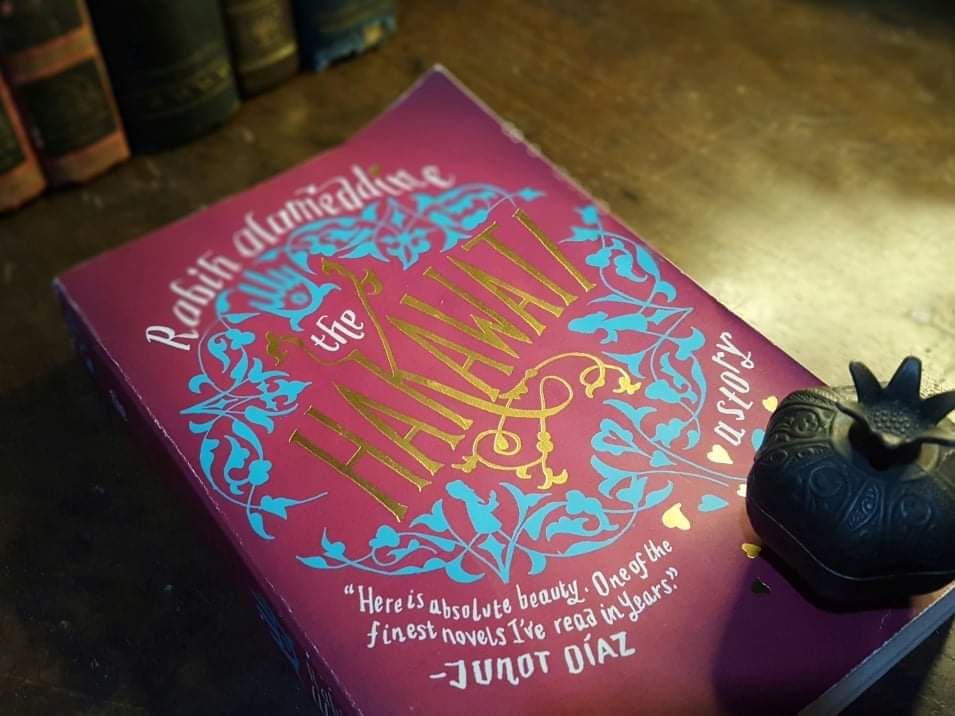
Rabih Alameddine: The Hakawati

February 18, 2021

This book is on fire! A dizzying magic carpet ride. A jealous book. It requires your full attention. Look away and you will lose track and get lost, look closer and you will get lost in the stories within stories within stories. It is a matter of choosing your definition of “lost.”

“No matter how good a story is, there is more at stake in the telling,” says the hakawati. The evidence is the book itself, a contemporary retelling of the Arabian Nights through the approach of Lebanese writer, Rabih Alameddine; but this is the Arabian Nights (uncensored, the author warns), deeper and more relevant, and suffused with rich Lebanese culture and history.  It is wondrous, bizarre, sometimes even vulgar and repulsive — but only when you take things literally and only until you realize they are metaphors and then it becomes disturbing, and then these parts become ingenious!

One does not have to read the Arabian Nights in order to enjoy this, but I believe it will be better appreciated with an ample background. Many references would have been lost to me and some sections would have seemed absurd had I bypassed the Arabian Nights. The writing style does not have a tinge of mediocrity, and yet I am aware that it cannot be everyone’s cup of coffee; but I will remember this book for the beautiful words it gave me:

Hakawati — “A hakawati is a teller of tales, myths, and fables (hekayat).  A story-teller, and entertainer. A troubadour of sorts, someone who earns his keep by beguiling an audience with yarns… ‘hakawati’ is derived from the Lebanese word ‘haki,’ which means ‘talk’ or ‘conversation’. This suggests that in Lebanese the mere act of talking is storytelling.”

Zajal — a poetry duel practiced in Lebanon until today.

Bakhshi — an oud player, a singer, and a storyteller.

Maqam — In the Arabic language it means place, location, situation, position, a shrine, but in Arabic music it is a scale and a mood. “Teardrops descending along cheeks, a cascade of grace,” as the protagonist puts it lyrically.

Tarab — “A musical enchantment. It is when both musician and listener are bewitched by the music.” An entrancement achieved between performer and listener while engaged in music.

This whole book is a cacophony of stories. How fitting that its last word is “listen”.

Naguib Mahfouz: Arabian Days and Nights

February 22, 2021

Aladdin asked, “Who are the associates of devils?”
“A prince without learning, a scholar without virtue… the corruption of the world lies in their corruption.”

Twenty pages into this book and it already felt like I was reading Crime and Punishment instead of another variation of the Arabian Nights. Apparently, it is not a retelling of the Arabian Nights but a grim sequel drained of the amusement and is, instead, a disquieting political message and social commentary. It weighs heavily.

Right at the beginning it exposes the false piety and corruption of those who are in power when a man of good social standing commits a heinous crime and the poor are arrested, questioned, and accused, whilst the authorities “believe in mercy even when we are chopping necks and cropping heads.”

Characters of the Arabian Nights appear throughout the book, their lives intertwined, but the genies are not the type that fulfill wishes. Some play fateful pranks and some act like consciences, testing the human capacity for good and evil, or calling out the faults of those in power, “If you are called upon to do good, you claim you are incapable; and if you are called upon to do evil, you set about it in the name of duty.” And those in power justify their deeds by saying, “He who’s too decent goes hungry in this city.”

As Scheherazade intimates to Sultan Shahryar, “The fact that stories repeat themselves is an indication of their truth, Your Majesty.” True enough. We see these stories repeated outside of fiction and right smack in the middle of our lives. 

This novel is, indeed, a ratification of Naguib Mahfouz’s Nobel Prize.

“Wisdom is a difficult requirement — it is not inherited as a throne is.”

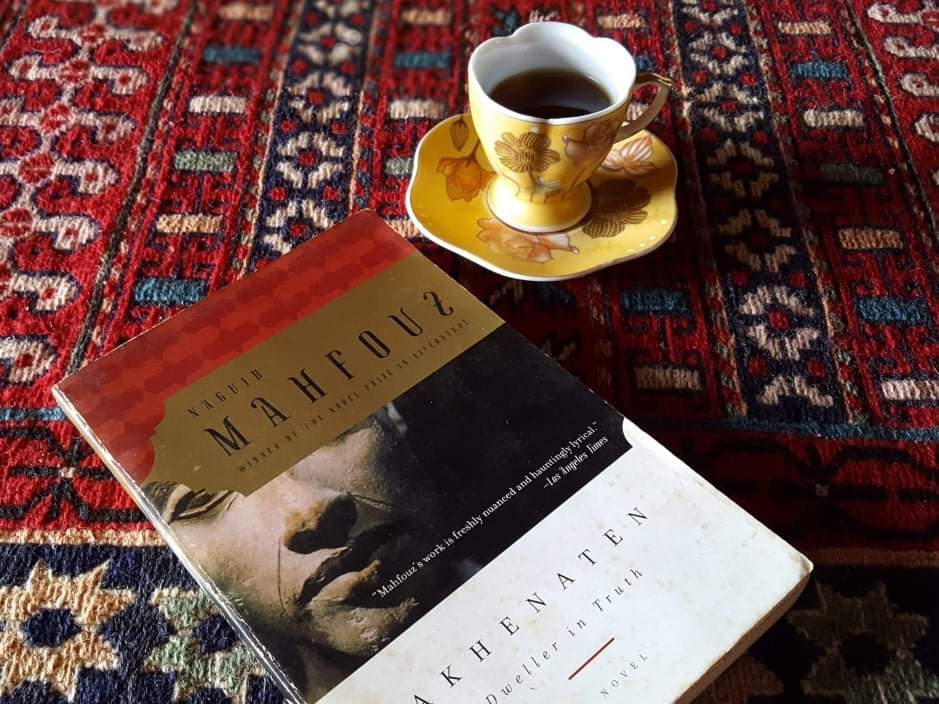
Naguib Mahfouz: Akhenaten

February 13, 2021

For its size, this book is surprisingly so many things at once! It is a subtle commentary on religion and faith aside from being an inquiry into the life of Egypt’s most controversial pharaoh who was persecuted and known as the “heretic pharaoh” for his monotheistic beliefs.

There is something so simple and elegant in the way Egyptian Nobel laureate Naguib Mahfouz allows Akhenaten’s story to unfold through the fictional narrator’s quest for the truth as he interviews the pharaoh’s contemporaries. Each chapter is named after these characters and it is through them that the reader is shown conflicting opinions and theories about the pharaoh and his powerful and beautiful queen, Nefertiti.

“…to set off along the path of history in search of truth, a path that has no beginning and no end, for it will always be extended by those who have a passion for eternal truth.”

What gave me goosebumps after reading it was when I learned that, out of all the days, The Metropolitan Opera was also streaming the premiere staging of Philip Glass’s Akhnaten! It became a mesmerizing continuation to what I had just read.

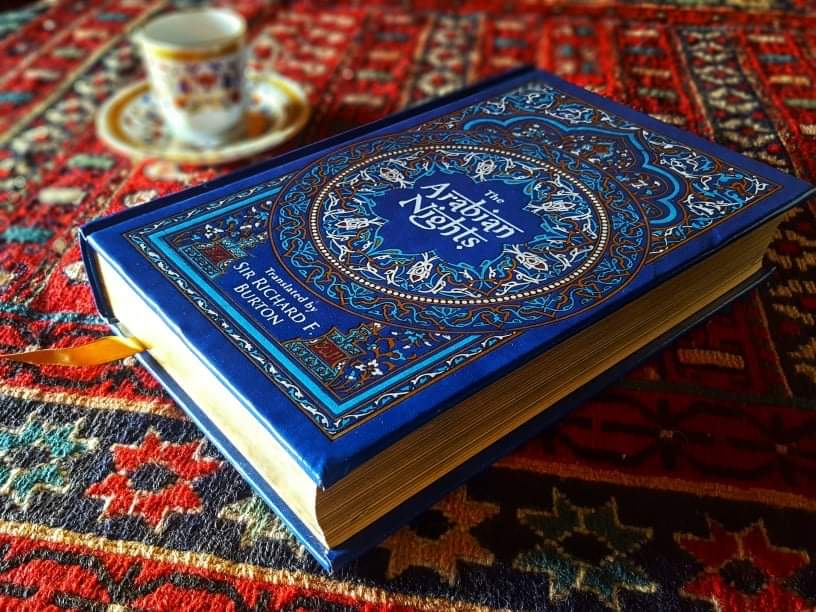
Arabian Nights Sir Richard Burton Translation

February 11, 2021

For this reading venture, I chose the controversial translation by Sir Richard Burton (1821-1890). I had to wade through hundreds of pages of old-fashioned language, terminology that are deemed politically incorrect nowadays, some unusual words that Burton coined himself, and content that was considered pornography in Burton’s time. (On a side note, Burton also translated the Kama Sutra and its Tunisian counterpart, The Perfumed Garden. Given those inclinations, this was not one of the watered-down versions we used to find lying around our grandparents’ living rooms.)

This edition has fine and tastefully-colored illustrations that are oases from the antiquated writing style that 21st Century eyes are no longer accustomed to.  A collection of Eastern folk tales and stories compiled during the Islamic Golden Age, I enjoyed coming across real historical figures from that era that were woven alongside the fictional characters.

Haroun al-Rashid, the fifth Abbasid Caliph who ruled from 786-809 appears in many of the stories along with his Persian vizier Jafar who, by the way, was not a villain.  The Islamic Empire was said to be at its most powerful under this caliph’s reign. They traded and maintained diplomatic ties with China, and because stories were also traded along the Silk Roads, it may not be too surprising that in the Arabian Nights, Aladdin is actually Chinese.

On the year Al-Rashid became caliph, his son Al-Mamun was born, and it would be Al-Mamun’s obsession for knowledge and a large-scale commissioning of translations of ancient texts from Mesopotamia, Persia, Greece, and India that would result into the Translation Movement — and perhaps, in addition, this compilation.

As one who finds this region of the world and that period of history intriguing, I still find this worthy of any book-lover’s shelf space. However, I now understand why later writers feel compelled to refashion the stories into something more relatable, or make adaptations for younger audiences without the sexual imagery, or modify the individual stories with a more discernible moral aim.

But whether we like it or not, the Arabian Nights in its entirety has revolutionized and influenced storytelling for centuries. After having read it myself, I realized that there is an aspect that is not emphasized enough: Hers was an unselfish act. Scheherazade volunteered herself at the risk of death to prove King Sharyar’s stereotypes wrong. By so doing, she saved not only her life, but other women’s lives as well — and through an unlikely medium!

After all, isn’t there inside each of us a Scheherazade, a being who depends on the magic of stories to survive?

Orhan Pamuk: A Strangeness in My Mind

February 5, 2021

The first page of this book quotes a passage from William Wordsworth’s The Prelude:
“I had melancholy thoughts…
A strangeness in my mind,
A feeling that I was not for that hour,
Nor for that place.”

For someone who has felt like an anachronism all her life, I felt like I owned these lines. It was as if I was meant to read the book just for this, and having come across it right at the start, the rest of the book was an additional literary present.

Ever since I read My Name is Red, I have been looking for the Orhan Pamuk I encountered there in each of his books. (I even looked for the actual Pamuk in Istanbul, persuading the whole family to visit his Museum of Innocence on the European side of the city in the hope of bumping into him.) I never seemed to find that Pamuk again.

But there is something in common with this book and My Name is Red. It is the way he allows different characters to gain control over the narration, thereby lending the reader a fuller grasp.

There are things Pamuk writes that make me uncomfortable, but these simultaneously compel me to admire a straightforwardness about life that only the most courageous writers can execute.

It is only through this book that I have seen for myself what all his works have in common — aside from providing details that escape the average consciousness, perhaps a result of having gone to architecture school — every book is a love story, no matter the plot or the characters: A love story between a writer and a place; between a writer and Istanbul, or Kars; between a writer and Turkey; a love story about the effects of the bittersweet passing of time on a place; about someone who recognizes a nation profoundly inside out, from its complicated politics to its inner conflicts and issues, its customs and traditions, from its spectacular buildings to its impoverished slums, from its most magnificent cities to its humble villages, from its splendid past to what it is now; a love story with a viewpoint only a lasting lover can deliver who, after having seen its glories and deepest flaws and undesirable secrets, remains and continues to love.

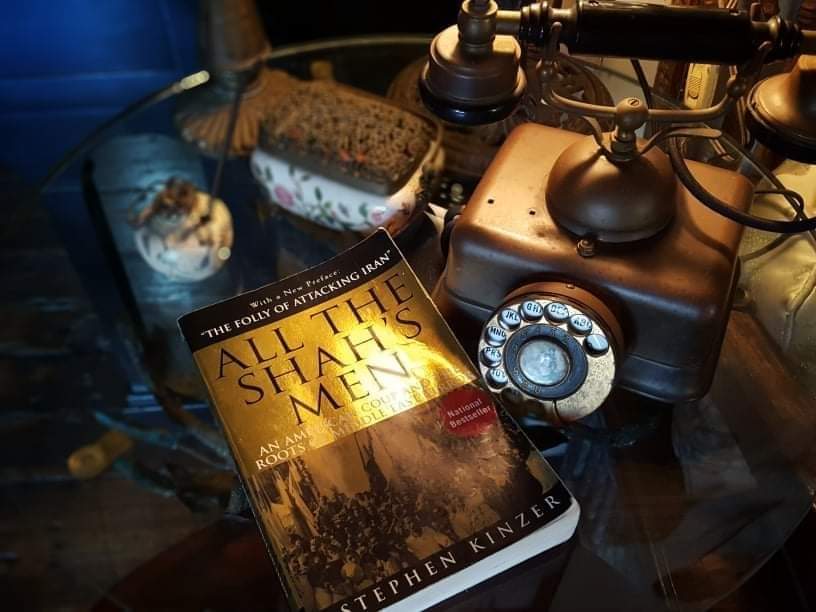
Stephen Kinzer: All the Shah’s Men

“There is nothing new in the world except the history you do not know.”

This quote by Harry Truman launches the book into previously confidential details about the 1953 Iranian coup d’état that had me gasping in shock from beginning to end!

It reads like espionage fiction but it is disquieting for the fact that it is nonfiction. It is by far the most comprehensive book I have read on Iran’s modern history. My notes and thoughts will remain private because I wish for my social media accounts to remain zones of peace haha, but I have to say that reading this reinforced my thoughts on Iran’s significance. It made me realize that many major circumstances around the world are ripples of a pivotal event that occurred in Iran more than half a century ago and that this nation continues to be a crucial piece on the chessboard of world history.

Jan Morris: Venice

Ordered by my best friend as a gift in preparation for a trip to La Serenissima in 2020, it finally arrived in 2021, two weeks shy of Venice’s 1600th founding anniversary! It is disappointing that the trip got postponed and that the book took over a year to get delivered because of the pandemic, but part of me is glad that I did not return to Venice without having read this! The details in this book are so rich and they would enrich any traveler.

Jan Morris writes beautifully, intimately, but most of all, truthfully; sometimes even bluntly. She takes us not merely along the lesser known nooks of Venice but also through the unvisited alleys of her tumultuous and mysterious history. “Nothing in the story of Venice is ordinary!”

I especially find it fascinating that even though my readings of late have been focused on the East, Venice is usually part of the narrative.  After all, “In Venice, as any gilded cockatrice will tell you, the East begins.” A major part of the Silk Route, Morris also notes that it is, in fact, the only Christian city marked in Ibn Khaldun’s map.  It will not come as a surprise that my favorite chapter is the seventeenth — Arabesque, because “the allusions of Venice are arabesque.”

Reading this already felt like a return and the book made it possible for me to be there — “through literary proxy,” as Gaston Bachelard would say.  It should also teach the reader about how and how not to travel: “Alas, the truth is that most visitors to Venice, in any case, move among her wonders mindlessly, pumped briskly through the machine and spewed out along the causeway as soon as they are properly processed.” Morris writes, too, of how the city’s “ingrained sadness is swamped with an effulgence of money-making.”

But despite its faults and tourism’s faults… it is still Venezia, which, according to Morris, is “an amphibious society peculiar to herself”; “half land, half sea… somewhere between a freak and a fairytale”; “a sexy city”; “a melancholy city at heart”; “a hall of curiosities.”

“A synonym for music,” echoes Nietzche.

Alain de Botton: The Art of Travel

“Ruskin was distressed by how seldom people noticed details. He deplored the blindness and haste of modern tourists, especially those who prided themselves on covering Europe in a week… ‘No changing of place at a hundred miles an hour will make us one whit stronger, happier, or wiser.  There was always more in the world than men could see, walked they ever so slowly; they will see it no better for going fast. The really precious things are thought and sight, not pace. It does… a man… no harm to go slow; for his glory is not all in going, but in being.’”

The really precious things are thought and sight! For his glory is not all in going, but in being! How beautiful is that?!

De Botton presents the chapters in an interesting way.  For each chapter there are featured places and featured guides. In Chapter 8, some of the places are Madrid, Amsterdam, Barbados, and the guide is John Ruskin.  In Chapter 7, the place is Provence, and the guide is Vincent Van Gogh. The places are de Botton’s destinations and the guides are the writers or artists who influenced his consciousness as he traveled.

“Our responses to the world are crucially moulded by whom we are with,” he writes. And in another line, “A danger of travel is that we see things at the wrong time, before we have had a chance to build up the necessary receptivity.” And how do we develop this necessary receptivity? The right company! Literature! Art! Art, he writes, are “immensely subtle instruments” that guide us to what we should pay attention to.

The Architecture of Happiness once accompanied me on a trip to Cambodia and deepened my experience with the country’s elaborate 12th Century structures, and yet The Art of Travel ironically kept getting shelved for some reason. But the pandemic that has forced me to stay put finally reunited me with this, and it is certain to augment future travels.

There are passages where I cannot relate with how de Botton feels about certain things, but I relish reading him for his enduring leitmotif — endeavoring against superficial experiences and a shallow existence. This book reminds me of something I wrote after my first solo international trip: “That is the thing about Utopia. It is not a place. If you go to Bali, do not expect to find Utopia, Faith, Peace, or Love. If you go to Bali, travel with these things within yourself and it is certain that you will find Beauty. So much Beauty.”

On this, de Botton and I surely agree that our experiences of a destination will depend so much on what we carry within us.

Freya Stark: Beyond Euphrates

“The genuinely wild is not interested in ‘seeing the world’; it is exclusively interested in being.”

Freya Stark excellently reiterates Ruskin’s view as quoted by De Botton in The Art of Travel. This is the attitude towards traveling that I truly resonate with, and for this to be repeated in two books that I happened to read successively accentuates its significance!

“With Freya Stark one doesn’t know where the traveller stops and the writer begins,” observes The Illustrated Virago Book of Women Travellers. And yet in Beyond Euphrates, Stark constantly mentions the inadequacy of words in describing what she has seen and experienced in her travels: “No medium has yet been devised for the translation of life into language…” But other passages also show that she knew the power of words: “I often think how heavy a responsibility we should feel, how careful we should be, if we realized how great an influence casual words may have… If one’s words have been ever a help and never a hindrance, that surely is a useful life and no other justification needed for it.”

Reading while traveling, as I also usually do, she often weaves her contemplations on her literary companions — the Arabian Nights, having “the same charm as one finds in some travel books” and “far more like real life than many stories”; the Odyssey, a “triumph of beautiful words!”

We seem to prepare for a trip the same way, too: “The foundation of such travel is careful planning; I read all I could, plotted out days and distances.” But these are not the only things we have in common. We are drawn to the same countries! “I am going to Persia in a few weeks. One’s dreams come true.” A few chapters later, “It is wonderful to be writing from Persia… it is just Persia, some high land in the centre of the world, getting near the tableland where all history began.”

_ _ _

I was introduced to the writings of Gertrude Bell and Freya Stark at the same time in 2017 when I received The Illustrated Virago Book of Women Travellers as a birthday present, and which travelled with me to Nepal. Since then I have been looking for both their books: I have scored two for Gertrude Bell, zero for Freya Stark.

To my delight, Beyond Euphrates came in the mail on World Book Day! My literary tastes are not easily influenced by contemporary trends but I have friends who know me well enough to know exactly what books I would enjoy! I am grateful to have such friends that are even rarer than the books!

Alain de Botton: How Proust Can Change Your Life

“It is unfortunately easier to lose a lover than complete In Search of Lost Time.” How funny but true!

Devoting the year 2009 to Proust’s In Search of Lost Time was one of my most rewarding undertakings as a reader. It is, indeed, easier to lose a lover, but basking in Proust is what I imagine having synesthesia would be like. The first volume alone led to an artistic rebirth; but by the end of all seven volumes I realized that it had instilled something so delicately through its entirety — empathy.

De Botton does not mention empathy but touches on how “experiences of fictional characters afford us a hugely expanded picture of human behavior” and nods toward artists “by whom our eyes are opened.” This is De Botton’s dissection of Proust, the colossal work, and its effects on the reader. For those who have not read Proust, it can serve as an introduction; and for those who have read Proust, a confirmation of the common reader’s exact thoughts, albeit expressed meticulously in a superior and delightful way.

There are two main things that stood out out for me:

The ending. It sings about the strength of the written word right from the beginning; and this makes the closing of the book unanticipated because it transitions into a gentle admonition for readers: “It is our own thoughts we should be developing even if it is another writer’s thoughts which help us do so.” It warns against artistic idolatry and adds this Proustian reminder: “Reading is on the threshold of spiritual life; it can introduce us to it: it does not constitute it.”

The view on escapism. Perhaps it is mainly the term that bothers me that I have always been uneasy with the idea of literature or any art form as a means of escapism. So when de Botton points out that escapism was not Proust’s way of handling the novel, it spoke to me and I felt understood without having to explain myself.  He does not say escapism is a bad thing, but elucidates how Proust’s opinion is more attuned to art’s potential to affect our lives rather than distract us from it.

Although it is easier said than done, I think this is also a beautiful and subtle nudge for us to try our utmost to live lives we do not feel the need to escape from.