A fascinating overview of the world my mind has been transported to in 2020. Without any intention of underrating the author, I doubt if I would have found this as easy to ingest had I not gone through all the other materials I devoured prior to reading this. The political, religious, and economic landscape already seemed familiar to me by the time I arrived at The Silk Roads.
Aside from agreeing on accounts and facts with the other books I read, and also declaring that it is time we look at history from another perspective; what details the other books chose not to elaborate, this one expounded and vice versa, altogether offering a more detailed and broader picture of history.
In my recent readings, the vastness of how much mainstream history excludes and how it reeks of western bias disturbed me deeply. I felt rather betrayed by history textbooks and it was tempting to shift entirely to an eastern-centric worldview.
But the remarkable thing about seeking to learn more is that it encourages openness, and you ultimately realize that the most wonderful way of viewing the world and history is to study it through not one, not two, but through as many vantage points as possible.
Quoting Peter Frankopan, “There was good reason why the cultures, cities and peoples who lived along the Silk Roads developed and advanced: as they traded and exchanged ideas, they learnt and borrowed from each other, stimulating further advances in philosophy, the sciences, language… As tastes became more sophisticated, so did appetites for information. Alongside increasingly sophisticated tastes came increasingly refined ideas.” History teaches us that this is how cities and cultures thrived, reasoning implies that this is how our minds could flourish.
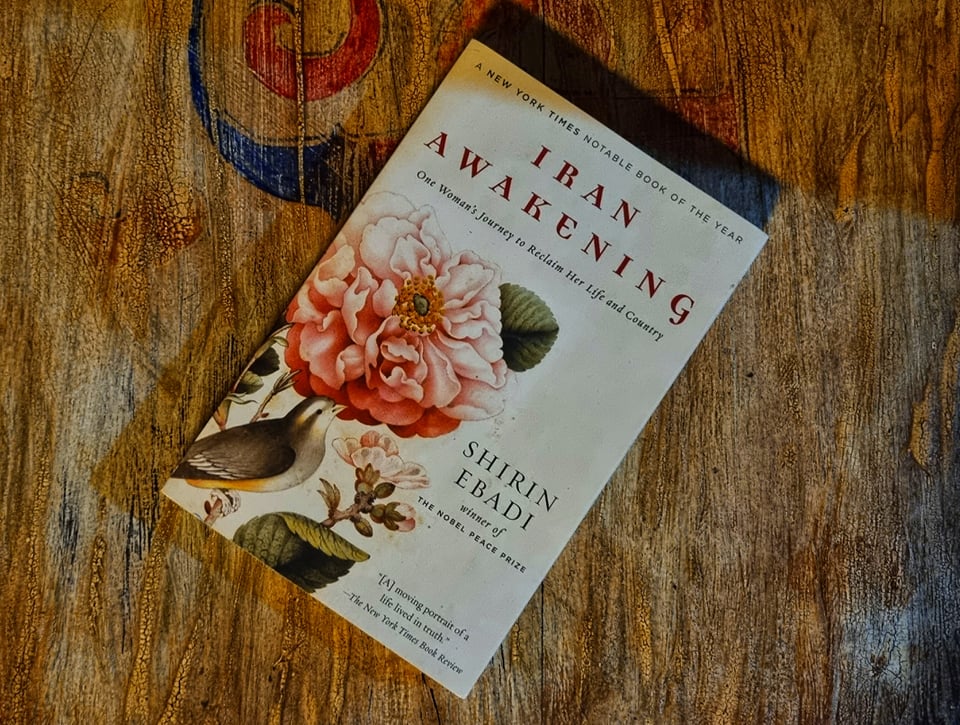
Iran’s first female judge, and winner of the Nobel Peace Prize in 2003, has penned this affecting book with such free-flowing sincerity that I could not help but cry in a number of passages.
Just as in 2011 when I read Azar Nafisi’s Reading Lolita in Tehran and it made me celebrate my freedom as a reader, Shirin Ebadi’s Iran Awakening is making me celebrate my freedom as a woman as it raises awareness of the many liberties that we often take for granted.
“The world was awake — it wakes early in the East.”
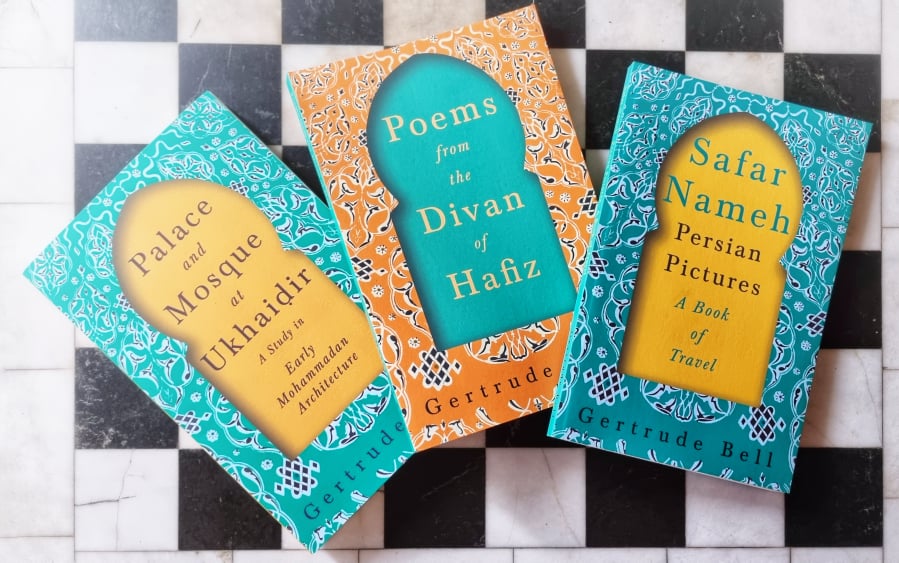
Gertrude Bell’s simple description of a Persian sunrise encapsulates, with figurative overtones, the theme of the books I have been reading lately. In The Silk Roads, she is described as dynamic and fiercely intelligent, brilliant, a mercurial scholar and traveler who knew the region and its people as well as anyone. Portrayed by Nicole Kidman in Queen of the Desert, she is called a Kingmaker for being influential in drawing up the borders of the new nation of Iraq and in bringing King Faisal to power as its first ruler in 1921. But it was only through Safar Nameh that I was introduced to her writing.
She writes so elegantly with a deep perception of places, people, and the relationship between East and West. She speaks of “the careless optimism of those who seek to pile one edifice upon another, a Western upon an Eastern world, and never pause to consider whether, if it stands at all, the newer will only stand by crushing the older out of all existence.”
This is a tiny book of a hundred pages that I thought I would be able to finish in one coffee break, but the writing is too beautiful that I had to savor the lines over and over again.
And for those times when my mind and soul are exceedingly wide awake in wonder, she has the right words… “The world was too lovely for sleep.”
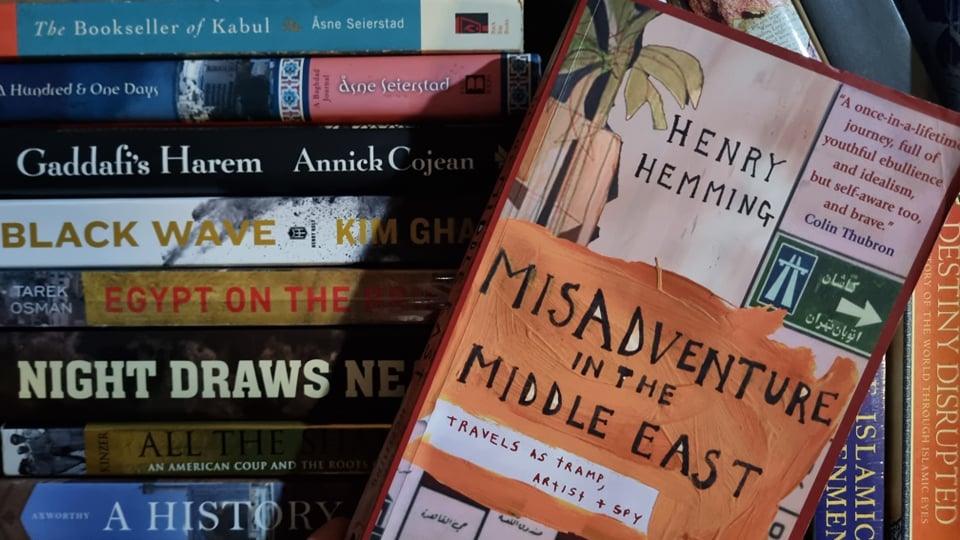
In contrast to de Botton’s encouraged manner of traveling by allowing art to guide us in our travels and what we pay attention to, Henry Hemming, a British painter and author, ventures to the Middle East and lets his travels guide his art.
He and his companion discovered that each country and their people were immensely different from the other that, as artists, it was now more difficult for them to paint a portrait of what we call the “Middle East.” But this is where the book comes in.
It may not be a complete picture, but it provides a keener understanding, especially at a time when we need it most.
I did not read these books. I inhaled the force of these books — in big and small gasps, and by the end of the third, I could not part with her. I do not think I can ever part with her. You would want to acquire her strength through osmosis!
She is my writer. Belonging to that rare breed who, even when writing about their lives, call attention to matters beyond themselves. Her words insist that you come out of her books knowing more about yourself, about the world.
Indeed, there are authors whose lives are as intense as their books. Nawal El Saadawi is one of them. Writer, activist, physician, and psychiatrist, her eventful life consists of losing her job as Director of Public Health Education due to political pressure, being imprisoned as a vocal critic of President Anwar Sadat and released only a month after his assassination, running for the Egyptian presidency in 2004, appearing on an Islamic fundamentalist death list, and being a potential Nobel laureate in literature until her death in March this year.
When it is Doris Lessing herself who says this is something we should all be reading, what is there left for me to say?
Woman at Point Zero & God Dies by the Nile
October 2021
Two books undiluted in their scathing criticism of religious hypocrisy among men and leaders, corruption, and the brutal treatment of women.
Both stories are based on real lives, and these are not to be read if you would rather prevent yourself from seething.
Written in 1973 and 1976, these stories and themes should have already become irrelevant at this point in history.
That they still aren’t is the tragedy.
Searching
April 2022
A Nawal El Saadawi work of fiction is an art film; one where nuanced cinematography captures the reflection of the sun on a window pane and which slowly pans toward the distress coursing through a woman’s veins; one that disquiets with its honesty; one with an unbroken tension that does not resolve, but bleeds into a thousand provoking questions as the end credits fade into darkness.
The Fall of the Imam
August 2022
“No one of you has ever possessed my mind. No one. And no matter how often you took my body my mind was always far away out of your reach, like the eye of the sun during the day, like the eye of the sky at night.”
In a culture where a buffalo has more worth than a woman, where love and marriage are usually two different things, where there is a disconnect between religious devotion and actions, where a man has the freedom to sin but where a woman can get stoned for being a victim, Nawal treads dangerously with her words.
She throws difficult questions at religion and those who are in power, beats us out of complacency and privilege, and prods us to be angry at injustice and inequality.
This is not the book I would recommend to someone who is new to her writings, but a seasoned Nawal reader would probably consider this an epitome of her literary prowess.
Prose-wise, it is the most ornate. Content-wise, it is the most potent. Form-wise, it is her most sophisticated. And wading through all of that is not so easy.
Different narrators for each chapter can get disorienting; the victims narrate, the criminals narrate, so do the dead, and oftentimes about the same incident. When it comes to the women, one can get confused trying to identify whether it is the mother speaking, or the daughter, or the new wife, or the first wife, or the mistress, or the sister. But I realize the intention: It is to emphasize the fact that they are women, and because they are women they suffer all the same.
“Like in The Thousand and One Nights, the beginning of each tale merged with the end of the one which had preceded it, like the night merges with the day…” And then she draws us away from Scheherazade to a lesser-viewed aspect of this literary heritage and culture, and points the spotlight at the hypocrisy of King Shahryar.
Through it all, the question that seems to reverberate loudest in my mind is this: What can we do if the leaders, those who are in power, the ones assigned to mete out judgment, are the perpetrators of the crime?
Because at times, they are. Not only in some culture foreign to us. But in ours, too.
The Hidden Face of Eve
March 2023
The best of Nawal El Saadawi’s books are nonfiction: They reveal the devastating truth that her works of fiction are, in fact, nonfiction.
A vital textbook for the study of women in the Arab world, The Hidden Face of Eve has a more academic structure compared to A Daughter of Isis, Walking through Fire, and her numerous memoirs that are deeply personal. But all her writings perfectly demonstrate how the personal is political, and there is not a hint of the tedium that we might encounter in textbooks.
The delicate preface alone is worth mulling over and digesting; and the book, thorough in the history and status of women in Arab society from pre-Islam days until the present, often enlightening or enraging, should be read in its entirety. Whether one agrees or disagrees with any of her views, no one will close this book without having learned anything substantial. Reading this showed me what a shallow understanding I have of the matter despite years of delving in books from Islamic nations.
Nawal does not launch into an angry tirade against religion, however, but against those who use religion “as an instrument in the hands of economic and political forces,” those who use religion to deprive women of knowledge and suppress the search for truth by intimidation and obscurantism, and those who misinterpret religion and utilize it as an instrument of oppression and exploitation. She challenges that religion, if authentic in the principles it stands for, “aims at truth, equality, justice, love, and a healthy wholesome life for all people, whether men or women.”
She criticizes feminism that is merely an instrument of a specific class, or a feminism that is fanatical and superficial, stressing that fanaticism of any form should be opposed, whether it be religion, political, or social. Interestingly, she even remarks on the “modern” woman, “who thinks that progress is manifested by a tendency to show more and more of her thighs,” but remains mentally and emotionally suppressed under the surface.
She therefore makes a stand for the education of the female child, the strengthening of the mind, a free mind, and a heightened level of consciousness, pointing out that a girl who has lost her personality through the throttling of her mind will lose the capacity “to think independently and to use her own mind,” and “will do what others have told her and will become a toy in their hands and a victim of their decisions.” Thus, “the emancipation of Arab women can only result from the struggle of the Arab women themselves, once they become an effective political force.” As we all know, this does not merely apply to Arab women. There is also the acknowledgement that “progress for women, and an improvement of their status, can never be attained unless the whole of society moves forward.”
Can you see why I wished to greet Women’s History Month by reading someone like Nawal El Saadawi? But because there is no one like Nawal El Saadawi, I read her.
“…with liberation they stand to lose nothing else but their chains…”
Two Women in One
March 2024
While I have long discovered that I prefer the nonfiction writer in Nawal, her fiction remains to be in a class by itself. (That’s why I still continue collecting what I can of her books, fiction and nonfiction, especially now that I’ve discovered these excellent editions — in terms of publication quality and translation — from Saqi Books.)
Two Women in One is not straightforward storytelling. There’s a tinge of Clarice in the free indirect prose. Unsettling, like any piece by Nawal; claustrophobic, and therefore, effective.
It’s not a good place to start if one is new to Nawal. The angst of a young woman, wanting to be an artist but who’s forced into medical school, is potent here.
Conformity becomes suffocating to her, “Everything had the same color and shape to her. All bodies were similar, and all gestures and voices. She found herself running aimlessly… fleeing the deadly sameness within and without…” When she realizes that none of her life is her doing or her own choice, she unleashes a rebellious other woman in her. “Freedom is dangerous, but life without it is no life at all.”
But what I found most powerful in this work is the underlying message that unless Egypt is free, she cannot be free. “Egypt was not free. The chains were still there.” Because when all is said and done, how a nation treats their women, is always a measure of that nation. A woman’s personal freedom is often symbiotic and synonymous with national freedom.
It was in 2008 when I read my first Ishiguro, Never Let Me Go. It would take another 9 years before he would win the Nobel, but that book already established that he would persist as one of my favorite novelists. In the years that followed, his other works consistently lured me back to an inimitable realm of pensive storytelling, but a phantom pain still pierces my heart when I think about it. Even to this day, it has not let me go.
And here comes Klara and the Sun, his first novel after the Nobel. This book cannot be more relevant to our generation. Never Let Me Go and Klara and the Sun represent what great art is for me: The kind that keeps you awake and urges you to ponder what it is to be human, the kind that encourages you to be more alive and insightful; Art that remains dignified even when it unsettles — a pain that you would feel alongside your happiness.*
With a title that alludes to that woman whose face purportedly launched such, the essence of “A Thousand Ships” is encapsulated in this line from the book uttered by Calliope, muse of epic poetry.
The author acknowledges that the Homeric epic poems are regarded as foundational texts on wars and warriors, men and masculinity; but through her retelling, the women of the Trojan War are highlighted. Finally, “she” is a person with fears, flaws, desires, and hopes; and “she” ceases to be a footnote.
It is largely tragic, but I personally think that this is an insightful recounting of one of the Western world’s greatest tales. The women’s feelings and opinions are expressed at last, and because of this thoughtful perspective, the previously overlooked voices make the lives affected by the Trojan War more realistic and compelling. This is definitely a fitting and worthy read for Women’s Month!
The lines by Calliope and Penelope (the loyal wife who awaited Odysseus’ return for 20 years) are my favorites:
“The bards all sing of the bravery of heroes and the greatness of your deeds: it is one of the few elements of your story on which they all agree. But no one sings of the courage required by those of us who were left behind.” — Penelope, in a letter addressed to Odysseus
“When did poets forget that they serve the muses, and not the other way around?”
“If he truly wants to understand the nature of the epic story I am letting him compose, he needs to accept that the casualties of war aren’t just the ones who die.”
“But this is the women’s war, just as much as it is the men’s, and the poet will look upon their pain — the pain of the women who have always been relegated to the edges of the story, victims of men, survivors of men, slaves of men…
And I have sung of the women, the women in the shadows. I have sung the forgotten, the ignored, the untold. I have picked up the old stories and I have shaken them until the hidden women appear in plain sight. I have celebrated them in song because they have waited long enough… this was never the story of one woman, or two. It was the story of all of them. A war does not ignore half the people whose lives it touches. So why do we?” — Calliope
This hypermasculine epic poem might be a startling selection for Women’s Month, but I chose it for the translation. Published in 2017, it is the first translation by a woman since the earliest of the sixty available English translations appeared in 1615!
I grew up with these tales. My maternal Lola was an English and Literature teacher who randomly inserted Odysseus and Greek mythological figures in bedtime stories and conversations as if they were old acquaintances. And so, even with the present-day debate on whether people should continue to read something so sexist by 21st Century standards, The Odyssey remains to have sentimental value to me. Ithaka by Cavafy and Ulysses by Tennyson are not some of my favorite poems for nothing.
But I have to admit that it was only through reading Emily Wilson’s translation that I thoroughly felt a connection with the epic poem. Her language is accessible but she does not sacrifice beauty.
The introduction takes up almost a fifth of the entire book and has maps especially drawn for this volume, informative etymology, and a historical background of the Bronze Age that bids the reader to examine the context that is vastly different from our own. For the first time, I recognize Odysseus for the problematic character that he truly is, and for the first time, I am able to view Helen of Troy in a different and slightly better light — the translator ensuring that she, “like that of the original, refrains from blaming herself for what men have done in her name.” This is not a feminist version but it does not gloss over character defects and instead allows the reader to “see the cracks and fissures in its constructed fantasy.”
Despite what contemporary readers might think, we cannot deny its impact on the history of literature. It has not survived three millennia for nothing. But if there is an edition of The Odyssey a reader of our age should read and keep, I believe it should be this one. As much as it is a timeless celebration of adventure and the longing for home, this translation is most definitely a celebration of Woman.
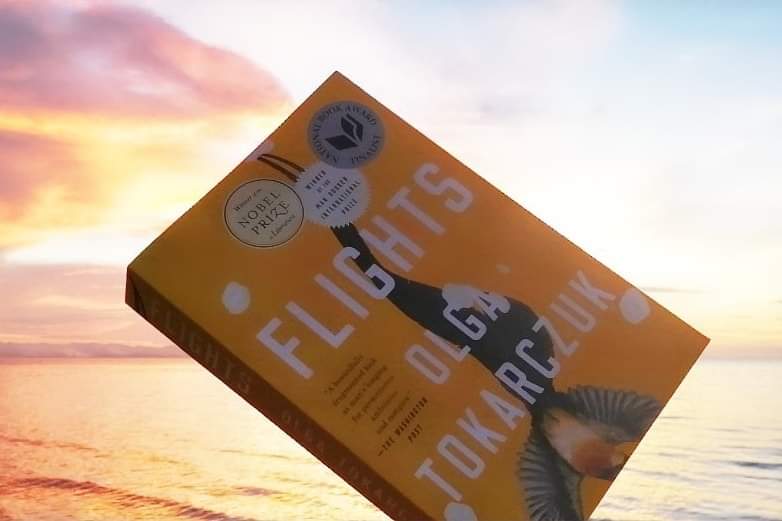
The main motivation for reading this book was in knowing that it recounts the transit of Chopin’s heart back to Warsaw while his body was interred at the Père Lachaise Cemetery in Paris. Every classical musician knows this strangely romantic story of how his homesick heart finally returned home; but naturally, I also wanted to read it narrated by a Nobel winner.
Flights turned out to be an unexpected reading experience. It is a literary collage written the way the author describes postcards nowadays: “Postcards of landscapes, panoramas of old ruins, postcards ambitiously prepared so as to show as much as possible on that flat surface, are slowly being replaced by photographs focusing on details. This is no doubt a good idea, because they relieve tired minds. There is too much world, so it’s better to concentrate on particulars, rather than the whole.”
And so she does. These details and particulars in question are the mind, the soul, psychology, the physical brain, the heart, and the entire human body; which, ironically, also turns out to be “so much world.” It is a travel book with emotional itineraries and mental maps. A special trip around, or more accurately, inside the world. But in its entirety, it is an unusual research on pain, and a unique meditation on traveling, space, time, and movement.
The literary phases of my life have always been geographic, I now realize. Even my shelves are organized based on geography. Russia on the topmost shelf, France, Germany, and the United Kingdom on the succeeding tiers, and so on… and there’s the presently expanding Fertile Crescent and Silk Route section. Tokarczuk being Polish might seem like a veering away from my current authors of choice, and yet, the undeniable influence of the Arabian Nights is still lurking in this masterpiece. Even though I have a feeling that this book will ultimately settle down in the Eastern European section beside Kundera, this one feels like it belongs to each and every section.
As it is with masterpieces, this one transcends geography and other borders.
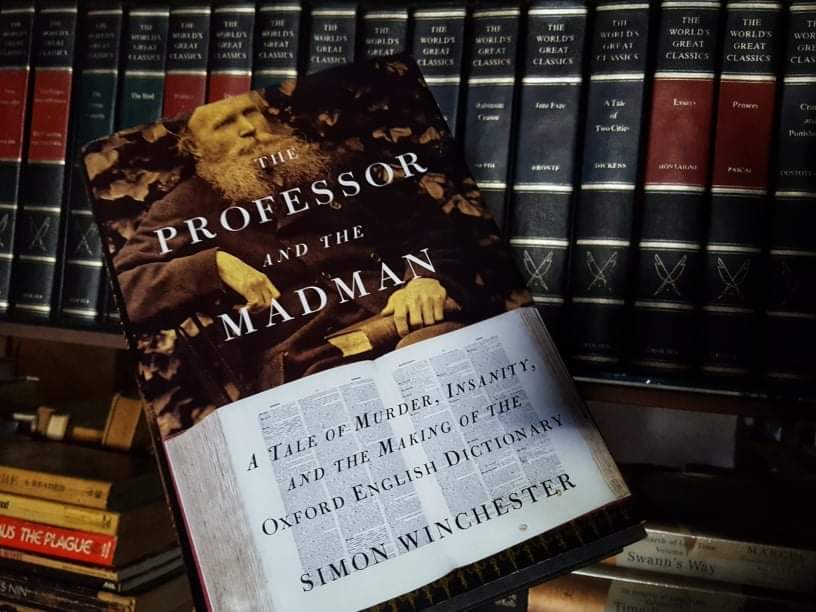
What book comes to mind when you read the lines, “One of the greatest romances of English literature?” or “One of the greatest literary achievements in the history of English letters”? This masterpiece of twelve volumes on its initial edition took almost eighty years to create — the Oxford English Dictionary.
When the British Empire was approaching its pinnacle and English was on the verge of becoming a global language, there was an urgency to “chart the life of each word, to offer its biography… to have a record of the register of its birth,” when it was first written down. “And at the heart of such a dictionary, should be the history of the life span of each and every word. Some words are ancient and exist still. Others are new and vanish like mayflies. Still others emerge in one lifetime, continue to exist through the next and the next, and look set to endure forever… There should be sentences that show the twists and turns of meanings — the way almost every word slips in its silvery, fishlike way, weaving this way and that, adding subtleties of nuance itself, and then perhaps shedding them as the public mood dictates…”
This book unravels the remarkable men behind such a momentous and historic undertaking: “Their scholarship sheer genius, their contributions to literary history profound. But who remembers them and who today makes use of all that they achieved?”
And yet the most astonishing question of all; what if we were told (the way this book exquisitely does) that the making of the Oxford English Dictionary is a tale of murder and insanity?
This story, at times tragic, at times disturbing but with slivers of hope and redemption, most of the time incredible, has the sort of narrative that I usually find in fiction; and it is written in such an absorbing manner that I had to check many times if it was really a work of non-fiction!
At the core of the story are the two learned men to whom we owe the success of the OED: Professor James Murray, the distinguished editor, and a surgeon whose contributions were vital, Dr. William Chester Minor. The two men maintained a correspondence for years but had never met, the latter constantly refusing invitations for a meeting in person. It was only after two decades when Prof. Murray discovered that Dr. Minor was the longest-staying resident at the Broadmoor, England’s harshest asylums for criminal lunatics.
I think this is essential reading for those who love history and words, and the history of words!
“I am not so lost in lexicography as to forget that words are daughters of earth…”
P.S. Just as I thought I veered away from the East and Iran, there is apparently a movie based on this book starring Mel Gibson and Sean Penn, and the movie is directed by Farhad Safinia, an Iranian.



 The Book-Butterfly