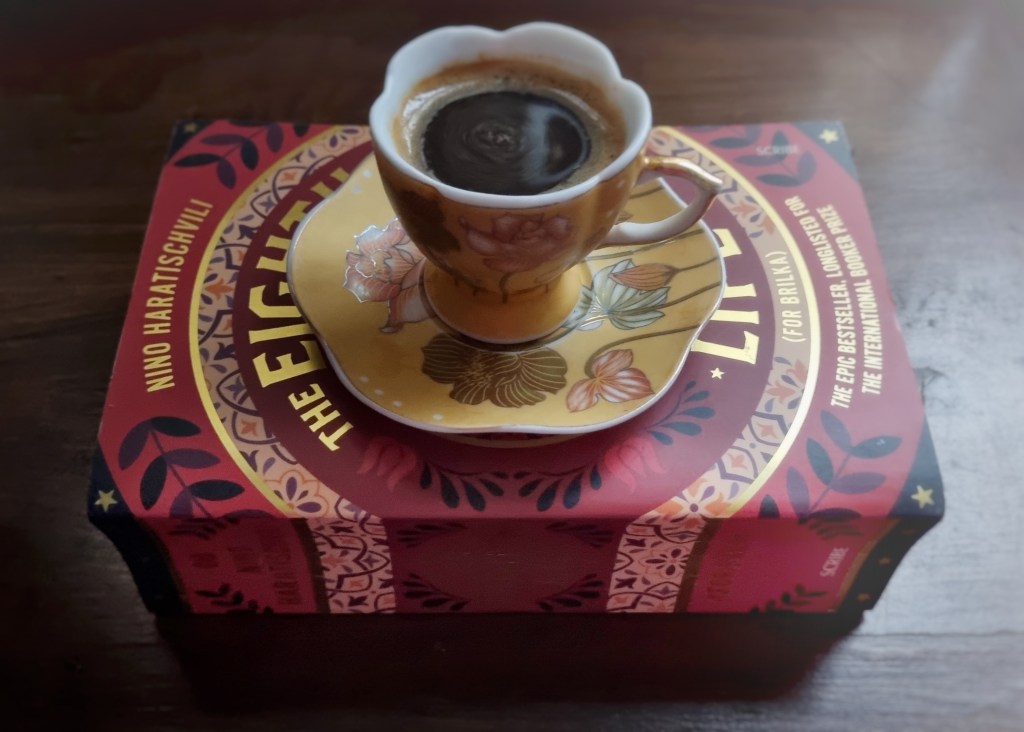
Like drinking the sunlight of a Georgian autumn

November 16, 2024 — That cliché about turning forty? I don’t buy it. People shouldn’t wait that long for life to begin. I am, however, a believer in new stories and new adventures beginning at forty. 

As light often precedes sound, the moon casting an ethereal halo over the city greeted me as the plane landed. The polyphony followed; of old and new, of east and west, of a language that sounds like a blend of High Valyrian and Dothraki, of autumnal chill and inner fire. 

It is almost midnight in yet another junction of the immeasurable Silk Route, one of the oldest trade centers in the Caucasus. A stone’s throw from where I’m staying is an underground market that was part of a network of tunnels dating back to the 4th century where East and West have traded goods and stories for hundreds of years. 

It is safe to walk at night. I have only encountered friendly faces and a group of men intoning the most otherworldly polyphonic singing at a roadside table as if it were the most natural thing on earth. At every turn lingers the influence of Scheherazade, mother threader of stories in the East, and Penelope, mother un-threader of storytelling in the West. Here, the narratives do not seem to contrast, they coexist. They take turns coaxing travelers to find their own stories to weave, and to unravel. 

Looking around and looking within, I can tell you that forty (and Old Tiflis), is a wonderful place to be. And I cannot wait to see Old Tiflis (and forty) shimmering in the sunlight!

November 20, 2024  “It’s likely and unfortunate that you are probably only dimly aware of Georgia—the country, not the state. It’s tucked away beneath Russia, next to Turkey, a contentious, strategic piece of real estate under constant pressure.

You should know Georgia because it’s nice. Because the food is excellent. The country is beautiful—some of the most beautiful scenery on Earth. It’s a place you should absolutely visit if given the chance.

But you should know it as well because it’s important. Because it emerged from years of Soviet rule into a chaotic, awful, lawless period, yet managed to turn itself around into a functioning democracy in a few short years.

And because, as you will see, it is still under constant threat from an increasingly belligerent Russia.

It’s a fascinating and very welcoming country. And I hope we convince some of you to visit it.”

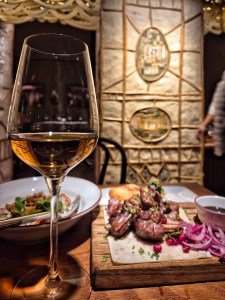
Don’t take my word for it. Take Anthony Bourdain’s. He said that, and I took his word for it. And so the first restaurant I checked out was one that he visited, and I ordered a dish that he also had (lamb ribs “semichka” with pomegranate sauce). Since that first dinner I haven’t had bad food or bad wine. 

I’ve been pairing most of my meals with the amber wine for which Georgia is known, and I don’t even know where or how to begin with Georgian wine. But as a preview, let me just say that it tastes exuberant. It’s like drinking the sunlight of a Georgian autumn.


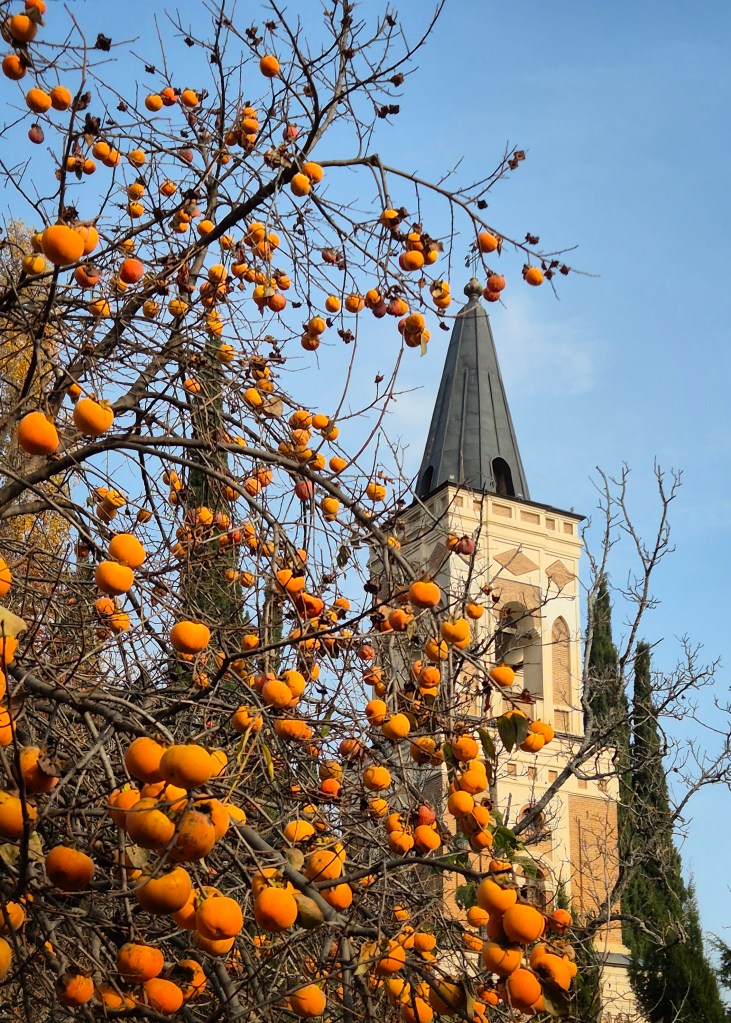
In autumn, Sighnaghi is tinted by all the colors of Georgia’s wines.
The Georgia Book Stack


A light rain was falling, a fine spray, unlike what rain is in the tropics. Within a couple of hours the deep purple of evening entered through that same window and transformed the spray into delicate snowflakes that vanished even before you could touch them; inconspicuous magic in the micro details when one season gives way to another.

It was toward the end of the trip when I took this photo of my traveling companions on the windowsill. Absent from the stack, but verily lodged in my consciousness, are Euripedes’ Medea and Percival Everett’s For Her Dark Skin.

I went to Georgia accompanied by seven books, and after jaunts to Tbilisi’s charming bookshops, a modest number of three Georgian masterpieces were read on the train and during long drives, then added to the pile. 

The eclectic curation is an education in itself as it includes a Greek tragedy, a rather feminist and modern retelling of the tragedy, a wonderful and informative chronicle of Georgia’s unique wine culture, journalistic reports and stories from the early years of post-Soviet Georgia, the greatest love story of the Caucasus, literary criticism, a portrait of young Stalin that is also a portrait of a nation, a painful recollection of the Georgian-Abkhazian armed conflict in the 90s, epic poetry, and Tolstoyan short stories.

Once again, people wondered whether I had gone to another destination just to read. But I know they’re only kidding. 

For who isn’t aware that reading and traveling are not separate experiences? They are halves of a whole that lend clarity and depth to each other.

In our travels, what we notice, perceive, and experience — and what we contribute to meaningful interactions, or how we overflow — largely depend on what is already inside us. “Nothing flows out of a jar except that already inside it,” writes the preeminent Georgian author, Shota Rustaveli in The Knight in the Panther’s Skin.

In life, reading and traveling are merely expressions of how one chooses to take their fill.

Nino Haratischvili: The Eighth Life

The first few things you will ask yourself after reading this are questions in the vicinity of, “Was that really 934 pages long? How was I able to read that so quickly?”

Tougher questions will follow: The question of identity, the question of who you are and what shaped you. The question of history and how you cannot ever separate your personal history from history in general.

What do you really know about history? What do you really know about yourself?

“For me, the greatest reward was her stories.”  Nino Haratischvili, The Eighth Life

At the beginning of the century that would suffer two World Wars, and many other wars, a chocolatier prospers in Georgia under the Russian Empire. His chocolaterie thrives and caters to townsmen and Russian nobility, but after a tragedy following the devouring of the the secret recipe in its purest form, he soon suspects that it holds a curse. The recipe would, however, always manage to find its way to the next generation and throughout the entire century. 

The accursed hot chocolate recipe was something I would normally expect to savor from Latin American magic realists and I was initially unsure of how I felt about coming across this flavor in The Eighth Life. I thought it could easily be dispensable in the grand, cinematic scope of the story.

But wasn’t this family saga set in junctions of the immeasurable Silk Route where anything could happen, and where the influence of Scheherazade’s fantasies still linger at every bend?

I eventually gave in to this literary ingredient and pondered if it was meant to symbolize the intergenerational curses — inherited pain, memory, and trauma — to which we become heirs and which we unknowingly impart.

_ _ _

The casual tone of the narrative deceived me at the onset. You could tell you were not reading Vasily Grossman or Olga Tokarczuk. (The comparison is unavoidable as theirs were the novels I read this year that are similar in length and with similar intersecting eras and geographies.)

It is, after all, addressed to Brilka, an adolescent; and so the narrator spells things out. We know that this is something masters of literature usually avoid, but it was this casual and explanatory tone that made me so unsuspecting of how it would sweep me up in its emotional and historical hurricane. I found myself wiping away tears a number of times, grieving for the characters with their extinguished hopes and dreams, and for the entire broken century that was also partly my own.

It is remarkable how the novel captured the spirit of each era it depicted, even the confusions and the troubles of each age reflected in the characters. To present these — along with the complex convergence of Russian and Georgian histories and politics, and how Soviet tyranny affected so many lives across borders — in such a readable manner only made me recognize Nino Haratischvili’s command of such topics.

This novel is a strange oxymoron to me: For being simultaneously accessible and wise, for being both painful and satisfying, and for lending answers as it asks questions.

_ _ _

What do you really know about history? What do you really know about yourself?

Could it be true, that chilling thing Kostya said about everything waiting to come back?

‘What statues and pictures?’ I asked.

‘You know, of Lenin, Marx, and Engels, the Generalissimus — all those men!’ He seemed to be giving it serious thought.

‘They’ve gone.’

‘But they can’t all just disappear, just like that!’

‘Apparently they can. Everything disappears sooner or later.’

‘Nothing disappears. Nothing, Niza!’ He laid is hand on mine.

‘You mean, everything is hidden somewhere, waiting to be found again?’ I tried to bring myself to smile. 

‘Everything is waiting to come back.’

_ _ _

Thank you, Anna, for recommending this book!