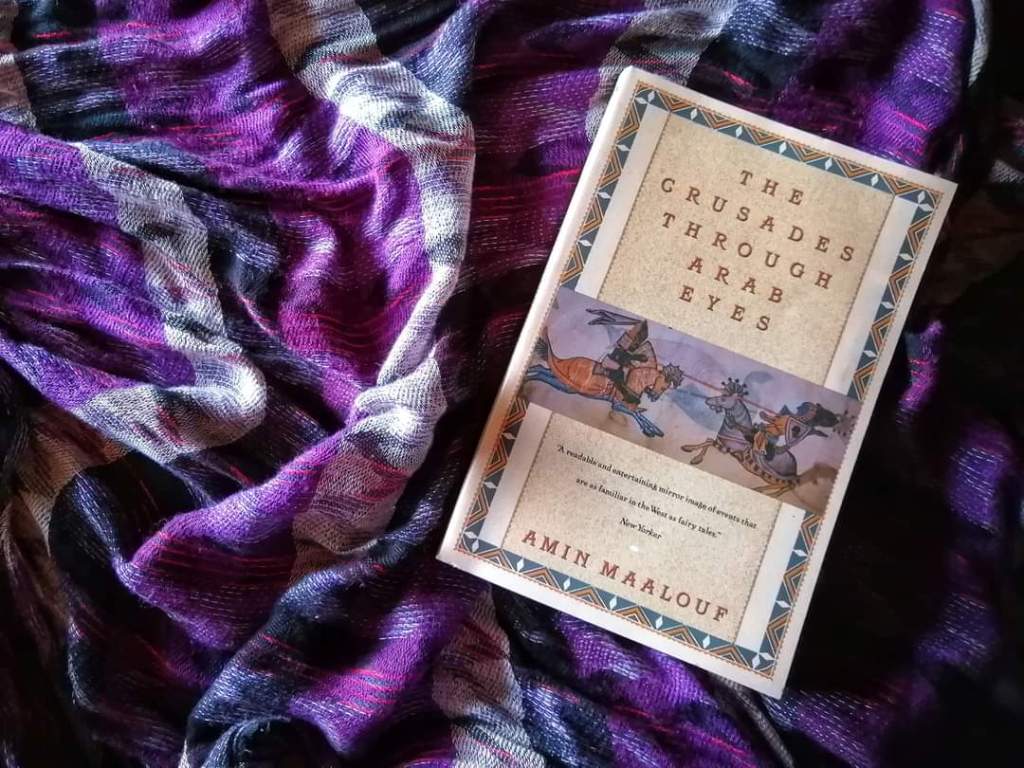
Amin Maalouf: The Crusades Through Arab Eyes

When Kingdom of Heaven premiered in 2005, the character that made the biggest impression on me was Saladin. Although I expected the film to be highly fictionalized, I hadn’t realized how much of it was true based on eye-witness accounts that survived from that period! From the writings of Ibn al-Athīr (1160-1233) to Ibn Jubayr (1145-1217) and others including a few Western chroniclers, Amin Maalouf condenses the events of 1099-1291 and gives us The Crusades Through Arab Eyes.

Published in 1984, this work questioned and redrafted the prevalent narrative of who the world thought of as barbarians. The reader is made mindful that, “At the time of the Crusades, the Arab world, from Spain to Iraq, was the intellectual and material repository of the planet’s most advanced civilization,” and it was only posterior to the Crusades that the trajectory of intellectual advancement and world history would shift to the West.

It was the era of Assassins, Seljuks, Fatimids, Ayyubids, Mamluks, the Crusaders, Templars, and eventually, the Mongols. Needless to say, Game of Throne-ish details abound! But what I value most about this book is how it defines the chronology, succession, and the characters of the Crusades in a gripping way that will not easily slip into the lapses of my memory; and more valuable is the epilogue where we are made to understand the repercussions and a seeming collective trauma nearly a thousand years later.

— “What they learned from the Arabs was indispensable in their subsequent expansion… In medicine, astronomy, chemistry, geography, mathematics, and architecture, the Franj drew their knowledge from Arabic books, which they assimilated, imitated, and then surpassed.”

— “The epoch of the Crusades ignited a genuine economic and cultural revolution in Western Europe, in the Orient these wars led to long centuries of decadence and obscurantism.”

— “Assaulted from all quarters, the Muslim world turned in on itself. It became over-sensitive, defensive, intolerant, sterile — attitudes that grew steadily worse as world-wide evolution, a process from which the Muslim world felt excluded, continued.”

— “The Arabs refused to open their own society to ideas from the West. And this, in all likelihood, was the most disastrous effect of the aggression of which they were the victims.”

— “The Arab world… cannot bring itself to consider the Crusades a mere episode in the bygone past. It is often surprising to discover the extent to which the attitude of the Arabs (and of Muslims in general) towards the West is still influenced, even today by events that supposedly ended some seven centuries ago.

— “There can be no doubt that the schism between these two worlds dates from the Crusades, deeply felt by the Arabs, even today, as an act of rape.”

Essays

These books were read little by little and treated as breathers between larger works, but they are by no means inferior or less meaningful to me. Having finally read the last of the essays, these three are now among the most prized books on my shelf. And I say this with confidence: Filipinos are my favorite essayists!


Using nature as a leitmotif, Aimee Nezhukumatathil’s World of Wonders nudges us to keep our eyes open with childlike curiosity and to keep our hearts soft. It is amazing how she touches on racism, school shootings, climate change, and life’s difficulties without any hint of vitriol. Her writing is refreshing — not like a cool drink on a summer day. Refreshing like a good cry that unburdens the heart and reminds you of life’s wonders. Our hearts need this.


Gideon Lasco’s The Philippines is Not a Small Country is a gift to the Filipino people that we should embrace with gratitude. He shows us the Philippines for what it really is and how deserving it is of new and hopeful eyes. What I’ve written about Pamuk and his relationship with Turkey, I can also write about Lasco and his relationship with our country: He is someone who recognizes a nation profoundly inside out, from its complicated politics to its inner conflicts and issues, its customs and traditions… and offers a viewpoint only a lasting lover can deliver who, after having seen a beloved’s glories and deepest flaws and undesirable secrets, remains and continues to love.

“When we realize that we Filipinos, far from passive victims of history, have always been active in making not just our history but that of the world, we begin to overcome the feeling of smallness that sets back our geopolitical imagination. What our past should give us is not an enmity for those who pressed us but an empathy for those who experience oppression.

What our past should give us is neither a feeling of victimization nor entitlement but a dignity of a people that has suffered much — but has overcome more.”


Even though there is so much to resonate with and quote from Carmen Guerrero Nakpil’s Woman Enough and Other Essays, despite being written between 1951-1961, I’m choosing to end with these relevant reminders as today we witness President Duterte’s final State of the Nation Address.

— “Politics is not all crooks and racketeers and ten percenters. It is not the loud, interminable speeches… or the handshaking in the barrios while a photographer snaps his camera or the number of dancing girls given to each delegate to the national convention. That is not politics, but only its aberrations. Among many of us, those practices have come to mean politics. But they are only the abuse of politics.”

— “This is one of the beautiful paradoxes of politics. Politics may make us, but it is for us to shape it.”

— “You should learn to look at elections, not as contests in goodness or popularity between two or more men, but as a national stock-taking, an occasion for citizens to make up their minds which course of national action to choose over another.”

— “You see how important it is for all citizens to be intelligent, well informed and judicious.”

— “The question is not whether some of us do not love our country or some of us do. The question is in what way we love it.”

— “As a parting favor, I would like to ask you all intelligent women not to take my word for this or for anything. Think about the things we have discussed here, and ponder on them yourself. Discuss them with your friends, seek the opinion of others, but make the decision yourself.”

— “In your intelligence, application, your honesty with yourself, and in your wisdom, will lie the future of the Philippines.”

Black Wave & From Beirut to Jerusalem

July 10, 2021

It is difficult to invest time in a book that is nearly six hundred pages thick these days, but From Beirut to Jerusalem was even more difficult to put down! This is impressive journalism!

Although Friedman writes with a more personal tone, one cannot help comparing it to Black Wave by Ghattas, because at some point after these books’ respective publications, it has been said of each that if there is a book one should read to achieve a better idea of the morass of Middle Eastern politics and relationships, it should be this. I think it should be both.

I read Kim Ghattas for her Lebanese roots, and Thomas Friedman for his Jewish upbringing and on account of his three Pulitzer awards. I assumed their backgrounds would affect their insights, but these two books surprisingly complement each other! Aside from a comprehensive account, they have chosen to elaborate on different aspects and, together, give the reader an even more exhaustive view — albeit exhausting, too.

These journalists have confronted some of the most complex and divisive issues and have endeavored to organize the confusion for us, readers, despite knowing they would ruffle feathers. While we know that no one can ever give us the complete picture, it is a substantial step.

I have to admit that most of what I know about Middle Eastern affairs are spoon-fed by selective news networks or social media pages that cater sensationalisms, half-truths, and over-simplifications to the passive.

If there is one good thing that this pandemic has given me, it is the chance to check my own biases and avoid shaping lazy opinions, and be reminded that there is so much I do not know; and that it is alright, and necessary, to reevaluate my thoughts and opinions — not just on matters of a realm thousands of miles away, but on life in general.

Eva Nour: City of Sparrows

“The birds have been a natural part of the city. That the sky was now devoid of the fluttering of wings was a clear sign that life had changed.”

One might find this in the fiction section of a bookstore, but only because the character’s real name and certain details had to be fictionalized to protect his identity and the identities of loved ones who are still living in Syria. Eva Nour is a pseudonym of the journalist who penned this.

This account is unusual for the different vantage points it acquaints us with, through the same character in different stages of his life — a regular boy growing up in peaceful Homs and whose father dismisses conversations on Hafez al-Assad’s dictatorship out of fear; an adolescent serving time in the government’s army when the protests against the regime begin; a rebel against the same army and regime but this time under Bashar al-Assad; a disillusioned man whose faith in the Free Syrian Army becomes tarnished in the midst of the mass exodus; a photographer who dangerously documents the inhumanity and the deaths so the world would be made aware; and after immeasurable suffering, an exile.

In a book about a place where the antagonist is the same government supposedly assigned to protect its people, would you expect to find these lines? “Poetry didn’t have anything to do with words. It was a way of viewing the world.”

I try hard not to abuse the word “beautiful” in my reviews even though the books that have come my way these days do not fall short of the adjective. This one, for all its gruesome and horrifying details, did not fit the description in almost its entirety — until I arrived at the last page and nearly uttered the word out loud.

Through my readings, I have realized how narratives from the Middle East are so important not only for the reader but more so for the storyteller, because their stories can either be one of three difficult things; an act of healing, an act of protest, or an act of love. In this case, it is all three at once.

Qais Akbar Omar: A Fort of Nine Towers

“I know of no other book in which the complex realities of life — and death — in contemporary Afghanistan are so starkly and intimately portrayed,” says Jason Elliot, a favorite travel writer who has written about Iran and Afghanistan, of this autobiography by Qais Akbar Omar.

I wholeheartedly agree. It is the first published memoir about growing up in Afghanistan. So beautifully written, it describes an extraordinary life and country, its marvels, its fascinating ethnic groups, the history of its conflicts, and the horrors of three tempestuous decades.
“Pain was our way of life now,” Omar writes. The book brims with pain and loss, but it is also full of life. To have been written by someone who found solace in literature during the darkest times, and who suffered but endured the cruelty and futility of wars, makes “extraordinary” an understatement.

I read from and about these places of conflict to learn, but I have been asking myself why I have also grown to love and seek out their literature. This book illuminates one of the answers: I am drawn to how their sensitivity to beauty is commensurate with their heightened awareness of the fragility of life.

And if it is this that their lives and words constantly teach me, among a hundred other things, then I will continue to read from this part of the world.

Jasmine Darznik: Song of a Captive Bird

She is known in the West as the Sylvia Plath of Iran. As if the name Forugh Farrokhzad is not enough.

Although I understand the comparison because of the early and tragic deaths, of troubled lives we wouldn’t hope to emulate but whose courage to immortalize raw emotion we secretly envy, the turbulent relationships, also their notoriety of speaking against the constraints that society imposed on women and paving the way for other women in literature — but Forugh Farrokhzad is Forugh Farrokhzad to me. The rebel poet of Iran.

“𝐓𝐡𝐢𝐧𝐤 𝐚𝐛𝐨𝐮𝐭 𝐭𝐡𝐞 𝐰𝐫𝐢𝐭𝐞𝐫𝐬 𝐲𝐨𝐮’𝐯𝐞 𝐦𝐨𝐬𝐭 𝐚𝐝𝐦𝐢𝐫𝐞𝐝. 𝐖𝐡𝐚𝐭 𝐡𝐚𝐬 𝐠𝐢𝐯𝐞𝐧 𝐲𝐨𝐮 𝐬𝐨𝐥𝐚𝐜𝐞 𝐢𝐧 𝐭𝐡𝐞𝐢𝐫 𝐰𝐨𝐫𝐝𝐬? 𝐖𝐡𝐚𝐭 𝐡𝐚𝐬 𝐠𝐢𝐯𝐞𝐧 𝐲𝐨𝐮 𝐜𝐨𝐮𝐫𝐚𝐠𝐞? 𝐈 𝐜𝐚𝐧 𝐠𝐮𝐞𝐬𝐬 𝐭𝐡𝐚𝐭 𝐰𝐡𝐞𝐧 𝐲𝐨𝐮 𝐡𝐚𝐯𝐞 𝐛𝐞𝐞𝐧 𝐦𝐨𝐯𝐞𝐝, 𝐢𝐭’𝐬 𝐛𝐞𝐞𝐧 𝐛𝐲 𝐚 𝐰𝐫𝐢𝐭𝐞𝐫 𝐰𝐡𝐨 𝐡𝐚𝐬 𝐫𝐢𝐬𝐤𝐞𝐝 𝐡𝐨𝐧𝐞𝐬𝐭𝐲.”

Hers is one of the strongest female voices in Iranian literature. I first came across her poems in an anthology featuring a thousand years of Persian poetry by women and in a film by Abbas Kiarostami, and subsequently the haunting poetry that she extended to filmmaking in 𝘛𝘩𝘦 𝘏𝘰𝘶𝘴𝘦 𝘪𝘴 𝘉𝘭𝘢𝘤𝘬. It is an extremely moving and artistic documentary about a leper colony in Azerbaijan, from where she afterwards adopted a son of the colony’s two inhabitants.

When I learned that Jasmin Darznik had written a well-researched book on her life, I was intrigued. Written in the first person in a most lyrical and revealing voice with generous layers of pain and art, this is that book.

“𝐎𝐧𝐜𝐞, 𝐰𝐡𝐞𝐧 𝐦𝐲 𝐩𝐨𝐞𝐦𝐬 𝐰𝐞𝐫𝐞 𝐛𝐚𝐧𝐧𝐞𝐝 𝐛𝐲 𝐭𝐡𝐞 𝐧𝐞𝐰 𝐫𝐞𝐠𝐢𝐦𝐞 𝐚𝐧𝐝 𝐚 𝐩𝐮𝐛𝐥𝐢𝐬𝐡𝐞𝐫 𝐰𝐨𝐮𝐥𝐝𝐧’𝐭 𝐬𝐭𝐨𝐩 𝐩𝐫𝐢𝐧𝐭𝐢𝐧𝐠 𝐭𝐡𝐞𝐦, 𝐡𝐢𝐬 𝐩𝐫𝐞𝐬𝐬 𝐰𝐚𝐬 𝐛𝐮𝐫𝐧𝐞𝐝 𝐭𝐨 𝐭𝐡𝐞 𝐠𝐫𝐨𝐮𝐧𝐝. 𝐀𝐬 𝐢𝐟 𝐩𝐨𝐞𝐭𝐫𝐲 𝐜𝐨𝐮𝐥𝐝 𝐛𝐞 𝐝𝐞𝐬𝐭𝐫𝐨𝐲𝐞𝐝 𝐥𝐢𝐤𝐞 𝐚 𝐛𝐮𝐢𝐥𝐝𝐢𝐧𝐠 𝐨𝐫 𝐚 𝐛𝐨𝐝𝐲. 𝐁𝐮𝐭 𝐚𝐫𝐭 𝐰𝐚𝐬𝐧’𝐭 𝐥𝐢𝐤𝐞 𝐭𝐡𝐚𝐭. 𝐀𝐫𝐭 𝐜𝐨𝐮𝐥𝐝 𝐬𝐮𝐫𝐯𝐢𝐯𝐞; 𝐞𝐯𝐞𝐧 𝐰𝐡𝐞𝐧 𝐬𝐮𝐩𝐩𝐫𝐞𝐬𝐬𝐞𝐝, 𝐞𝐯𝐞𝐧 𝐰𝐡𝐞𝐧 𝐨𝐮𝐭𝐥𝐚𝐰𝐞𝐝, 𝐢𝐭 𝐜𝐨𝐮𝐥𝐝 𝐬𝐮𝐫𝐯𝐢𝐯𝐞 𝐟𝐚𝐫 𝐰𝐨𝐫𝐬𝐞 𝐟𝐚𝐭𝐞𝐬 𝐭𝐡𝐚𝐧 𝐟𝐢𝐫𝐞.” 

Nadeem Aslam: The Wasted Vigil

August 8, 2021

As soon as my eyes traced the first line, the words held my face in its hands, implored me to keep looking it in the eye, made me reread and reread sentences and paragraphs for the sheer texture and the lushness of its polyphony; even when it became too brutal, even when it felt too much, it would not let me look away.

I have not experienced a novel this heartbreakingly breathtaking since Ondaatje and de Bernières — for its beauty, for its pain, for its music, for its truths.

This is a poetic education on the conflict in Afghanistan with an intricately wrought storyline and a web of characters that could only have been written so painstakingly. 

Set in a time when its people were still in a daze, trying to assess who, what, and how much was left or if there was anything left at all, it was that period after the fall of the Twin Towers in New York, and as retribution, the collapse of the Taliban.

But for many days now, I have been waking up to updates of the Taliban’s resurgence in Afghanistan; and here I am reading a book published in 2008 that carries this ominous line: “The Americans should not exult: the war hasn’t ended. The real war is about to begin.”

It chills me to the core and I cannot look away.

V.S. Naipaul and Geraldine Brooks

AUGUST 21, 2021

A Nobel laureate and a Pulitzer winner.
Two books with their fair share of advocates and detractors. But a discerning reader will understand both the praise and the criticism.

Naipaul traveled to Iran, Pakistan, Malaysia, and Indonesia for six months to examine the heightening Islamic fundamentalism in countries with a pre-Islamic history but have become theocratic states.

Brooks, stationed in Cairo for six years as a journalist, explored Egypt, Iran, Israel, Palestine, Jordan, Eritrea, Saudi Arabia, and other Arab states of the Persian Gulf, to ask a specific question: “𝘐𝘴𝘭𝘢𝘮 𝘥𝘪𝘥 𝘯𝘰𝘵 𝘩𝘢𝘷𝘦 𝘵𝘰 𝘮𝘦𝘢𝘯 𝘰𝘱𝘱𝘳𝘦𝘴𝘴𝘪𝘰𝘯 𝘰𝘧 𝘸𝘰𝘮𝘦𝘯. 𝘚𝘰 𝘸𝘩𝘺 𝘸𝘦𝘳𝘦 𝘴𝘰 𝘮𝘢𝘯𝘺 𝘔𝘶𝘴𝘭𝘪𝘮 𝘸𝘰𝘮𝘦𝘯 𝘰𝘱𝘱𝘳𝘦𝘴𝘴𝘦𝘥?” “𝘈𝘯𝘺 𝘵𝘪𝘮𝘦 𝘵𝘩𝘪𝘯𝘨𝘴 𝘴𝘵𝘢𝘳𝘵𝘦𝘥 𝘵𝘰 𝘨𝘰 𝘸𝘳𝘰𝘯𝘨 𝘪𝘯 𝘵𝘩𝘦 𝘔𝘪𝘥𝘥𝘭𝘦 𝘌𝘢𝘴𝘵, 𝘸𝘰𝘮𝘦𝘯 𝘴𝘶𝘧𝘧𝘦𝘳𝘦𝘥 𝘧𝘰𝘳 𝘪𝘵 𝘧𝘪𝘳𝘴𝘵,” she observed. And this is what the world especially fears in the wake of the Taliban takeover of Afghanistan.

I read the Naipaul earlier in August but wasn’t quite sure what to say about it openly. Naipaul’s disregard for political correctness is sometimes shocking, but his directness can also be refreshing. Brooks’ courage is admirable and her accounts overwhelming; and made more fascinating by personal interviews with Salman Rushdie, Naguib Mahfouz, the Ayatollah Khomeini’s daughter Zahra, King Hussein and Queen Noor of Jordan. Whether the reader ends up appreciating the scrutiny or not, one has to admit that both authors have written only the truth derived from their interaction with the people.

One was published in 1981, the other in 1995. Some information is dated because much has changed in the world since then, but much hasn’t either. What remains unchanged in the matters discussed is the reason why these two books are still valuable and pertinent.

Ismail Kadare: The Palace of Dreams

AUGUST 17, 2021

There are books, and then there are literary giants. The thing about the latter is that they do not announce their importance, their work speaks for them and you simply know you are in the presence of one. 

This does not fall in the beautiful category. This one takes its place alongside Orwell’s 𝟭𝟵𝟴𝟰 and Bradbury’s 𝘍𝘢𝘩𝘳𝘦𝘯𝘩𝘦𝘪𝘵 𝟰𝟱𝟭.

Someone told me in jest that maybe I should take a break from my reading repertoire because what is happening in certain parts of the world of late uncannily intersects with it. Veering westward only found a disquieting relevance in this Ismail Kadare dystopian masterpiece.

𝘛𝘩𝘦 𝘗𝘢𝘭𝘢𝘤𝘦 𝘰𝘧 𝘋𝘳𝘦𝘢𝘮𝘴 is not what the title might immediately imply, but at the same time, it is exactly what the name implies: “The task of our Palace of Dreams, which was created directly by the reigning Sultan, is to classify and examine not the isolated dreams of certain individuals… but the ‘Tabir’ as a whole: in other words, all the dreams of all citizens without exception…

…the Padishah decreed that no dream, not even one dreamed in the remotest part of the empire on the most ordinary day by the most godforsaken creature, must fail to be examined by the Tabir Sarrail.”

Beware the authorities and the institutions that take away even the freedom of your dreams. They exist in the real world. 

Kamila Shamsie: Burnt Shadows

AUGUST 31, 2021

Imagine my delight when I opened this recently acquired secondhand book and discovered that it was a signed copy!

_ _ _

Nagasaki just before the bomb dropped in 1945, Delhi at the cusp of the partition that created Pakistan in 1947, Istanbul briefly, life in Pakistan in the early 1980s where Islamic fundamentalism began to be felt, post-9/11 New York, Afghanistan amid the hunt for Osama bin Laden, Iran much more briefly than Istanbul, and back to North America — this is where the book takes you.

Now I understand why Salman Rushdie described Kamila Shamsie as a “writer of immense ambition and strength.” The scope of this novel is ambitious, and to succeed in carrying it out is where her strength manifests.

Although admittedly, this will not be one of the books I would immediately recommend if asked to suggest a Pakistani work, I have to say that it also gave me much. Through the characters the reader encounters the nuances of what it felt to be an ordinary German or Japanese after the Second World War, to be English in India during the last days of the British Empire, to be Muslim in India before the partition, to be a member of the mujahideen that would drive the Soviets out of Afghanistan, to be an American in the midst of all these, and simply to be human in the face of war and conflict.

To humanize what we tend to generalize is what this novel does best. This one is certainly not bereft of poetry and pain.

“𝘞𝘢𝘳 𝘪𝘴 𝘭𝘪𝘬𝘦 𝘥𝘪𝘴𝘦𝘢𝘴𝘦. 𝘜𝘯𝘵𝘪𝘭 𝘺𝘰𝘶’𝘷𝘦 𝘩𝘢𝘥 𝘪𝘵, 𝘺𝘰𝘶 𝘥𝘰𝘯’𝘵 𝘬𝘯𝘰𝘸 𝘪𝘵… 𝘣𝘶𝘵 𝘤𝘰𝘶𝘯𝘵𝘳𝘪𝘦𝘴 𝘭𝘪𝘬𝘦 𝘺𝘰𝘶𝘳𝘴 𝘵𝘩𝘦𝘺 𝘢𝘭𝘸𝘢𝘺𝘴 𝘧𝘪𝘨𝘩𝘵 𝘸𝘢𝘳𝘴, 𝘣𝘶𝘵 𝘢𝘭𝘸𝘢𝘺𝘴 𝘴𝘰𝘮𝘦𝘸𝘩𝘦𝘳𝘦 𝘦𝘭𝘴𝘦. 𝘐𝘵’𝘴 𝘸𝘩𝘺 𝘺𝘰𝘶 𝘧𝘪𝘨𝘩𝘵 𝘮𝘰𝘳𝘦 𝘸𝘢𝘳𝘴 𝘵𝘩𝘢𝘯 𝘢𝘯𝘺𝘰𝘯𝘦 𝘦𝘭𝘴𝘦; 𝘣𝘦𝘤𝘢𝘶𝘴𝘦 𝘺𝘰𝘶 𝘶𝘯𝘥𝘦𝘳𝘴𝘵𝘢𝘯𝘥 𝘸𝘢𝘳 𝘭𝘦𝘢𝘴𝘵 𝘰𝘧 𝘢𝘭𝘭.”