It was in 2008 when I read my first Ishiguro, Never Let Me Go. It would take another 9 years before he would win the Nobel, but that book already established that he would persist as one of my favorite novelists. In the years that followed, his other works consistently lured me back to an inimitable realm of pensive storytelling, but a phantom pain still pierces my heart when I think about it. Even to this day, it has not let me go.
And here comes Klara and the Sun, his first novel after the Nobel. This book cannot be more relevant to our generation. Never Let Me Go and Klara and the Sun represent what great art is for me: The kind that keeps you awake and urges you to ponder what it is to be human, the kind that encourages you to be more alive and insightful; Art that remains dignified even when it unsettles — a pain that you would feel alongside your happiness.*
With a title that alludes to that woman whose face purportedly launched such, the essence of “A Thousand Ships” is encapsulated in this line from the book uttered by Calliope, muse of epic poetry.
The author acknowledges that the Homeric epic poems are regarded as foundational texts on wars and warriors, men and masculinity; but through her retelling, the women of the Trojan War are highlighted. Finally, “she” is a person with fears, flaws, desires, and hopes; and “she” ceases to be a footnote.
It is largely tragic, but I personally think that this is an insightful recounting of one of the Western world’s greatest tales. The women’s feelings and opinions are expressed at last, and because of this thoughtful perspective, the previously overlooked voices make the lives affected by the Trojan War more realistic and compelling. This is definitely a fitting and worthy read for Women’s Month!
The lines by Calliope and Penelope (the loyal wife who awaited Odysseus’ return for 20 years) are my favorites:
“The bards all sing of the bravery of heroes and the greatness of your deeds: it is one of the few elements of your story on which they all agree. But no one sings of the courage required by those of us who were left behind.” — Penelope, in a letter addressed to Odysseus
“When did poets forget that they serve the muses, and not the other way around?”
“If he truly wants to understand the nature of the epic story I am letting him compose, he needs to accept that the casualties of war aren’t just the ones who die.”
“But this is the women’s war, just as much as it is the men’s, and the poet will look upon their pain — the pain of the women who have always been relegated to the edges of the story, victims of men, survivors of men, slaves of men…
And I have sung of the women, the women in the shadows. I have sung the forgotten, the ignored, the untold. I have picked up the old stories and I have shaken them until the hidden women appear in plain sight. I have celebrated them in song because they have waited long enough… this was never the story of one woman, or two. It was the story of all of them. A war does not ignore half the people whose lives it touches. So why do we?” — Calliope
This hypermasculine epic poem might be a startling selection for Women’s Month, but I chose it for the translation. Published in 2017, it is the first translation by a woman since the earliest of the sixty available English translations appeared in 1615!
I grew up with these tales. My maternal Lola was an English and Literature teacher who randomly inserted Odysseus and Greek mythological figures in bedtime stories and conversations as if they were old acquaintances. And so, even with the present-day debate on whether people should continue to read something so sexist by 21st Century standards, The Odyssey remains to have sentimental value to me. Ithaka by Cavafy and Ulysses by Tennyson are not some of my favorite poems for nothing.
But I have to admit that it was only through reading Emily Wilson’s translation that I thoroughly felt a connection with the epic poem. Her language is accessible but she does not sacrifice beauty.
The introduction takes up almost a fifth of the entire book and has maps especially drawn for this volume, informative etymology, and a historical background of the Bronze Age that bids the reader to examine the context that is vastly different from our own. For the first time, I recognize Odysseus for the problematic character that he truly is, and for the first time, I am able to view Helen of Troy in a different and slightly better light — the translator ensuring that she, “like that of the original, refrains from blaming herself for what men have done in her name.” This is not a feminist version but it does not gloss over character defects and instead allows the reader to “see the cracks and fissures in its constructed fantasy.”
Despite what contemporary readers might think, we cannot deny its impact on the history of literature. It has not survived three millennia for nothing. But if there is an edition of The Odyssey a reader of our age should read and keep, I believe it should be this one. As much as it is a timeless celebration of adventure and the longing for home, this translation is most definitely a celebration of Woman.
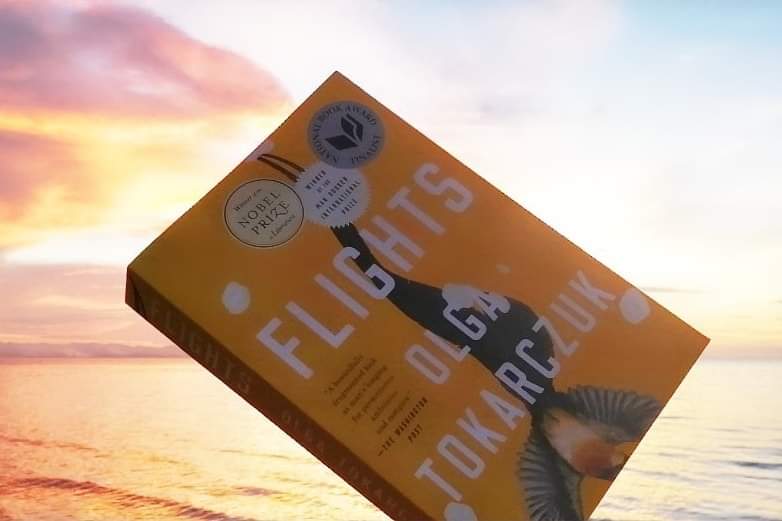
The main motivation for reading this book was in knowing that it recounts the transit of Chopin’s heart back to Warsaw while his body was interred at the Père Lachaise Cemetery in Paris. Every classical musician knows this strangely romantic story of how his homesick heart finally returned home; but naturally, I also wanted to read it narrated by a Nobel winner.
Flights turned out to be an unexpected reading experience. It is a literary collage written the way the author describes postcards nowadays: “Postcards of landscapes, panoramas of old ruins, postcards ambitiously prepared so as to show as much as possible on that flat surface, are slowly being replaced by photographs focusing on details. This is no doubt a good idea, because they relieve tired minds. There is too much world, so it’s better to concentrate on particulars, rather than the whole.”
And so she does. These details and particulars in question are the mind, the soul, psychology, the physical brain, the heart, and the entire human body; which, ironically, also turns out to be “so much world.” It is a travel book with emotional itineraries and mental maps. A special trip around, or more accurately, inside the world. But in its entirety, it is an unusual research on pain, and a unique meditation on traveling, space, time, and movement.
The literary phases of my life have always been geographic, I now realize. Even my shelves are organized based on geography. Russia on the topmost shelf, France, Germany, and the United Kingdom on the succeeding tiers, and so on… and there’s the presently expanding Fertile Crescent and Silk Route section. Tokarczuk being Polish might seem like a veering away from my current authors of choice, and yet, the undeniable influence of the Arabian Nights is still lurking in this masterpiece. Even though I have a feeling that this book will ultimately settle down in the Eastern European section beside Kundera, this one feels like it belongs to each and every section.
As it is with masterpieces, this one transcends geography and other borders.
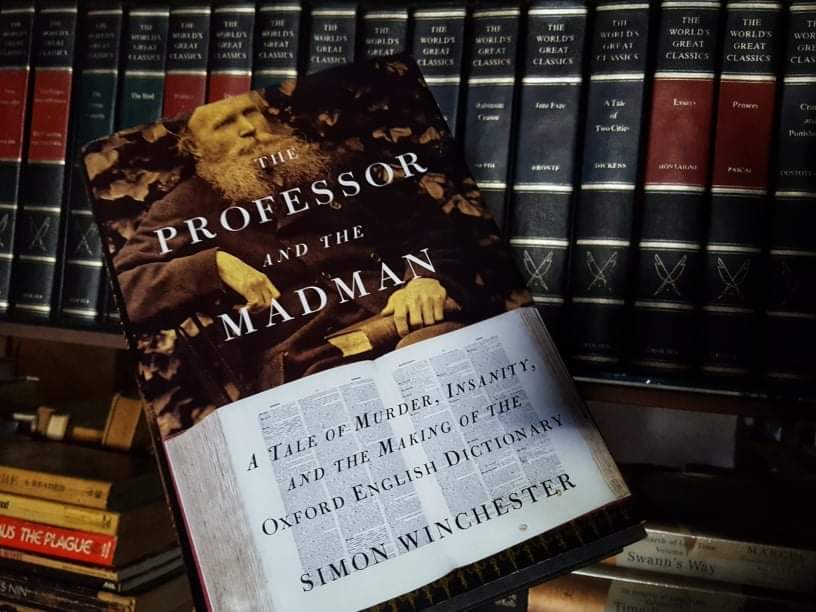
What book comes to mind when you read the lines, “One of the greatest romances of English literature?” or “One of the greatest literary achievements in the history of English letters”? This masterpiece of twelve volumes on its initial edition took almost eighty years to create — the Oxford English Dictionary.
When the British Empire was approaching its pinnacle and English was on the verge of becoming a global language, there was an urgency to “chart the life of each word, to offer its biography… to have a record of the register of its birth,” when it was first written down. “And at the heart of such a dictionary, should be the history of the life span of each and every word. Some words are ancient and exist still. Others are new and vanish like mayflies. Still others emerge in one lifetime, continue to exist through the next and the next, and look set to endure forever… There should be sentences that show the twists and turns of meanings — the way almost every word slips in its silvery, fishlike way, weaving this way and that, adding subtleties of nuance itself, and then perhaps shedding them as the public mood dictates…”
This book unravels the remarkable men behind such a momentous and historic undertaking: “Their scholarship sheer genius, their contributions to literary history profound. But who remembers them and who today makes use of all that they achieved?”
And yet the most astonishing question of all; what if we were told (the way this book exquisitely does) that the making of the Oxford English Dictionary is a tale of murder and insanity?
This story, at times tragic, at times disturbing but with slivers of hope and redemption, most of the time incredible, has the sort of narrative that I usually find in fiction; and it is written in such an absorbing manner that I had to check many times if it was really a work of non-fiction!
At the core of the story are the two learned men to whom we owe the success of the OED: Professor James Murray, the distinguished editor, and a surgeon whose contributions were vital, Dr. William Chester Minor. The two men maintained a correspondence for years but had never met, the latter constantly refusing invitations for a meeting in person. It was only after two decades when Prof. Murray discovered that Dr. Minor was the longest-staying resident at the Broadmoor, England’s harshest asylums for criminal lunatics.
I think this is essential reading for those who love history and words, and the history of words!
“I am not so lost in lexicography as to forget that words are daughters of earth…”
P.S. Just as I thought I veered away from the East and Iran, there is apparently a movie based on this book starring Mel Gibson and Sean Penn, and the movie is directed by Farhad Safinia, an Iranian.
Reading this is like walking into the vibrance of the color spectrum and ending up enveloped in its deepest and darkest hues.
But which caused the author to be put on trial for “denigrating Turkishness” under Article 301 of the Turkish Penal Code. By lending voice to the Armenian characters in the novel, Elif Shafak risked being sentenced to prison. The charges were eventually dropped, but the incident highlights the fearlessness of a Turkish woman brave enough to write about something which, until now, the Turkish government denies — the Armenian Genocide during World War I.
The dialogues between the descendants of the oppressed Armenians and modern-day Turks are moving and revealing on equal sides; the characters are relatable and human; historical facts and astonishing twists leave the reader no choice but to gasp; magic realism effectively subtle; all these, interlaced into the breathtaking and bewitching chaos that is Istanbul make it a triumph of unforgettable and disquieting beauty.
And because the two main characters are readers, there are ruminations on the power of the written word: “Though books were potentially harmful, novels were all the more dangerous. The path of fiction could easily mislead you into the cosmos of stories where everything was fluid, quixotic, and as open to surprises as a moonless night in the desert… Imagination was a dangerously captivating magic for those compelled to be realistic in life, and words could be poisonous for those destined always to be silenced.”
“The regime had understood that one person leaving her house asking herself: Are my trousers long enough? Is my veil in place? Can my make-up be seen? Are they going to whip me?
No longer asks herself: Where is my freedom of thought? Where is my freedom of speech? My life, is it livable? What’s going on in the political prisons?”
“In every religion, you find the same extremists.”
The title takes after the capital of the Persian Achaemenid Empire, but it is an autobiography presented as a graphic novel written and drawn by the author! The two volumes of Persepolis chronicles the life of Marjane Satrapi growing up in Tehran witnessing the downfall of the Shah and the Islamic Revolution, living through the Iran-Iraq War, her high school years in Vienna, and her university life back in Tehran under the Islamic regime.
Persepolis is a memoir, a historical record, a political statement, but also an extraordinarily creative reading experience. Being a newbie to the genre, I had not realized that graphic novels could be this powerful! It is an honest account of a life and a nation, and I admire how it sends out a strong message of how crucial it is to educate oneself to attain freedom, especially the freedom of the mind.
She expounds these thoughts in a later interview with Emma Watson, “I have lived in a dictatorship. There was a ban on everything! Was I less free in my mind? No, I wasn’t. Did I become a stupid person? No, I didn’t. Because no matter how much they looked at me, they could not get into my mind. That belongs to me. And that is under my control if I decide it is. And I can only decide that if I train it. If you don’t use it, it shrinks, and if you use it, it grows. So it is up to us.”
In Volume I, published in 2000, we see a very young Satrapi wishing to be an educated and liberated woman like Marie Curie; and in Volume II, she promises to make her ancestors proud. Remarkably enough, her 2007 animated movie adaptation of Persepolis premiered at the Cannes Film Festival and won the Jury Award. In 2019 she directed the biopic Radioactive starring Rosamund Pike as Marie Curie. Full circle. Watching both films over the weekend turned out to be yet another excellent toast to Women’s Month!
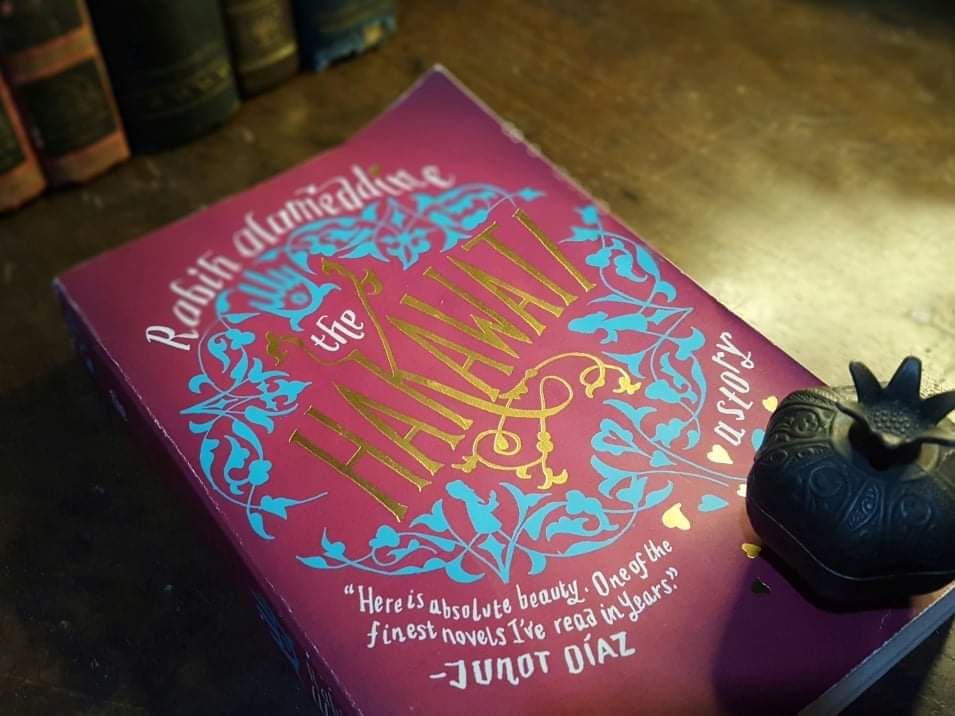
This book is on fire! A dizzying magic carpet ride. A jealous book. It requires your full attention. Look away and you will lose track and get lost, look closer and you will get lost in the stories within stories within stories. It is a matter of choosing your definition of “lost.”
“No matter how good a story is, there is more at stake in the telling,” says the hakawati. The evidence is the book itself, a contemporary retelling of the Arabian Nights through the approach of Lebanese writer, Rabih Alameddine; but this is the Arabian Nights (uncensored, the author warns), deeper and more relevant, and suffused with rich Lebanese culture and history. It is wondrous, bizarre, sometimes even vulgar and repulsive — but only when you take things literally and only until you realize they are metaphors and then it becomes disturbing, and then these parts become ingenious!
One does not have to read the Arabian Nights in order to enjoy this, but I believe it will be better appreciated with an ample background. Many references would have been lost to me and some sections would have seemed absurd had I bypassed the Arabian Nights. The writing style does not have a tinge of mediocrity, and yet I am aware that it cannot be everyone’s cup of coffee; but I will remember this book for the beautiful words it gave me:
Hakawati — “A hakawati is a teller of tales, myths, and fables (hekayat). A story-teller, and entertainer. A troubadour of sorts, someone who earns his keep by beguiling an audience with yarns… ‘hakawati’ is derived from the Lebanese word ‘haki,’ which means ‘talk’ or ‘conversation’. This suggests that in Lebanese the mere act of talking is storytelling.”
Zajal — a poetry duel practiced in Lebanon until today.
Bakhshi — an oud player, a singer, and a storyteller.
Maqam — In the Arabic language it means place, location, situation, position, a shrine, but in Arabic music it is a scale and a mood. “Teardrops descending along cheeks, a cascade of grace,” as the protagonist puts it lyrically.
Tarab — “A musical enchantment. It is when both musician and listener are bewitched by the music.” An entrancement achieved between performer and listener while engaged in music.
This whole book is a cacophony of stories. How fitting that its last word is “listen”.
This book is on fire! A dizzying magic carpet ride. A jealous book. It requires your full attention. Look away and you will lose track and get lost, look closer and you will get lost in the stories within stories within stories. It is a matter of choosing your definition of “lost.”
“No matter how good a story is, there is more at stake in the telling,” says the hakawati. The evidence is the book itself, a contemporary retelling of the Arabian Nights through the approach of Lebanese writer, Rabih Alameddine; but this is the Arabian Nights (uncensored, the author warns), deeper and more relevant, and suffused with rich Lebanese culture and history. It is wondrous, bizarre, sometimes even vulgar and repulsive — but only when you take things literally and only until you realize they are metaphors and then it becomes disturbing, and then these parts become ingenious!
One does not have to read the Arabian Nights in order to enjoy this, but I believe it will be better appreciated with an ample background. Many references would have been lost to me and some sections would have seemed absurd had I bypassed the Arabian Nights. The writing style does not have a tinge of mediocrity, and yet I am aware that it cannot be everyone’s cup of coffee; but I will remember this book for the beautiful words it gave me:
Hakawati — “A hakawati is a teller of tales, myths, and fables (hekayat). A story-teller, and entertainer. A troubadour of sorts, someone who earns his keep by beguiling an audience with yarns… ‘hakawati’ is derived from the Lebanese word ‘haki,’ which means ‘talk’ or ‘conversation’. This suggests that in Lebanese the mere act of talking is storytelling.”
Zajal — a poetry duel practiced in Lebanon until today.
Bakhshi — an oud player, a singer, and a storyteller.
Maqam — In the Arabic language it means place, location, situation, position, a shrine, but in Arabic music it is a scale and a mood. “Teardrops descending along cheeks, a cascade of grace,” as the protagonist puts it lyrically.
Tarab — “A musical enchantment. It is when both musician and listener are bewitched by the music.” An entrancement achieved between performer and listener while engaged in music.
This whole book is a cacophony of stories. How fitting that its last word is “listen”.
Aladdin asked, “Who are the associates of devils?” “A prince without learning, a scholar without virtue… the corruption of the world lies in their corruption.”
Twenty pages into this book and it already felt like I was reading Crime and Punishment instead of another variation of the Arabian Nights. Apparently, it is not a retelling of the Arabian Nights but a grim sequel drained of the amusement and is, instead, a disquieting political message and social commentary. It weighs heavily.
Right at the beginning it exposes the false piety and corruption of those who are in power when a man of good social standing commits a heinous crime and the poor are arrested, questioned, and accused, whilst the authorities “believe in mercy even when we are chopping necks and cropping heads.”
Characters of the Arabian Nights appear throughout the book, their lives intertwined, but the genies are not the type that fulfill wishes. Some play fateful pranks and some act like consciences, testing the human capacity for good and evil, or calling out the faults of those in power, “If you are called upon to do good, you claim you are incapable; and if you are called upon to do evil, you set about it in the name of duty.” And those in power justify their deeds by saying, “He who’s too decent goes hungry in this city.”
As Scheherazade intimates to Sultan Shahryar, “The fact that stories repeat themselves is an indication of their truth, Your Majesty.” True enough. We see these stories repeated outside of fiction and right smack in the middle of our lives.
This novel is, indeed, a ratification of Naguib Mahfouz’s Nobel Prize.
“Wisdom is a difficult requirement — it is not inherited as a throne is.”





 The Book-Butterfly