Two books set in the Balkans to start the year!

But the thing is, she didn’t die.
No, she went on.”

Black Butterflies by Priscilla Morris

A book set during the Siege of Sarajevo hits differently when it is recommended by someone whose family was directly affected by the Bosnian War. It heightens the truth in a work of historical fiction.

It was an easy pick as my first book of the year, despite the promise of grim events. I did not wait for the hard copy to fall into my hands. The e-book was immediately downloaded when I learned that its main characters were an artist, a writer, and a bookstore owner who lent his books during the siege because he believed it was a time when people needed stories the most; and I could not put the book down as soon as I learned that “black butterflies” were the scorched pages from the burning of the national library — “burnt fragments of poetry and art catching in people’s hair.”

The friend who told me that I should read this was not wrong. It is a poignant story about how art triumphs and can oftentimes be the thing that saves us. But at the same time, this book is a sobering and relevant reminder, amidst the season’s celebrations, that similar things are happening in other parts of the world; histories are being erased; libraries are being bombed and burned; entire nations are going through the most violent traumas; and the heritage of entire peoples are being turned to debris.

Books like this convey what hate can do, but books like this also proclaim what art can do. To be one less person in this world who hates — may this be the lesson that the books and the art we consume always teach us.


“He had put the Times Atlas of World History under the paper on which he was noting my answers… The boy likes leafing through it when the shells fall.”

Death in the Museum of Modern Art by Alma Lazarevska

These evocative short stories by Bosnian writer, Alma Lazarevska, complement Black Butterflies. It does not go into detail about the history of the besieged city in which her characters are set. Nothing about what caused the war or about the opposing factions, nothing about a nation’s history. Rather, the history of a day, the history of a feeling, and the intimacy of a thought. Lazarevska leaves the greater scheme of things to the historians and paints ordinary life and “the space of their painful interweaving” as the city is being starved and bombed. 

This was recommended to me by another friend after I posted about Black Butterflies. I wouldn’t have predicted earlier on that the first two books I’d read in 2025 would be set in the Balkans, and yet, here we are. Are the Balkans calling (louder this time)?

In one of the stories, an Austrian writer is referred to, “Whose books are an excellent weapon against shallow sentiment.” That line stuck with me and it aptly applies to this masterful work.


Thank you, Anna and Vishy for these splendid recommendations!
Eric Ambler: The Mask of Dimitrios

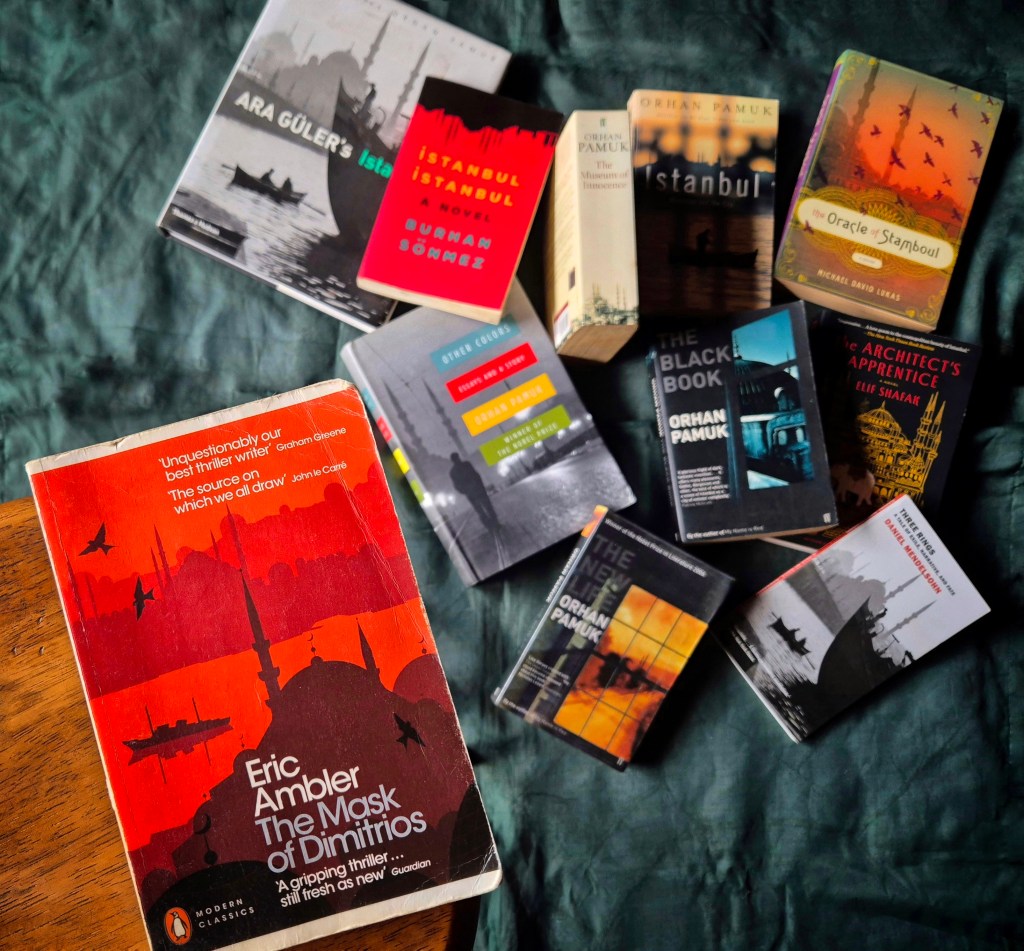
What makes me buy a book for its cover design? My favorite city’s unparalleled skyline!

That is why I read Eric Ambler even though thrillers and spy novels are not my usual genre of choice… especially those written circa 1939.

It was the lure of Istanbul that pulled me into the orbit of Charles Latimer, a detective novelist vacationing in Turkey in the 1930s. There he meets a Turkish colonel who broaches the subject of Dimitrios, a murdered criminal whose body was found floating in the Bosphorus. Intrigued by the dead man’s notoriety, Latimer does his own investigating. What he uncovers is a web of international intrigue that leads him to Smyrna, Athens, Sofia, Geneva, and finally, Paris.

But I began to suspect that this book was not a regular thriller when Charles Latimer inspected the body of Dimitrios in the morgue and saw him, “Not as a corpse in a mortuary, but as a man, not as an isolate, a phenomenon, but as a unit in a disintegrating social system.” It is also worthy of note how Dimitrios, who had become the epitome of evil in Latimer’s mind, turned out to be, “A picture of distinguished respectability,” when he was alive.

“But it was useless to try to explain him in terms of Good and Evil. They were no more than baroque abstractions. Good Business and Bad Business were the elements of the new theology. Dimitrios was not evil. He was logical and consistent; as logical and consistent in the European jungle as the poison gas called Lewisite and the shattered bodies of children killed in the bombardment of an open town. The logic of Michelangelo’s David, Beethoven’s quartets and Einstein’s physics had been replaced by that of the Stock Exchange Year Book and Hitler’s Mein Kampf.”

The Mask of Dimitrios does not read like a thriller. It is unlike those formulaic bestsellers that cater to superficial and momentary sensations. Those who seek such will be disappointed. It is rather a perceptive insight into that rapidly splintering era sandwiched between two World Wars.

What makes it terrifying is the way he seemed to be describing the world today.

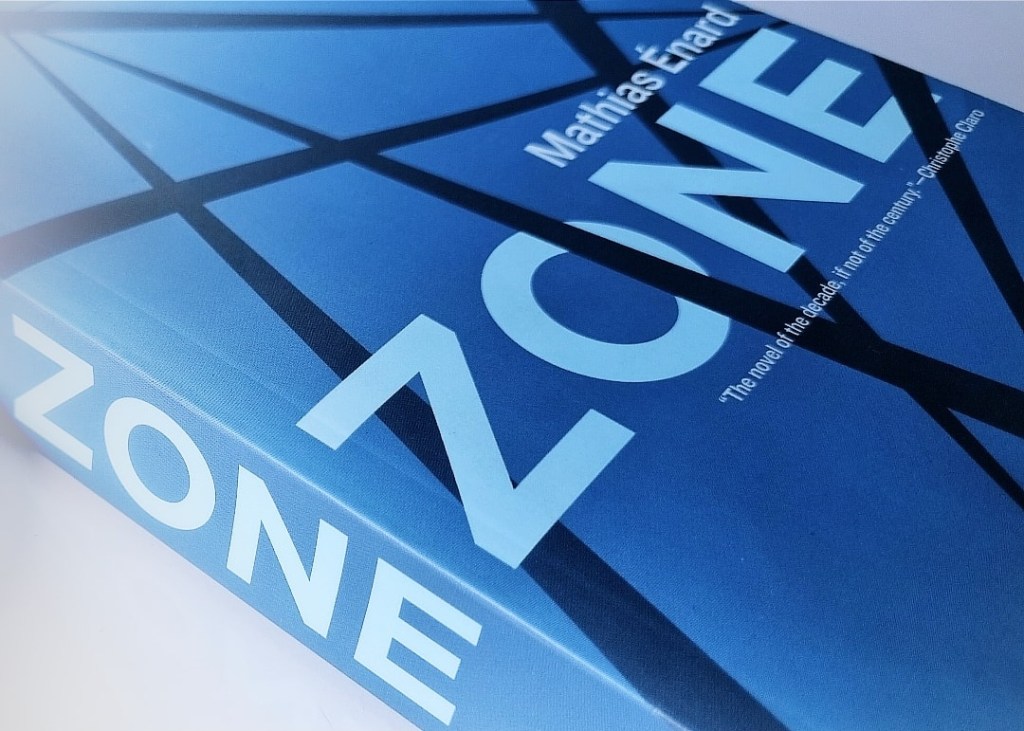
Mathias Énard: Zone

Tell them of battles, kings, and elephants,

without the elegance, without the elephants,

only battles, cruel kings, and pawns,

“Comrade, one last handshake before the end

of the world,” says a madman

at the station in Milan,

Francis Servain Mirković is burdened

by the remark, burdened

by the contents

of his suitcase, by the contents

of his mind,

as the train steers to Rome,

it is not scenery that flash by,

it is his life; no home,

Balkan conscript, a spy,

dysfunctional lover, son,

former informer

in the Zone, epicenter

of my literary quakes,

“the Zone, land of the wrathful savage

gods who have been clashing

endlessly

since the Bronze Age,” but he is

convinced that tomorrow he will

be a new man, as the train moves

memory

is a threnody

of the guilt of nations,

of the sins of the world,

of over a century’s worth

of savagery,

a brutal montage

of conflict, training our eyes to truths 

that we prefer to turn away from, a book

to make our consciences flinch, no one

is ever prepared

for official truth

says our antihero, this man,

a product of a history

of violence,

a tragic aspect

of a portrait

of a man

of our time.