“The world was awake — it wakes early in the East.”
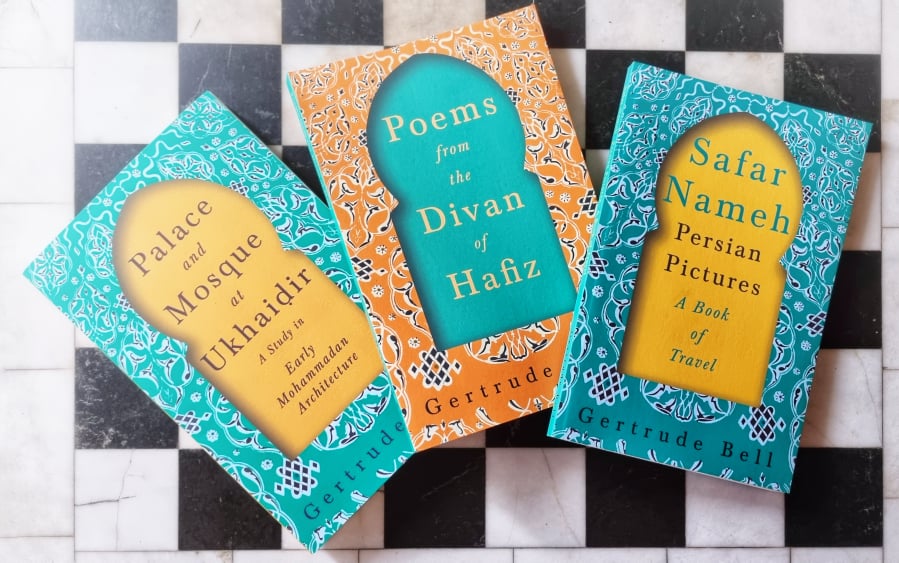
Gertrude Bell’s simple description of a Persian sunrise encapsulates, with figurative overtones, the theme of the books I have been reading lately. In The Silk Roads, she is described as dynamic and fiercely intelligent, brilliant, a mercurial scholar and traveler who knew the region and its people as well as anyone. Portrayed by Nicole Kidman in Queen of the Desert, she is called a Kingmaker for being influential in drawing up the borders of the new nation of Iraq and in bringing King Faisal to power as its first ruler in 1921. But it was only through Safar Nameh that I was introduced to her writing.
She writes so elegantly with a deep perception of places, people, and the relationship between East and West. She speaks of “the careless optimism of those who seek to pile one edifice upon another, a Western upon an Eastern world, and never pause to consider whether, if it stands at all, the newer will only stand by crushing the older out of all existence.”
This is a tiny book of a hundred pages that I thought I would be able to finish in one coffee break, but the writing is too beautiful that I had to savor the lines over and over again.
And for those times when my mind and soul are exceedingly wide awake in wonder, she has the right words… “The world was too lovely for sleep.”
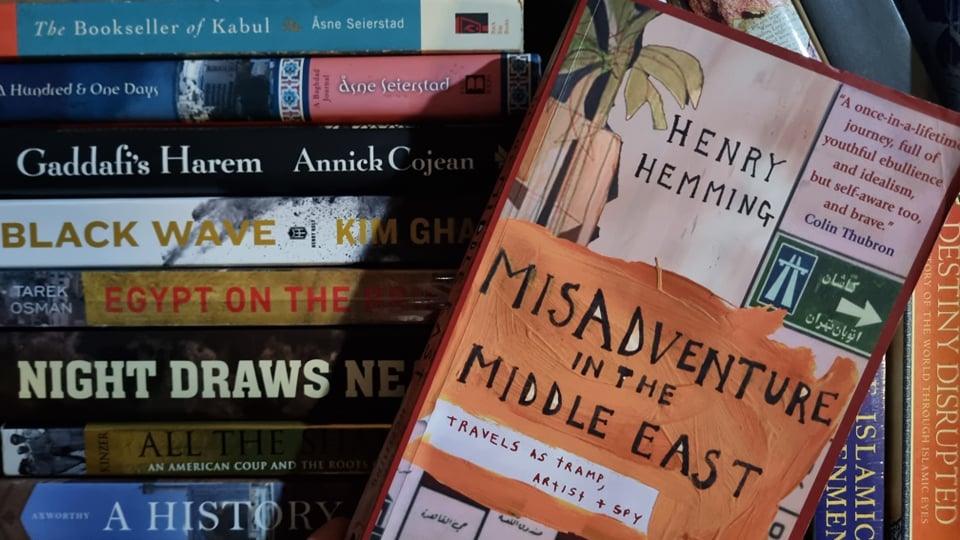
In contrast to de Botton’s encouraged manner of traveling by allowing art to guide us in our travels and what we pay attention to, Henry Hemming, a British painter and author, ventures to the Middle East and lets his travels guide his art.
He and his companion discovered that each country and their people were immensely different from the other that, as artists, it was now more difficult for them to paint a portrait of what we call the “Middle East.” But this is where the book comes in.
It may not be a complete picture, but it provides a keener understanding, especially at a time when we need it most.
It was in 2008 when I read my first Ishiguro, Never Let Me Go. It would take another 9 years before he would win the Nobel, but that book already established that he would persist as one of my favorite novelists. In the years that followed, his other works consistently lured me back to an inimitable realm of pensive storytelling, but a phantom pain still pierces my heart when I think about it. Even to this day, it has not let me go.
And here comes Klara and the Sun, his first novel after the Nobel. This book cannot be more relevant to our generation. Never Let Me Go and Klara and the Sun represent what great art is for me: The kind that keeps you awake and urges you to ponder what it is to be human, the kind that encourages you to be more alive and insightful; Art that remains dignified even when it unsettles — a pain that you would feel alongside your happiness.*
The Library of Alexandria was not the first systematically organized library in the world. There was another one that was much older: The great library of Nineveh built circa 668 BCE by Assyrian King Ashurbanipal. Although it shared Alexandria’s fate through destruction by fire, it had another advantage — its clay tablets. Alexandria’s papyrus were reduced to ashes, but Nineveh’s cuneiform clay tablets that exceeded twenty thousand in number were merely baked afresh. Not only did this library preserve the Epic of Gilgamesh for future generations, the Nineveh excavation has become a prime source of information about the Assyrians and the Babylonians whose knowledge and culture they inherited.
We all know Nineveh — this wonder of the ancient world, for a time the largest city in the world — from the Old Testament account of Jonah, but for thousands of years, it could have remained a fictional city for unbelievers until its unearthing. “Without the evidence that these monuments afford, we might almost have doubted that the great city ever existed,” writes Austen Henry Layard.
“Existing ruins show that Nineveh had acquired its greatest extent in the time of the Assyrian kings mentioned in the Old Testament. It was then that Jonah visited it, and that reports of its size and magnificence were carried to the West, and gave rise to those traditions from which the Greeks mainly derived the information they have handed down to us concerning the city.” On a footnote, Layard adds, “With regard to the connection between the ornaments mentioned in the text and those of Greek architecture, it is now impossible to doubt that all that is Ionic in the arts of Greece is derived from the valleys of the Tigris and Euphrates.”
Austen Henry Layard, a name no longer too familiar to our generation, was once a household name in Europe when he discovered Nineveh in the 1840s. Quoting from the introduction, his journals “took Europe by storm and became one of those books that everyone had to read.” It has never gone out of print and is still considered to be among the greatest archaeological books of all time.
Layard being an art historian, a draughtsman, a cuneiformist, and a diplomat, among other things, this book is also so many things at once! The journals have occasional sketches of details from the excavations, he ponders on art, history, religion, civilizations, and takes the reader on his expeditions while painting a vibrant portrait of the time, places, the tribes and people that he encounters on his journeys, and writes vividly of life-threatening experiences. But the best parts are those moments of discovery that lead to spine-tingling wonder! He can be quite poetic, too: “On all sides, as far as the eye could reach, rose the grass-covered heaps marking the site of ancient habitations. The great tide of civilisation had long since ebbed, leaving these scattered wrecks on the solitary shore. Are those waters to flow again, bearing back the seeds of knowledge and of wealth that they have wafted to the West? We wanderers were seeking what they had left behind, as children gather up the coloured shells on the deserted sands.”
Reading this book recalls and intensifies the question that Jason Elliot posed in his book on Iran: “What will future archaeologists think of us when they find what we’ve left for them?”
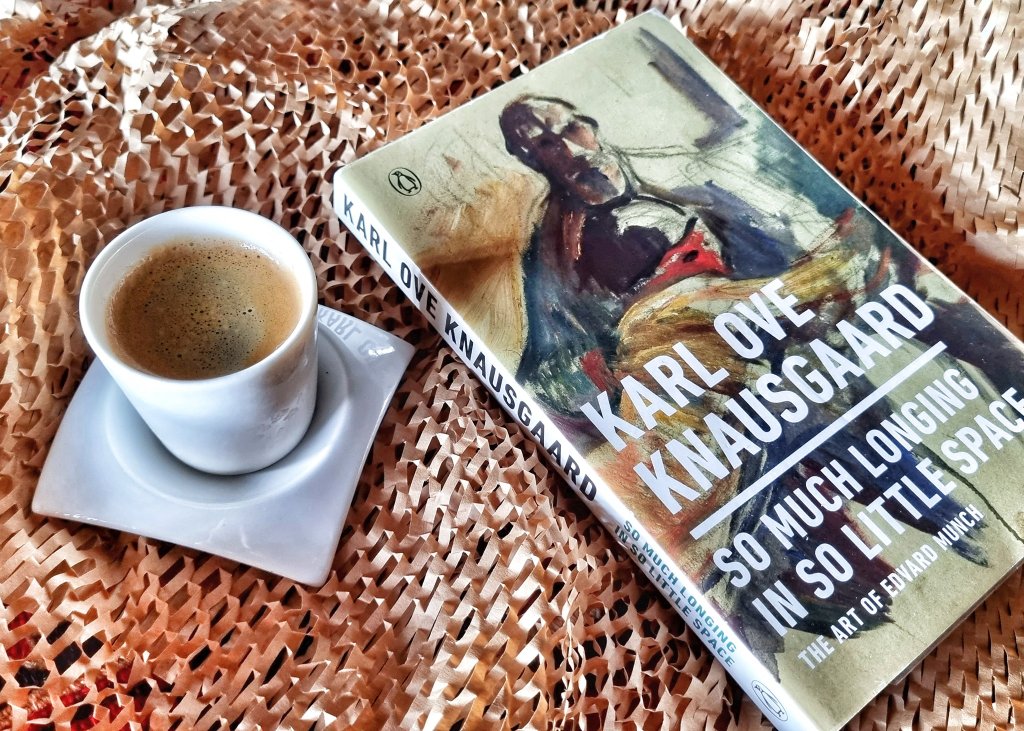
Edvard Munch beyond and behind 𝘛𝘩𝘦 𝘚𝘤𝘳𝘦𝘢𝘮, written by Karl Ove Knausgaard beyond and behind the bestselling memoirs.
It reads like a personal meditation on the driving force for art, literature, music, the impact of emotional and psychological experiences on the artistic process. In essence, it is enlightening art investigation, history, and criticism… but after all of these, splendidly rendered inconsequential by Knausgaard who ultimately acknowledges that real art transcends words.
A book you can read in the span of two cups of coffee, but one that has more insightful layers than some thicker tomes. I soon discovered that the play has been a recipient of theatre’s most prestigious awards! And it is about art, and friendship, and dissimilar aesthetic opinions.
– – –
Three best friends and their opinions about art and of each other are exposed when Serge purchases an art piece for two hundred thousand francs. It is a white canvas with fine diagonal scars.
Marc thinks it’s ridiculous, Serge takes offense, Yvan attempts to pacify both sides, and in return gets accused of being unable to take a stand.
What is hilarious and entertaining is how the reader can resonate with each character in different parts of their argument.
Is it a real friendship if we keep our thoughts to ourselves to maintain good relations? Should we allow difference of opinion to imperil friendships?
As the scenes play out, we ultimately learn from the dialogue that offense is given and taken not entirely by the contrasting beliefs but mainly through the approach and manner in which they are presented.
Inside these pages is a realm where a poet is described as someone who speaks on the threshold of being, where poetry is a commitment of the soul, where an artist is a producer of light, where imagination is believed to augment the values of reality, where art is a phenomenon of the soul and an increase of life, a sort of competition of surprises that stimulates our consciousness and keeps it from becoming somnolent, where art’s intention is to redeem an impassioned soul, and where spaces must be loved.
It reads like a much-needed daydream; a daydream that pulled me away from distressing pandemic thoughts and spirited my mind away to an elevated plane. It addresses the musician, the reader, and the many aspects of my being. It beckons each of us to become poets, or at least, to listen more to poets. The world seemed to gleam whenever I looked up from the pages, and after making me sigh over its most elegant passages, it vivified my feelings toward words, my surroundings, light, shade, silence, and toward spaces internal and external, physical and metaphysical. It called my attention to the beautiful immensity of all these! My copy will continue to be revisited whenever the mind’s eye needs to retrieve lost sparkle.
_ _ _
The Poetics of Space is usually classified as a book about architecture, but it felt like so much more to me. I initially thought that describing it as such unfairly truncates it. It was only through subsequent readings that I understood how much it truly is about architecture, and how works like these continue to exert influence on one’s sensibilities long after turning the last page!
While reading Kazuo Ishiguro’s An Artist of the Floating World, Mathias Enard’s Tell Them of Battles, Kings & Elephants, and Jan Morris’ Venice, I noticed that I had suddenly become instinctively aware of the architecture and how spaces are respected in the books! I even realized that my favorite writers are those who are attentive to spaces. The Poetics of Space is turning out to be a magnifying lens for architecture in the real world and in literature, giving reading and living experiences more depth.
It is, essentially, a book about architecture, and to have thought that this description was insufficient only reveals that it is actually my understanding of architecture that is limited. Wasn’t Elif Shafak hinting at this in The Architect’s Apprentice? “For the eye that could see, architecture was everywhere.”
Architecture — when vouchsafed to the right mind, heart, and soul — is music, poetry, and many things in between.




 The Book-Butterfly