September 14, 2023 – Aswan: The Unfinished Obelisk, Philae Temple, and Abu Simbel

Aswan. This is where Egypt begins. It only seemed logical to begin my excursions to the ancient Egyptian archaeological sites here.

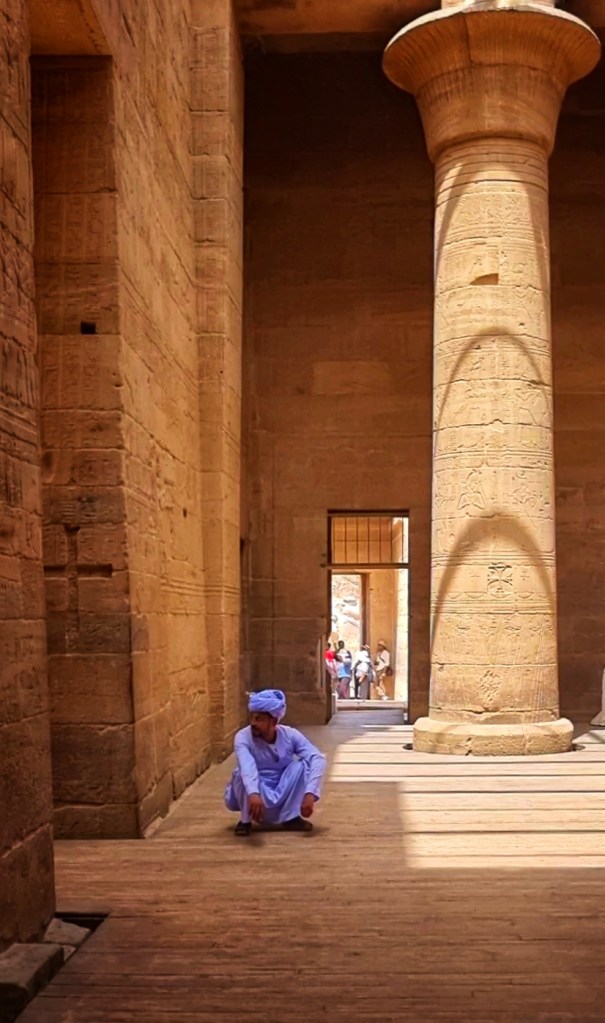
If you’re wondering what that drill is doing there… well, I wanted to finish the obelisk! Who wants unfinished business anyway?! Haha… kidding. They were constructing a ramp for tourists and the carpenter kindly offered to take my picture.

In one of Aswan’s stone quarries, one site has intrigued me almost as much as the pyramids. Had it been completed, it would have been the largest obelisk ever built by the ancient Egyptians. The speculation that it had been commissioned by Queen Hapshetsut added to my wonder. Needless to say, within an hour after landing in Aswan, I was already at the site of the Unfinished Obelisk, fascinated by the existing evidence of the ancients’ construction process.

The following day, I set out early and hired a private car to take me to Abu Simbel. The ride itself was exciting as I witnessed a most enigmatic sunrise, passed checkpoints due to the proximity to the Sudanese border, saw more Nubian villages and the place where they quarantine camels from Sudan, drove through an otherworldly terrain, and finally beheld the twin temples originally carved out of the mountainside in the 13th century BCE, during the reign of Ramesses II.

But when it comes to idyll, Philae Temple Complex takes the throne. A small ferry took me to an island on the Nile and I was immediately transported to the pages of Mahfouz’s Rhadopis of Nubia. The Temple of Isis built in the reign of Nectanebo I in 380-362 BCE is the island’s most striking feature, and yet through the different architectural structures, one could see the Pharaonic, the Ptolemaic, the Romans, and the Christians, stamping their identities on the landscape. It has never been this clear to me; how architecture IS identity.
September 13, 2023 – Aswan: Nubian Village

Looking at a map, one might wonder why Lower Egypt is up north and Upper Egypt is down south. The terms are derived from the flow of the Nile from the highlands of South East Africa down to the Mediterranean Sea.

Aswan is a city on the banks of the Nile, known even in ancient times as the place where Egypt begins.

From the subdued and earth tones of Alexandria in Lower Egypt to the bold and bright colors of Aswan in Upper Egypt! What an abrupt change of culture and climate for a flight so brief! Traffic involves camels and donkeys, and even the coffee is thicker and darker!

My Aswan itinerary included a trip to the Nubian Village. Little did I know that the guest house I booked was right smack in the middle of the Nubian Village — a far cry from the Aswan depicted in Agatha Christie’s Death on the Nile and the Aswan in which she wrote parts of the novel. Although I also intend to explore that tamer Aswan (sans death haha) in the coming days, I’m more than grateful to experience this Aswan that’s just as much a mystery and a most wonderful shock to the senses!

Abdulrazak Gurnah: Desertion

If you intend to read this, do not allow the abrupt and tidy ending of the love story in the first part to dissuade you from continuing. That’s not exactly how it ends. Make sure you persevere until the second to the last chapter to find the poetic piece of the puzzle that renders the last chapter almost unnecessary and makes the whole book worth reading.

And do not read this if you are in a hurry. It is writing that begs you to slow down, to savor elegant lines such as “…he was an upright shadow moving so slowly that in that peculiar underwater light his approach was almost imperceptible, inching forward like destiny”; it is writing that urges you to be there in an East African town of a British protectorate with Hassanali when he finds the half-conscious sunstricken Englishman, Martin Pearce, in 1899. 

1899, only a year after our independence from another entitled European power who thought the world was intended for European colonization. “So I had to learn about that,” our narrator remarks, “and about imperialism and how deeply the narratives of our inferiority and the aptness of European overlordship had bedded down in what passed for knowledge in the world.” 

As a Filipina, this book made me understand and applaud the Nobel Prize motivation — for Gurnah’s “uncompromising and compassionate penetration of the effects of colonialism and the fate of the refugee in the gulf between cultures and continents.”

As a woman, I felt the bitter aftertaste of the intergenerational injuries colonialists cause, not just to a place but to their women. 

As a daughter and a lover, I recognized that honorable layer of filial duty and the sacrifices we make for love.

As a reader, I relished the passages that put weight on the value of stories: “She missed his noises, his voice, his bulk, his presence, but after that she realized how much more she missed his stories.”

“It is about how one story contains many and how they belong not to us but are part of the random currents of our time, and about how stories capture us and entangle us for all time.” 

“It’s remarkable, isn’t it, that these people have got by for centuries without writing anything down… everything is memorized and passed on… It’s a staggering thought, that no African language had writing until the missionaries arrived,” says one English character in the book.

It is remarkable, and even more remarkable that Tanzania now has a Nobel Prize laureate in literature.

Desertion is a sorrowful title. But as it is written in my favorite chapter, “Sorrow has its gifts.”