There is the romantic in me who would like to write an ode of admiration to this exceptional journalist for tackling a most pertinent matter and there is also the dormant journalist tempted to fangirl. However, the teacher of little children prevailed and simplified the lessons instead.
Who is my “Other”?
Those who do not hold the same beliefs. The most obvious right now are those who do not share the same political views.
How should we relate to Others?
There seems to be three approaches: War, isolation, and a third one learned through trade routes like the Silk Road — cooperation.
Why not war?
“It is hard to justify wars; I think everyone loses them, because it is a defeat for the human being. It exposes his inability to come to terms, to empathize with the Other, to be kind and reasonable…”
Why not isolation?
“The idea that prompted man to build great walls and vast moats, to surround himself with them and isolate himself from others, has in modern times been given the name of the doctrine of apartheid.”
What is the main content of the encounter with the Other?
Dialogue. Dialogical openness, perspective, and awareness. “The will to become acquainted.”
What should I equip myself with?
“…it is so important to have one’s own distinct identity, a sense of its strength, value and maturity. Only then can a man boldly confront another culture. Otherwise he will lurk in his hiding place, fearfully isolating himself from others.”
Why should we cooperate and why should we relate to the Other?
Because building bridges of understanding with Others “is not just an ethical duty but also an urgent task for our time in a world where everything is so fragile and where there is so much demagogy, disorientation, fanaticism and bad will.”
“The Self not only has to relate to the Other, but must assume responsibility for him and be prepared to bear the consequences for such a decision, such an attitude. Is there a Christian act of sacrifice in this? Yes — of sacrifice, renunciation and humility.”
The sound of sirens woke me up. Whose witty idea was it to celebrate Women’s Month with Fire Prevention Month in the Philippines? Woman is a fire you cannot prevent. Sirens are also women.
These were my tangled thoughts as I got up on the first day of March, a month I look forward to as a reading woman. It’s when I devote most of my reading time to women authors.
Rebecca had to be the first choice, because maybe my mind treats literature like medicine and it cyclically hankers for a more potent dose to achieve efficacy, and she lives up to this promise — this sort of writing that painfully confronts the hurts and pinpoints the ills but becomes the balm through impeccable information-giving and matchless storytelling, all administered with strength and grace.
The title is an acknowledgement to how the artist Georgia O’Keefe signed her letters for the people she loved, “from the faraway nearby.” A way to measure physical and psychic geography together, Rebecca observes. “We’re close, we say, to mean that we’re emotionally connected, that we are not separate… emotion has its geography, affection is what is nearby…” We can be distant from the person next to us but be hopelessly attached to another who is hundreds of miles away. Was it Ondaatje who asked, “Do you understand the sadness of geography?” It seems Rebecca understands and she holds your hand through this sadness.
But that is only one of the myriads of things meaningful to me that she weaves artfully into this narrative. The curious format of this book is a nod to the Arabian Nights. It was only recently when I remarked how Latin American and Eastern European literature are under Scheherazade’s spell, but this book makes me ask, “Who isn’t?”
“The fairy-tale heroines spin cobwebs, straw, nettles into whatever is necessary to survive. Scheherazade forestalls her death by telling a story that is like a thread that cannot be cut; she keeps spinning and spinning, incorporating new fragments, characters, incidents, into her unbroken, unbreakable narrative thread. Penelope at the other end of the treasury of stories prevents her wedding to any of her suitors by unweaving at night what she weaves by day… By spinning, weaving, and unraveling, these women master time itself, and though master is a masculine word, this mastery is feminine.”
“Stories are compasses and architecture; we navigate by them, we build our sanctuaries and our prisons out of them…” This is the line with which Rebecca opens this book.
And this is how she ends. “Who drinks your tears? Who has your wings? Who hears your story?”
“Who has your wings?” Who else can ask such a poignant question?
This mastery is, indeed, feminine. Happy Women’s Month!
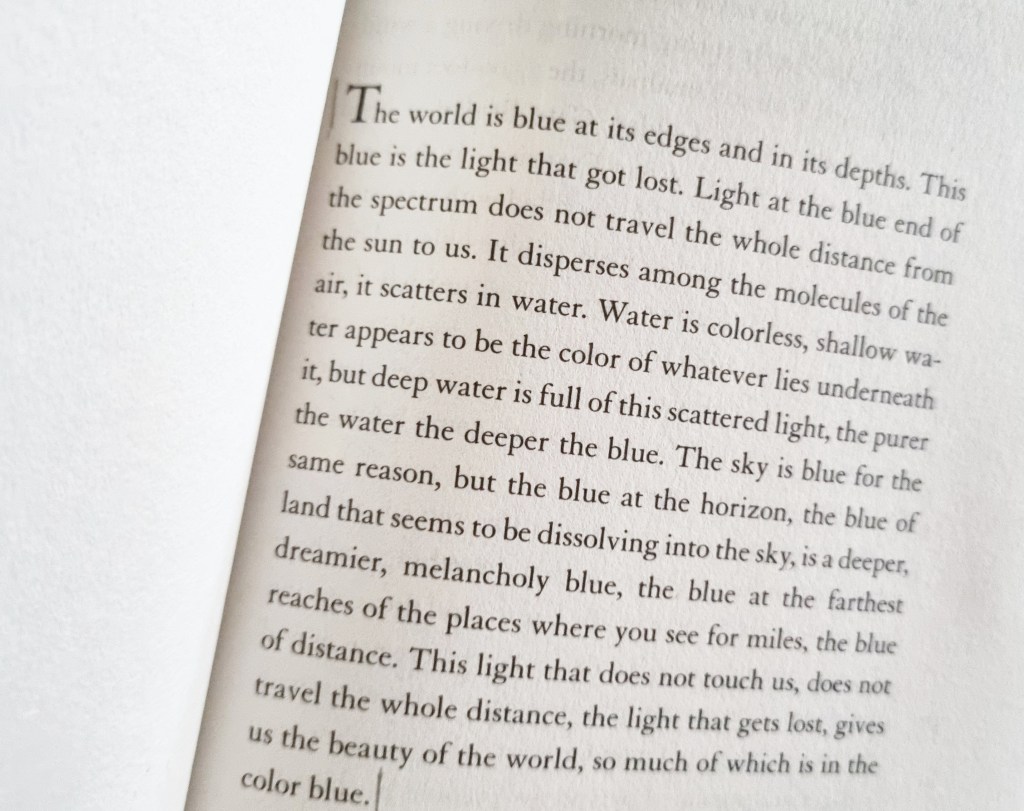
A Field Guide to Getting Lost
January 25, 2022
Life is unpredictable, but nothing highlights this fact more than the pandemic. If we care to admit it, everyone feels a little lost in the midst of this all.
This beauty of a book is the fresh perspective on being lost that I did not know I needed, for Solnit invites you to be at home with being lost and to be comfortable with it. She encourages you to “leave the door open for the unknown” and calls it art.
“That thing the nature of which is totally unknown to you is usually what you need to find, and finding it is a matter of getting lost. The word ‘lost’ comes from the Old Norse ‘los,’ meaning the disbanding of an army, and this origin suggests soldiers falling out of formation to go home…”
The first two chapters took possession of me, the rest of it was simply a bonus. There are passages that are painful to read but in a cathartic way.
Sometimes, in our arrogance as readers, we approach a book as confident as Alexander on a Persian conquest; and in our confidence, we allow ourselves and others to believe that we have conquered it. Only to learn and be humbled, again and again, that the ones that matter, are those that conquer us.
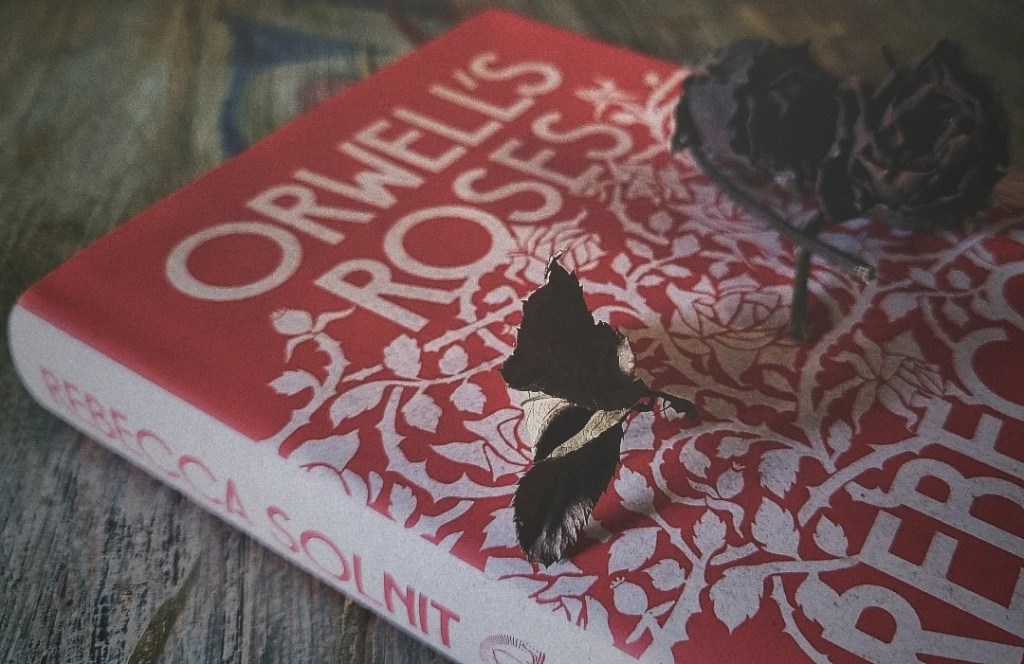
Orwell’s Roses
March 11, 2022
When you turn to a book for solace and get chills instead.
Yes, this has got to be the most beautiful literary criticism of Nineteen Eighty-Four: It rethinks the man that was George Orwell, it guides us to reassess beauty, and it reviews Nineteen Eighty-Four in a light that is distinctly hers. But with Rebecca Solnit, you never know where she will take you next; it is only guaranteed to be a place of startling insight and perspective.
Written and published amid the Covid-19 pandemic, it surprisingly mentions and describes Putin as an admirer and rehabilitator of Stalin’s reputation; even calling to mind the Holodomor, also known as the Terror-Famine, recognized by 16 nations as a genocide carried out by the Soviet government that killed 3-5 million Ukrainians from 1932-1933… and it seems like George Orwell’s Nineteen Eighty-Four will not be the only prescient book in question here.
What is chilling is the reminder that, “To be corrupted by totalitarianism, one does not have to be in a totalitarian country.” Orwell set Nineteen Eighty-Four in England, “To emphasize that totalitarianism could triumph anywhere.”
And what buttresses totalitarianism? Lies. “Lies gradually erode the capacity to know and to connect… Lies are integral to totalitarianism… demands, in fact, the continuous alteration of the past, and in the long run probably demands a disbelief in the very existence of objective truth.”
“Who controls the past controls the future: who controls the present controls the past. The attack on truth and language makes the atrocities possible. If you can erase the witnesses, convince people of the merit of supporting a lie, if you can terrorize people into silence, obedience, lies, if you can make the task of determining what is true so impossible or dangerous they stop trying, you can perpetuate your crimes. The first victim of war is truth.”
And yet, despite these ominous warnings for which Orwell is known, Solnit asks us to reconsider the word “Orwellian” and look at the man who, in the spring of 1936, planted roses. Beautiful is far from the first word that comes to mind when confronted with his writings, but there is a definition of beauty, Solnit emphasizes, that does not have to do with prettiness. “Another kind of beauty, of a toughness that is life…” The beauty to which Orwell was most committed and for which he strove was “this beauty in which ethics and aesthetics are inseparable, this linguistic beauty of truth and of integrity as a kind of wholeness and connectedness, between language and what it describes, between one person and another, or between members of a community or society.”
What was beautiful to him was truth, clarity, honesty — and roses. “Orwell was passionate about the beauty and gestures and intentions, ideals and idealism when he encountered them, and it was to defend them that he spent much of his life facing their opposites.”
“Orwell’s work was about ugliness of various kinds, but what he found hideous serves as a negative image of what he found beautiful.”
There is, after all, solace through the roses telling us that stopping to smell them does not necessarily distract us from the seemingly more important things in life, but strengthens us instead. Through Rebecca Solnit, and through the man who made my birth year significant in literary history, we are spurred to recalibrate what we deem beautiful, to acknowledge our need for beauty, and to always strive to pursue it.
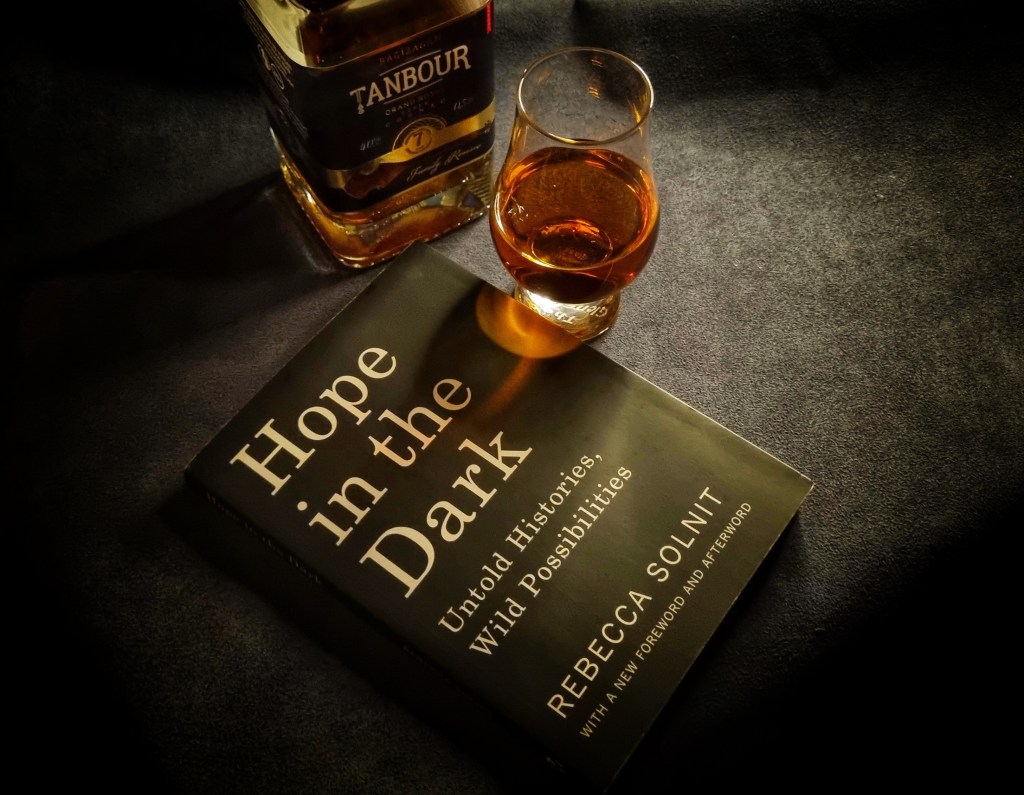
Hope in the Dark
July 4, 2022
If it were not Rebecca Solnit who wrote this, I would have dismissed the title as another one of those inspirational books that I do not gravitate towards so much. But having experienced four Solnits this year prior to this, which all proved to be books I needed at the exact time I read them, I seized this as soon as it arrived. And once again, she delivered.
I felt it was written for me, who, upon returning from an exhilarating trip, returned to my country with a new president whom I did not vote for. Solnit’s books are extremely political, but she wrote this to make the case for hope, especially for those who, on the surface, seemingly lost:
To point out that just because my side did not win the election, does not mean we are not victorious in many things. To challenge myself to live the same way with the leadership I did not choose as I would have had my candidate won, and to continue being a responsible citizen and human being — because being victorious and seemingly right is small comfort when, around the world, and around the country, there is still injustice and there are still people dying and living horribly.
“Hope doesn’t mean denying these realities. It means facing them and addressing them by remembering what else the twenty-first century has brought, including movements, heroes, and shifts in consciousness that address these things now.”
“The hope I’m interested in is about broad perspectives with specific possibilities, ones that invite or demand that we act. It’s also not a sunny everything-is-getting-better narrative, though it may be a counter to the everything-is-getting-worse narrative.”
Consider reading this if you, like me, paid your taxes dutifully and was called “self-righteous” when you pointed out that our new president failed to pay his; if you campaigned for your candidate without insulting anyone but the many enjoyed branding everyone on your side as toxic, even though poisonous ones were actually present on both sides if we care to admit (I have screenshots); if you were maligned and called names because of who you supported while the same people demanded respect but has been disrespecting your candidate for six years; if you, hopefully, like some of them, just wished for a better country. Consider reading this if you are frustrated and you think hope is lost, because it just made me realize that it isn’t.
This book reminded me that hope and action feed each other, and that every action and inaction have more impact than we know; to not merely demand change but to embody it.
Hope, above all, is action; and as long as we do our part and, if possible, do more than what’s required of us, there is hope.
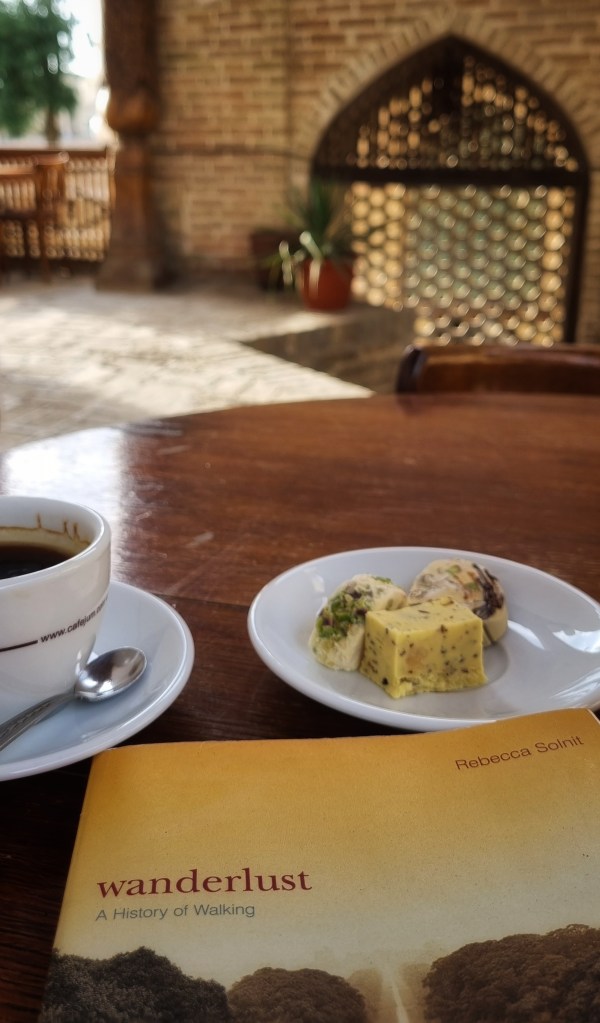
Wanderlust
June 19, 2022
…with a title perfect for a trip, Solnit shared an Eskimo custom of offering an angry person release by walking the emotion out of his or her system by going in a line across the landscape; “The point at which the anger is conquered is marked with a stick, bearing witness to the strength or length of the rage.”
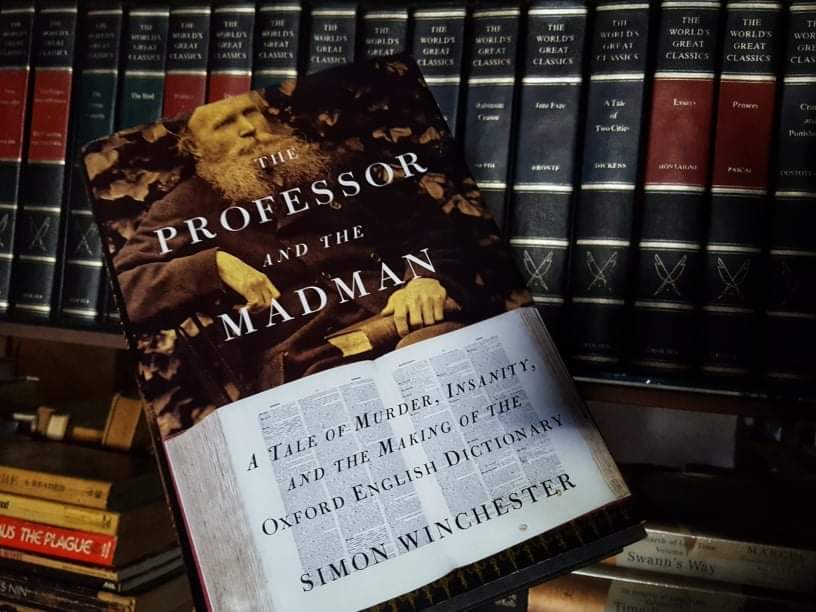
What book comes to mind when you read the lines, “One of the greatest romances of English literature?” or “One of the greatest literary achievements in the history of English letters”? This masterpiece of twelve volumes on its initial edition took almost eighty years to create — the Oxford English Dictionary.
When the British Empire was approaching its pinnacle and English was on the verge of becoming a global language, there was an urgency to “chart the life of each word, to offer its biography… to have a record of the register of its birth,” when it was first written down. “And at the heart of such a dictionary, should be the history of the life span of each and every word. Some words are ancient and exist still. Others are new and vanish like mayflies. Still others emerge in one lifetime, continue to exist through the next and the next, and look set to endure forever… There should be sentences that show the twists and turns of meanings — the way almost every word slips in its silvery, fishlike way, weaving this way and that, adding subtleties of nuance itself, and then perhaps shedding them as the public mood dictates…”
This book unravels the remarkable men behind such a momentous and historic undertaking: “Their scholarship sheer genius, their contributions to literary history profound. But who remembers them and who today makes use of all that they achieved?”
And yet the most astonishing question of all; what if we were told (the way this book exquisitely does) that the making of the Oxford English Dictionary is a tale of murder and insanity?
This story, at times tragic, at times disturbing but with slivers of hope and redemption, most of the time incredible, has the sort of narrative that I usually find in fiction; and it is written in such an absorbing manner that I had to check many times if it was really a work of non-fiction!
At the core of the story are the two learned men to whom we owe the success of the OED: Professor James Murray, the distinguished editor, and a surgeon whose contributions were vital, Dr. William Chester Minor. The two men maintained a correspondence for years but had never met, the latter constantly refusing invitations for a meeting in person. It was only after two decades when Prof. Murray discovered that Dr. Minor was the longest-staying resident at the Broadmoor, England’s harshest asylums for criminal lunatics.
I think this is essential reading for those who love history and words, and the history of words!
“I am not so lost in lexicography as to forget that words are daughters of earth…”
P.S. Just as I thought I veered away from the East and Iran, there is apparently a movie based on this book starring Mel Gibson and Sean Penn, and the movie is directed by Farhad Safinia, an Iranian.
“Ruskin was distressed by how seldom people noticed details. He deplored the blindness and haste of modern tourists, especially those who prided themselves on covering Europe in a week… ‘No changing of place at a hundred miles an hour will make us one whit stronger, happier, or wiser. There was always more in the world than men could see, walked they ever so slowly; they will see it no better for going fast. The really precious things are thought and sight, not pace. It does… a man… no harm to go slow; for his glory is not all in going, but in being.’”
The really precious things are thought and sight! For his glory is not all in going, but in being! How beautiful is that?!
De Botton presents the chapters in an interesting way. For each chapter there are featured places and featured guides. In Chapter 8, some of the places are Madrid, Amsterdam, Barbados, and the guide is John Ruskin. In Chapter 7, the place is Provence, and the guide is Vincent Van Gogh. The places are de Botton’s destinations and the guides are the writers or artists who influenced his consciousness as he traveled.
“Our responses to the world are crucially moulded by whom we are with,” he writes. And in another line, “A danger of travel is that we see things at the wrong time, before we have had a chance to build up the necessary receptivity.” And how do we develop this necessary receptivity? The right company! Literature! Art! Art, he writes, are “immensely subtle instruments” that guide us to what we should pay attention to.
The Architecture of Happiness once accompanied me on a trip to Cambodia and deepened my experience with the country’s elaborate 12th Century structures, and yet The Art of Travel ironically kept getting shelved for some reason. But the pandemic that has forced me to stay put finally reunited me with this, and it is certain to augment future travels.
There are passages where I cannot relate with how de Botton feels about certain things, but I relish reading him for his enduring leitmotif — endeavoring against superficial experiences and a shallow existence. This book reminds me of something I wrote after my first solo international trip: “That is the thing about Utopia. It is not a place. If you go to Bali, do not expect to find Utopia, Faith, Peace, or Love. If you go to Bali, travel with these things within yourself and it is certain that you will find Beauty. So much Beauty.”
On this, de Botton and I surely agree that our experiences of a destination will depend so much on what we carry within us.
“It is unfortunately easier to lose a lover than complete In Search of Lost Time.” How funny but true!
Devoting the year 2009 to Proust’s In Search of Lost Time was one of my most rewarding undertakings as a reader. It is, indeed, easier to lose a lover, but basking in Proust is what I imagine having synesthesia would be like. The first volume alone led to an artistic rebirth; but by the end of all seven volumes I realized that it had instilled something so delicately through its entirety — empathy.
De Botton does not mention empathy but touches on how “experiences of fictional characters afford us a hugely expanded picture of human behavior” and nods toward artists “by whom our eyes are opened.” This is De Botton’s dissection of Proust, the colossal work, and its effects on the reader. For those who have not read Proust, it can serve as an introduction; and for those who have read Proust, a confirmation of the common reader’s exact thoughts, albeit expressed meticulously in a superior and delightful way.
There are two main things that stood out out for me:
The ending. It sings about the strength of the written word right from the beginning; and this makes the closing of the book unanticipated because it transitions into a gentle admonition for readers: “It is our own thoughts we should be developing even if it is another writer’s thoughts which help us do so.” It warns against artistic idolatry and adds this Proustian reminder: “Reading is on the threshold of spiritual life; it can introduce us to it: it does not constitute it.”
The view on escapism. Perhaps it is mainly the term that bothers me that I have always been uneasy with the idea of literature or any art form as a means of escapism. So when de Botton points out that escapism was not Proust’s way of handling the novel, it spoke to me and I felt understood without having to explain myself. He does not say escapism is a bad thing, but elucidates how Proust’s opinion is more attuned to art’s potential to affect our lives rather than distract us from it.
Although it is easier said than done, I think this is also a beautiful and subtle nudge for us to try our utmost to live lives we do not feel the need to escape from.
“One can have a very lofty idea of literature, and at the same time have a good-natured laugh at it,” Proust said in reply to a friend’s question on how seriously books should be taken.
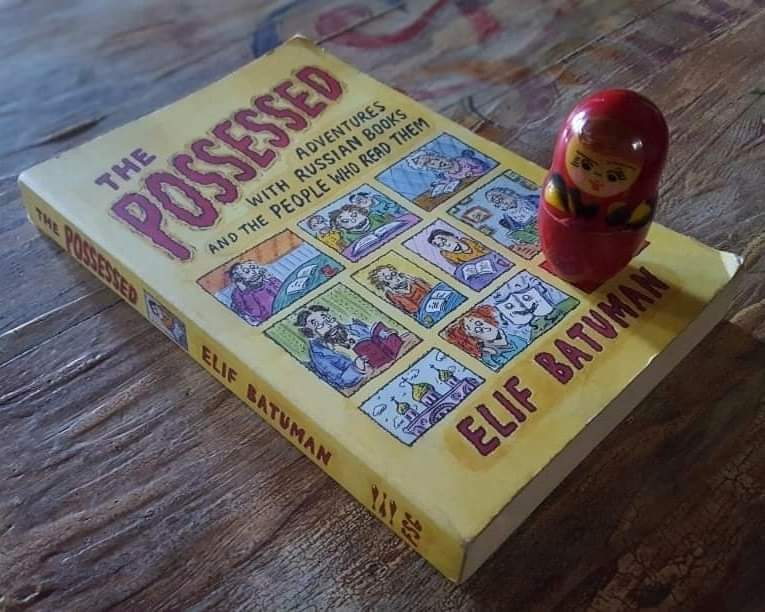
This is exactly what Elif Batuman does in this essay collection that doubles as a memoir. The title is lengthy and self-explanatory, and based on her book titles, one can tell how influenced she is by Russian literature: The Idiot , which I read in March, and The Possessed. It is entertaining how she manages to write such serious topics with a candid humor.
Although written seven years earlier than The Idiot I seem to have enjoyed this more as it does away with much of the the main character’s adolescent romantic concerns present in the former. Perhaps it was the three sections of her summer in Samarkand that made this more appealing to me, where she learns that the Old Uzbek language has a hundred different words for crying! Or maybe it was that passing line that I really loved, “Wasn’t the point of love that it made you want to learn more?”
Despite not being able to say that this will be a favorite, it’s funny how it contains passages that I know will stay with me forever.
— “A contemporary dictator wishing to establish power would not need to do anything so obviously sinister as banning the news: he or she would only have to see to it that the news organizations broadcast a flow of random-sounding bulletins, in great numbers but with little explanation of context, within an agenda that kept changing, without giving any sense of ongoing relevance of an issue that had seemed pressing only a short while before, the whole interspersed with constant updates about the colorful antics of murderers and film stars. This would be quite enough to undermine most people’s capacity to grasp political reality — as well as any resolve they might otherwise have summoned to alter it. The status quo could confidently remain forever undisturbed by a flood of, rather than a ban on, news.”
— “The opposite of facts is bias.”
— “The news may present itself as the authoritative portraitist of reality. It may claim to have an answer to the impossible question of what has really been going on, but it has no overarching ability to transcribe reality. It merely selectively fashions reality through the choices it makes about which stories to cast its spotlight on and which ones to leave out.”
— “For all their talk of education, modern societies neglect to examine by far the most influential means by which their populations are educated. Whatever happens in our classrooms, the more potent and ongoing kind of education takes place on the airwaves and on our screens.”
— “To consult the news is to raise a seashell to our ears and to be overpowered by the roar of humanity.”
— “…without regular contact with poetry, we may lose our vitality, cease to understand ourselves, neglect our powers of empathy or become unimaginative, brittle and sterile. Literature… is the medium that can reawaken us to the world.”
A manual on how to approach and handle the news whether you are at the giving or receiving end; a challenge for “journalists in a hurry” to turn to art; a masterclass in journalism and photojournalism, and of course — because this is Alain de Botton — life.
“It is mostly through stories that we learn to think, perceive, feel and remember the world in a more nuanced and reflective way. As we gain a better understanding of the struggles of people from different backgrounds, and start to imagine lives beyond the one we are living, we recognize the complexity and richness of identities and the damage we do to ourselves and to others when we seek to reduce them to a single defining characteristic.”
“If wanting to be heard is one side of the coin, the other side is being willing to listen.”
“…we have become bad listeners and even worse learners. Whether in public or digital spaces nuanced debates are not welcome anymore. Instead there are clashing certainties… They are not there to listen and they are not there to learn.”
“If and when I am a reluctant listener, I will also become a poor learner. I will interact less and less with theories and opinions that do not agree with mine. And there will come a point when I will simply stop talking to people who are different from me.”
“When coexistence is undermined in this way societies become extremely polarized and bitterly politicized, ever wary of the ‘other side and their intentions’. Democracy, which is essentially about compromise and negotiation, conflict resolution and pluralism, a system of checks and balances, suffers from this constant tension and escalating antagonism… It is not a coincidence that all across the world authoritarian demagogues go to great lengths to incite and inflame polarization. They know they will benefit from it.”
Written by Elif Shafak during the pandemic and reading this amidst the cacophony of the Philippine political menagerie, this little book cannot be more relevant.
What if we can transform this age of division into an age of reading, connecting, engaging, listening, learning, examining our assumptions and stereotypes, expanding our minds, and softening our hearts? Who is willing?
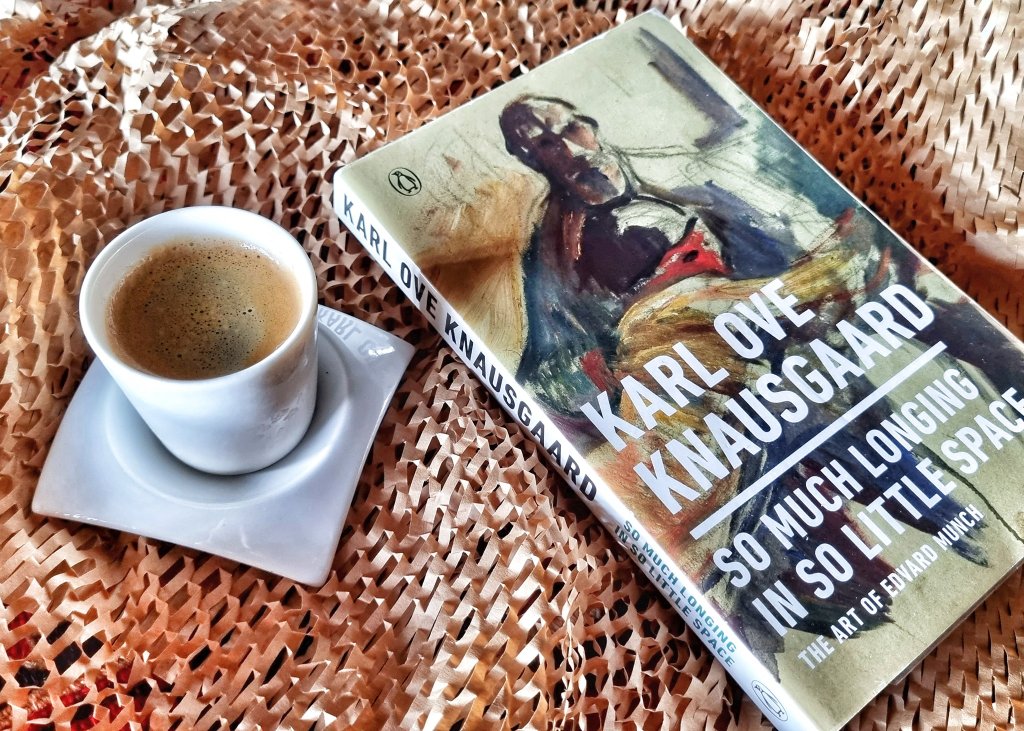
Edvard Munch beyond and behind 𝘛𝘩𝘦 𝘚𝘤𝘳𝘦𝘢𝘮, written by Karl Ove Knausgaard beyond and behind the bestselling memoirs.
It reads like a personal meditation on the driving force for art, literature, music, the impact of emotional and psychological experiences on the artistic process. In essence, it is enlightening art investigation, history, and criticism… but after all of these, splendidly rendered inconsequential by Knausgaard who ultimately acknowledges that real art transcends words.






 The Book-Butterfly