Hisham Matar: A Month in Siena

A Month in Siena, Hisham Matar

“Only love and art can do this: only inside a book or in front of a painting can one truly be let into another’s perspective. It has always struck me as a paradox how in the solitary arts there is something intimately communal.”


Yesterday was heavy. Not only for me but for a lot of people I care for, and for different reasons. It somehow made me yearn for Hisham Matar’s prose, because I don’t think I have read any other writer who speaks straight to my heart about life with such authenticity and accuracy and with such emotional and artistic intelligence. (I read three of his books in 2024, and one of them, My Friends, was the best book I read last year. Until now I cannot find the words to do it justice.)

So, I tried to see if there was an older book of his that escaped my attention. A Month in Siena was the answer. I finished reading it last night and had taken five pages worth of notes by midnight. I’m glad today is a Sunday so that I can reread my notes and fully process the beauty of this understated book that is a meditation and an education in art and life.

“I hope that when there is laughter, it’s laughter made wise by having known real grief — and when there is grief, it is made wise by having known real joy,” Kaveh Akbar writes in Martyr! Whether he is writing about art, architecture, his homeland, or politics, Hisham Matar’s books are often so heartfelt — wholly made wise by having known such things.
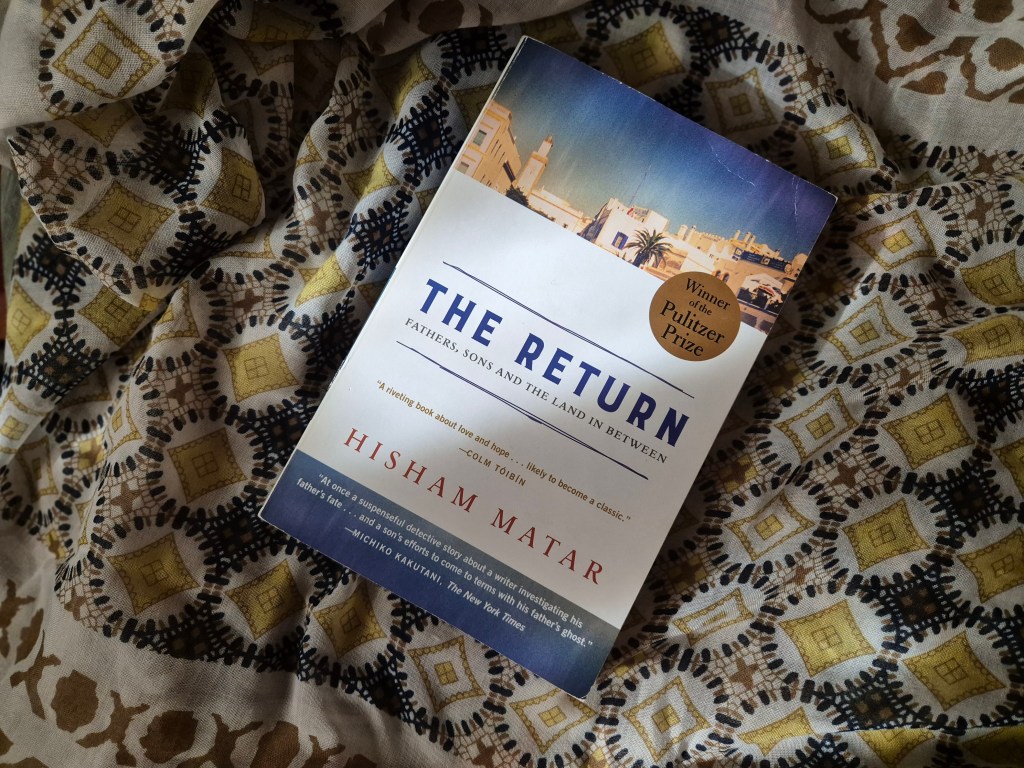

Hisham Matar: The Return

Part of this month’s reading agenda was to read Hisham Matar’s earlier books — which have been left untouched on my shelf for years — in preparation for his latest novel that made it to this year’s Booker Prize longlist. His debut novel, In the Country of Men, did not exceed my expectations, but after having just read The Return, and reeling from the force and the beauty of this work, I am hesitant to read anything else by him for the time being. This, right here, could be peak Hisham Matar. 

I was in my late twenties when news of Qaddafi’s assassination hit the headlines, but even after that, and apart from a vague idea that it had been under Roman dominion in older times and under a dictatorship in recent times, I remained ignorant of Libya’s modern history.

“All the books on the modern history of the country could fit neatly on a couple of shelves. The best amongst them is slim enough to slide into my coat pocket and be read in a day or two,” writes Matar in The Return. “Libya has perfected the dark art of devaluing books.”

The Qaddafi censorships were culpable for the dearth of Libyan literature, and it comes as no surprise that our generation reads so little of Libya beyond occasional one-liner news tickers.

Matar changes that for his readers and lights up the void. The book is a formidable testament to a bleeding country and of the atrocities of Muammar Qaddafi’s regime and its complex aftermath, and it is also a moving account of the invisible and invincible bonds that tie fathers and sons.

The story of a son returning to Libya seeking answers to his father’s disappearance is poignant enough, but Matar writes beyond the journalistic and allows his background in art and architecture to seep into his prose. This adds a poetic aspect to an attention to detail that makes the writing engaging and lyrical. 

For this book to have won the 2017 Pulitzer Prize for Biography/Autobiography and to have made it to NYT’s 100 Best Books of the 21st Century was, I suppose, inevitable. 

Hisham Matar & Colette Fellous

In the Country of Men & This Tilting World

The books I’ve read on two consecutive weekends; of Libya and Tunisia; and it so happens that they are neighbors on the world map.

In the Country of Men has been languishing on my shelf for over a decade, and Matar’s appearance on this year’s Booker Prize longlist reminded me of his silent presence in my library. On the other hand, This Tilting World was recently acquired after Fellous’s work caught my attention in an anthology. 

Aside from the geographic proximity of their respective settings, these two books surprisingly have more in common: In the Country of Men often feels painfully autobiographical, while This Tilting World admits to being utterly personal. They are simultaneously love letter and farewell letter to their homelands; they explore questions of nationalism, and both present a character’s fraught, and yet loving, relationship with a father and a country; and the writing seems to be an attempt at making sense of the loss of innocence, of the violently shattered idyll of their childhood and hometowns.

However, these are books which, I feel, have unfulfilled potential: In the Country of Men left me wishing for characters with more integrity, This Tilting World left me in want of a more cohesive opus for Fellous’s luscious and elegant prose.

But both contain their own beauty and remain valuable records of Libya’s and Tunisia’s recent history. The books are, therefore, still worth reading. 

In response to what the mother in In the Country of Men recounted, (…part of the punishment was to leave me with no books. “Don’t give her any more ammunition,” your grandfather had said…) we say: the more “ammunition” the better! It’s the only way we can make sense of this tilting world.