“Is this the way to the Museum of Books?” The main entrance where a statue of Shota Rustaveli stood guard seemed to have been closed for an indefinitely long time, so I had to walk around the loggia and look for another door.
“Follow me,” the guard said without hesitation and led me through office backdoors and hallways lined with filing cabinets and some curious eyes peering through them when the rhythmic footfalls of my boots echoed through the corridors.
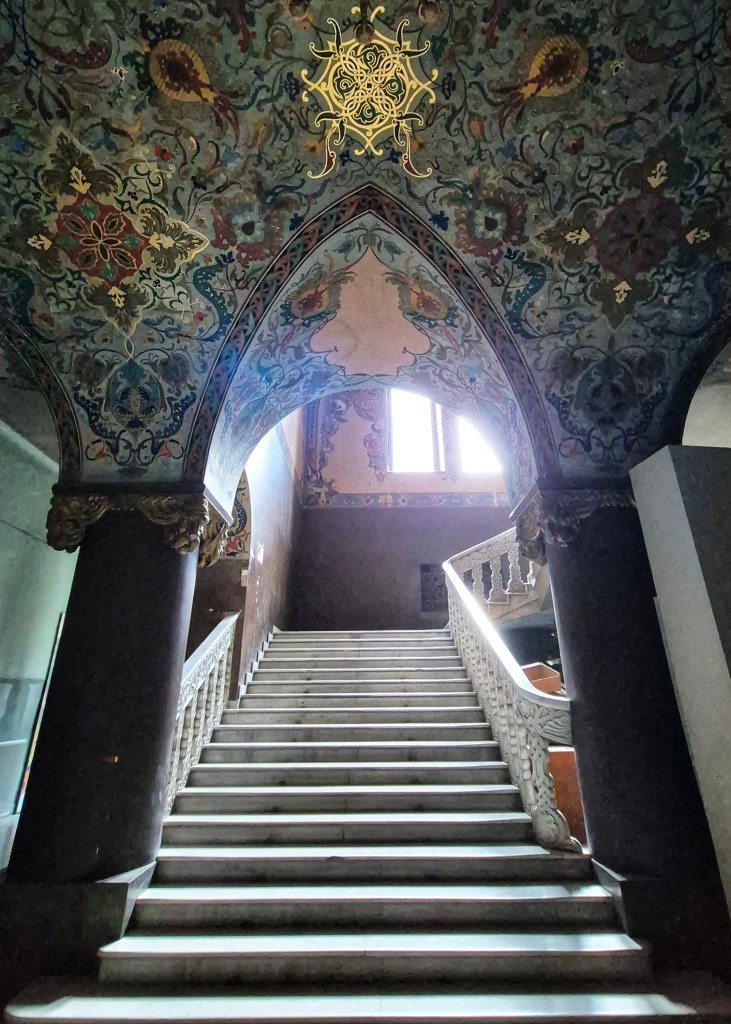
Just as I was feeling a little lost and self-conscious for being the only non-employee around, he turned around and said, “When you’re done, just exit the way you came in.” He left me, alone, staring open-mouthed at what was the entrance hall of Tbilisi’s Museum of Books.
Amber sunshine streamed through the windows, casting light on intricate adornments that I had never seen applied to buildings before. It was as if I was drawn inside a page of a medieval illuminated manuscript.
I soon learned that the building is a collaboration between the architect Anatoli Kargin and well-known painter Henry Hrinevski, who was also a book illustrator and manuscript illuminator as well as a scholar on traditional Georgian architecture, but who was sadly arrested and killed during Stalin’s Great Purge.
The building was completed in 1916 and erected as a bank, but became part of Georgia’s series of libraries, fittingly so, in 1931. It is Building I out of V monumental buildings housing the National Parliamentary Library of Georgia.
Recognized as one of the finest museums dedicated to the written word, it boasts of personal libraries of Georgia’s eminent authors, the first book printed in the Georgian language, and autographed works by famous writers including Victor Hugo.
I went there for the books but came out deeply impressed knowing that the building that holds such treasures is, itself, one for the books.
A light rain was falling, a fine spray, unlike what rain is in the tropics. Within a couple of hours the deep purple of evening entered through that same window and transformed the spray into delicate snowflakes that vanished even before you could touch them; inconspicuous magic in the micro details when one season gives way to another.
It was toward the end of the trip when I took this photo of my traveling companions on the windowsill. Absent from the stack, but verily lodged in my consciousness, are Euripedes’ Medea and Percival Everett’s For Her Dark Skin.
I went to Georgia accompanied by seven books, and after jaunts to Tbilisi’s charming bookshops, a modest number of three Georgian masterpieces were read on the train and during long drives, then added to the pile.
The eclectic curation is an education in itself as it includes a Greek tragedy, a rather feminist and modern retelling of the tragedy, a wonderful and informative chronicle of Georgia’s unique wine culture, journalistic reports and stories from the early years of post-Soviet Georgia, the greatest love story of the Caucasus, literary criticism, a portrait of young Stalin that is also a portrait of a nation, a painful recollection of the Georgian-Abkhazian armed conflict in the 90s, epic poetry, and Tolstoyan short stories.
Once again, people wondered whether I had gone to another destination just to read. But I know they’re only kidding.
For who isn’t aware that reading and traveling are not separate experiences? They are halves of a whole that lend clarity and depth to each other.
In our travels, what we notice, perceive, and experience — and what we contribute to meaningful interactions, or how we overflow — largely depend on what is already inside us. “Nothing flows out of a jar except that already inside it,” writes the preeminent Georgian author, Shota Rustaveli in The Knight in the Panther’s Skin.
In life, reading and traveling are merely expressions of how one chooses to take their fill.
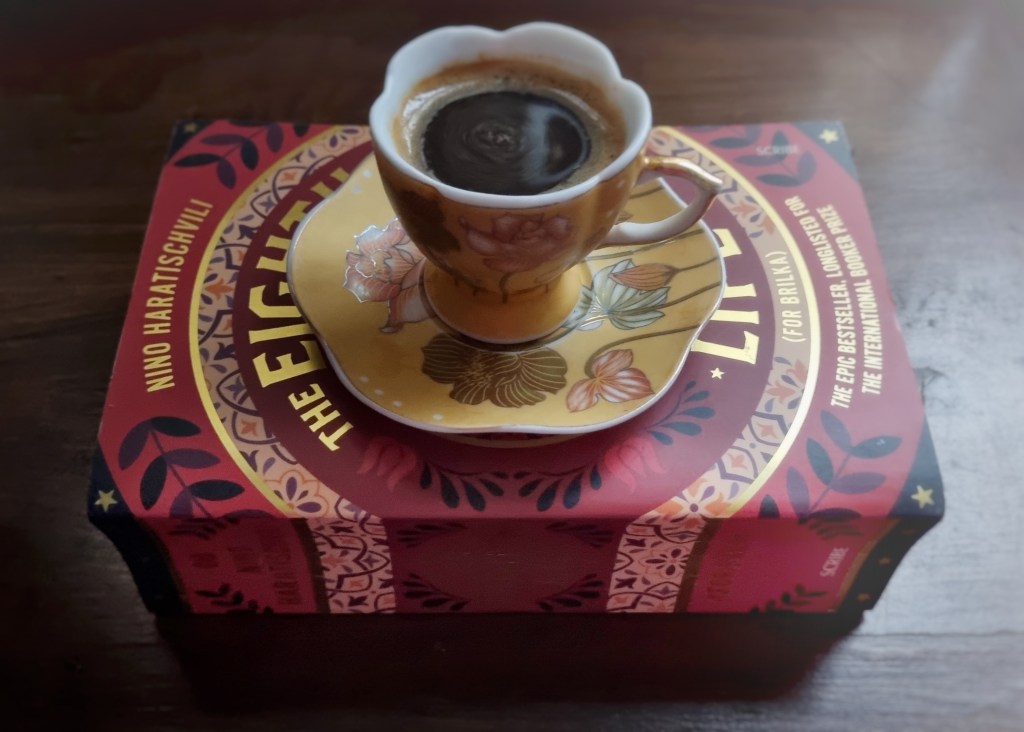
The first few things you will ask yourself after reading this are questions in the vicinity of, “Was that really 934 pages long? How was I able to read that so quickly?”
Tougher questions will follow: The question of identity, the question of who you are and what shaped you. The question of history and how you cannot ever separate your personal history from history in general.
What do you really know about history? What do you really know about yourself?
“For me, the greatest reward was her stories.” – Nino Haratischvili, The Eighth Life
At the beginning of the century that would suffer two World Wars, and many other wars, a chocolatier prospers in Georgia under the Russian Empire. His chocolaterie thrives and caters to townsmen and Russian nobility, but after a tragedy following the devouring of the the secret recipe in its purest form, he soon suspects that it holds a curse. The recipe would, however, always manage to find its way to the next generation and throughout the entire century.
The accursed hot chocolate recipe was something I would normally expect to savor from Latin American magic realists and I was initially unsure of how I felt about coming across this flavor in The Eighth Life. I thought it could easily be dispensable in the grand, cinematic scope of the story.
But wasn’t this family saga set in junctions of the immeasurable Silk Route where anything could happen, and where the influence of Scheherazade’s fantasies still linger at every bend?
I eventually gave in to this literary ingredient and pondered if it was meant to symbolize the intergenerational curses — inherited pain, memory, and trauma — to which we become heirs and which we unknowingly impart.
_ _ _
The casual tone of the narrative deceived me at the onset. You could tell you were not reading Vasily Grossman or Olga Tokarczuk. (The comparison is unavoidable as theirs were the novels I read this year that are similar in length and with similar intersecting eras and geographies.)
It is, after all, addressed to Brilka, an adolescent; and so the narrator spells things out. We know that this is something masters of literature usually avoid, but it was this casual and explanatory tone that made me so unsuspecting of how it would sweep me up in its emotional and historical hurricane. I found myself wiping away tears a number of times, grieving for the characters with their extinguished hopes and dreams, and for the entire broken century that was also partly my own.
It is remarkable how the novel captured the spirit of each era it depicted, even the confusions and the troubles of each age reflected in the characters. To present these — along with the complex convergence of Russian and Georgian histories and politics, and how Soviet tyranny affected so many lives across borders — in such a readable manner only made me recognize Nino Haratischvili’s command of such topics.
This novel is a strange oxymoron to me: For being simultaneously accessible and wise, for being both painful and satisfying, and for lending answers as it asks questions.
_ _ _
What do you really know about history? What do you really know about yourself?
Could it be true, that chilling thing Kostya said about everything waiting to come back?
‘What statues and pictures?’ I asked.
‘You know, of Lenin, Marx, and Engels, the Generalissimus — all those men!’ He seemed to be giving it serious thought.
‘They’ve gone.’
‘But they can’t all just disappear, just like that!’
‘Apparently they can. Everything disappears sooner or later.’
‘Nothing disappears. Nothing, Niza!’ He laid is hand on mine.
‘You mean, everything is hidden somewhere, waiting to be found again?’ I tried to bring myself to smile.




 The Book-Butterfly