Mahmoud Darwish

By now, Palestine and Israel are probably on everyone’s radar. By now, young and old have probably taken a side, or have opinions; but sadly, based only on social media algorithms. By now, many have probably come across that post about the Palestinian writer, Mahmoud Darwish, who fell in love with a Mossad agent, reposted many times however false. (He did have a relationship with an Israeli-Jew that would haunt many of his works: “Rita” in his poems, Tamar Ben-Ami in real life, who later served for a time in the IDF.) Or he may be known to some as the controversial poet who criticized Hamas. 

I know his name from every important Palestinian work that I have read. It’s sad that it took a war for me to try harder to acquire his books and finally experience his writings. I have been reading these four collections slowly and carefully, in random order, and in-between other books. The very last piece, I read today. And yet, here I am, still lost for words that will give justice to this body of work.

How beautifully he writes! And how enlightening his works are of the Palestinian sentiment and predicament!

  • A River Dies of Thirst is where one will find the famous line, “All beautiful poetry is an act of resistance.”  
  • “In the Presence of Absence” hints at the term “present absentee” that refers to Arabs who fled or were expelled from their homes during the Nakba, and it is the volume that touched me the most.

“Poetry, then, is an act of freedom.”

“For what can a poet do before history’s bulldozer but guard the spring and trees, visible and invisible, by the old roads? And protect language from receding from metaphorical precision and from being emptied of the voices of victims calling for their share of tomorrow’s memory on that land over which a struggle is being waged? A struggle for what lies beyond the power of weapons: the power of words.”

“What does it mean for a Palestinian to be a poet and what does it mean for a poet to be Palestinian? In the first instance: it is to be the product of history, to exist in language. In the second: to be a victim of history and triumph through language. But both are one and the same and cannot be divided or entwined.”

  • Why Did You Leave the Horse Alone? is special not only for its poems but for being a bilingual edition! Even though I cannot read Arabic, I love tracing the elegant curves of its script with my eyes. 
  • Journal of an Ordinary Grief is anything but ordinary and it is the volume out of these four that I would readily recommend, no matter whose side one is on. Because maybe after turning the last page, one will be less concerned about taking sides, but be more concerned about having humanity.
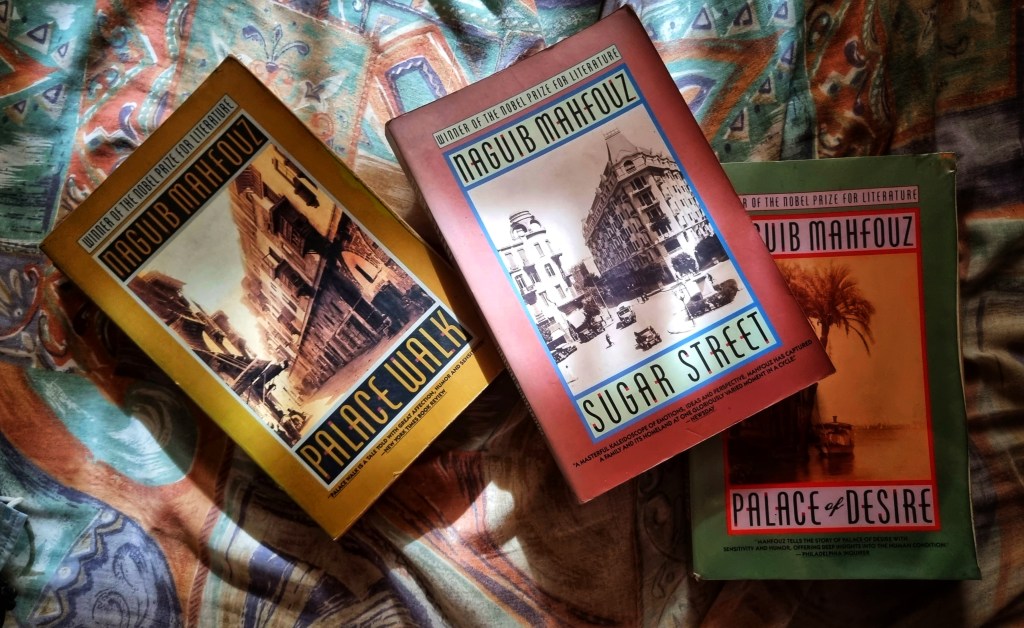
Naguib Mahfouz: The Cairo Trilogy

There are better editions with attractive new covers now. Mine still carry the designs of the first American edition of the English translation, but I love how the first volume depicts the antique mashrabiyas of Old Cairo. These projecting windows with intricate latticework are some of my favorite features of traditional Islamic architecture. They seem to me exemplars of how a thing of beauty and tradition can become a refuge or a prison.

And yet, not even these mashrabiyas could shield Ahmad Abd al-Jawad and his family from life, love, death, and a changing world.

It is often said that the Cairo Trilogy is a family saga spanning three generations, from the period of the Egyptian revolt against British colonizers in 1919 to the final days of the Second World War. But it is more than a family saga: It is an astute record of a society, a city, a nation, and a world in transition. 

I admit that I found good reason to put the first volume down. I was constantly infuriated by how women were perceived and treated by the male characters, by how men justified their immorality and hypocrisy and got off scot-free while women were punished severely for the most innocent blunders, and by how women themselves accepted this as the natural order of things. Those passages were deeply frustrating.

But Mahfouz’s exquisite storytelling carried me through. He does not so much describe Cairo as transport me there — into the volatile political scene of an Egypt yearning for independence, through its wondrous or disreputable backstreets and alleys, and especially into the women’s cloistered lives so I could hear the questions brewing in their hearts, and eventually to the reflection of society’s gradual development through the change in attitude toward women and their education.

In this trilogy, imperial tyranny juxtaposes with tyranny in the family, but through it all, an incredible compassion and empathy emanates from Mahfouz who humanizes everyone, even the tyrants.

Before I knew it I was at the final page of the last volume, not quite ready to let go, and contemplating on the fact that I had just read one of the finest works of literature ever written.

Naguib Mahfouz: Three Novels of Ancient Egypt

Cleopatra’s era is closer to the invention of the iPhone than it is to the construction of the pyramids of Giza. A podcast episode that I listened to years ago pointed this out. The fact still blows my mind. When they are mere numbers written on a page, the breadth of history’s timeline cannot be fully grasped until such a comparison is made; but to make those epochs come alive is a task for the novelist.

Khufu’s Wisdom is set in Ancient Egypt’s Fourth Dynasty (circa 2625 – 2500 BCE). Khufu, also known as Cheops, whose sarcophagus rests in the Great Pyramid of Giza, is the pharaoh to whom Egypt’s biggest pyramid is commonly attributed when people are not busy attributing it to aliens. Rhadopis of Nubia in the Sixth Dynasty (circa 2350 – 2710 BCE), gravitates around a courtesan and King Merenra’s short-lived reign. Thebes at War, set between the Seventeenth to Eighteenth Dynasty (1630-1292 BCE), reimagines the interval when Egypt was ruled by the Hyksos or “foreign kings”.

I have read several works by Naguib Mahfouz before taking on this trilogy but have found this to be the easiest to read and the most entertaining thus far! Yes, the language is grand and often pompous — it has to match its pharaonic subjects! Yes, some details can be politically incorrect by today’s standards — the publication years of each volume are as follows: 1939, 1943, and 1944! But reading this made me feel like a very young girl again; one who cannot help but be swept away with abandon into wondrous tales of the past. How I was able to imagine the stories as grand cinematic adaptations in my head is proof of Mahfouz’s skill as a storyteller!

Although the stories are easy to read, they are not as simple as they seem on the surface:

Khufu’s Wisdom is a classic contemplation on fate and duty, and about the difficult submission to both. My favorite passage comes from a secondary character who asks the protagonist, a skilled warrior, “And now, tell me, are you reading anything useful? …the virtuous mind never dismisses wisdom even for a day, just as the healthy stomach does not renounce food for a day… The virtue of the science of war is that it trains the soldier to serve his homeland and his sovereign with might, though his soul does not benefit at all. And the soldier who is ignorant of wisdom is like the faithful beast — nothing more… if the soul isn’t nourished by wisdom then it sinks to the level of the lesser creatures.”

It was in Rhadopis of Nubia where I felt the political undertones deepen. While it also questions the role of beauty and art, there are questions posed to corruption in theocracies and the tricky relationship between king and clergy. In the hall of Rhadopis, politicians and all manner of men gathered to be entranced, even though it was believed to be a most dangerous thing to set eyes upon her. Her tragic tale left me wondering whether she inspired Salman Rushdie’s Enchantress of Florence and whether she is, as I continue to reckon Rushdie’s enchantress, an allegory for Power.

Thebes at War is the most dramatic out of all the three and a most fitting finale for the trilogy. It is where one will find this line, “Weeping is no use, gentlemen. The past will disappear into ancient times and obliteration so long as you are content to do nothing but mourn it.” 

Mahfouz is a man who did more than mourn Egypt’s past. He has built literary edifices forged from existing architectural wonders and archaeological findings, constructed modern allegories out of ancient lives and times, and transformed them into timeless political missives — knowing that there will always be those who are doomed to forget and repeat the follies of history.

Tayeb Salih Duo

“…and if we are lies we shall be lies of our own making.”

“Mark these words of mine, my son. Has not the country become independent? Have we not become free men in our own country? Be sure, though, that they will direct our affairs from afar. This is because they have left behind them people who think as they do.”

– – –

Could dictatorships in developing countries be a side-effect of colonialism?

The effects of colonialism do not end after a nation’s independence, the same way the effects of a dictatorship do not end after a people’s revolution.

Colonialism has defenders who maintain that they served whom they oppressed, dictatorships have the same apologists; but do not both warrant that succeeding leaders would grapple with a democratic exercise of authority — among many other ills they leave in their wake?

Perhaps I am late to these reflections, but there are many people still who do not understand that colonialism and dictatorships have a profound impact on political structures that one simply cannot move on from.

– – –


Season of Migration to the North was the catalyst for these thoughts; a dark and rather absurdist but lyrical depiction of the post-colonial struggle; not an angry tirade but one that challenges opposing views.

It overshadows The Wedding of Zein in many ways, tempting me to say that if there’s one Salih work you must read it should be Season of Migration to the North. On the other hand, The Wedding of Zein comes with two of his finest short stories: One of them is The Doum Tree of Wad Hamid that wistfully contemplates on the clash of social modernity and traditions.

“There will not be the least necessity for cutting down the doum tree… What all these people have overlooked is that there’s plenty of room for all these things.”

So, perhaps it’s wise to read these books together.

Sudan, the largest country in Africa that shares a border with nine other countries including Egypt. And yet we read so little of/from them. It’s time we do. We (I speak as a Filipina reader) share so much more in common than we think.

Naguib Mahfouz: The Day the Leader Was Killed

When Naguib Mahfouz wrote this, he had not been awarded the Nobel yet, but his Adrift on the Nile had already been banned during the term of Anwar Sadat — the leader to whom the title refers. The story is set during Sadat’s Infitah, the policy that would incense Arabs to oppose him and one that would lead to his assassination.

Mahfouz had not known then that after Sadat there would be worse intellectual persecutors, and the future would find him stabbed in the neck in an attack that would tragically impair his writing hand.

Eleven years before the incident, this was published. One should not expect grandeur from this, or a sweeping account of Egypt’s history and politics. Here, Mahfouz intimates to us the lives of three common people, “redundant people,” as one narrator would describe.

The three narrators are Muhtashimi Zayed, the grandfather; Elwan, the grandson; and Randa, Elwan’s fiancée: Characters whose daily lives are affected by the Infitah.

The juxtaposition of their lives and the trajectory of their sentiments with the day the leader is killed is an intelligent tool. Because with momentous events such as the assassination, we think little of these lives, their loves, their troubles. The strength of this book is in the intimacy that Mahfouz beckons us to experience. I like how the title cleverly deceives us like a headline by a Western news network of news in the Middle East: We are tricked into thinking that we already know what the story is about, when in fact, we don’t.