Hisham Matar: The Return

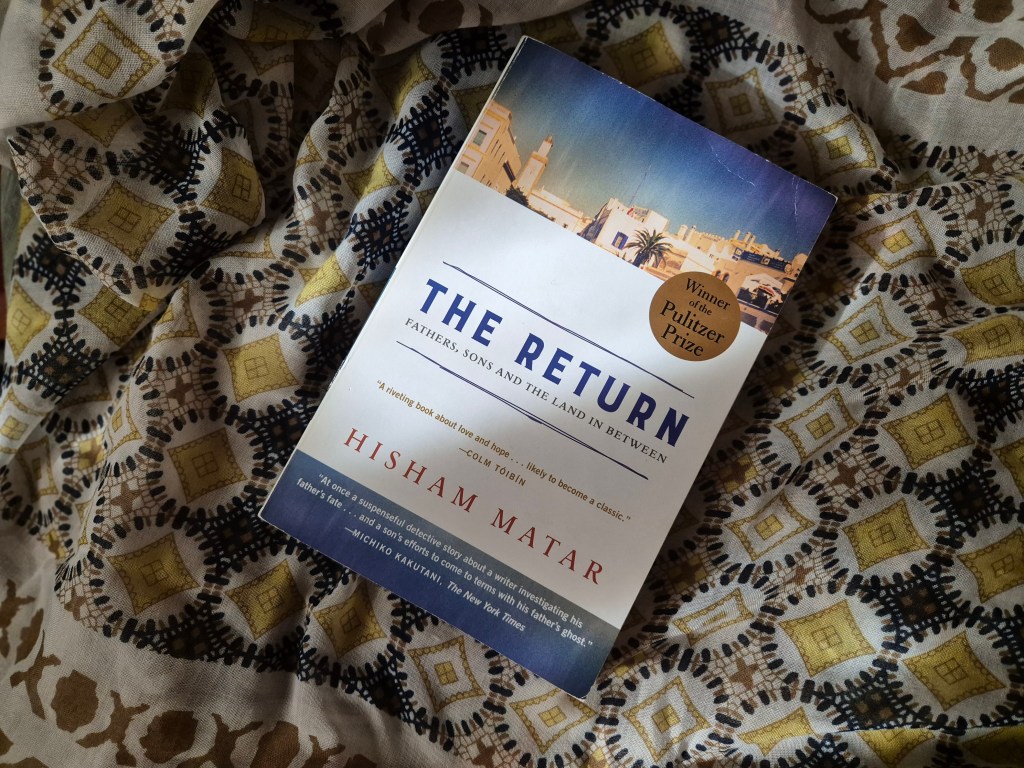
Part of this month’s reading agenda was to read Hisham Matar’s earlier books — which have been left untouched on my shelf for years — in preparation for his latest novel that made it to this year’s Booker Prize longlist. His debut novel, In the Country of Men, did not exceed my expectations, but after having just read The Return, and reeling from the force and the beauty of this work, I am hesitant to read anything else by him for the time being. This, right here, could be peak Hisham Matar. 

I was in my late twenties when news of Qaddafi’s assassination hit the headlines, but even after that, and apart from a vague idea that it had been under Roman dominion in older times and under a dictatorship in recent times, I remained ignorant of Libya’s modern history.

“All the books on the modern history of the country could fit neatly on a couple of shelves. The best amongst them is slim enough to slide into my coat pocket and be read in a day or two,” writes Matar in The Return. “Libya has perfected the dark art of devaluing books.”

The Qaddafi censorships were culpable for the dearth of Libyan literature, and it comes as no surprise that our generation reads so little of Libya beyond occasional one-liner news tickers.

Matar changes that for his readers and lights up the void. The book is a formidable testament to a bleeding country and of the atrocities of Muammar Qaddafi’s regime and its complex aftermath, and it is also a moving account of the invisible and invincible bonds that tie fathers and sons.

The story of a son returning to Libya seeking answers to his father’s disappearance is poignant enough, but Matar writes beyond the journalistic and allows his background in art and architecture to seep into his prose. This adds a poetic aspect to an attention to detail that makes the writing engaging and lyrical. 

For this book to have won the 2017 Pulitzer Prize for Biography/Autobiography and to have made it to NYT’s 100 Best Books of the 21st Century was, I suppose, inevitable. 

Hisham Matar & Colette Fellous

In the Country of Men & This Tilting World

The books I’ve read on two consecutive weekends; of Libya and Tunisia; and it so happens that they are neighbors on the world map.

In the Country of Men has been languishing on my shelf for over a decade, and Matar’s appearance on this year’s Booker Prize longlist reminded me of his silent presence in my library. On the other hand, This Tilting World was recently acquired after Fellous’s work caught my attention in an anthology. 

Aside from the geographic proximity of their respective settings, these two books surprisingly have more in common: In the Country of Men often feels painfully autobiographical, while This Tilting World admits to being utterly personal. They are simultaneously love letter and farewell letter to their homelands; they explore questions of nationalism, and both present a character’s fraught, and yet loving, relationship with a father and a country; and the writing seems to be an attempt at making sense of the loss of innocence, of the violently shattered idyll of their childhood and hometowns.

However, these are books which, I feel, have unfulfilled potential: In the Country of Men left me wishing for characters with more integrity, This Tilting World left me in want of a more cohesive opus for Fellous’s luscious and elegant prose.

But both contain their own beauty and remain valuable records of Libya’s and Tunisia’s recent history. The books are, therefore, still worth reading. 

In response to what the mother in In the Country of Men recounted, (…part of the punishment was to leave me with no books. “Don’t give her any more ammunition,” your grandfather had said…) we say: the more “ammunition” the better! It’s the only way we can make sense of this tilting world.

September 14, 2023 – Aswan: The Unfinished Obelisk, Philae Temple, and Abu Simbel

Aswan. This is where Egypt begins. It only seemed logical to begin my excursions to the ancient Egyptian archaeological sites here.

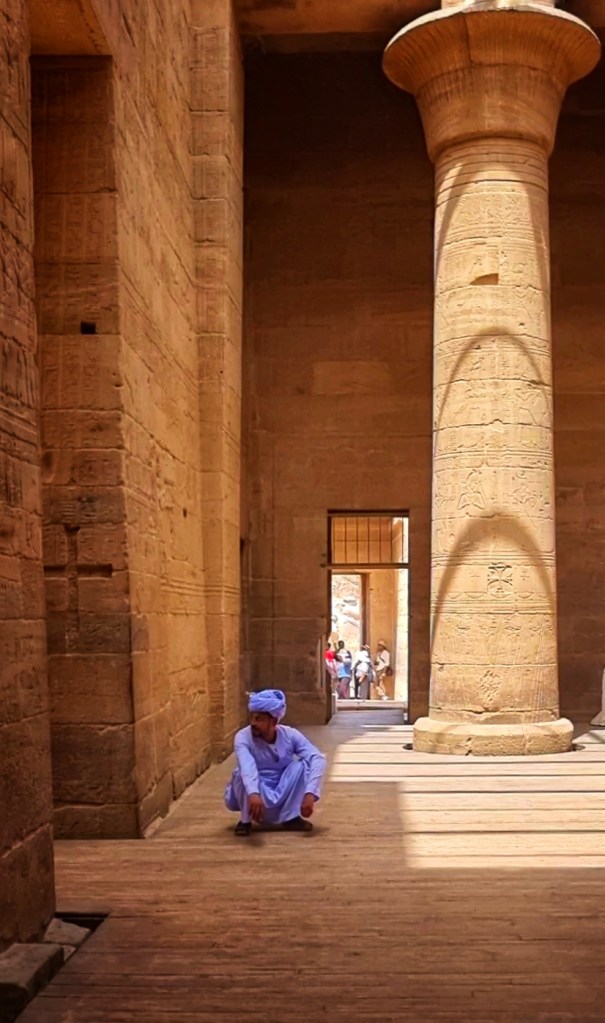
If you’re wondering what that drill is doing there… well, I wanted to finish the obelisk! Who wants unfinished business anyway?! Haha… kidding. They were constructing a ramp for tourists and the carpenter kindly offered to take my picture.

In one of Aswan’s stone quarries, one site has intrigued me almost as much as the pyramids. Had it been completed, it would have been the largest obelisk ever built by the ancient Egyptians. The speculation that it had been commissioned by Queen Hapshetsut added to my wonder. Needless to say, within an hour after landing in Aswan, I was already at the site of the Unfinished Obelisk, fascinated by the existing evidence of the ancients’ construction process.

The following day, I set out early and hired a private car to take me to Abu Simbel. The ride itself was exciting as I witnessed a most enigmatic sunrise, passed checkpoints due to the proximity to the Sudanese border, saw more Nubian villages and the place where they quarantine camels from Sudan, drove through an otherworldly terrain, and finally beheld the twin temples originally carved out of the mountainside in the 13th century BCE, during the reign of Ramesses II.

But when it comes to idyll, Philae Temple Complex takes the throne. A small ferry took me to an island on the Nile and I was immediately transported to the pages of Mahfouz’s Rhadopis of Nubia. The Temple of Isis built in the reign of Nectanebo I in 380-362 BCE is the island’s most striking feature, and yet through the different architectural structures, one could see the Pharaonic, the Ptolemaic, the Romans, and the Christians, stamping their identities on the landscape. It has never been this clear to me; how architecture IS identity.

Scholastique Mukasonga

COCKROACHES

It is and it isn’t Kafkaesque. It is because, not too long ago, the Tutsi people woke up as inyenzi — cockroaches. It isn’t because it is no longer allegory, no longer fiction. 

“The soldiers… were always there to remind us what we were… cockroaches. Nothing human about us. One day we’d have to be got rid of.”

Mukasonga, who lost an entire family, an entire clan, and an entire people in the genocide, chronicles life as a Tutsi in Hutu-dominated Rwanda. As a child, she and her family were forced to relocate to a camp during the first pogroms against the Tutsi; and from then on, they knew what awaited them. “Humiliated, afraid, waiting day after day for what was to come, what we didn’t have a word for: genocide.”

In this disturbing and exceptional account, we become witnesses to how hatred and prejudice crescendoed from the 1950s into what erupted as the Rwandan genocide in 1994.

OUR LADY OF THE NILE

In two chapters of Cockroaches, there is an account of being unexpectedly accepted to the prestigious Lycée Notre Dame de Citeaux, a Catholic boarding school in Kigali. The experience becomes a fictionalized novel here.

The elite school for young women perched on the ridge of the Nile remarkably becomes a microcosm of Rwandan society. Corruption, the tension between Tutsis and Hutus, history, their myths, Rwanda’s relationship with the west, orientalists, disinformation and lies that fuel prejudice — “It’s not lies,” justifies one of the girls. “It’s politics.” — the complexities of government and society, and how Mukasonga proficiently mirrors these through the lives of the young women makes it a powerful work of fiction.

IGIFU

An anthology of 5 stories that remind us of why we should read about worlds and lives so different from our own. And if you’re wondering about the identity of Igifu, “who woke you long before the chattering birds announced the first light of dawn,” who “stayed at your side…to bedevil your sleep,” “the heartless magician who conjured up lying mirages…” you would be heartbroken, just as I was, to know that he is Hunger.

THE BAREFOOT WOMAN

A lament with pockets of lightheartedness dedicated to the mother she lost, written by someone who, in her own words, has the sorrow of surviving.

KIBOGO

A spirited portrait of a people grappling with the choice between the faith of their European colonizers and their pagan beliefs. A relatable quandary amongst peoples of colonized lands, but written in a manner only Mukasonga can achieve.


Truly, an African section of a library would be inadequate without Mukasonga. These are essentials in world literature. The word essential has been abused, but there are times when essential is appropriate.

Tayeb Salih Duo

“…and if we are lies we shall be lies of our own making.”

“Mark these words of mine, my son. Has not the country become independent? Have we not become free men in our own country? Be sure, though, that they will direct our affairs from afar. This is because they have left behind them people who think as they do.”

– – –

Could dictatorships in developing countries be a side-effect of colonialism?

The effects of colonialism do not end after a nation’s independence, the same way the effects of a dictatorship do not end after a people’s revolution.

Colonialism has defenders who maintain that they served whom they oppressed, dictatorships have the same apologists; but do not both warrant that succeeding leaders would grapple with a democratic exercise of authority — among many other ills they leave in their wake?

Perhaps I am late to these reflections, but there are many people still who do not understand that colonialism and dictatorships have a profound impact on political structures that one simply cannot move on from.

– – –


Season of Migration to the North was the catalyst for these thoughts; a dark and rather absurdist but lyrical depiction of the post-colonial struggle; not an angry tirade but one that challenges opposing views.

It overshadows The Wedding of Zein in many ways, tempting me to say that if there’s one Salih work you must read it should be Season of Migration to the North. On the other hand, The Wedding of Zein comes with two of his finest short stories: One of them is The Doum Tree of Wad Hamid that wistfully contemplates on the clash of social modernity and traditions.

“There will not be the least necessity for cutting down the doum tree… What all these people have overlooked is that there’s plenty of room for all these things.”

So, perhaps it’s wise to read these books together.

Sudan, the largest country in Africa that shares a border with nine other countries including Egypt. And yet we read so little of/from them. It’s time we do. We (I speak as a Filipina reader) share so much more in common than we think.

Abdulrazak Gurnah: Desertion

If you intend to read this, do not allow the abrupt and tidy ending of the love story in the first part to dissuade you from continuing. That’s not exactly how it ends. Make sure you persevere until the second to the last chapter to find the poetic piece of the puzzle that renders the last chapter almost unnecessary and makes the whole book worth reading.

And do not read this if you are in a hurry. It is writing that begs you to slow down, to savor elegant lines such as “…he was an upright shadow moving so slowly that in that peculiar underwater light his approach was almost imperceptible, inching forward like destiny”; it is writing that urges you to be there in an East African town of a British protectorate with Hassanali when he finds the half-conscious sunstricken Englishman, Martin Pearce, in 1899. 

1899, only a year after our independence from another entitled European power who thought the world was intended for European colonization. “So I had to learn about that,” our narrator remarks, “and about imperialism and how deeply the narratives of our inferiority and the aptness of European overlordship had bedded down in what passed for knowledge in the world.” 

As a Filipina, this book made me understand and applaud the Nobel Prize motivation — for Gurnah’s “uncompromising and compassionate penetration of the effects of colonialism and the fate of the refugee in the gulf between cultures and continents.”

As a woman, I felt the bitter aftertaste of the intergenerational injuries colonialists cause, not just to a place but to their women. 

As a daughter and a lover, I recognized that honorable layer of filial duty and the sacrifices we make for love.

As a reader, I relished the passages that put weight on the value of stories: “She missed his noises, his voice, his bulk, his presence, but after that she realized how much more she missed his stories.”

“It is about how one story contains many and how they belong not to us but are part of the random currents of our time, and about how stories capture us and entangle us for all time.” 

“It’s remarkable, isn’t it, that these people have got by for centuries without writing anything down… everything is memorized and passed on… It’s a staggering thought, that no African language had writing until the missionaries arrived,” says one English character in the book.

It is remarkable, and even more remarkable that Tanzania now has a Nobel Prize laureate in literature.

Desertion is a sorrowful title. But as it is written in my favorite chapter, “Sorrow has its gifts.”