Nawal El Saadawi

November 2021

I did not read these books. I inhaled the force of these books — in big and small gasps, and by the end of the third, I could not part with her. I do not think I can ever part with her. You would want to acquire her strength through osmosis!

She is my writer. Belonging to that rare breed who, even when writing about their lives, call attention to matters beyond themselves. Her words insist that you come out of her books knowing more about yourself, about the world.

Indeed, there are authors whose lives are as intense as their books. Nawal El Saadawi is one of them. Writer, activist, physician, and psychiatrist, her eventful life consists of losing her job as Director of Public Health Education due to political pressure, being imprisoned as a vocal critic of President Anwar Sadat and released only a month after his assassination, running for the Egyptian presidency in 2004, appearing on an Islamic fundamentalist death list, and being a potential Nobel laureate in literature until her death in March this year.

When it is Doris Lessing herself who says this is something we should all be reading, what is there left for me to say?

Woman at Point Zero & God Dies by the Nile

October 2021

Two books undiluted in their scathing criticism of religious hypocrisy among men and leaders, corruption, and the brutal treatment of women.

Both stories are based on real lives, and these are not to be read if you would rather prevent yourself from seething.

Written in 1973 and 1976, these stories and themes should have already become irrelevant at this point in history.

That they still aren’t is the tragedy.

Searching

April 2022

A Nawal El Saadawi work of fiction is an art film; one where nuanced cinematography captures the reflection of the sun on a window pane and which slowly pans toward the distress coursing through a woman’s veins; one that disquiets with its honesty; one with an unbroken tension that does not resolve, but bleeds into a thousand provoking questions as the end credits fade into darkness.

The Fall of the Imam

August 2022

“No one of you has ever possessed my mind. No one. And no matter how often you took my body my mind was always far away out of your reach, like the eye of the sun during the day, like the eye of the sky at night.”

In a culture where a buffalo has more worth than a woman, where love and marriage are usually two different things, where there is a disconnect between religious devotion and actions, where a man has the freedom to sin but where a woman can get stoned for being a victim, Nawal treads dangerously with her words.

She throws difficult questions at religion and those who are in power, beats us out of complacency and privilege, and prods us to be angry at injustice and inequality.

This is not the book I would recommend to someone who is new to her writings, but a seasoned Nawal reader would probably consider this an epitome of her literary prowess.

Prose-wise, it is the most ornate. Content-wise, it is the most potent. Form-wise, it is her most sophisticated. And wading through all of that is not so easy.

Different narrators for each chapter can get disorienting; the victims narrate, the criminals narrate, so do the dead, and oftentimes about the same incident. When it comes to the women, one can get confused trying to identify whether it is the mother speaking, or the daughter, or the new wife, or the first wife, or the mistress, or the sister. But I realize the intention: It is to emphasize the fact that they are women, and because they are women they suffer all the same.

“Like in The Thousand and One Nights, the beginning of each tale merged with the end of the one which had preceded it, like the night merges with the day…” And then she draws us away from Scheherazade to a lesser-viewed aspect of this literary heritage and culture, and points the spotlight at the hypocrisy of King Shahryar.

Through it all, the question that seems to reverberate loudest in my mind is this: What can we do if the leaders, those who are in power, the ones assigned to mete out judgment, are the perpetrators of the crime?

Because at times, they are. Not only in some culture foreign to us. But in ours, too.

The Hidden Face of Eve

March 2023

The best of Nawal El Saadawi’s books are nonfiction: They reveal the devastating truth that her works of fiction are, in fact, nonfiction.

A vital textbook for the study of women in the Arab world, The Hidden Face of Eve has a more academic structure compared to A Daughter of Isis, Walking through Fire, and her numerous memoirs that are deeply personal. But all her writings perfectly demonstrate how the personal is political, and there is not a hint of the tedium that we might encounter in textbooks.

The delicate preface alone is worth mulling over and digesting; and the book, thorough in the history and status of women in Arab society from pre-Islam days until the present, often enlightening or enraging, should be read in its entirety. Whether one agrees or disagrees with any of her views, no one will close this book without having learned anything substantial. Reading this showed me what a shallow understanding I have of the matter despite years of delving in books from Islamic nations.

Nawal does not launch into an angry tirade against religion, however, but against those who use religion “as an instrument in the hands of economic and political forces,” those who use religion to deprive women of knowledge and suppress the search for truth by intimidation and obscurantism, and those who misinterpret religion and utilize it as an instrument of oppression and exploitation. She challenges that religion, if authentic in the principles it stands for, “aims at truth, equality, justice, love, and a healthy wholesome life for all people, whether men or women.”

She criticizes feminism that is merely an instrument of a specific class, or a feminism that is fanatical and superficial, stressing that fanaticism of any form should be opposed, whether it be religion, political, or social. Interestingly, she even remarks on the “modern” woman, “who thinks that progress is manifested by a tendency to show more and more of her thighs,” but remains mentally and emotionally suppressed under the surface.

She therefore makes a stand for the education of the female child, the strengthening of the mind, a free mind, and a heightened level of consciousness, pointing out that a girl who has lost her personality through the throttling of her mind will lose the capacity “to think independently and to use her own mind,” and “will do what others have told her and will become a toy in their hands and a victim of their decisions.” Thus, “the emancipation of Arab women can only result from the struggle of the Arab women themselves, once they become an effective political force.” As we all know, this does not merely apply to Arab women. There is also the acknowledgement that “progress for women, and an improvement of their status, can never be attained unless the whole of society moves forward.”

Can you see why I wished to greet Women’s History Month by reading someone like Nawal El Saadawi? But because there is no one like Nawal El Saadawi, I read her.

“…with liberation they stand to lose nothing else but their chains…”

Two Women in One

March 2024

While I have long discovered that I prefer the nonfiction writer in Nawal, her fiction remains to be in a class by itself. (That’s why I still continue collecting what I can of her books, fiction and nonfiction, especially now that I’ve discovered these excellent editions — in terms of publication quality and translation — from Saqi Books.)

Two Women in One is not straightforward storytelling. There’s a tinge of Clarice in the free indirect prose. Unsettling, like any piece by Nawal; claustrophobic, and therefore, effective.

It’s not a good place to start if one is new to Nawal. The angst of a young woman, wanting to be an artist but who’s forced into medical school, is potent here. 

Conformity becomes suffocating to her, “Everything had the same color and shape to her. All bodies were similar, and all gestures and voices. She found herself running aimlessly… fleeing the deadly sameness within and without…” When she realizes that none of her life is her doing or her own choice, she unleashes a rebellious other woman in her. “Freedom is dangerous, but life without it is no life at all.”

But what I found most powerful in this work is the underlying message that unless Egypt is free, she cannot be free. “Egypt was not free. The chains were still there.” Because when all is said and done, how a nation treats their women, is always a measure of that nation. A woman’s personal freedom is often symbiotic and synonymous with national freedom. 

Elif Shafak: The Bastard of Istanbul

Reading this is like walking into the vibrance of the color spectrum and ending up enveloped in its deepest and darkest hues.

But which caused the author to be put on trial for “denigrating Turkishness” under Article 301 of the Turkish Penal Code. By lending voice to the Armenian characters in the novel, Elif Shafak risked being sentenced to prison. The charges were eventually dropped, but the incident highlights the fearlessness of a Turkish woman brave enough to write about something which, until now, the Turkish government denies — the Armenian Genocide during World War I. 

The dialogues between the descendants of the oppressed Armenians and modern-day Turks are moving and revealing on equal sides; the characters are relatable and human; historical facts and astonishing twists leave the reader no choice but to gasp; magic realism effectively subtle; all these, interlaced into the breathtaking and bewitching chaos that is Istanbul make it a triumph of unforgettable and disquieting beauty.

And because the two main characters are readers, there are ruminations on the power of the written word: “Though books were potentially harmful, novels were all the more dangerous.  The path of fiction could easily mislead you into the cosmos of stories where everything was fluid, quixotic, and as open to surprises as a moonless night in the desert… Imagination was a dangerously captivating magic for those compelled to be realistic in life, and words could be poisonous for those destined always to be silenced.”

Rabih Alameddine: The Hakawati

February 18, 2021

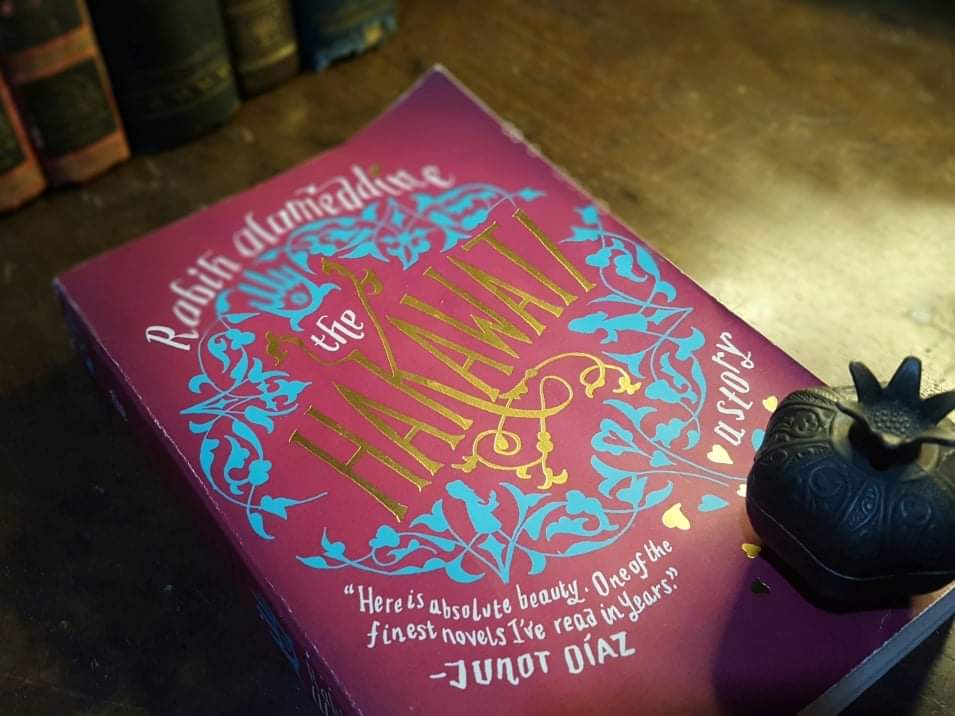
This book is on fire! A dizzying magic carpet ride. A jealous book. It requires your full attention. Look away and you will lose track and get lost, look closer and you will get lost in the stories within stories within stories. It is a matter of choosing your definition of “lost.”

“No matter how good a story is, there is more at stake in the telling,” says the hakawati. The evidence is the book itself, a contemporary retelling of the Arabian Nights through the approach of Lebanese writer, Rabih Alameddine; but this is the Arabian Nights (uncensored, the author warns), deeper and more relevant, and suffused with rich Lebanese culture and history.  It is wondrous, bizarre, sometimes even vulgar and repulsive — but only when you take things literally and only until you realize they are metaphors and then it becomes disturbing, and then these parts become ingenious!

One does not have to read the Arabian Nights in order to enjoy this, but I believe it will be better appreciated with an ample background. Many references would have been lost to me and some sections would have seemed absurd had I bypassed the Arabian Nights. The writing style does not have a tinge of mediocrity, and yet I am aware that it cannot be everyone’s cup of coffee; but I will remember this book for the beautiful words it gave me:

Hakawati — “A hakawati is a teller of tales, myths, and fables (hekayat).  A story-teller, and entertainer. A troubadour of sorts, someone who earns his keep by beguiling an audience with yarns… ‘hakawati’ is derived from the Lebanese word ‘haki,’ which means ‘talk’ or ‘conversation’. This suggests that in Lebanese the mere act of talking is storytelling.”

Zajal — a poetry duel practiced in Lebanon until today.

Bakhshi — an oud player, a singer, and a storyteller.

Maqam — In the Arabic language it means place, location, situation, position, a shrine, but in Arabic music it is a scale and a mood. “Teardrops descending along cheeks, a cascade of grace,” as the protagonist puts it lyrically.

Tarab — “A musical enchantment. It is when both musician and listener are bewitched by the music.” An entrancement achieved between performer and listener while engaged in music.

This whole book is a cacophony of stories. How fitting that its last word is “listen”.

Arabian Nights Sir Richard Burton Translation

February 11, 2021

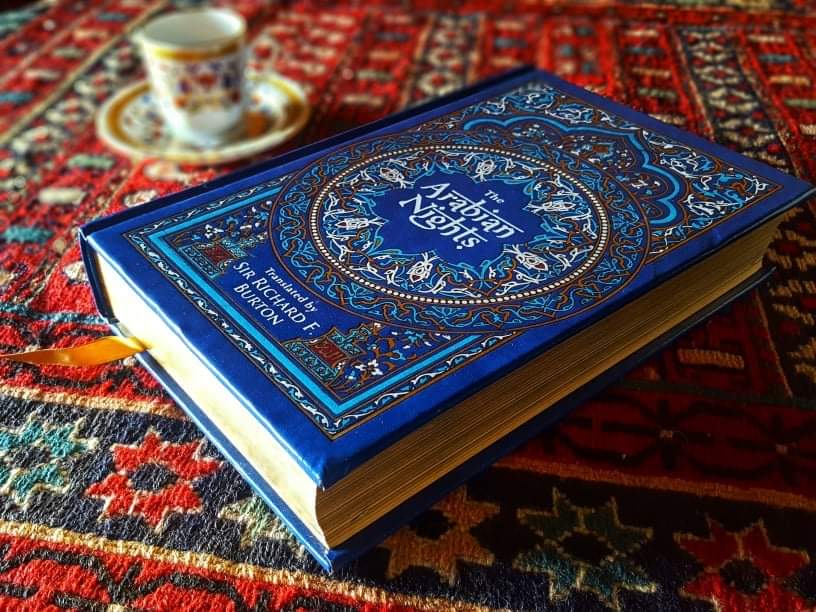
For this reading venture, I chose the controversial translation by Sir Richard Burton (1821-1890). I had to wade through hundreds of pages of old-fashioned language, terminology that are deemed politically incorrect nowadays, some unusual words that Burton coined himself, and content that was considered pornography in Burton’s time. (On a side note, Burton also translated the Kama Sutra and its Tunisian counterpart, The Perfumed Garden. Given those inclinations, this was not one of the watered-down versions we used to find lying around our grandparents’ living rooms.)

This edition has fine and tastefully-colored illustrations that are oases from the antiquated writing style that 21st Century eyes are no longer accustomed to.  A collection of Eastern folk tales and stories compiled during the Islamic Golden Age, I enjoyed coming across real historical figures from that era that were woven alongside the fictional characters.

Haroun al-Rashid, the fifth Abbasid Caliph who ruled from 786-809 appears in many of the stories along with his Persian vizier Jafar who, by the way, was not a villain.  The Islamic Empire was said to be at its most powerful under this caliph’s reign. They traded and maintained diplomatic ties with China, and because stories were also traded along the Silk Roads, it may not be too surprising that in the Arabian Nights, Aladdin is actually Chinese.

On the year Al-Rashid became caliph, his son Al-Mamun was born, and it would be Al-Mamun’s obsession for knowledge and a large-scale commissioning of translations of ancient texts from Mesopotamia, Persia, Greece, and India that would result into the Translation Movement — and perhaps, in addition, this compilation.

As one who finds this region of the world and that period of history intriguing, I still find this worthy of any book-lover’s shelf space. However, I now understand why later writers feel compelled to refashion the stories into something more relatable, or make adaptations for younger audiences without the sexual imagery, or modify the individual stories with a more discernible moral aim.

But whether we like it or not, the Arabian Nights in its entirety has revolutionized and influenced storytelling for centuries. After having read it myself, I realized that there is an aspect that is not emphasized enough: Hers was an unselfish act. Scheherazade volunteered herself at the risk of death to prove King Sharyar’s stereotypes wrong. By so doing, she saved not only her life, but other women’s lives as well — and through an unlikely medium!

After all, isn’t there inside each of us a Scheherazade, a being who depends on the magic of stories to survive?

Stephen Kinzer: All the Shah’s Men

“There is nothing new in the world except the history you do not know.”

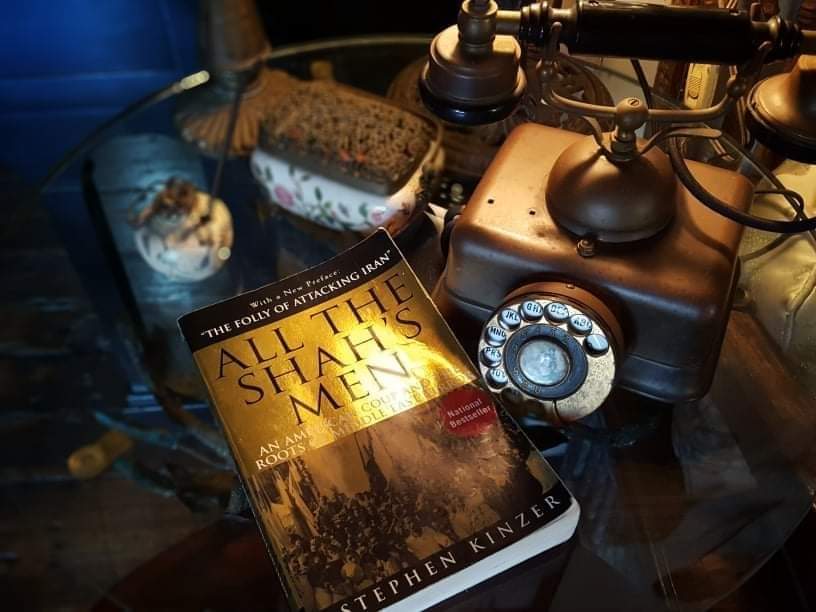
This quote by Harry Truman launches the book into previously confidential details about the 1953 Iranian coup d’état that had me gasping in shock from beginning to end!

It reads like espionage fiction but it is disquieting for the fact that it is nonfiction. It is by far the most comprehensive book I have read on Iran’s modern history. My notes and thoughts will remain private because I wish for my social media accounts to remain zones of peace haha, but I have to say that reading this reinforced my thoughts on Iran’s significance. It made me realize that many major circumstances around the world are ripples of a pivotal event that occurred in Iran more than half a century ago and that this nation continues to be a crucial piece on the chessboard of world history.

Colin Thubron: The Shadow of the Silk Road

Frankopan’s The Silk Roads was the first book I finished reading this year. By the time a dozen friends sent me messages that Joanna Lumley’s Silk Road Adventure on Netflix reminded them of me, the Silk Route had already taken over my neural pathways. Haha! When I was finally able to watch it, I noticed that at the end of the show, Joanna Lumley thanks Peter Frankopan and Colin Thubron. I did not know who the latter was. She led me to this book.

While Frankopan gives the reader a sweeping aerial view, Thubron walks down the roads and creates a more intimate experience. The two would be beautiful to read in succession — Frankopan for the historical details, Thubron for making history felt through intimacy. Aside from his own poetic voice, his writing becomes the voice of places and people who would have otherwise been destined to remain absent or silent in our consciousness.


“Sometimes a journey arises out of hope and instinct, the heady conviction, as your finger travels along the map: Yes, here and here… and here. These are the nerve-ends of the world… A hundred reasons clamor for your going. You go to touch on human identities, to people an empty map. You have a notion that this is the world’s heart.

Yet to follow the Silk Road is to follow a ghost. It flows through the heart of Asia, but it has officially vanished, leaving behind the pattern of restlessness: counterfeit borders, unmapped peoples. The road forks and wanders wherever you are. It is not a single way, but many: a web of choices.”

I did not want this book to end, and yet, even the best books do, but only to give us a deeper yearning to continue the journey beyond the pages.

Austen Henry Layard: Nineveh and its Remains

The Library of Alexandria was not the first systematically organized library in the world. There was another one that was much older: The great library of Nineveh built circa 668 BCE by Assyrian King Ashurbanipal. Although it shared Alexandria’s fate through destruction by fire, it had another advantage — its clay tablets. Alexandria’s papyrus were reduced to ashes, but Nineveh’s cuneiform clay tablets that exceeded twenty thousand in number were merely baked afresh. Not only did this library preserve the Epic of Gilgamesh for future generations, the Nineveh excavation has become a prime source of information about the Assyrians and the Babylonians whose knowledge and culture they inherited.

We all know Nineveh — this wonder of the ancient world, for a time the largest city in the world — from the Old Testament account of Jonah, but for thousands of years, it could have remained a fictional city for unbelievers until its unearthing. “Without the evidence that these monuments afford, we might almost have doubted that the great city ever existed,” writes Austen Henry Layard.

“Existing ruins show that Nineveh had acquired its greatest extent in the time of the Assyrian kings mentioned in the Old Testament.  It was then that Jonah visited it, and that reports of its size and magnificence were carried to the West, and gave rise to those traditions from which the Greeks mainly derived the information they have handed down to us concerning the city.” On a footnote, Layard adds, “With regard to the connection between the ornaments mentioned in the text and those of Greek architecture, it is now impossible to doubt that all that is Ionic in the arts of Greece is derived from the valleys of the Tigris and Euphrates.”

Austen Henry Layard, a name no longer too familiar to our generation, was once a household name in Europe when he discovered Nineveh in the 1840s. Quoting from the introduction, his journals “took Europe by storm and became one of those books that everyone had to read.” It has never gone out of print and is still considered to be among the greatest archaeological books of all time.

Layard being an art historian, a draughtsman, a cuneiformist, and a diplomat, among other things, this book is also so many things at once! The journals have occasional sketches of details from the excavations, he ponders on art, history, religion, civilizations, and takes the reader on his expeditions while painting a vibrant portrait of the time, places, the tribes and people that he encounters on his journeys, and writes vividly of life-threatening experiences.  But the best parts are those moments of discovery that lead to spine-tingling wonder! He can be quite poetic, too: “On all sides, as far as the eye could reach, rose the grass-covered heaps marking the site of ancient habitations. The great tide of civilisation had long since ebbed, leaving these scattered wrecks on the solitary shore. Are those waters to flow again, bearing back the seeds of knowledge and of wealth that they have wafted to the West? We wanderers were seeking what they had left behind, as children gather up the coloured shells on the deserted sands.”

Reading this book recalls and intensifies the question that Jason Elliot posed in his book on Iran: “What will future archaeologists think of us when they find what we’ve left for them?”

Ahdaf Soueif: The Map of Love

This is a story about Egypt. The Egypt that seldom comes to mind when we think of Egypt. The awkward Egypt that won a nominal independence from a fading Ottoman Empire and finds itself ruled by the British. The Egypt in the 1900s and, a hundred years later, the Egypt on the cusp of the Millennium.

This is a scathing commentary about the relationship of East and West where the West is accused of holding one system of values dear to themselves while denying it to their fellows in the East; of foreign intervention; of emasculated natives accused in turn of being unfit to rule themselves; of world powers playing nations and people like chess pieces and waging dishonest wars.

This is about three intelligent women across time, the family that connects them, the men they love, and how they love differently. This is a story written with, and about, beautiful words: “‘Hubb’ is love,
‘ishq’ is love that entwines two people together,
‘shaghaf’ is love that nests in the chambers of the heart,
‘hayam’ is love that wanders the earth,
‘teeh’ is love in which you lose yourself,
‘walah’ is love that carries sorrow within it,
‘sababah’ is love that exudes from your pores,
‘hawa’ is love that shares its name with ‘air’ and with ‘falling’,
‘gharam’ is love that is willing to pay the price.”

But categorizing this as a romance novel would be to miss the point. This is very much a political novel, and Ahdaf Soueif is a gift to those who recognize the power of fiction to embody the intricacies of politics, history, and ethics as painstakingly as a work of nonfiction. Then again, love is a political act. Maybe we can call it a love story, too.

Elif Shafak: Three Daughters of Eve

Peri, the Turkish; Shirin, the Iranian; Mona, the Egyptian; and a philosophy professor. Three women and a man whose lives intersect at the University of Oxford.

Deep into this multi-layered novel, it gradually occurred to me that the characters are actually a microcosm of beliefs, sentiments, and nations: Peri’s father and mother represent both the secular and the religious in Turkey, but despite all their irreconcilable arguments they are bound to coexist; Shirin, the atheist, is the Iranian who believes that the veil stands for the religious fundamentalism that sent her and her family to exile; Mona, the Islam believer, is the Egyptian who is convinced that the veil is her choice and her identity; Peri, the confused, the Turk who always felt somewhere in between (very much like her city, that hinge between Europe and Asia) and whose past is a burden; and the dynamic Professor Azur who challenges not only his students’ beliefs but their unbeliefs, too!

There are too many significant passages to iterate that I have resolved to leave it to the next reader to find and treasure those penetrating lines for themselves.  In the acknowledgements, Elif Shafak writes, “My motherland, Turkey, is a river country, neither solid nor settled. During the course of writing this novel that river changed so many times, flowing with a dizzying speed… Motherlands are beloved, no doubt; sometimes they can also be exasperating and maddening. Yet I have also come to learn that for writers and poets for whom national borders and cultural barriers are there to be questioned, again and again, there is, in truth, only one motherland, perpetual and portable. Storyland.”

And yet this is a story that is not merely a story. It is a peephole into politics, stereotypes, philosophy, and life. The dialogues are a source of profound thought and it touches on relevant issues that are painfully ignored by the higher powers in government. But perhaps what I should be saying is that, nevermind my qualms with some metaphors, this is how stories should be — the kind that challenges the idea of what readers should be looking for in a book.