Jasmine Darznik: Song of a Captive Bird

She is known in the West as the Sylvia Plath of Iran. As if the name Forugh Farrokhzad is not enough.

Although I understand the comparison because of the early and tragic deaths, of troubled lives we wouldn’t hope to emulate but whose courage to immortalize raw emotion we secretly envy, the turbulent relationships, also their notoriety of speaking against the constraints that society imposed on women and paving the way for other women in literature — but Forugh Farrokhzad is Forugh Farrokhzad to me. The rebel poet of Iran.

“𝐓𝐡𝐢𝐧𝐤 𝐚𝐛𝐨𝐮𝐭 𝐭𝐡𝐞 𝐰𝐫𝐢𝐭𝐞𝐫𝐬 𝐲𝐨𝐮’𝐯𝐞 𝐦𝐨𝐬𝐭 𝐚𝐝𝐦𝐢𝐫𝐞𝐝. 𝐖𝐡𝐚𝐭 𝐡𝐚𝐬 𝐠𝐢𝐯𝐞𝐧 𝐲𝐨𝐮 𝐬𝐨𝐥𝐚𝐜𝐞 𝐢𝐧 𝐭𝐡𝐞𝐢𝐫 𝐰𝐨𝐫𝐝𝐬? 𝐖𝐡𝐚𝐭 𝐡𝐚𝐬 𝐠𝐢𝐯𝐞𝐧 𝐲𝐨𝐮 𝐜𝐨𝐮𝐫𝐚𝐠𝐞? 𝐈 𝐜𝐚𝐧 𝐠𝐮𝐞𝐬𝐬 𝐭𝐡𝐚𝐭 𝐰𝐡𝐞𝐧 𝐲𝐨𝐮 𝐡𝐚𝐯𝐞 𝐛𝐞𝐞𝐧 𝐦𝐨𝐯𝐞𝐝, 𝐢𝐭’𝐬 𝐛𝐞𝐞𝐧 𝐛𝐲 𝐚 𝐰𝐫𝐢𝐭𝐞𝐫 𝐰𝐡𝐨 𝐡𝐚𝐬 𝐫𝐢𝐬𝐤𝐞𝐝 𝐡𝐨𝐧𝐞𝐬𝐭𝐲.”

Hers is one of the strongest female voices in Iranian literature. I first came across her poems in an anthology featuring a thousand years of Persian poetry by women and in a film by Abbas Kiarostami, and subsequently the haunting poetry that she extended to filmmaking in 𝘛𝘩𝘦 𝘏𝘰𝘶𝘴𝘦 𝘪𝘴 𝘉𝘭𝘢𝘤𝘬. It is an extremely moving and artistic documentary about a leper colony in Azerbaijan, from where she afterwards adopted a son of the colony’s two inhabitants.

When I learned that Jasmin Darznik had written a well-researched book on her life, I was intrigued. Written in the first person in a most lyrical and revealing voice with generous layers of pain and art, this is that book.

“𝐎𝐧𝐜𝐞, 𝐰𝐡𝐞𝐧 𝐦𝐲 𝐩𝐨𝐞𝐦𝐬 𝐰𝐞𝐫𝐞 𝐛𝐚𝐧𝐧𝐞𝐝 𝐛𝐲 𝐭𝐡𝐞 𝐧𝐞𝐰 𝐫𝐞𝐠𝐢𝐦𝐞 𝐚𝐧𝐝 𝐚 𝐩𝐮𝐛𝐥𝐢𝐬𝐡𝐞𝐫 𝐰𝐨𝐮𝐥𝐝𝐧’𝐭 𝐬𝐭𝐨𝐩 𝐩𝐫𝐢𝐧𝐭𝐢𝐧𝐠 𝐭𝐡𝐞𝐦, 𝐡𝐢𝐬 𝐩𝐫𝐞𝐬𝐬 𝐰𝐚𝐬 𝐛𝐮𝐫𝐧𝐞𝐝 𝐭𝐨 𝐭𝐡𝐞 𝐠𝐫𝐨𝐮𝐧𝐝. 𝐀𝐬 𝐢𝐟 𝐩𝐨𝐞𝐭𝐫𝐲 𝐜𝐨𝐮𝐥𝐝 𝐛𝐞 𝐝𝐞𝐬𝐭𝐫𝐨𝐲𝐞𝐝 𝐥𝐢𝐤𝐞 𝐚 𝐛𝐮𝐢𝐥𝐝𝐢𝐧𝐠 𝐨𝐫 𝐚 𝐛𝐨𝐝𝐲. 𝐁𝐮𝐭 𝐚𝐫𝐭 𝐰𝐚𝐬𝐧’𝐭 𝐥𝐢𝐤𝐞 𝐭𝐡𝐚𝐭. 𝐀𝐫𝐭 𝐜𝐨𝐮𝐥𝐝 𝐬𝐮𝐫𝐯𝐢𝐯𝐞; 𝐞𝐯𝐞𝐧 𝐰𝐡𝐞𝐧 𝐬𝐮𝐩𝐩𝐫𝐞𝐬𝐬𝐞𝐝, 𝐞𝐯𝐞𝐧 𝐰𝐡𝐞𝐧 𝐨𝐮𝐭𝐥𝐚𝐰𝐞𝐝, 𝐢𝐭 𝐜𝐨𝐮𝐥𝐝 𝐬𝐮𝐫𝐯𝐢𝐯𝐞 𝐟𝐚𝐫 𝐰𝐨𝐫𝐬𝐞 𝐟𝐚𝐭𝐞𝐬 𝐭𝐡𝐚𝐧 𝐟𝐢𝐫𝐞.” 

V.S. Naipaul and Geraldine Brooks

AUGUST 21, 2021

A Nobel laureate and a Pulitzer winner.
Two books with their fair share of advocates and detractors. But a discerning reader will understand both the praise and the criticism.

Naipaul traveled to Iran, Pakistan, Malaysia, and Indonesia for six months to examine the heightening Islamic fundamentalism in countries with a pre-Islamic history but have become theocratic states.

Brooks, stationed in Cairo for six years as a journalist, explored Egypt, Iran, Israel, Palestine, Jordan, Eritrea, Saudi Arabia, and other Arab states of the Persian Gulf, to ask a specific question: “𝘐𝘴𝘭𝘢𝘮 𝘥𝘪𝘥 𝘯𝘰𝘵 𝘩𝘢𝘷𝘦 𝘵𝘰 𝘮𝘦𝘢𝘯 𝘰𝘱𝘱𝘳𝘦𝘴𝘴𝘪𝘰𝘯 𝘰𝘧 𝘸𝘰𝘮𝘦𝘯. 𝘚𝘰 𝘸𝘩𝘺 𝘸𝘦𝘳𝘦 𝘴𝘰 𝘮𝘢𝘯𝘺 𝘔𝘶𝘴𝘭𝘪𝘮 𝘸𝘰𝘮𝘦𝘯 𝘰𝘱𝘱𝘳𝘦𝘴𝘴𝘦𝘥?” “𝘈𝘯𝘺 𝘵𝘪𝘮𝘦 𝘵𝘩𝘪𝘯𝘨𝘴 𝘴𝘵𝘢𝘳𝘵𝘦𝘥 𝘵𝘰 𝘨𝘰 𝘸𝘳𝘰𝘯𝘨 𝘪𝘯 𝘵𝘩𝘦 𝘔𝘪𝘥𝘥𝘭𝘦 𝘌𝘢𝘴𝘵, 𝘸𝘰𝘮𝘦𝘯 𝘴𝘶𝘧𝘧𝘦𝘳𝘦𝘥 𝘧𝘰𝘳 𝘪𝘵 𝘧𝘪𝘳𝘴𝘵,” she observed. And this is what the world especially fears in the wake of the Taliban takeover of Afghanistan.

I read the Naipaul earlier in August but wasn’t quite sure what to say about it openly. Naipaul’s disregard for political correctness is sometimes shocking, but his directness can also be refreshing. Brooks’ courage is admirable and her accounts overwhelming; and made more fascinating by personal interviews with Salman Rushdie, Naguib Mahfouz, the Ayatollah Khomeini’s daughter Zahra, King Hussein and Queen Noor of Jordan. Whether the reader ends up appreciating the scrutiny or not, one has to admit that both authors have written only the truth derived from their interaction with the people.

One was published in 1981, the other in 1995. Some information is dated because much has changed in the world since then, but much hasn’t either. What remains unchanged in the matters discussed is the reason why these two books are still valuable and pertinent.

Amir Ahmadi Arian: Then the Fish Swallowed Him

SEPTEMBER 3, 2021

Out of all the post-Iranian Revolution books I have encountered, this one is rather unusual. Here, the revolution takes a backseat. Or does it?

Published in 2020, perhaps it is heralding the era of significant literature on the revolution’s longterm effects.

Named after the prophet Jonah, Yunus is a bus driver arrested during a strike, and sent to Tehran’s most notorious prison where his descent into absurdity deepens.

At first glance, the physical belly of the whale is Evin prison. But given a closer look, the psychological belly of the whale is madness and totalitarian politics from which there is no reprieve for this Yunus; and its haunting effects on the psyche, lasting.

The novel is unnerving, but even more so when the reader remembers scripture and realizes… Wasn’t the prophet Jonah sent to warn the people?

Vladimir Bartol: Alamut

August 25, 2021

From what I gather, Alamut is a literary anomaly.

It is also here that great writing intersects with my fascination for Iran.

But first, the trivia:
— This novel became an inspiration for Assassin’s Creed, although it was published long before the era of video games.
— It was written in 1938, after Slovenian Vladimir Bartol spent ten years of extensive research on the Assassins, as a response to the rise of totalitarianism in Europe.
— Bartol intended to dedicate the first edition to Benito Mussolini, but it goes without saying that no publisher would have allowed that.
— The nature of the book is frightening that it led a recent reviewer from L’Express in France to write, “If Osama bin Laden did not exist, Vladimir Bartol would have invented him.”

_ _ _

While there are many myths surrounding the Order of the Assassins who inspired terror from 1090 to 1275, it is agreed among historians that no enemy of theirs ever managed to evade their daggers. The fanaticism of their followers readily willing to die for their cause became legendary. They felled viziers, emirs, and caliphs, shaped the entire political landscape in the region according to their conceits, and held the reins of power for almost two hundred years. Their most mighty fortress stood in Iran, the “Eagle’s Nest,” the impregnable Alamut. 

_ _ _

Engrossing, tragic, and rife with philosophy, Bartol also plays on the myths, but this novel is essentially a chilling warning against charismatic leaders who test the limits of human blindness, against ideologies that have the ability to manipulate minds and emotions and subsequently annihilate logical thought. 

“…𝘪𝘵 𝘴𝘦𝘦𝘮𝘦𝘥 𝘮𝘰𝘳𝘦 𝘱𝘳𝘢𝘤𝘵𝘪𝘤𝘢𝘭 𝘵𝘰 𝘵𝘩𝘦𝘮 𝘵𝘰 𝘩𝘰𝘭𝘥 𝘰𝘯𝘵𝘰 𝘴𝘰𝘮𝘦𝘵𝘩𝘪𝘯𝘨 𝘴𝘰𝘭𝘪𝘥 𝘵𝘩𝘢𝘯 𝘵𝘰 𝘨𝘳𝘰𝘱𝘦 𝘵𝘩𝘦𝘪𝘳 𝘸𝘢𝘺 𝘵𝘰 𝘦𝘵𝘦𝘳𝘯𝘢𝘭 𝘶𝘯𝘤𝘦𝘳𝘵𝘢𝘪𝘯𝘵𝘺 𝘢𝘯𝘥 𝘦𝘯𝘥𝘭𝘦𝘴𝘴 𝘯𝘦𝘨𝘢𝘵𝘪𝘰𝘯. 𝘕𝘰𝘵 𝘫𝘶𝘴𝘵 𝘴𝘪𝘮𝘱𝘭𝘦 𝘧𝘰𝘭𝘬 𝘧𝘳𝘰𝘮 𝘵𝘩𝘦 𝘮𝘢𝘴𝘴𝘦𝘴, 𝘦𝘷𝘦𝘯 𝘵𝘩𝘦 𝘮𝘰𝘳𝘦 𝘦𝘹𝘢𝘭𝘵𝘦𝘥 𝘮𝘪𝘯𝘥𝘴 𝘱𝘳𝘦𝘧𝘦𝘳𝘳𝘦𝘥 𝘢 𝘵𝘢𝘯𝘨𝘪𝘣𝘭𝘦 𝘭𝘪𝘦 𝘵𝘰 𝘢𝘯 𝘶𝘯𝘨𝘳𝘢𝘴𝘱𝘢𝘣𝘭𝘦 𝘵𝘳𝘶𝘵𝘩.”

It is both unsettling and incredible how a novel set in the 11th century, written in 1938, reads like a warning written specifically for our generation.

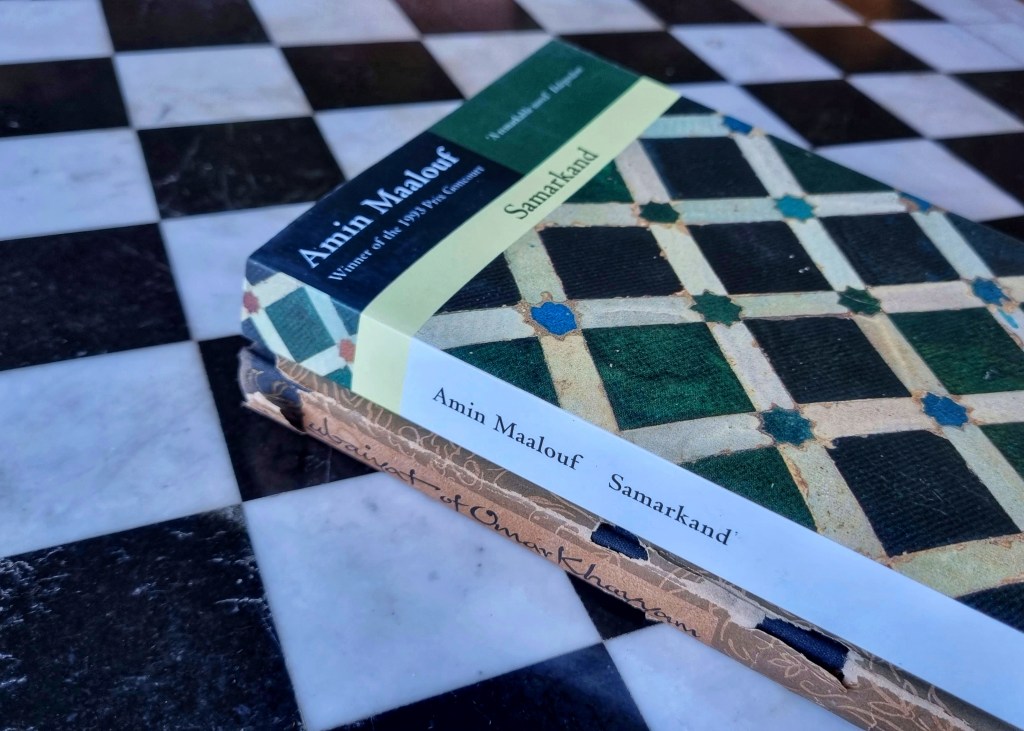
Amin Maalouf: Samarkand

November 20, 2021

It is almost impossible to tell a story of Omar Khayyam without involving his contemporaries: Hassan-i Sabbah, founder of the Order of Assassins, and Nizam Al-Mulk, Persian history’s most famous vizier — the very first victim of the Assassins. Their destinies and of Persia’s are so entwined that it would also be impossible to discuss Persian history without touching on this legendary trio. Amin Maalouf takes these characters and animates history with his seamless blending of fact and imagination, making Samarkand an entertaining read for any Persophile.

Chapter one wrests the reader from the present to vibrant 11th century Samarkand where a qadi tells Omar Khayyam, after the latter is nabbed in the marketplace and recognized as a failasuf (a philosopher or a person associated with the sciences widely considered profane at such a time and place), “The Almighty has granted you the most valuable things that a son of Adam can have — intelligence, eloquence, health, beauty, the desire for knowledge and a lust for life… I hope that He has not deprived you of the wisdom of silence, without which all of the foregoing can neither be appreciated nor preserved.”

The wise judge proceeds to present the young Omar a blank book wherein he could write his thoughts instead of speaking them out loud to a populace unprepared for his unconventional views. The pages would then be filled and would persevere through time to become what we know as The Rubaiyat.

The Rubaiyat is a collection of ruba’i or quatrains that would establish Khayyam’s name as a poet centuries later in the West, but the work of poetry would ironically make readers oblivious to the complete man — a polymath: mathematician, astronomer, scientist, philosopher, among many other things. Born eleven years after the death of the great Ibn Sina (Avicenna), Khayyam is considered his intellectual successor.

Although Samarkand is mainly about the imagined fate of The Rubaiyat’s original manuscript, in my mind these all took a backseat to a man whose genius was irrespective of the mode of expression. It made me feel wistful when the novel’s timeline left Omar Khayyam and the 11th century. It feels as if something of myself, sitting in a Persian garden while listening to him speak, remained in Samarkand.

“I am old now and need to know that I have a trusty man at my side — because of the manuscript. That is the most precious thing I possess. In order to take on the world, Hassan-i Sabbah has built Alamut (the Assassins’ fortress), whereas I have only constructed this minuscule paper castle, but I choose to believe that it will outlive Alamut.”

It did. It continues to…

Iran’s Trees

Iran’s trees. The arboreal titles led me to read this as a pair.

The cypress and the greengage now adorn landscapes and orchards around the world, but it was in Persia that they originated; and although these books are not about the history of trees, these sing of the Iranian soul — finding enlightenment through a greengage, or ever-bending like the cypress. 

The Cypress Tree can stand as a refresher or introduction to Iran’s history. Kamin Mohammadi does not make it seem like she is merely listing events chronologically. The melody in her language is retained despite summarizing a civilization and sharply criticizing its rulers.

Of Khomeini, “Hadn’t he dug up the earth in which we thrived and condemned the nutrients that fed our beings as unhealthy, corrupt and un-Islamic?” Of its culture she accurately expresses how, throughout history, it “infiltrates the dominant culture of the invader, transforming it to glory.” Of its food, their day shapes itself around it. Of its language “made so absolutely for amusement and love.”

As cliche as it may sound, this is truly a love letter to Iran — the Iran “not one of mullahs and fundamentalism, but a place of kindness and love, an abundant paradise of mountains and deserts and turquoise seas… not populated by implacable priests and unshaven blood-hungry young men… but where the language even of strangers was affectionate and poetic.”

The Enlightenment of the Greengage Tree is written by none other than the first Iranian woman to hitchhike the entire length of the Silk Road, Shokoofeh Azar. 

When it comes to Magic Realism, our favorite Latin American writers come to mind. But this work reminds us that as far as recorded literature goes, this region goes way back to the Arabian Nights and further.

For readers who are not fans of the genre, this can be overwhelming and chaotic. Having read mostly non-fiction in November, it took me a few chapters to adjust and warm up to it. But for those who have the patience for Magical Realism suffused with Persian mythology and superstition, this can be an exceptional experience. It was shortlisted for the 2020 International Booker Prize, after all.

By chapter 5, you will begin to understand that a dead person is narrating the story. There will be indelible scenes of Khomeini’s death reimagined, of musical instruments and books being burned, of a mother’s heart becoming a graveyard… but the political, the poetic, the evocative, the profound figures of speech, crescendo toward the end, and by then, you will realize that you have a forceful piece of literature in your hands. 

“Write. Write all you remember. The characters in novels, their loves, war, peace; their adventures, hates, betrayals… write down anything you remember from the books.”

I will.

Dalia Sofer: Man of My Time

June 15, 2021


The clues appear unhurriedly through sardonic remarks and thoughts, a twisted streak here and there, and then it suddenly registers. You are inside the mind of an antihero — someone you are not meant to like, but a character necessary for probing into an individual and a nation’s psyche beyond the conventional point of view.

 
Hamid Mozaffarian carries the cracks of his dysfunctional childhood into adulthood as a broken man and hurts those closest to him.  He becomes an idealistic revolutionary and lands a position as an interrogator for the new regime.  And in what he describes as the germinal act of his downfall, he betrays his own father.


But didn’t his father, under the corrupt regime of the Shah, also betray his closest friend to the dreaded secret police? So we see how the same vein of treachery and weakness course through history, albeit under different regimes.


Yet this is a man who is aware of his brokenness and his faults. Hamid wrestles with himself as he begins to become disillusioned with the Revolution: “How can we become the very beast we combatted? How do we reconcile… what we could have been with what we are becoming?”


“Homemade alcohol, black-market gasoline, glassy-eyed addicts, smugglers, pushers, sweaty men passing the hours in downtown teahouses amid the clatter of saucers and cups, people blindfolded and spirited away only to be distilled later into names on execution lists in newspapers—these things, which I, like others, had been witnessing, flashed in my mind.  These were the makings of an underground parallel city shadowing the so-called pious city above, the scaffolding of a professed republic that like the monarchy preceding it did not dare to look at its own reflection save in a draped mirror. So our revolution had been accomplished, but what of it? And what of us?”


Through the darkness, we see slivers of hope as he attempts to become a better man, but the consequences of his past sins continue to engulf him, and he often allows it to drown him.

Written with the command of a great 20th century existentialist, the clarity with which Dalia Sofer navigates the absurdities of human contradiction and the perplexing intricacies of the Iranian Revolution is astounding. This book, although published in 2020, can make the reader believe that it came from that golden era of novelists who also identified as philosophers and psychologists.


It is a series of painful events, but one passage reduced me to tears. It is when his father dies and leaves him an old edition of The Epic of Gilgamesh with the inscription: “To my son, Hamid, this was my first copy of this timeless tale, which I studied in school, in 1948.  I hope you will one day receive from it all the beauty that I failed to teach you. With love, Sadegh Mozaffarian.”


This is where we grasp Dalia Sofer’s genius in subtleties by alluding to the region’s literary treasures. The Babylonian society in The Epic of Gilgamesh was an Eastern society where community was also most likely upheld over the individual; and where, despite the ephemerality of the individual, his actions are believed to affect not only himself but his community and their collective destiny and history.


Hamid also ponders on the Persian classic, Attar’s The Conference of the Birds — the story where a flock of birds go in search of the mythical bird, the Simorgh. At the end of the life-changing journey, it is only then that they discover that in the Persian language “si” means thirty, and “morgh” means bird. Thirty birds. Together, they find, and together they are, the Simorgh. 


In Sofer’s words, “There is no such thing as a solitary act in family life or in history.” 

For isn’t the dissolution of the individual the downfall of a nation, the same way the betterment of the individual is to a nation’s advantage?