“One can have a very lofty idea of literature, and at the same time have a good-natured laugh at it,” Proust said in reply to a friend’s question on how seriously books should be taken.
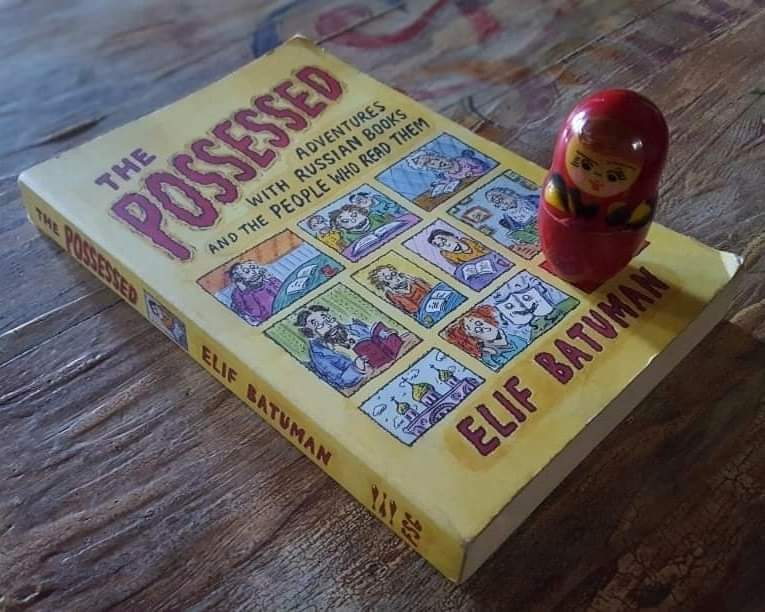
This is exactly what Elif Batuman does in this essay collection that doubles as a memoir. The title is lengthy and self-explanatory, and based on her book titles, one can tell how influenced she is by Russian literature: The Idiot , which I read in March, and The Possessed. It is entertaining how she manages to write such serious topics with a candid humor.
Although written seven years earlier than The Idiot I seem to have enjoyed this more as it does away with much of the the main character’s adolescent romantic concerns present in the former. Perhaps it was the three sections of her summer in Samarkand that made this more appealing to me, where she learns that the Old Uzbek language has a hundred different words for crying! Or maybe it was that passing line that I really loved, “Wasn’t the point of love that it made you want to learn more?”
Despite not being able to say that this will be a favorite, it’s funny how it contains passages that I know will stay with me forever.
Frankopan’s The Silk Roads was the first book I finished reading this year. By the time a dozen friends sent me messages that Joanna Lumley’s Silk Road Adventure on Netflix reminded them of me, the Silk Route had already taken over my neural pathways. Haha! When I was finally able to watch it, I noticed that at the end of the show, Joanna Lumley thanks Peter Frankopan and Colin Thubron. I did not know who the latter was. She led me to this book.
While Frankopan gives the reader a sweeping aerial view, Thubron walks down the roads and creates a more intimate experience. The two would be beautiful to read in succession — Frankopan for the historical details, Thubron for making history felt through intimacy. Aside from his own poetic voice, his writing becomes the voice of places and people who would have otherwise been destined to remain absent or silent in our consciousness.
“Sometimes a journey arises out of hope and instinct, the heady conviction, as your finger travels along the map: Yes, here and here… and here. These are the nerve-ends of the world… A hundred reasons clamor for your going. You go to touch on human identities, to people an empty map. You have a notion that this is the world’s heart.
Yet to follow the Silk Road is to follow a ghost. It flows through the heart of Asia, but it has officially vanished, leaving behind the pattern of restlessness: counterfeit borders, unmapped peoples. The road forks and wanders wherever you are. It is not a single way, but many: a web of choices.”
I did not want this book to end, and yet, even the best books do, but only to give us a deeper yearning to continue the journey beyond the pages.
The Library of Alexandria was not the first systematically organized library in the world. There was another one that was much older: The great library of Nineveh built circa 668 BCE by Assyrian King Ashurbanipal. Although it shared Alexandria’s fate through destruction by fire, it had another advantage — its clay tablets. Alexandria’s papyrus were reduced to ashes, but Nineveh’s cuneiform clay tablets that exceeded twenty thousand in number were merely baked afresh. Not only did this library preserve the Epic of Gilgamesh for future generations, the Nineveh excavation has become a prime source of information about the Assyrians and the Babylonians whose knowledge and culture they inherited.
We all know Nineveh — this wonder of the ancient world, for a time the largest city in the world — from the Old Testament account of Jonah, but for thousands of years, it could have remained a fictional city for unbelievers until its unearthing. “Without the evidence that these monuments afford, we might almost have doubted that the great city ever existed,” writes Austen Henry Layard.
“Existing ruins show that Nineveh had acquired its greatest extent in the time of the Assyrian kings mentioned in the Old Testament. It was then that Jonah visited it, and that reports of its size and magnificence were carried to the West, and gave rise to those traditions from which the Greeks mainly derived the information they have handed down to us concerning the city.” On a footnote, Layard adds, “With regard to the connection between the ornaments mentioned in the text and those of Greek architecture, it is now impossible to doubt that all that is Ionic in the arts of Greece is derived from the valleys of the Tigris and Euphrates.”
Austen Henry Layard, a name no longer too familiar to our generation, was once a household name in Europe when he discovered Nineveh in the 1840s. Quoting from the introduction, his journals “took Europe by storm and became one of those books that everyone had to read.” It has never gone out of print and is still considered to be among the greatest archaeological books of all time.
Layard being an art historian, a draughtsman, a cuneiformist, and a diplomat, among other things, this book is also so many things at once! The journals have occasional sketches of details from the excavations, he ponders on art, history, religion, civilizations, and takes the reader on his expeditions while painting a vibrant portrait of the time, places, the tribes and people that he encounters on his journeys, and writes vividly of life-threatening experiences. But the best parts are those moments of discovery that lead to spine-tingling wonder! He can be quite poetic, too: “On all sides, as far as the eye could reach, rose the grass-covered heaps marking the site of ancient habitations. The great tide of civilisation had long since ebbed, leaving these scattered wrecks on the solitary shore. Are those waters to flow again, bearing back the seeds of knowledge and of wealth that they have wafted to the West? We wanderers were seeking what they had left behind, as children gather up the coloured shells on the deserted sands.”
Reading this book recalls and intensifies the question that Jason Elliot posed in his book on Iran: “What will future archaeologists think of us when they find what we’ve left for them?”
This is a story about Egypt. The Egypt that seldom comes to mind when we think of Egypt. The awkward Egypt that won a nominal independence from a fading Ottoman Empire and finds itself ruled by the British. The Egypt in the 1900s and, a hundred years later, the Egypt on the cusp of the Millennium.
This is a scathing commentary about the relationship of East and West where the West is accused of holding one system of values dear to themselves while denying it to their fellows in the East; of foreign intervention; of emasculated natives accused in turn of being unfit to rule themselves; of world powers playing nations and people like chess pieces and waging dishonest wars.
This is about three intelligent women across time, the family that connects them, the men they love, and how they love differently. This is a story written with, and about, beautiful words: “‘Hubb’ is love, ‘ishq’ is love that entwines two people together, ‘shaghaf’ is love that nests in the chambers of the heart, ‘hayam’ is love that wanders the earth, ‘teeh’ is love in which you lose yourself, ‘walah’ is love that carries sorrow within it, ‘sababah’ is love that exudes from your pores, ‘hawa’ is love that shares its name with ‘air’ and with ‘falling’, ‘gharam’ is love that is willing to pay the price.”
But categorizing this as a romance novel would be to miss the point. This is very much a political novel, and Ahdaf Soueif is a gift to those who recognize the power of fiction to embody the intricacies of politics, history, and ethics as painstakingly as a work of nonfiction. Then again, love is a political act. Maybe we can call it a love story, too.
Peri, the Turkish; Shirin, the Iranian; Mona, the Egyptian; and a philosophy professor. Three women and a man whose lives intersect at the University of Oxford.
Deep into this multi-layered novel, it gradually occurred to me that the characters are actually a microcosm of beliefs, sentiments, and nations: Peri’s father and mother represent both the secular and the religious in Turkey, but despite all their irreconcilable arguments they are bound to coexist; Shirin, the atheist, is the Iranian who believes that the veil stands for the religious fundamentalism that sent her and her family to exile; Mona, the Islam believer, is the Egyptian who is convinced that the veil is her choice and her identity; Peri, the confused, the Turk who always felt somewhere in between (very much like her city, that hinge between Europe and Asia) and whose past is a burden; and the dynamic Professor Azur who challenges not only his students’ beliefs but their unbeliefs, too!
There are too many significant passages to iterate that I have resolved to leave it to the next reader to find and treasure those penetrating lines for themselves. In the acknowledgements, Elif Shafak writes, “My motherland, Turkey, is a river country, neither solid nor settled. During the course of writing this novel that river changed so many times, flowing with a dizzying speed… Motherlands are beloved, no doubt; sometimes they can also be exasperating and maddening. Yet I have also come to learn that for writers and poets for whom national borders and cultural barriers are there to be questioned, again and again, there is, in truth, only one motherland, perpetual and portable. Storyland.”
And yet this is a story that is not merely a story. It is a peephole into politics, stereotypes, philosophy, and life. The dialogues are a source of profound thought and it touches on relevant issues that are painfully ignored by the higher powers in government. But perhaps what I should be saying is that, nevermind my qualms with some metaphors, this is how stories should be — the kind that challenges the idea of what readers should be looking for in a book.
“People don’t get lost on the outside. They get lost on the inside. Why are there no maps of that?”
“If you don’t know the tale of where you come from, the words of others can overwhelm and drown out your own. So, you see, you must keep careful track of the borders of your stories, where your voice ends and another’s begins.”
“Things change too much. We’ve always got to fix the maps, repaint the borders of ourselves.”
“He motioned to the shelves of books, their spines polished gold, tawny brown, and russet leather. “Anyone who wants companionship and knowledge will find what they seek here,” he said. “We are among friends.”
“People think that stories can be walled off, kept outside and separate. They can’t. Stories are inside of you.”
“Then stories map the soul,” Rawiya said, “in the guise of words.”
“Don’t forget, stories ease the pain of living, not dying.”
“Their broken places remind me of how contagious pain is.”
“Is pain poisonous?”
“But the top of my head is pulsing, and my fingers are trembling, and in my head I am counting the broken families I have seen. I am counting the missing fathers and the buried brothers, giving form and breath to those who were left behind…”
“Wealth is no substitute for belonging.”
“Is the world nothing more than a collection of senseless hurts waiting to happen, one long cut waiting to bleed?”
* * *
There are books that are intellectually satisfying, and then there are those that pierce your heart to the core and put your anxieties and problems into perspective. These two belong to the latter. Reading Ahdaf Soueif’s and Elif Shafak’s cerebral women prior to this did not make the 12-year-old narrator seem less profound. In true Arabian Nights fashion, which I find brilliant, this has a story within a story; but these books are, indeed, a starting point for empathy and education on the Syrian refugee crisis.
The Iranian’s remark to the Turkish in Three Daughters of Eve kept playing in my mind, “Lucky you! If you are homesick, it means you have a home somewhere.”
The Iranian Jewish main character adds a layer of complexity to an already convoluted political terrain, and that is what sets it apart from the few books I have read about the Iranian Revolution.
Isaac Amin, a poet turned wealthy gemologist, is arrested and accused of being an Israeli spy. His ethnicity and his status incriminates him. He is guilty of the blatant sin of being a wealthy Jew.
But who can hope for a fair trial? “If you think there is going to be a trial you’re going to be very disappointed.” There is only interrogation and torture.
Dalia Sofer writes with a slow burning suspense and unravels difficult matters with a remarkable ease. From affecting scenes of prisoners reciting poetry to each other, to dialogues that confront social issues, to thoughts about religion and family, she breathes into them beautiful subtleties and realities that are literary pearls.
I judged this book by its cover. There seemed something saccharine about it that it took me a while to pick it up. But because of a long-standing personal intention to piece together a literary tapestry of the Fertile Crescent, I finally read it.
How wrong I was! There is absolutely nothing saccharine about post-Revolution Iran or in the physical and psychological tortures of their prisons.
The novel moves back and forth between Isaac in prison, his wife and daughter who take control of their situation in individual ways in Tehran, and a son studying architecture in New York. We see almost nothing of Shiraz, and it takes a while to understand that Septembers of Shiraz is a wistful metaphor and allusion to brighter days that have become irredeemable.
Rabih Alameddine is insane. His Hakawati is Arabian Nights on drugs, a dizzying magic carpet ride. When I thought a book’s structure could not get crazier, I end up with this: I, The Divine. A novel in first chapters. Yes, each section is Chapter One all throughout the book! With the exception of the Prologue on page 110 and the Introduction at the very end!
But I cannot recommend this author to everyone. He will make readers feel uncomfortable. There are obscenities. Lots of it. But these obscenities are often realities — war, murder, suicide, rape. With the Lebanese Civil War as backdrop, and through the main character and her family, we are shown how a nation’s events shape the lives of its people.
He seems to be the kind of writer who loves giving the reader a good challenge; one has to be sensitive to allusions and metaphors otherwise the point is overlooked. But amidst these dark and heavy themes, he surprises you by making you laugh! I repeat, Rabih Alameddine is insane…
…but who also happens to be a painter who has exhibited in London, New York, and Paris. This explains the colorful passages, and in his two works that I’ve read, references to art and artists adorn his pages. In one of the earlier first chapters, he quotes the artist, John Dwyer McLaughlin, “These Asian paintings I could get into and they made me wonder who I was. By contrast, Western painters tried to tell me who they were.”
This, to me, was a signpost that signaled how this book is, above anything else, about identity, a comparison of Eastern and Western thought, and an additional reflection to my Fertile Crescent literary tapestry on individuality and community. By the end of the book, this is confirmed:
“If I wanted to know about lion, I had to look at the entire pride. I had to look at it not as a single organism per se, but as a new unit much larger than the sum of its parts… I could not begin to fathom what being a lion was if I only looked at each lion individually, or even at the relationships between the lions. All of them together, not all of them individually summed up, but all of them as a dynamic organism, were the species; all were the word lion.
I had tried to write my memoir by telling an imaginary reader to listen to my story. Come learn about me, I said. I have a great story to tell you because I have led an interesting life. Come meet me. But how can I expect readers to know who I am if I do not tell them about my family, my friends, the relationships in my life? Who am I if not where I fit in the world, where I fit in the lives of the people dear to me? I have to explain how the individual participated in the larger organism, to show how I fit into this larger whole. So instead of telling the reader, Come meet me, I have to say something else. Come meet my family. Come meet my friends. Come here, I say. Come meet my pride.”
My initiation to Pamuk was My Name is Red circa 2006. He opened up a whole new world of literature to me. Scouring bookstores for his other works was a natural aftermath.
It goes without saying that I found the writing spectacular, but fifteen years ago The White Castle meant nothing more to me than a tale set in the 17th century about an Italian intellectual who sets sail from Venice to Naples only to be captured by Turks and brought to Constantinople where his master would turn out to be his doppelgänger. I knew it was a novel about identity, but it did not leave a lasting impression back then.
I had even forgotten that this was set during a pandemic wherein people lived in fear of the plague! “Janissaries guarded the entrances to the market-places, the avenues, the boat landings, halting passers-by, interrogating them: ‘Who are you? Where are you going? Where are you coming from?’”
The same questions that each doppelgänger would often ask the other and himself — the same questions that confront the reader.
Through my re-reading, I discovered nuances that were lost to my younger mind; and passages that I previously failed to mark with a pencil leapt up from the pages with intensity.
Over the course of time, the two characters’ lives would become inextricably entwined, they would embark on engineering projects, study astronomy, work on other branches of science, write books and and share a life together. As soon as Pamuk tricks us into thinking that one is inferior to the other, and into making us think we have a good grasp of who is truly master or slave, their roles would be reversed until it becomes difficult to tell them apart. And yet, their likeness is something that they do not acknowledge openly.
By and by, the question of who is superior? fades into oblivion and metamorphoses into who is who?
On one occasion, the Sultan asks them, “Have you two never looked at yourselves in the mirror together?”
And there it was, the very point that I missed hiding in plain sight — East and West personified!
And who else more qualified to write about their tumultuous but inevitable relationship? But of course! A man from that city perched on both East and West!
When Naguib Mahfouz wrote this, he had not been awarded the Nobel yet, but his Adrift on the Nile had already been banned during the term of Anwar Sadat — the leader to whom the title refers. The story is set during Sadat’s Infitah, the policy that would incense Arabs to oppose him and one that would lead to his assassination.
Mahfouz had not known then that after Sadat there would be worse intellectual persecutors, and the future would find him stabbed in the neck in an attack that would tragically impair his writing hand.
Eleven years before the incident, this was published. One should not expect grandeur from this, or a sweeping account of Egypt’s history and politics. Here, Mahfouz intimates to us the lives of three common people, “redundant people,” as one narrator would describe.
The three narrators are Muhtashimi Zayed, the grandfather; Elwan, the grandson; and Randa, Elwan’s fiancée: Characters whose daily lives are affected by the Infitah.
The juxtaposition of their lives and the trajectory of their sentiments with the day the leader is killed is an intelligent tool. Because with momentous events such as the assassination, we think little of these lives, their loves, their troubles. The strength of this book is in the intimacy that Mahfouz beckons us to experience. I like how the title cleverly deceives us like a headline by a Western news network of news in the Middle East: We are tricked into thinking that we already know what the story is about, when in fact, we don’t.


 The Book-Butterfly