My initiation to Pamuk was My Name is Red circa 2006. He opened up a whole new world of literature to me. Scouring bookstores for his other works was a natural aftermath.
It goes without saying that I found the writing spectacular, but fifteen years ago The White Castle meant nothing more to me than a tale set in the 17th century about an Italian intellectual who sets sail from Venice to Naples only to be captured by Turks and brought to Constantinople where his master would turn out to be his doppelgänger. I knew it was a novel about identity, but it did not leave a lasting impression back then.
I had even forgotten that this was set during a pandemic wherein people lived in fear of the plague! “Janissaries guarded the entrances to the market-places, the avenues, the boat landings, halting passers-by, interrogating them: ‘Who are you? Where are you going? Where are you coming from?’”
The same questions that each doppelgänger would often ask the other and himself — the same questions that confront the reader.
Through my re-reading, I discovered nuances that were lost to my younger mind; and passages that I previously failed to mark with a pencil leapt up from the pages with intensity.
Over the course of time, the two characters’ lives would become inextricably entwined, they would embark on engineering projects, study astronomy, work on other branches of science, write books and and share a life together. As soon as Pamuk tricks us into thinking that one is inferior to the other, and into making us think we have a good grasp of who is truly master or slave, their roles would be reversed until it becomes difficult to tell them apart. And yet, their likeness is something that they do not acknowledge openly.
By and by, the question of who is superior? fades into oblivion and metamorphoses into who is who?
On one occasion, the Sultan asks them, “Have you two never looked at yourselves in the mirror together?”
And there it was, the very point that I missed hiding in plain sight — East and West personified!
And who else more qualified to write about their tumultuous but inevitable relationship? But of course! A man from that city perched on both East and West!
When Naguib Mahfouz wrote this, he had not been awarded the Nobel yet, but his Adrift on the Nile had already been banned during the term of Anwar Sadat — the leader to whom the title refers. The story is set during Sadat’s Infitah, the policy that would incense Arabs to oppose him and one that would lead to his assassination.
Mahfouz had not known then that after Sadat there would be worse intellectual persecutors, and the future would find him stabbed in the neck in an attack that would tragically impair his writing hand.
Eleven years before the incident, this was published. One should not expect grandeur from this, or a sweeping account of Egypt’s history and politics. Here, Mahfouz intimates to us the lives of three common people, “redundant people,” as one narrator would describe.
The three narrators are Muhtashimi Zayed, the grandfather; Elwan, the grandson; and Randa, Elwan’s fiancée: Characters whose daily lives are affected by the Infitah.
The juxtaposition of their lives and the trajectory of their sentiments with the day the leader is killed is an intelligent tool. Because with momentous events such as the assassination, we think little of these lives, their loves, their troubles. The strength of this book is in the intimacy that Mahfouz beckons us to experience. I like how the title cleverly deceives us like a headline by a Western news network of news in the Middle East: We are tricked into thinking that we already know what the story is about, when in fact, we don’t.
A Nobel laureate and a Pulitzer winner. Two books with their fair share of advocates and detractors. But a discerning reader will understand both the praise and the criticism.
Naipaul traveled to Iran, Pakistan, Malaysia, and Indonesia for six months to examine the heightening Islamic fundamentalism in countries with a pre-Islamic history but have become theocratic states.
Brooks, stationed in Cairo for six years as a journalist, explored Egypt, Iran, Israel, Palestine, Jordan, Eritrea, Saudi Arabia, and other Arab states of the Persian Gulf, to ask a specific question: “𝘐𝘴𝘭𝘢𝘮 𝘥𝘪𝘥 𝘯𝘰𝘵 𝘩𝘢𝘷𝘦 𝘵𝘰 𝘮𝘦𝘢𝘯 𝘰𝘱𝘱𝘳𝘦𝘴𝘴𝘪𝘰𝘯 𝘰𝘧 𝘸𝘰𝘮𝘦𝘯. 𝘚𝘰 𝘸𝘩𝘺 𝘸𝘦𝘳𝘦 𝘴𝘰 𝘮𝘢𝘯𝘺 𝘔𝘶𝘴𝘭𝘪𝘮 𝘸𝘰𝘮𝘦𝘯 𝘰𝘱𝘱𝘳𝘦𝘴𝘴𝘦𝘥?” “𝘈𝘯𝘺 𝘵𝘪𝘮𝘦 𝘵𝘩𝘪𝘯𝘨𝘴 𝘴𝘵𝘢𝘳𝘵𝘦𝘥 𝘵𝘰 𝘨𝘰 𝘸𝘳𝘰𝘯𝘨 𝘪𝘯 𝘵𝘩𝘦 𝘔𝘪𝘥𝘥𝘭𝘦 𝘌𝘢𝘴𝘵, 𝘸𝘰𝘮𝘦𝘯 𝘴𝘶𝘧𝘧𝘦𝘳𝘦𝘥 𝘧𝘰𝘳 𝘪𝘵 𝘧𝘪𝘳𝘴𝘵,” she observed. And this is what the world especially fears in the wake of the Taliban takeover of Afghanistan.
I read the Naipaul earlier in August but wasn’t quite sure what to say about it openly. Naipaul’s disregard for political correctness is sometimes shocking, but his directness can also be refreshing. Brooks’ courage is admirable and her accounts overwhelming; and made more fascinating by personal interviews with Salman Rushdie, Naguib Mahfouz, the Ayatollah Khomeini’s daughter Zahra, King Hussein and Queen Noor of Jordan. Whether the reader ends up appreciating the scrutiny or not, one has to admit that both authors have written only the truth derived from their interaction with the people.
One was published in 1981, the other in 1995. Some information is dated because much has changed in the world since then, but much hasn’t either. What remains unchanged in the matters discussed is the reason why these two books are still valuable and pertinent.
My Name is Red was unlike anything I had ever read that it drove a scimitar across my consciousness sixteen years ago. Its literary mischief, its bursts of color, and its contemplations on art and style ushered me into a whole new world of literature.
Since then I have been looking for the Pamuk I encountered there in each of his books. I admit that I even looked for the actual Pamuk and visited his Museum of Innocence, on the European side of that wondrous city straddling two continents, with the hope of bumping into him.
I never seemed to encounter that Pamuk again but I would instead go on to discover other aspects of him, other aspects of the city so inextricably entwined with his soul, and other aspects of myself.
As serendipity would have it, his books have been present in life’s significant moments to vivify specific memories. On the way back home from Turkey in 2016 and while inside a cafe waiting for someone, I attempted to finish reading Istanbul in Manila. I soon found out that the book would not exactly become a favorite — the consolation is that the person I waited for would be.
While I cannot say that every single work by Pamuk wholly appeals to me, he bottles the sounds, the smells, the sights, the tastes, the textures, the realities, and the melancholies of Turkey; and allows me to be, as he would say, “In possession of another world”.
Pamuk has, in some measure, shaped my mindscape, and I would have remained a much poorer reader and traveler had I not stumbled across that mass market paperback copy of My Name is Red one fateful day at the Fully Booked branch at Greenhills Promenade. I have since upgraded my editions to two different trade paperbacks and then to hardcover, re-reading it each time a new edition fell into my hands.
“The beauty and mystery of this world only emerges through affection, attention, interest and compassion… open your eyes wide and actually see this world by attending to its colors, details and irony.” — Orhan Pamuk, My Name is Red
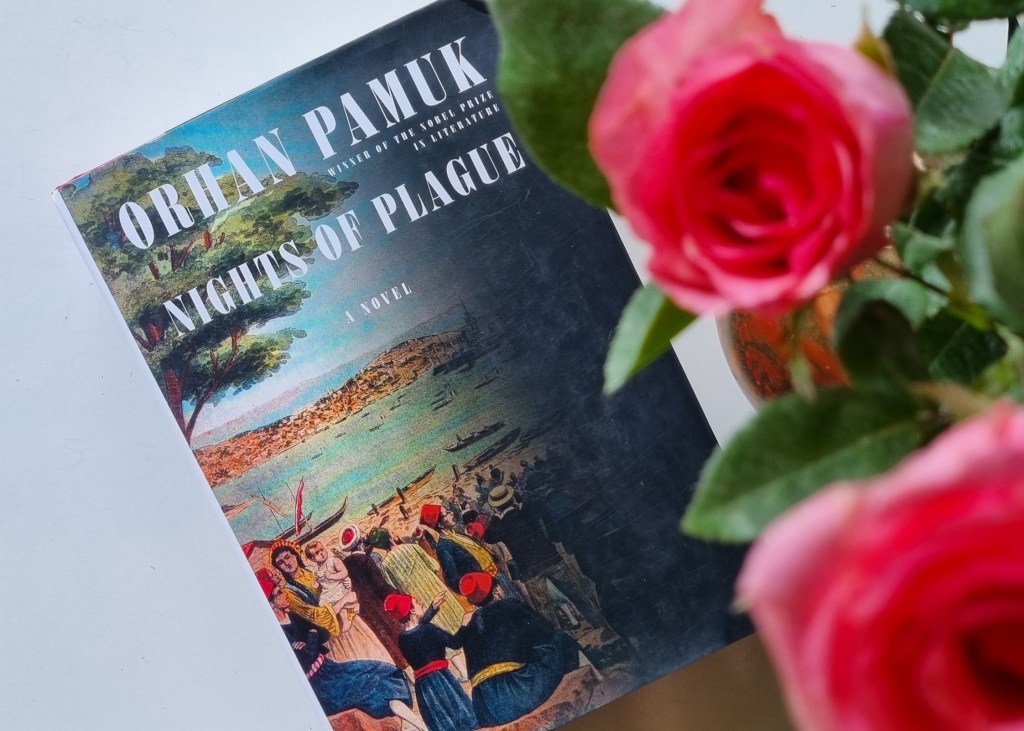
Nights of Plague
November 2022
Orhan Pamuk’s longest novel to date unravels with a pace that tends to linger, to wit: it is not for readers who are in a hurry. For that reason, I found it strangely refreshing. Strange because it is a plague narrative that is not meant to be refreshing, refreshing because of the reading experience it provided; defiant of the modern reader’s preference for a literary quick fix, and defiant of our silly reading goals that have more to do with the number of books rather than the languid relishing in an author’s descriptive prowess.
Perhaps I simply feel at home in the expression of an author whose mind is a museum of melancholy, but I am now sensing that part of the allure is in how his books are written for their own sake — written because he felt they needed to be written rather than written for their salability. Isn’t that pure art?
Set in 1901, in the fictional island of Mingheria, “on the route between Istanbul and Alexandria,” it is a curious deviation from a usual Pamuk novel that stays within reach of Istanbul. While Snow is set farther in eastern Turkey, an invented island between Crete and Cyprus is still a surprising backdrop for seasoned Pamuk readers; but only until we realize that the creation of Mingheria allows for a certain leverage and freedom for political criticism. Methinks Mingheria speaks more about present-day Turkey than it does about an imaginary island nation in 1901.
This novel can teach a thing or two about running a nation during a plague; about epidemiology; how to deal with resistance from different sectors against quarantine measures; how plagues do not distinguish between Christian or Muslim; how failed attempts at containing a plague can fan the flames of a revolution; how revolutions can be exploited; the similarities between solving a murder and stopping an epidemic; and living or loving through the sickness and political ferment. It is about plagues, and revolutions, nationalism, the fickleness of governments, about the accidents of history, how history is made, and how history is written.
It echoes Camus’ The Plague in the way that the narrator’s significance is revealed only at the end and also for the chilling reminder that plagues reappear throughout history “for the bane and enlightenment of men”.
Unfortunately, man easily forgets, and unwittingly asks to be reminded ever so often.
Other Colors
Other Colors, my first signed copy by a Nobel laureate.
“Nothing can penetrate into the cracks, holes, and invisible gaps of life as fast or as thoroughly as words can. It is in these cracks that the essence of things — the things that make us curious about life, about the world — can be first ascertained, and it is good literature that first reveals them.”
The White Castle (a re-reading)
June 2021
Fifteen years ago The White Castle meant nothing more to me than a tale set in the 17th century about an Italian intellectual who sets sail from Venice to Naples only to be captured by Turks and brought to Constantinople where his master would turn out to be his doppelgänger. I knew it was a novel about identity, but it did not leave a lasting impression back then.
I had even forgotten that this was set during a pandemic wherein people lived in fear of the plague! “Janissaries guarded the entrances to the market-places, the avenues, the boat landings, halting passers-by, interrogating them: ‘Who are you? Where are you going? Where are you coming from?’”
The same questions that each doppelgänger would often ask the other and himself — the same questions that confront the reader.
Through my re-reading, I discovered nuances that were lost to my younger mind; and passages that I previously failed to mark with a pencil leapt up from the pages with intensity.
Over the course of time, the two characters’ lives would become inextricably entwined, they would embark on engineering projects, study astronomy, work on other branches of science, write books and and share a life together. As soon as Pamuk tricks us into thinking that one is inferior to the other, and into making us think we have a good grasp of who is truly master or slave, their roles would be reversed until it becomes difficult to tell them apart. And yet, their likeness is something that they do not acknowledge openly.
By and by, the question of who is superior? fades into oblivion and metamorphoses into who is who?
On one occasion, the Sultan asks them, “Have you two never looked at yourselves in the mirror together?”
And there it was, the very point that I missed hiding in plain sight — East and West personified!
And who else more qualified to write about their tumultuous but inevitable relationship? But of course! A man from that city perched on both East and West!
The Black Book
February 2025
This reader has been through Pamuk’s longest novels and still felt the density of the mystery and prose in this book’s mere four hundred pages.
It explores the writing process and the precariousness of identity. It is also about how much the books we read, the stories we hear, the movies we watch, the everyday objects in our lives, and our city’s history shape the multiplicities of our being.
I enjoyed that twist at the end and relished the familiarity of Istanbul as a breathing character in a Pamuk novel. But maybe, just maybe, The Black Book is not for the Pamuk newbie, and not for those who are in a hurry.
A Strangeness in My Mind
February 2021
The first page of this book quotes a passage from William Wordsworth’s The Prelude: “I had melancholy thoughts… A strangeness in my mind, A feeling that I was not for that hour, Nor for that place.”
For someone who has felt like an anachronism all her life, I felt like I owned these lines. It was as if I was meant to read the book just for this, and having come across it right at the start, the rest of the book was an additional literary present.
There are things Pamuk writes that make me uncomfortable, but these simultaneously compel me to admire a straightforwardness about life that only the most courageous writers can execute. It is only through this book that I have seen for myself what all his works have in common — aside from providing details that escape the average consciousness, perhaps a result of having gone to architecture school — every book is a love story, no matter the plot or the characters: A love story between a writer and a place; between a writer and Istanbul, or Kars; between a writer and Turkey; a love story about the effects of the bittersweet passing of time on a place; about someone who recognizes a nation profoundly inside out, from its complicated politics to its inner conflicts and issues, its customs and traditions, from its spectacular buildings to its impoverished slums, from its most magnificent cities to its humble villages, from its splendid past to what it is now; a love story with a viewpoint only a lasting lover can deliver who, after having seen its glories and deepest flaws and undesirable secrets, remains and continues to love.




 The Book-Butterfly